


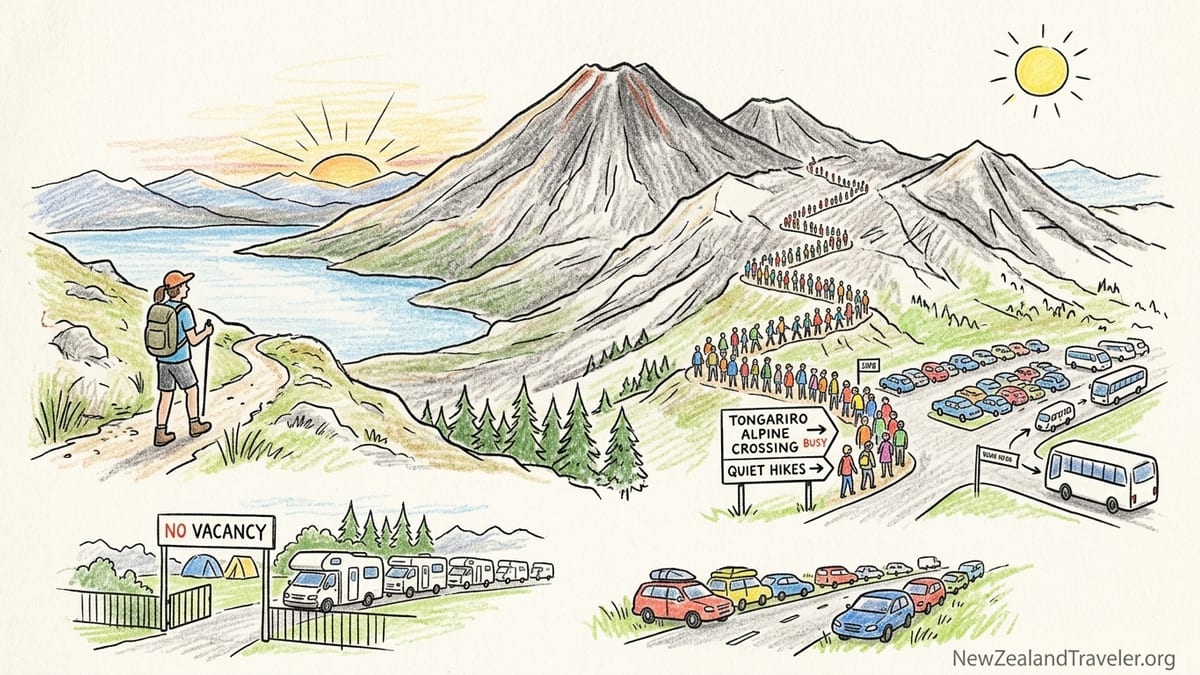
I arrived in New Zealand at the start of January expecting long, quiet days in the backcountry. The brochures and social media posts had promised endless alpine space: a single figure on a ridgeline, an empty trail curling past a turquoise lake, a campervan alone beneath a galaxy of stars. What I found instead, travelling through the country’s most famous national parks from December to February, was a very different kind of wilderness experience. Car parks were full by mid-morning, trailheads felt like start lines, and the biggest challenge was not the terrain but the logistics of simply getting onto the track.
The Summer Dream Versus the Midday Reality
The classic New Zealand fantasy is easy to believe when you are planning a trip from a distance. The marketing images are usually taken at sunrise in shoulder season, with a single hiker on the Tongariro Alpine Crossing or a lone car on the Milford Road. On paper, visiting in peak summer from December to February seems perfect. Days are long, temperatures are milder than in spring or autumn, and most of the country’s alpine routes are at their most accessible. I booked my flights around this promise of light and space.
On the ground, especially in the most famous national parks, the reality was more complex. Visitor numbers surge in summer and concentrate on the best-known walks and view points. The Department of Conservation has reported that the Tongariro Alpine Crossing alone sees in the region of 100,000 walkers in a typical summer season between October and April, with the busiest days clustered around clear-weather weekends and holidays. I did not need a counter to believe that; standing at the Mangatepōpō trailhead just after 8.30 a.m., it felt like a small-town festival had emptied directly onto the track.
This disconnect between expectation and reality shaped almost every day. I still found quiet valleys and long, contemplative stretches of trail, but they were usually early in the morning, late in the evening or away from the marquee routes. Around the most photographed spots, peak summer in New Zealand’s national parks is less about solitude and more about managing a shared experience with hundreds of others who have arrived with the same dream.
Tongariro Alpine Crossing: Shuttles, Restrictions and Hiking in a Line
No walk captures the pressures of peak summer like the Tongariro Alpine Crossing in Tongariro National Park. This 19 to 20 kilometre traverse of volcanic craters and emerald lakes is frequently described as the country’s best day hike, and visitor numbers show it. The Department of Conservation has introduced strict parking rules at both road ends over the main season from mid-October to late April. At Mangatepōpō and Ketetahi road ends, the public car parks carry four-hour limits that effectively rule them out for anyone doing the full crossing, which commonly takes six to eight hours for fit walkers. During the height of summer DOC also states that there is no parking at Mangatepōpō for people attempting the full crossing, steering visitors towards shuttle services instead.
My introduction to this system came on a clear January morning. I had planned what I thought was an early start from National Park village with a shuttle departure just after 7 a.m. By the time our minibus rolled into Mangatepōpō, the narrow access road was already lined with tour coaches and vans dropping groups at the gate. There was no space left in the small trailhead car park, and drivers were carefully observing the time-restricted signs for short walks. When I stepped out, I joined a moving queue of people snaking up-valley: families in trainers, guided groups adjusting helmets, and independent hikers like me checking that they had enough water. Any notion of having the mountain to myself vanished before my pack was even on properly.
Once on the track, the density of people rose and fell with the terrain. On the initial boardwalk sections I could count twenty or thirty hikers within immediate sight, with more visible on the zigzags above. At the steep climb to the South Crater, progress slowed to the pace of the slowest person on each narrow pinch point. I found myself matching steps with strangers from Europe and North America, pausing not just to admire views but because the line had backed up at short scrambles and photo stops. Crossing the central plateau towards Red Crater and the bright pools of the Emerald Lakes felt less like a wilderness tramp and more like a pilgrimage, a shared, continuous procession across the volcanic landscape.
The crowds did not ruin the day, but they did reshape it. The famous scree descent from Red Crater to the Emerald Lakes became a careful negotiation, waiting for those ahead to move aside before sliding down. At the Ketetahi end, the stream of tired walkers arriving at the car park filled shuttle vans as fast as they could cycle back to nearby towns. Those who had not reserved seats were left comparing notes about which private car parks still had space or how long they might have to wait for a spare seat. The lesson was clear. On this track in summer, the wilderness experience begins long before the first step and depends heavily on how you plan your transport.
Fiordland and Mt Aspiring: Full Car Parks on Famous Trails
If Tongariro is the best-known example, Fiordland and Mount Aspiring National Parks show that the pattern repeats itself across the South Island. The Milford Road, which threads north of Te Anau towards Milford Sound, passes a string of popular short walks and day hikes. On paper they look like perfect impromptu stops. In practice, on sunny days in January, I repeatedly arrived to find car parks overflowing and roadside verges lined with vehicles.
At the Lake Marian track near the Hollyford turn-off, a mid-morning arrival meant joining a convoy of rental cars and campervans creeping through the small gravel car park in search of gaps. DOC signage warned of limited capacity, and a park-and-walk alternative further down the valley has been promoted at times to relieve pressure on the trailhead. On the day I visited, cars were already wedged along the access road, forcing latecomers to reverse carefully between ditches and trees. Several parties who had driven all the way from Queenstown decided to skip the walk rather than leave their vehicles poorly parked for several hours.
Further north in Mount Aspiring National Park, the access road to the Rob Roy Glacier track from Wanaka told a similar story. The last portion of the gravel road, with its fords and blind corners, naturally limits visitor numbers, but at the Raspberry Creek car park walkers still found it full by late morning on a blue-sky summer day. Drivers circled and double-parked until rangers intervened and asked people to leave space for emergency vehicles. Some visitors who had not reserved accommodation for another night in Wanaka faced an awkward choice: turn back without the walk they had planned for weeks, or risk parking in marginal spots and hope they did not return to a warning notice.
Even in places with more extensive parking, famous viewpoints can feel unexpectedly congested. On the road to Glenorchy and the start of the Routeburn track, a cloudless afternoon saw cars stacked at every vantage point, from Bennett’s Bluff to the small lakeside laybys, each one swarming with tripods and selfie sticks. The scenery is as beautiful as advertised, but the mood shifts when you step out into an existing crowd rather than a quiet layover. By the end of my first circuit through these southern parks I learned to approach the most popular car parks like scarce resources. If I wanted the freedom to choose my track rather than being dictated to by the number of available spaces, I had to arrive at trailheads much earlier or much later in the day.
Campgrounds, Motor Camps and the Frustration of “No Vacancy”
The parking pressures at trailheads are mirrored at overnight stops around the main national parks, especially in January when New Zealand school holidays overlap with the international visitor peak. While DOC manages many basic campsites, the sites closest to iconic locations are limited in size and operate on a first-come, first-served or pre-booked basis. The more comfortable holiday parks in gateway towns like Te Anau, Wanaka and Turangi act as safety valves, but even they reach capacity during holiday weekends.
In Fiordland, I had assumed that arriving at a DOC campsite on the Milford Road by mid-afternoon would secure a space for a small van. Instead, rolling into Cascade Creek in early January, I found a handwritten “full” notice and a line of hopeful vehicles idling by the entrance. Campers told me the last open pitches had been snapped up shortly after lunchtime. A ranger suggested trying Henry Creek closer to Te Anau or paying for a powered site at a commercial park in town. The extra sixty kilometres of round-trip driving, combined with a higher nightly rate at a private campground, turned what I had imagined as a spontaneous lakeside evening into a scramble for any legal space to sleep.
On the eastern side of the Southern Alps, Mount Cook village added an extra layer of complexity. The official DOC campground at White Horse Hill sits within walking distance of the Hooker Valley and Sealy Tarns tracks, prime territory for early starts. In theory, booking a space there several weeks ahead should remove stress. In practice, summer demand outruns supply so consistently that many visitors end up pushed back to Twizel or Lake Pukaki freedom camping zones, forty to sixty minutes’ drive away. During my visit, a couple from Germany recounted arriving at White Horse Hill without a reservation just after noon, confident they could pay on arrival. They were turned away and ended up driving back towards the hydro lakes in gathering evening cloud, calculating whether they could still manage a sunrise start for the Mueller Hut route from so far out.
North of Tongariro, the pattern repeats. In peak season, accommodation at Whakapapa Village and National Park village can sell out or jump markedly in price, particularly around New Year and long weekends. Last-minute planners often find themselves booking cheaper beds in Taupō or Rotorua, two or more hours away, then facing pre-dawn drives and tight returns after long days on the trail. By the time I reached the central plateau, I had accepted that securing a bed or a campsite within or just outside a major park was less a luxury and more a key part of having a relaxed experience.
Living With the Crowds: What Summer Still Gets Right
For all the frustrations of full car parks and “no vacancy” boards, summer in New Zealand’s national parks does deliver some gifts that are hard to ignore. The first is daylight. In late December and early January, the sun can rise before 6 a.m. and not set until after 9 p.m., depending on latitude. For walkers, this effectively extends the safe window for longer routes and creates space in the day to move against the main flow of visitors. On more than one occasion I used those extra hours to start hikes at times that would be unthinkable in winter and to enjoy golden light on ridges long after most people had gone back to their cabins.
Warmer average temperatures also change the character of the experience. While alpine weather remains highly changeable and frost or even snow can still appear at altitude, valley floors and mid-level tracks are generally more comfortable in a light layer and a windproof shell. Creek crossings on routes into Mount Aspiring’s side valleys felt less daunting without the bite of snowmelt on bare legs, and lunch breaks at high passes became lingered, social pauses instead of hurried refuelling stops. Even on a crowded trail, there is something deeply pleasant about resting on a sun-warmed rock while other parties file past in shirtsleeves.
Most importantly for route choice, summer opens up terrain that would be unsafe or unpleasant for many visitors at other times of year. Rock steps on the Ben Lomond track above Queenstown, exposed scree traverses near Arthur’s Pass and the upper sections of long day walks like Avalanche Peak or the ascent towards Mueller Hut are typically snow-free in January and February. That does not mean they are easy, but it does mean that fit, prepared hikers have many more options. When I needed to escape the churn of famous valley-floor walks, I often found relative solitude by climbing two or three hours higher onto less advertised ridges where the only other figures in sight were the occasional trail runner or local club party.
Summer also brings services that are simply not available in shoulder or winter seasons. Shuttle operators on the Tongariro Alpine Crossing, water taxis in Fiordland and guided walk providers across multiple parks run fuller schedules between December and February. While that contributes to crowding, it also means more flexibility if you are prepared to book ahead. After one long, hot day on the Routeburn, I was grateful for the extra afternoon water taxi departure from the Greenstone end that allowed me to adjust plans on the fly without facing an additional several hours of road driving.
Rethinking the Day: Beating the Buses and Using the Quiet Hours
By the middle of my trip, the most effective way to reclaim breathing room in New Zealand’s busiest parks turned out not to be finding some secret, empty valley, but simply reordering the day around the known pressure points. Tour buses and large guided groups tend to operate to similar schedules: mid-morning departures from gateway towns, lunch at scenic stops, afternoon returns. That creates predictable surges at car parks and viewpoints. If I was willing to start earlier or later, I could often step sideways out of those waves.
On the Hooker Valley track in Aoraki/Mount Cook National Park, one of the country’s most photographed day walks, arriving at the trailhead just before 7 a.m. meant crossing the first swing bridge in the company of only a handful of other independent walkers. The famous view of Aoraki reflected in the terminal lake was still a shared experience, but the narrow sections were calm and photo stops did not involve queuing. When I walked back towards the car shortly after 10.30 a.m., the stream of incoming visitors had turned almost continuous, car parks were close to full and coaches were lining up along the access road. The same pattern repeated at Roys Peak above Wanaka and on sections of the Queenstown hill network. The earlier I moved, the easier it was to imagine those brochure images as something close to the truth.
Evening can provide a similar release. In Te Wahipounamu’s glacier valleys and along parts of the Milford Road, day-trippers begin to drain out by mid-afternoon to make it back to Queenstown or Te Anau by dinner. Starting shorter walks after 4 p.m. meant accepting a later meal but often offered quieter paths and a richer sense of the landscape settling into dusk. In Abel Tasman National Park, where boats deposit large numbers of walkers at golden beaches, choosing to catch a mid-afternoon water taxi and then walk back towards Marahau in the evening delivered long, empty stretches of sand that would have been crowded at midday.
These shifts in timing did require sacrifices. Pre-dawn alarms became habitual, and lazy slow breakfasts mostly disappeared. Yet they also transformed the emotional tone of the trip. Instead of spending mornings circling crowded car parks, I was out on the track watching first light hit mountain faces, returning to the car as the biggest wave of visitors arrived and, in some cases, reclaiming a second short walk in the quieter edges of the day.
Choosing the Right Trails: Famous Names Versus Quiet Alternatives
Not every summer crowd can be out-run with an early start. On signature routes like the Tongariro Alpine Crossing or the main sections of the Abel Tasman Coast Track, high numbers are effectively baked into the experience during the peak months. In those cases, the key decision becomes whether to accept the social nature of the walk or to look nearby for lesser-known options that can still deliver a strong sense of place.
In Tongariro National Park, that might mean swapping a full crossing attempt for an out-and-back hike from Whakapapa on tracks like the Taranaki Falls loop or the longer Tongariro Northern Circuit sections that see fewer day walkers. DOC visitor data suggests that while the Crossing attracts tens of thousands of visitors each season, overnight numbers on the Northern Circuit are far lower. On the day I combined a shorter leg of the Circuit with a side trip towards Tama Lakes, I met only a fraction of the people I had seen on the Crossing two days earlier, even though the scenery was just as compelling.
In Fiordland, choosing the Key Summit track as a half-day outing rather than trying to add a full extra side-trip to an already packed itinerary allowed me to enjoy subalpine tarns and wide views with manageable company. Further north, instead of joining the procession up Roys Peak for the iconic switchback photograph, I found more breathing room on the nearby Isthmus Peak track above Lake Hāwea. The climb was still demanding, the view arguably just as satisfying and the path noticeably less congested even in late January.
The same principle applies in Abel Tasman, where the central bays carry the highest day-walker traffic. Discussing plans with local operators and DOC staff led me to start from less fashionable access points and walk against the main flow. On one particularly hot February afternoon, choosing a short inland track towards Cleopatra’s Pool rather than yet another coastal stretch gave my legs a break from soft sand, took me away from the thickest clusters of beach umbrellas and delivered a shaded, river-cooled interlude that felt surprisingly peaceful given how busy the main anchorages were.
The Takeaway
Looking back on that peak-summer circuit through New Zealand’s national parks, the main surprise was not that the iconic places were busy, but how fundamentally the crowds reshaped the lived experience of the landscape. I arrived expecting a mostly solitary encounter with mountains and forests. Instead, from Tongariro to Fiordland, I found myself sharing the trails with long lines of other hikers, negotiating full car parks and occasionally abandoning plans when campsites and motor camps flashed “full” signs earlier in the day than I had thought possible.
Yet the trip was far from a disappointment. The long daylight hours of December to February opened up flexible, creative ways to work around the pressure points. Warmer conditions and mostly snow-free alpine routes made it possible to explore higher, more demanding terrain where numbers naturally thin. And conversations with fellow walkers from every corner of the globe, forged while leapfrogging on steep switchbacks or sharing viewpoints, added a social richness that the marketing images never show.
If I were to design the same journey again, I would make several deliberate changes. I would plan my key day walks to start before the first tour buses, even if that meant checking into accommodation within or right next to the parks so that 5 a.m. alarms translated into 5.30 a.m. trailheads rather than long drives in the dark. I would book those beds and DOC campsites as early as reasonably possible for the most popular areas, accepting that spontaneity in peak season often leads not to hidden gems but to long detours and late-night searches for vacancies.
During the middle of each day, rather than chasing an impossible dream of having the most photographed lookout to myself, I would lean into the rhythm of the crowds on the marquee routes and then consciously step away from them. That might mean choosing quieter, unsigned ridges, mid-level circuits or alternative summits during the peak hours, reserving my visits to the famous vistas for dawn or late evening. In short, I would still come in summer, but I would treat New Zealand’s great national parks less as untouched wilderness and more as shared public spaces where thoughtful timing and flexible planning are the real tools for finding the sense of wildness so many of us cross the world to seek.
FAQ
Q1. Is it still worth visiting New Zealand’s national parks in peak summer?
Yes. Despite the crowds, summer brings long daylight, mostly snow-free alpine routes and more transport options. If you adjust your expectations and plan for busy hotspots, you can still have outstanding days on the trail.
Q2. How early do I need to arrive at popular trailheads to avoid parking problems?
At major day walks like Hooker Valley, Roys Peak or Lake Marian, aim to arrive by 7 a.m. or earlier in January and February. After 9 a.m. on clear days, car parks often become congested and latecomers may have to turn back or park far from the official areas.
Q3. Do I really need to use a shuttle for the Tongariro Alpine Crossing in summer?
In practice, yes. DOC applies four-hour parking limits at the Mangatepōpō and Ketetahi road ends during the main season, which is too short for the full six to eight hour walk. Most visitors now park in nearby towns or private car parks and use licensed shuttles to reach the trailheads.
Q4. How far in advance should I book accommodation near the main parks?
For January and early February, it is sensible to secure key nights several weeks or even a couple of months ahead, especially around Christmas, New Year and public holidays. This is particularly important for places like Mount Cook village, Te Anau, Wanaka and the villages around Tongariro National Park.
Q5. Are there quieter alternatives to New Zealand’s most famous day hikes?
Yes. Near Tongariro, consider parts of the Tongariro Northern Circuit or the Taranaki Falls track. Around Wanaka, Isthmus Peak offers a less crowded alternative to Roys Peak. Talking with DOC staff in each region is one of the best ways to discover less publicised options.
Q6. How can I avoid hiking in a constant line of people?
The most effective strategies are timing and trail choice. Start early or late, walk against the main flow where possible, and use the middle of the day for less famous routes nearby. On marquee tracks in mid-summer, you may still encounter long sequences of walkers, but you can often find quieter sections by getting an hour or two ahead of the biggest groups.
Q7. What happens if I arrive at a DOC campsite and it is already full?
If a serviced campsite is full, rangers will generally direct you to alternative sites or to commercial holiday parks in nearby towns. You will need to drive on rather than squeeze into unofficial spaces, so carrying updated information on other options in the region and enough fuel to reach them is important.
Q8. Is midweek really less busy than weekends in summer?
In most popular areas, yes. While December to February is busy every day, midweek dates outside public holidays usually see slightly fewer domestic visitors. That can mean easier parking and a little more space on the most popular tracks, especially in the early mornings.
Q9. How flexible should I be with my itinerary in case of weather or closures?
Very flexible. Weather can change quickly in alpine areas and park managers sometimes restrict access or close tracks for safety or cultural reasons. Try to base yourself in a region for several days rather than scheduling a single fixed day for a flagship hike, so you have options to shuffle activities if conditions do not cooperate.
Q10. What is the single biggest change I can make to improve my summer park experience?
Staying overnight inside or very near each key park so you can start walking before the first tour buses arrive has the greatest impact. It simplifies transport, reduces stress around parking and gives you access to the calmest hours on even the most popular trails.