


Our family spent five weeks road tripping through New Zealand’s national parks with three children aged 4, 8 and 13. We went in expecting “Great Walk” glory and Instagram-perfect lookouts. What we actually learned was that toilets, snack access, boredom thresholds and emergency exit options mattered far more than trail rankings. This is not a generic list of “family-friendly hikes,” but a report on what genuinely worked for our kids in specific parks, what flopped, and what we would happily postpone until everyone is older.
How Our Kids’ Ages Shaped Every Park Decision
Travelling with a four-year-old, an eight-year-old and a thirteen-year-old meant that every national park experience felt like running three different trips at once. Our teenager wanted big views and long days, our middle child needed variety and chances to explore, and our youngest cared mostly about snacks, sand and not being cold. The same one-hour walk could feel easy for our teen, pleasantly active for the eight-year-old and like a full expedition for the four-year-old if the path was rocky or exposed.
Because of this, distance alone was a terrible planning tool. A 3 km loop on a smooth, sheltered track near facilities usually went better than a shorter but exposed ridge walk, even if guidebooks labelled both as “easy.” We came to rely on a simple checklist before committing: driving time to the start, toilets at or near the car park, chances to bail early, whether we could push a stroller, and how quickly we could get to food and shelter if the weather turned.
We also learned that the emotional energy of getting three children moving often mattered more than the physical effort. Adding 30 minutes of driving at the end of a big walk could be harder on everyone than another short side track near where we were already parked. When we ignored this and chased “must-do” experiences, the day unravelled fast. When we matched walks to the developmental stage of our youngest child, everyone else usually had a better time as well.
In the sections below, I compare the national parks we actually visited using the criteria that ended up mattering most: walking distance and terrain, toilets and shelter, access to food, stroller suitability, water play opportunities, driving time, boredom factor, and how easy it was to cut a day short when things went sideways.
Abel Tasman: Water Taxis, Beaches and an Easy Escape Plan
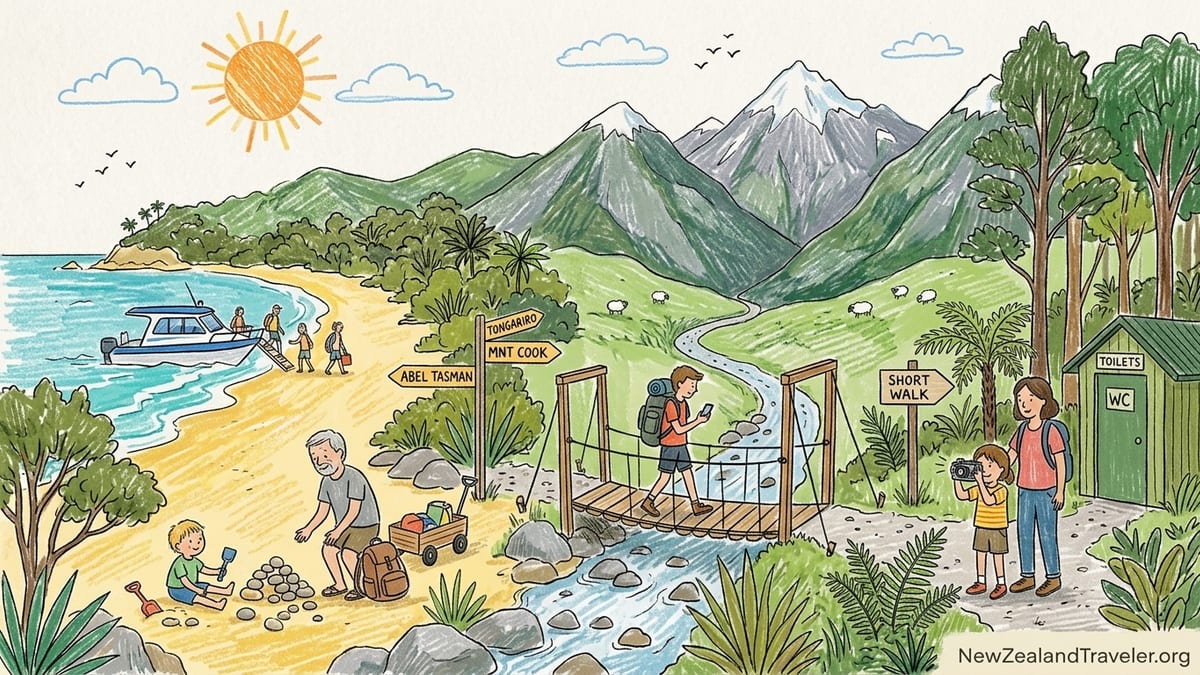
Abel Tasman National Park turned out to be the most flexible park for mixed-age kids, largely because of its network of water taxis and sheltered beaches. Operators such as Abel Tasman Sea Shuttle and other local companies run boats between Marahau and northern beaches like Anchorage, Bark Bay and Tōtaranui, usually between about 7 am and late afternoon, with defined pick-up windows at each access point. This meant we could design half-day adventures with clear bailout options. If our four-year-old melted down on the sand instead of the track, we could simply spend longer at the beach and catch a later boat back.
Our best Abel Tasman day started with a mid-morning water taxi from Marahau to Anchorage. The kids loved the boat ride more than any viewpoint: sitting on outside benches, spotting seals on rocks and watching the golden beaches appear as we cruised past bays like Apple Tree and Torrent. From Anchorage, the older two and one adult walked a short section of the Abel Tasman Coast Track south toward Pitt Head for panoramic views, while the other adult stayed on the main beach with our youngest, building sandcastles and paddling in the shallow, usually calm water. Knowing there were toilets right behind the beach and DOC staff moving through the campground made it easy to relax.
Stroller suitability in Abel Tasman was mixed. Sections of the Coast Track from Marahau towards Anchorage are well formed but narrow, with occasional roots, short climbs and coastal exposure that made us glad we opted for a framed child carrier instead of pushing a buggy. On the beaches themselves a stroller was more nuisance than help, so we relied on a simple fold-up wagon only in the Marahau car park and for hauling gear at the edge of camp. When squalls rolled in, shelter meant either the DOC cooking shelter at Anchorage campsite or the water taxi timetable. We planned our day so that at least one boat back departed within an hour or two of our longest walk, which kept the perceived risk low for the kids and for us.
We camped one night at Anchorage, which has DOC-style facilities such as toilets, treated water and simple cooking shelters rather than the full-service infrastructure of a commercial holiday park. That trade-off worked well because we arrived by boat in daylight, with the weather forecast settled and everyone already familiar with the beach from earlier in the week. For families with toddlers, I would keep Abel Tasman to water-taxi-and-beach days, possibly with short out-and-back walks to nearby lookouts, instead of trying to stitch together big chunks of the Coast Track.
Aoraki / Mount Cook: Short Walks, Big Mountains and Weather Reality
Aoraki / Mount Cook was the park we were most excited about and the one where we had to moderate our expectations the most. Famous walks like the Hooker Valley Track leave from near White Horse Hill campground, about a 4 km drive from Mount Cook Village, and offer an approximately 10 km return path across swing bridges to views of Aoraki and the glacier lake. Official information describes Hooker Valley as well formed and suitable for most ages, but with three children and changeable alpine weather we treated it as a half-day commitment that required early starts and plenty of snacks.
To test everyone’s stamina, we began with shorter tracks from the village. Governors Bush Track, a roughly one-hour loop through beech forest near Mount Cook Village, gave us shelter from wind and rain, a soft surface for our four-year-old and enough up-and-down to interest the older two. The Bowen Bush and Glencoe walks, signed from village streets, filled an hour or less each and were close to toilets, the visitor centre and the small cluster of cafes. When the weather came in low and grey, these forest walks were a success because we could retreat to indoor seating and hot chocolate within fifteen minutes.
Our main “too much” day in Aoraki came when we tried to combine Kea Point and Hooker Valley in a single push, chasing a rare blue-sky window. Kea Point is a roughly 1 to 1.5 hour return track from White Horse Hill, leading to a viewing platform over Mueller Glacier. The path is gravel and gently climbing, with toilets at the car park but not on the track. Our teenager considered it “just a warm up,” the eight-year-old loved the changing views, and the four-year-old coped well with frequent snack stops. Flushed with that success, we set off straight from Kea Point onto Hooker Valley, expecting the younger two to ride in turns in a child carrier.
Halfway across the second swing bridge, the wind rose and clouds thickened along the valley. The four-year-old started to cry from the noise and movement of the bridge, while our eight-year-old suddenly decided the drop looked “too big.” With no toilets beyond the campground and no quick shelter apart from hunkering behind rocks, we did the sensible thing and turned back before the third bridge. It still took nearly an hour to retrace our steps to the car, and another 15 minutes to drive back to the village for hot food. Everyone was cold and tired. Looking back, we should have treated Hooker Valley as its own outing, starting mid-morning on a day with lighter winds, and stopped at the second bridge to avoid stretching our youngest past his comfort point.
Tongariro and Taranaki Forest Walks: Avoiding the “Epic” and Embracing the Short
On paper, Tongariro National Park is all about the Tongariro Alpine Crossing, a full-day traverse over crater landscapes that guidebooks often call one of the best day hikes in the world. With kids aged 4, 8 and 13, we ruled it out immediately. Instead, we based ourselves in Whakapapa Village and focused on forest and waterfall walks that let us dip into the volcanic scenery without long exposure to wind or sudden weather changes.
The standout there was the Taranaki Falls Track, an approximately two-hour loop through tussock and beech forest to a 20 metre waterfall that plunges into a boulder-lined pool. The loop starts and finishes in Whakapapa Village, where there are toilets and a café at the visitor centre. We walked the upper track first in calm, cloudy conditions, which gave wide views of the volcanoes for our teenager’s photos, then descended through sheltered forest on the lower track when the wind picked up. The four-year-old walked about two-thirds of the loop and rode in the carrier for the rest. The eight-year-old loved clambering on rocks at the falls, although the spray meant we kept waterproof layers on even on a dry forecast.
Near Mount Taranaki on the west coast, we used the same strategy. The mountain has spectacular alpine routes, but our best family day there was in the lower forest on short circuit tracks signposted from visitor areas rather than on exposed slopes. Here, driving time from New Plymouth or Stratford was usually under an hour, which felt manageable with younger kids. Toilets at visitor centres and trailheads made a big difference, as did the option to cut most of the shorter forest loops into out-and-back walks if someone ran out of steam.
In both Tongariro and Taranaki, we found boredom more of a risk than physical exhaustion for the older two. Long, straight sections of track without landmarks led to “are we there yet” complaints. We solved this by giving the teenager control of the map and allowing the eight-year-old to be “photographer of the day” with an old point-and-shoot camera. That small sense of responsibility kept them engaged on walks that might otherwise have felt repetitive, while still keeping distances reasonable for the four-year-old.
The crucial lesson from these volcanic parks was that you do not need to chase the headline alpine routes to give children a sense of place. Waterfalls, short forest loops and picnic areas near rivers offered more fun, fewer logistics and faster exit options if the famously rapid mountain weather turned ugly.
DOC Campsites vs Hotels: When Simple Works and When It Adds Stress
New Zealand’s Department of Conservation runs a network of campsites across the country, from basic “standard” sites with long-drop toilets and untreated water to fully serviced camps with flush toilets, hot showers and cooking shelters. Recent guidance shows that standard DOC campsites usually cost about 10 to 15 New Zealand dollars per adult per night, with children discounted and infants under five often staying free. Serviced sites are more expensive but add comfort in the form of hot showers and kitchen benches, and the DOC campsite pass offers a flat-fee option for frequent campers, though its price has increased in the last couple of seasons.
In Abel Tasman and Aoraki, DOC campsites worked brilliantly for our family when three conditions were met. First, when driving time to the site was short and the access road straightforward, so that we did not arrive at dusk with tired kids. Second, when the weather forecast was stable for at least 24 hours, meaning we were not likely to spend an entire day zipped inside a tent with restless children. Third, when there was something interesting and low-effort to do straight from the campsite: a beach in the case of Anchorage, or a short, flat walk like the track from White Horse Hill to the start of Hooker Valley.
At White Horse Hill in Aoraki, the basic facilities and spectacular setting were a good trade-off. The kids treated the campground itself as an adventure playground, racing along the perimeter track and looking for kea in the evening light. The flush toilets and running water were enough, and we could be at the Hooker Valley or Kea Point trailheads within minutes on foot. By contrast, nights we spent at commercial holiday parks in nearby towns, although more expensive, gave us full kitchens, indoor lounges and pillow-top beds, which everyone appreciated before big driving days.
Where DOC campsites created unnecessary stress was on longer driving legs or in poor weather. One memorable low point was arriving at a more basic lakeside DOC site after a three-hour drive that included a supermarket stop. The site had drop toilets, untreated tap water and no shelter other than the trees. On a warm, dry evening that could have been idyllic. Instead, rain set in just as we started cooking, the four-year-old knocked over the pot and our teenager discovered her sleeping bag had absorbed a leak from a drink bottle. With no kitchen building, no lounge and the nearest town 40 minutes away on dark roads, we spent a damp, miserable night and left at first light.
Our takeaway was simple. With school-age kids and a preschooler, DOC campsites are wonderful for short stays anchored to one or two nearby walks or beaches, especially if you can secure a serviced site with hot showers and cooking shelter. Before and after long driving days or in shoulder seasons when evenings are cold and dark early, cabins or motels near the park edge are kinder to everyone’s mood and sleep.
The Day We Tried Too Much – and the Simple Win the Kids Loved Best
Every family trip has at least one “what were we thinking” day. Ours came in the central South Island, when we tried to combine a long scenic drive, a major national park walk and an evening campsite check-in. The plan looked elegant on paper: leave Lake Tekapo after breakfast, drive to Aoraki, walk Hooker Valley, then continue to our next DOC campsite before dark. The total walking distance that day ended up close to what the older kids could handle, but the cumulative sitting, waiting and weather changes pushed everyone past their limit.
The warning signs started on the drive in. We stopped at scenic pull-outs along the shore of Lake Pukaki to photograph Aoraki across the water. Each stop only added five or ten minutes, but by the time we reached Mount Cook Village, it was already late morning. Hooker Valley car park looked busy, the wind was up and the teenager had run low on mobile reception and patience. Our four-year-old had already been in and out of his car seat several times. We pushed on anyway, reasoning that we had come all this way.
The track itself was as impressive as promised: wide gravel path, swing bridges, glimpses of the glacier lake. For the first hour, everyone managed. After that, the wind funnelling down the valley wore down the younger two. Toilets were back at the campground, so every small complaint about cold fingers or needing to pee felt more urgent. We shortened our turnaround time, but the damage was done. Back at the car, the kids were hungry and wired, and we still had a long drive to the next campsite. That evening’s tent set-up in the fading light was a fragile operation of snacks and negotiations.
Two days later, we had our simplest and happiest outing of the entire trip. Tired from continuous movement, we decided to stay put near a small North Island regional town between big national park days. We picnicked by a shallow river on the edge of a DOC-managed reserve, where a five-minute flat track led from the car park through native bush to the water’s edge. The children spent nearly three hours building dams with stones, paddling in calf-deep water, spotting tiny fish and taking turns floating sticks like “boats” downstream. There were toilets at the car park, a covered picnic shelter for shade and rain, and the car loaded with spare clothes ten metres away.
That unspectacular, almost anonymous little reserve beat every big-view hike for our kids. It had low friction, total flexibility and no fixed goal. The older two could wander up and down the bank within sight, while the four-year-old had all the stimulation he needed right at his feet. The experience reshaped how we planned the rest of our trip. On subsequent days we deliberately paired any long national park walk with an hour of unstructured water or playground time near the car, even if that meant skipping one more lookout.
Recommendations by Age: What to Do Now and What to Postpone
For toddlers and preschoolers, roughly ages two to five, New Zealand’s national parks are best enjoyed in short bursts anchored to easy access points. Abel Tasman works well as a series of boat-and-beach days, picking a single destination like Anchorage or Bark Bay with toilets, sheltered sand and the option to wrap up early on a water taxi back to Marahau or Kaiteriteri. In Aoraki, I would focus on the Governors Bush and Bowen Bush loops near the village, with perhaps a partial outing on Hooker Valley to the first swing bridge on a calm day, ready to turn back at the first sign of tiredness. For this age, DOC campsites are a treat close to beaches and flat walks in stable summer weather, but I would choose cabins or motels before and after long drives.
For primary-school children, say six to eleven, you can stretch distances but still prioritize variety and bailout options. In Tongariro, the full Taranaki Falls loop offers enough terrain change to keep eight to ten year olds interested without committing them to alpine exposure. At Aoraki, a full Hooker Valley return on a good forecast day is realistic for many school-age kids if you allow four to five hours with breaks and carry plenty of layers. In Abel Tasman, combining a one-way coastal walk of a few kilometres with a return by water taxi or vice versa gives this age group a sense of journey without overloading them. Standard or serviced DOC campsites become more appealing at this stage, especially when you pick sites with rivers, lakes or forest tracks accessible straight from your tent.
Active teenagers aged twelve and up can genuinely enjoy some of the more demanding national park experiences, but even here I would be selective. They are usually ready for longer days and bigger climbs, yet still benefit from clear time limits, decent food access and warm, dry sleeping arrangements. For this age group, I would consider adding longer volcanic routes around the flanks of Tongariro, full-day coastal sections in Abel Tasman between water taxi points, and steeper tracks like Sealy Tarns in Aoraki on settled summer days. Here, mixing DOC campsites with the occasional hotel night keeps morale high, especially before and after the biggest walks.
Across all ages, there are famous experiences I would mostly postpone. The Tongariro Alpine Crossing, with its long duration, exposure to wind and narrow escape options once committed, is better saved for when the youngest in your group is at least mid-teens and genuinely interested. Multi-day hut-to-hut traverses in any alpine park are also worth delaying until all family members can safely carry their own gear and cope with bad weather days. Similarly, ambitious itineraries that stack long drives, boat trips and major walks into a single day usually look better in a spreadsheet than in real life with children.
If I were planning our national park circuit again, I would build the trip around three hubs that worked best for our mixed-age crew: Abel Tasman for its beach-and-boat flexibility, Aoraki for short big-mountain walks linked to a comfortable base in the village or nearby town, and Tongariro or Taranaki for forest and waterfall loops under the volcanoes. I would allow generous buffer days between them, stay in DOC campsites only when conditions and schedules lined up, and remember that the most child-friendly national park experiences are often the ones that keep your exit options as wide open as the views.
FAQ
Q1. Is Abel Tasman really suitable for very young kids, or should we wait until they are older?
Abel Tasman works well even with toddlers if you treat it as a beach and boat destination rather than a multi-day tramping trip. Choose one or two accessible beaches with toilets and book water taxis for short, clearly timed rides so you can head back whenever the smallest children have had enough.
Q2. How far can primary-school children realistically walk in Aoraki / Mount Cook in one day?
Many school-age kids can manage the full Hooker Valley Track return, which is about 10 kilometres, if you allow most of a day with regular snack breaks and carry warm layers. Pair it with easier short walks, such as Governors Bush or Bowen Bush, on adjacent days instead of trying to stack everything into one visit.
Q3. Are DOC campsites safe and comfortable enough for families who usually stay in hotels?
Serviced DOC campsites with flush toilets, running water and cooking shelters are a comfortable step down from holiday parks and suit most families for short stays. More basic sites can feel remote and challenging with young kids, especially in bad weather, so it is worth starting with one or two nights at better equipped DOC sites before trying anything more rustic.
Q4. How do we handle toileting and hygiene with young children on longer tracks?
Plan around toilets at visitor centres and main trailheads and check park information ahead of time so you know where facilities are. On tracks without toilets, carry bags, wipes and hand sanitiser, and be prepared to turn back early rather than forcing a child to wait uncomfortably for the car park.
Q5. Is it worth bringing a stroller into New Zealand’s national parks?
In most parks, a lightweight hiking carrier works better than a stroller, because many tracks have steps, roots or narrow bridges. A compact stroller may be useful around visitor centres, car parks and paved lakeside paths, but we rarely found it helpful once we were on the national park tracks themselves.
Q6. Can families safely do the Tongariro Alpine Crossing with older children?
Fit teenagers can complete the Crossing in good conditions with the right gear and preparation, but it is still a committing alpine day with limited escape routes. For families where the youngest is under mid-teens or not used to long mountain days, shorter walks like the Taranaki Falls loop are usually a better and safer taste of Tongariro.
Q7. How much should we budget per night for DOC campsites compared with holiday parks?
Recent DOC guidance suggests that standard campsites often cost around 10 to 15 New Zealand dollars per adult per night, with discounts for children and free stays for infants, while serviced DOC sites and private holiday parks cost more. Exact prices vary by location and change over time, so check current fees before travelling and expect to pay extra at commercial parks for powered sites and full facilities.
Q8. What is the best season to visit these parks with kids?
Late spring through early autumn usually offers longer daylight and more stable weather, which helps with both walking and camping. Summer school holidays are the busiest and require more advance booking, particularly for Abel Tasman water taxis and serviced DOC campsites, while shoulder seasons can be quieter but colder and wetter, especially in alpine areas.
Q9. How do we build rest days into a national park-focused itinerary?
Alternate big park days with low-key stops in regional towns, lakeside reserves or easy coastal areas where driving distances are short and activities are optional. Simple outings to rivers, playgrounds and short bush tracks near the car do more for everyone’s energy than trying to fill every day with a headline hike.
Q10. Which famous New Zealand hikes would you personally postpone until the kids are older?
I would postpone the Tongariro Alpine Crossing, most multi-day alpine hut trips and the longest exposed summit routes on peaks like Mount Taranaki until the youngest in the family is at least mid-teens, comfortable with mountain weather and able to carry their own gear. Until then, shorter day walks and coastal tracks offer plenty of adventure without the same level of risk or fatigue.