


I did not go to New Zealand’s national parks with a checklist and a telephoto lens. I went as a regular hiker with a pair of mid-range binoculars, a notebook and a stubborn habit of getting up before sunrise. Over several trips spread across late spring and summer, I walked South Island alpine passes, coastal tracks and quiet North Island forests, plus one very memorable night on Rakiura. This is not a ranking of parks, but a record of what I actually saw, where and how, and the one place where I expected wildlife and came away with almost nothing.
Kea in the High Country: South Island Alpine Parks
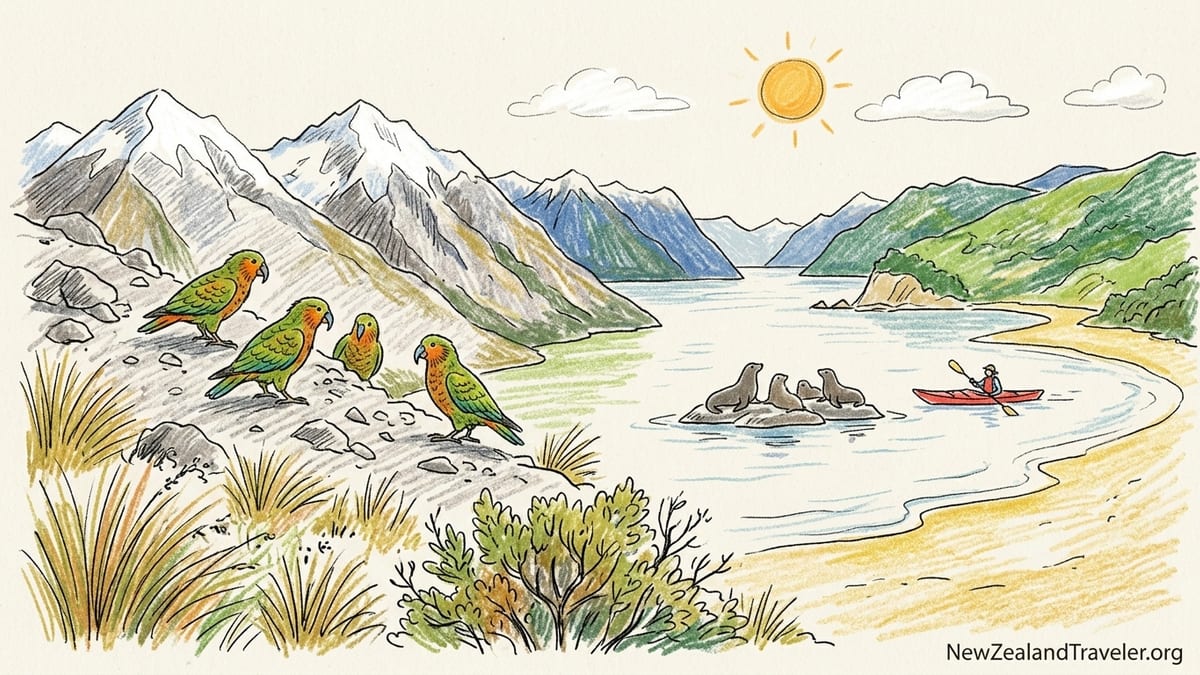
My most vivid wildlife memories in New Zealand are not of something rare, but of a very loud, very curious parrot. Kea live in alpine and subalpine habitat right along the spine of the South Island, including Arthur’s Pass, Aoraki / Mount Cook and Fiordland. Department of Conservation notes them as the most distinctive bird in Aoraki / Mount Cook National Park, and they are present from beech forest to rock and snow. I saw them on three separate days in three different alpine parks, always above the treeline and always in the hours when day hikers were thin on the ground.
The most intense encounter was on the Avalanche Peak Track above Arthur’s Pass village in early December, late spring in New Zealand. I reached the open tussock and rock around 10:30 a.m., after two hours of steady climbing from the forest. Within minutes, a single kea glided in from the ridge, then another, until five birds were strutting around my rest spot. They stayed for about 20 minutes, close enough that binoculars were unnecessary for detail, though I used them to watch their olive plumage flare orange under the wings when they hopped into the air. No guide was involved; I was alone on the track at that moment, which probably encouraged their curiosity.
A week later in Aoraki / Mount Cook National Park, on the Sealy Tarns section of the Mueller Hut Route in the late afternoon, I had a shorter but similar encounter. One kea landed beside a snowpatch roughly 30 metres off the track just after 4 p.m. in calm, clear weather. It spent about five minutes probing around rocks and picking at alpine vegetation before lifting off toward Mueller Hut. Again, no binoculars were needed. This encounter illustrated something I saw repeatedly in South Island alpine parks: kea appear where humans pause, whether at huts, car parks or favourite lunch ledges, because they have learned that people often mean food opportunities, even when not intentionally fed.
Fiordland provided a final alpine kea moment. On the Milford Road, just south of the Homer Tunnel on an overcast January morning around 9 a.m., three kea worked their way along a row of parked cars while people queued for tunnel traffic. I spent about 15 minutes watching from a distance of 10 to 15 metres, occasionally using binoculars to inspect coloured leg bands. It felt less wild than the high ridges of Arthur’s Pass, but it showed how normal kea are in the South Island’s high country national parks if you spend time above the trees in daylight and are willing to stop and just watch.
Seals and Sea Birds: Abel Tasman’s Soft Intro to Coastal Wildlife
Abel Tasman National Park offers the gentlest wildlife watching I experienced, both in terms of landscape and logistics. The coastal track runs above a string of golden beaches, and commercial water taxis and kayak operators connect most bays. New Zealand fur seals are common along this coast and haul out on offshore rocks, especially around Adele Island and Tonga Island, which sit inside the Tonga Island Marine Reserve.
My best Abel Tasman encounters came by boat and kayak rather than on foot. On a mid-November morning, with high cloud and flat seas, I took a water taxi from Mārahau to Bark Bay, routing via Adele Island. Around 9:30 a.m., the skipper idled near a low rock stack where at least a dozen fur seals rested. The boat remained about 20 to 30 metres away; binoculars made a real difference here, allowing me to see pups squirming between adults and one animal slipping into the water. We stayed for perhaps ten minutes before continuing north. It was a classic, brief, group wildlife moment, but unquestionably a real sighting inside the park-coast system.
The more intimate view came the next day on a guided kayak trip between Torrent Bay and Anchorage in the late afternoon. Departing around 2 p.m. on a bright, calm day, our small group hugged the coastline. Near Pitt Head, our guide quietly pointed to a single fur seal cruising just outside the kelp edge. At water level from the kayak I watched it porpoise along for two or three minutes at a respectful distance of roughly 15 metres, before it dived and vanished. I was glad for polarised sunglasses, but did not need binoculars. The guide emphasized that we should not paddle closer or try to block its path, a reminder that even apparently relaxed seals can feel crowded.
On foot along the Abel Tasman Coast Track, wildlife was more subtle. We saw variable oystercatchers probing the tide line on Torrent Bay beach at dusk, and shags roosting on rock outcrops in the early morning when walking from Anchorage to Bark Bay. These sightings were transient, typically a minute or two before the birds moved on or we did. In Abel Tasman, the best wildlife moments, at least in my experience, came from slowing down on the water rather than racing between huts on the track.
Fiordland from the Water: Dolphins, Penguins and More Seals
Fiordland National Park, backed by adjoining marine reserves, turned out to be the most dramatic stage for marine wildlife I experienced. The famous fiords are deep, steep-sided inlets, and New Zealand’s conservation agencies highlight that bottlenose dolphins, fur seals and rare Fiordland crested penguins all use these waters and rocky shorelines. What you actually see depends heavily on season, sea conditions and, bluntly, luck, but the potential is real.
On an overnight cruise in Doubtful Sound in mid-January, I had three separate wildlife windows. The first came in late afternoon, around 4 p.m., as the vessel entered one of the side arms. A small pod of bottlenose dolphins materialised off the bow, initially three, then perhaps six animals in total. They remained with the boat for roughly 15 minutes, riding the bow wave and surfacing within five to ten metres of the hull. From the open foredeck, binoculars were useful to pick out scars and fin shapes, but the animals were close enough that even a simple phone camera could capture them. No one on board had any guarantee this would happen; the crew made it clear that dolphins are free to appear or not on any given day.
Later that evening, close to 7 p.m., we approached a known New Zealand fur seal haul-out on a low, sloping rock ledge near the entrance of the fiord. Here the viewing was more predictable. Around a dozen seals sprawled on the rocks, with a few slipping into the water as we neared. Regulations and company policy kept the boat at an estimated 30 metres. In the low-angle light of a clear summer evening, binoculars gave beautiful views of whiskers and flippers, but were not essential to confirm what we were seeing. We lingered for about ten minutes.
The rarest wildlife moment came the next morning just after 6 a.m. on the same cruise, in light drizzle and very soft grey light. As we edged along a shaded rock wall, the guide suddenly called out a Fiordland crested penguin standing on a narrow ledge above the waterline. The bird remained visible for perhaps two minutes, occasionally stretching and turning its head, before hopping awkwardly downward and disappearing into the sea. It was at least 25 metres away and partially obscured, so binoculars were essential. It felt less like a tour highlight and more like a private reward for being up on deck while most passengers were still eating breakfast.
I also joined a half-day sea kayak trip in Milford Sound in early February, launching before the bulk of day-cruise traffic. Setting off at 8 a.m. under high cloud, we paddled along the northern shore for about two hours. A single fur seal surfaced near us twice at a distance of 20 to 30 metres, and we saw several shags on rock outcrops, but no dolphins or penguins. It underscored how variable Fiordland can be. The fiords and adjacent marine reserves clearly harbour rich wildlife, yet any given half day on the water may still yield only a few brief encounters.
Rakiura National Park: Chasing the Kiwi in the Dark
If there is one place in New Zealand where an ordinary traveller has a realistic chance of seeing a wild kiwi without entering a fenced sanctuary, it is Rakiura National Park on Stewart Island. The park contains most of the island, and official track guides estimate a population of many thousands of southern brown kiwi, known locally as Rakiura tokoeka. Even here, though, seeing one is far from guaranteed, and my own experience involved both patience and some luck.
I booked an evening kiwi tour out of Oban in late January, run by an operator that works with local Department of Conservation guidance. The trip began with a short boat ride just before sunset, around 9 p.m. in high summer, to a sandy beach on the fringes of the national park. From there, our small group walked quietly under red-filtered headlamps for about two hours, following a guide who scanned the grass and forest edges. For the first 90 minutes we saw only weka and possums. Finally, close to 11 p.m., a kiwi emerged from the shadow of the dunes to probe for invertebrates at the high-tide line.
The bird remained in view, at varying distances between 15 and 25 metres, for roughly ten minutes. The guide kept us in a loose semicircle, asking everyone to stay behind him and to keep noise low. Binoculars were not particularly helpful in the very low light; the red headlamps and the bird’s dark plumage meant naked-eye viewing was actually better. It was unquestionably the wildlife highlight of my time in New Zealand, yet even on this structured tour the guide reminded us that some groups on other nights do not see kiwi at all, especially when conditions are bright or windy.
On a separate visit during a different trip, I walked the first section of the Rakiura Track self-guided, leaving Oban before 6 a.m. on a still, overcast spring morning. Track notes and local advice suggest that early and late in the day are the best times for chance kiwi encounters, since these birds can be partly diurnal when nights are very short. I did not see a kiwi on that walk, only hearing one distant call in the coastal forest and flushing several kaka and parakeet from the canopy. It confirmed what local rangers say: Rakiura is rich with kiwi, but the forest is large and the birds are secretive. A guided night outing meaningfully improves your odds, though it can be expensive and still comes with no promise.
Between these two visits, Rakiura as a national park gave me both my most sought-after encounter and a reminder that wildlife does not perform on cue. I left with deep appreciation for how much habitat remains intact on the island, and how carefully operators manage visitor expectations while still sustaining real excitement.
Forest Birds in Whanganui and Kahurangi: Looking Up, Hearing First
New Zealand’s forests can seem quiet at first, especially if you arrive expecting the constant chatter of European woodlands. Predators have taken a toll, and many of the country’s rarest birds now survive best in fenced sanctuaries rather than open national parks. Even so, I had rewarding, if low-key, encounters in two large forest parks: Whanganui on the central-west North Island and Kahurangi in the northwest of the South Island.
In Whanganui National Park, which protects a long stretch of the Whanganui River valley, my best wildlife moments came by canoe and on short side walks. Paddling a three-day section of the river in late November, I launched each morning around 8 a.m. from river campsites set within the park boundary. Blue ducks, or whio, do occur on this river system, but despite scanning every rapid with binoculars, I never saw one. What I did see regularly were pairs of paradise shelducks grazing on river flats at dawn and dusk, and New Zealand fantails flitting along the bushy river margins whenever I pulled ashore.
On the Matemateaonga Track, a forest walk that skirts the edge of the park, I had one memorable encounter with a more cryptic bird. Around 7:30 a.m. on a cool, still morning, I heard a series of clear whistles high in the canopy and eventually located a single tui feeding in a flowering tree about 40 metres above the track. Binoculars were essential here; without them it would have been just a disembodied song. The bird remained in view for about five minutes before disappearing into thicker foliage. Whanganui felt like a park where birdlife is present but often detected by ear first, and where patience with binoculars can slowly turn sound into sightings.
Kahurangi National Park offered more variety, especially along the Cobb Valley and at the forest edge near the Heaphy and Wangapeka tracks. On a late October tramp up the Cobb Valley, I set out from the road end at 9 a.m. in bright spring sunshine. Within half an hour I had already seen South Island robins hopping along the track only a couple of metres from my boots, and tomtits working the lower branches. These encounters lasted only a minute or two each, but they were numerous. Binoculars were useful mainly for watching kaka circling high above the beech canopy later in the afternoon.
Near the higher alpine basins of Kahurangi, traps along the track were a constant reminder of ongoing predator control. Conservation staff and volunteers target stoats and rats here in part to protect native birds such as rock wren and kea in the high country, even though most casual walkers will never see those species. I glimpsed one distant kea silhouette near a ridge at dusk, far too brief and far away to count as a satisfying sighting, but enough to suggest that with more time above the treeline, Kahurangi could rival Arthur’s Pass for alpine birdlife.
Missed Expectations: The Park Where I Saw Almost Nothing
Every wildlife-focused trip includes at least one place where reality falls well short of the glossy brochure. For me that park was Tongariro National Park in the central North Island. It is a spectacular volcanic landscape and a dual World Heritage site, and its marketing images are dominated by crater lakes and steaming vents. I thoroughly enjoyed the hiking, but in terms of wildlife the experience was close to a blank.
I walked the Tongariro Alpine Crossing on a clear, cool day in early March, setting out from the Mangatepopo Road end at 7 a.m. The crossing is one of the most popular day hikes in the country, and even at that early hour there was a steady stream of people on the track. Over the entire 19 kilometres, from tussock lowlands up to the red crater and down past the Emerald Lakes, I noted only a handful of skylarks and a single harrier circling above the valley. I paused frequently, scanned slopes and skies with binoculars and still turned up almost nothing.
A shorter side trip on a separate afternoon to Taranaki Falls yielded slightly more life: a few finches in the scrub and a fantail around the forested section, each in view for less than a minute. No native parrots, no kiwi calls at night from the village, no blue ducks in the streams I crossed. Local rangers later confirmed that while the park contains native birds and lizards, the combination of heavy day-use and exposed alpine habitat means visible wildlife along the main tracks can seem sparse. For me, Tongariro became a reminder that even famous national parks can offer extraordinary scenery without giving up many animal encounters, and that expectations should be set accordingly.
How I Watched: Timing, Tools and Not Getting Too Close
Looking back over my notes, certain patterns stand out. Most of my meaningful wildlife sightings happened in the first two hours after sunrise or the last two before sunset, regardless of park. The Arthur’s Pass kea on Avalanche Peak were active late morning, but even there the encounter was stronger because day-tripper numbers were still low. On Rakiura, the kiwi appeared deep into the evening. In Fiordland, dolphins and penguins were most active when the light was soft and boat traffic thinned.
In practice, that meant building my walking and boating days around those windows. In Whanganui and Kahurangi, I tried to be on the track or river by 7 or 8 a.m., packing breakfast to eat on the move. Around Fiordland and Abel Tasman, I deliberately booked the earliest kayak departures and, where possible, smaller boats. On Rakiura, I accepted the late-night finish of the kiwi walk as part of the cost of a real chance at a sighting. None of this guarantees wildlife, but it stacks the odds in your favour compared to hiking only in the midday peak.
Simple tools also made a big difference. I carried compact 8x32 binoculars on every outing and used them daily. In Abel Tasman and Fiordland they turned distant seals and penguins into clear, satisfying views. In forest parks like Whanganui and Kahurangi, they transformed faint movement in the canopy into solid bird IDs. I did not carry a spotting scope or huge telephoto lens; they felt unnecessary for the sort of mixed hiking and paddling I was doing. A small notebook helped me record time of day, weather and approximate distances, which later made patterns more obvious.
Just as important as how I watched was how closely I stayed to the animals. New Zealand’s Department of Conservation advises people to keep well back from wildlife, avoid surrounding or chasing animals and never feed them. On guided trips, skippers kept boats tens of metres from seal haul-outs and adjusted speed and direction to match dolphin behaviour rather than the other way around. On land, guides on Rakiura enforced a buffer around kiwi, and Abel Tasman kayak guides steered paddlers so seals and sea birds could choose their own route. Those distances sometimes felt conservative in the moment, but they allowed the animals to remain relaxed and continue natural behaviour.
Why Food Rules Matter, Especially With Kea
Nowhere did the consequences of human behaviour feel more obvious than in the presence of kea. These parrots are naturally curious and extremely intelligent, and several conservation and research sources note that many populations now forage freely in human-modified areas from ski fields to roadside car parks. That adaptability is a double-edged sword. Every time someone feeds a kea or leaves food scraps accessible, the birds learn to associate people and buildings with snacks, which increases the risk of vehicle strikes, poisoning from inappropriate foods and conflict when birds damage gear.
On the Milford Road near the Homer Tunnel, I watched tourists hold out muesli bars and chips to kea as they pecked at rubber window seals. A nearby information panel explicitly asked people not to feed wildlife and to keep car doors closed, but the temptation for close photos was strong. Rangers and conservation groups repeatedly stress that processed human food can make native birds ill, alter their foraging patterns and encourage aggressive behaviour. In the long run, habituated kea are more likely to be injured or killed, whether by cars or by people frustrated with damage.
Food rules apply just as much to seals, dolphins and kiwi, even if direct feeding is less common. On boats in Fiordland, crew members reminded passengers not to throw food scraps overboard, both to prevent pollution and to avoid teaching marine mammals to associate vessels with handouts. On Rakiura, guides insisted that snacks stay in packs during kiwi walks so that birds would not be drawn toward people by smell. The principle is simple: if you want wildlife to retain wild behaviour inside national parks, you cannot turn them into beggars or performers.
For me as a visitor, respecting those rules sometimes meant stepping back from what could have been closer photos or briefer, more intense moments. In return, I saw animals that were clearly going about their own business: kea shredding natural vegetation rather than food packaging, seals sleeping undisturbed on rocks, a kiwi unconcerned by a small, quiet group at the edge of its feeding ground. The satisfaction of those encounters outweighed any missed selfies.
The Takeaway: Which Parks I Would Pick for Different Kinds of Encounters
After several trips across both islands, if I were planning a wildlife-focused itinerary built specifically around national parks, my choices would be shaped more by the kinds of encounters I wanted than by any promise of guaranteed sightings. New Zealand’s animals are too independent for that. But patterns did emerge from time spent on the ground and water.
For birdlife, especially forest and alpine birds, I would return first to Kahurangi and Arthur’s Pass, with a side trip to Aoraki / Mount Cook. Kahurangi’s mix of valley forest and subalpine basins, supported by active predator control, produced frequent small encounters with robins, tomtits, kaka and others, even on casual day walks. Arthur’s Pass and Mount Cook provided the most consistent kea experiences, and plenty of opportunity to see and hear other high-country species if you are prepared to climb above the trees and linger on ridges in calm weather.
For coastal wildlife in a national park setting, Fiordland and Abel Tasman stand out in different ways. Fiordland’s fiords and adjacent marine reserves are where I saw the greatest range of marine life dolphins, penguins and seals but only when I committed to being on small boats or kayaks and accepted that some outings would be quiet. Abel Tasman, by contrast, is gentler and sunnier, with very reliable views of fur seals from water taxis and kayaks around offshore islands, and good supporting cast in the form of shags and shorebirds. Neither coast can promise a particular animal on a given day, but both reward time on the water and early starts.
For chance encounters while hiking, far from car parks and at normal walking pace, my vote would go to Kahurangi, Whanganui and selected corners of Rakiura. On their quieter tracks, birdlife gradually emerges if you slow down: robins on the path, tui in flowering trees, kaka overhead. Rakiura adds the thrilling possibility of kiwi along its forested routes, particularly in the dim edges of day, though you should frame that as a happy accident rather than an expectation. Tongariro, for all its volcanic drama, would sit on my itinerary for scenery and geology rather than wildlife.
What ties all of this together is not a checklist but a mindset. New Zealand’s national parks still protect large, functioning ecosystems, from alpine herbfields and beech forests to coastal fiords. Enter them with patience, respect distance, keep your food to yourself and be out on the track or water when most others are still in bed. Do that, and while you will never be guaranteed a kea, a seal or a kiwi, you give yourself a fair chance of the sort of encounters that stay with you long after your boots have dried.
FAQ
Q1. Do I need a guide to see wildlife in New Zealand national parks?
For most general wildlife, no. I saw kea, seals and forest birds on regular tracks without a guide. For specific goals like seeing a wild kiwi on Rakiura, a local guided night walk significantly improves your chances, though it still does not guarantee a sighting.
Q2. What basic gear should I bring for wildlife watching on hiking trips?
A compact pair of binoculars, ideally 8x32 or similar, makes a huge difference, especially for birds and distant marine life. Add a notebook or phone notes for recording time, place and conditions, plus neutral-coloured clothing, a headlamp with red light for any night walks and dry bags if you will be on the water.
Q3. When is the best time of day to see wildlife in these parks?
Early and late are usually best. Most of my meaningful encounters happened within two hours of sunrise or around sunset, when tracks and waterways were quieter and animals were more active. Midday, especially on busy routes, tended to be quieter for wildlife.
Q4. Is it safe to get close to seals and dolphins in places like Abel Tasman and Fiordland?
It is safe as long as you keep a respectful distance and let the animals choose how close to come. On guided boats and kayaks, skippers and guides usually follow local regulations that keep people tens of metres from haul-outs or resting animals and adjust course if wildlife seems disturbed.
Q5. Why is feeding kea and other wildlife such a problem?
Feeding teaches animals to associate humans with food, which changes their natural behaviour and can harm their health. For kea, it increases the risk of vehicle strikes, encourages them to damage cars and gear while searching for snacks and exposes them to processed foods they are not adapted to digest.
Q6. Which parks would you choose if your main interest is birdlife?
For a mix of forest and alpine birds, I would focus on Kahurangi, Arthur’s Pass and Aoraki / Mount Cook. They offered frequent smaller encounters with native species and, in the alpine zones, regular opportunities to watch kea behaving naturally in their high-country habitat.
Q7. Where are the best places for coastal and marine wildlife?
Fiordland is outstanding for variety, with chances to see dolphins, penguins and fur seals from small boats and kayaks in the fiords. Abel Tasman complements this with very reliable views of fur seals on offshore rocks and good opportunities to watch shorebirds and shags along its beaches and headlands.
Q8. How realistic is it to see a wild kiwi in a national park?
Rakiura National Park on Stewart Island offers the most realistic opportunity, thanks to its large kiwi population and guided night walks. Even there, sightings are not certain, and self-guided walkers should treat any encounter as a bonus rather than a guarantee.
Q9. Are popular tracks like the Tongariro Alpine Crossing good for wildlife?
In my experience, no. Tongariro delivered stunning volcanic scenery but almost no visible wildlife along the main crossing, likely due to exposed habitat and heavy day use. It is worth visiting for landscapes rather than for animal encounters.
Q10. How can I watch wildlife responsibly in New Zealand’s national parks?
Stay on marked tracks, keep a generous distance from all animals, move quietly, never feed wildlife, and follow any instructions from rangers or guides. If an animal changes its behaviour because of your presence, you are probably too close and should back away until it relaxes again.