


“All 13 New Zealand national parks are free to enter.” It sounded like a budget traveler’s dream when I was planning my first long trip through Aotearoa. Coming from countries where a single national-park gate fee can rival a week’s accommodation, the idea of paying nothing to walk into Fiordland or Tongariro felt almost suspiciously generous. Then I started booking shuttles, huts, campsites, water taxis and last-minute motels when the weather changed, and the true cost of my “free” park visits came into focus.
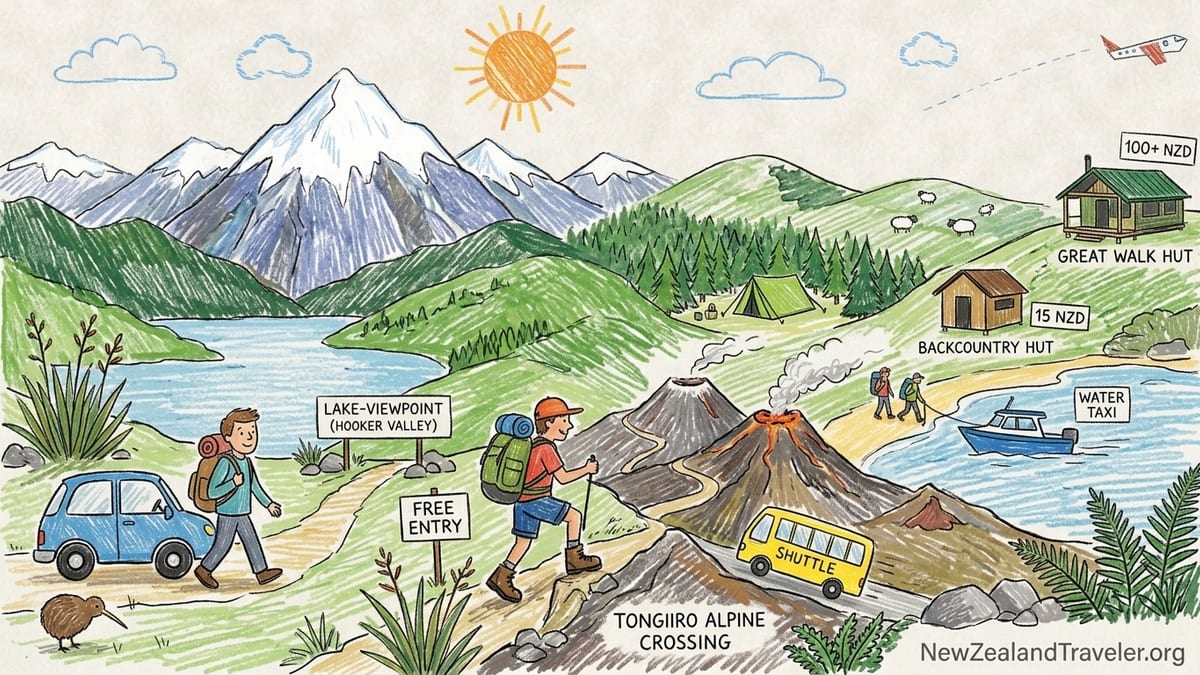
Free Entry, Not a Free Holiday
New Zealand’s national parks are unusual in one crucial way. There is no entry gate and no per-person or per-vehicle admission fee. The National Parks Act promises freedom of entry and access, and in practice that means you simply drive into places like Tongariro, Aoraki / Mount Cook or Abel Tasman without paying anything at a barrier. For travelers used to daily passes and annual cards in the United States or Canada, it genuinely feels liberating.
That policy does not mean you can visit the parks without spending money. Instead of entry gates, New Zealand’s Department of Conservation, or DOC, funds much of its visitor infrastructure through hut fees, campsite charges, concessions from guiding companies, parking controls at busy trailheads and a substantial subsidy from taxpayers. Internal DOC figures indicate that user fees only cover a small fraction of the overall cost of maintaining tracks, huts and facilities, with the rest supported by general government funding.
On the ground, this funding model shifts your spending from “pay to enter” to “pay for almost everything you actually do.” The longer or more complex your trip, the more that reality bites. A traveler who drives in for a one-hour lakeside stroll will spend almost nothing. Someone attempting a multi-day Great Walk with shuttles, huts and contingency plans for bad weather can easily spend hundreds of New Zealand dollars in a single park without ever encountering an entry gate.
Understanding this distinction is essential when you plan a supposedly budget-friendly national-park holiday. You will not pay to cross an official boundary, but you will pay for how long you stay, how far you go and how much comfort or safety margin you want along the way.
Short Walks by Car: The Closest Thing to Free
The cheapest way I experienced New Zealand’s parks was also the simplest. I rented a compact car, packed a supermarket picnic, and focused on short walks that began and ended at the same car park. In Aoraki / Mount Cook National Park, for example, I could drive directly to the Hooker Valley Road end and walk the popular Hooker Valley Track without paying a cent in park-specific fees. Inland from Kaikōura, I did the same for short alpine walks in Arthur’s Pass, and in Fiordland I visited viewpoints and short forest tracks off the Milford Road.
In this style of travel, costs concentrate outside the park system itself. The rental car was my biggest expense, followed by fuel, which in recent years has often hovered around the equivalent of several New Zealand dollars per litre. Parking at most standard DOC day-use car parks was still free at the time of my trip, provided I respected local rules and time limits, so there were no surprise ticket machines swallowing coins every time I stopped to stretch my legs.
Accommodation could also be kept moderate if I stayed in nearby towns rather than deep inside the parks. In Te Anau, gateway to Fiordland, I alternated between holiday-park cabins and private hostel rooms. Near Tongariro, I based myself in Turangi and National Park Village, where off-peak motel and lodge rates were noticeably lower than the high-season prices closer to major trailheads. Because I was not locked into pre-booked huts or shuttles, I could also chase good weather and move on quickly if conditions turned bad.
For a traveler content with scenic viewpoints and two to four hour day walks, this approach keeps national-park spending relatively low. You still pay for a rental car, fuel, food and a bed, but you are not committing to the higher-cost elements that come with linear routes and overnight trips. Free entry feels almost literal when you can step out of your vehicle, wander up a valley and be back at your own kitchen within a few hours.
When “Free” Starts to Add Up: Shuttles and One-Way Hikes
The first time the real costs of a free-entry park surprised me was on the Tongariro Alpine Crossing. The track is a one-way, 19.4 km hike through volcanic terrain, and private vehicles can no longer simply be left all day at the main road-ends in peak season. Instead, local operators run shuttles that solve the transport puzzle and help manage congestion and safety.
I booked a seat from a private car park near the Ketetahi end of the track to the start at Mangatepōpō Road. Recent pricing information from local shuttle companies and traveler reports in late 2025 and 2026 suggests that a return or one-way shuttle for the crossing commonly sits somewhere around 50 to 70 New Zealand dollars per adult, depending on where you are picked up. Visitors staying in Taupō or Turangi often pay more than those who drive themselves to a private car park close to the trail.
On paper, that is still cheaper than a national-park vehicle entry fee in some countries, but it changes how “free” the day feels. Two adults booking a shuttle from Taupō can easily spend over 100 dollars before buying food, renting any extra gear, or booking backup accommodation in case weather closes the crossing. Because departures are weather dependent and the alpine environment is serious, some operators only confirm trips at short notice, which adds another layer of planning stress.
One-way logistics costs are not limited to Tongariro. In Abel Tasman National Park, coastal water taxis make linear day walks possible by dropping hikers at bays and picking them up further along the coast. A single water-taxi trip between popular bays can cost several dozen dollars per person, and a full return or multi-stop arrangement can exceed the cost of a night in a mid-range motel. Once you factor in those shuttles and boats, a “free” beach walk along the Abel Tasman Coast Track becomes a reasonably expensive day out.
The Big Divide: Backcountry Huts vs Great Walk Accommodation
The most striking price difference I encountered in New Zealand’s park system sits between standard backcountry huts and the Great Walk huts and campsites. DOC categorizes huts into several types. At the budget end, many basic huts in remote locations are free, but they often have very simple facilities. The standard huts that make up the bulk of the backcountry network generally charge around 15 New Zealand dollars per adult per night, confirmed on DOC guidance and hut ticket information published in 2026. That fee usually buys you a bunk with a mattress, toilets and a water source, sometimes with a wood burner below the bushline.
In contrast, accommodation on the premier multi-day Great Walks is much more expensive, especially for international visitors. Current DOC pricing tables for the 2026 to 2027 season show single-night hut fees on popular walks such as the Kepler and Routeburn well over standard-backcountry levels, and often much higher again for non-residents. It is common for an adult bunk on a marquee summer-season Great Walk to cost several times the standard 15 dollar hut price, with precise amounts depending on the track, the time of year and whether you qualify for New Zealand resident rates.
On the heavily marketed Milford Track, for example, recent independent summaries of DOC fee schedules report hut prices for overseas visitors that climb into the low hundreds of dollars per person per night during the main season, although DOC also publishes a much lower “off-peak” rate in winter when avalanche risk and storms make the track suitable only for highly experienced parties. That means a four-night hut-based Milford Traverse for two international hikers can easily exceed a thousand dollars in hut fees alone, all within a park that remains legally free to enter.
This gap is not an accident. DOC has deliberately used higher Great Walk fees to help fund maintenance of these world-famous tracks and to manage demand, while keeping the more modest backcountry hut network affordable. From a traveler perspective, it creates two very distinct price experiences. A three-night trip using standard backcountry huts might cost under 50 dollars per person for accommodation. The same number of nights on a Great Walk in peak season can cost several hundred.
Camping Costs, Holiday Parks and Weather-Driven Plan B
I went to New Zealand imagining I would camp constantly to save money. The reality was more nuanced. DOC campsites vary widely in price, from free basic sites with a long-drop toilet to more developed serviced camps with kitchen shelters and flushing toilets that cost closer to a modest motel per week. Standard DOC front-country campsites in many areas are priced to sit well below commercial holiday-park rates, but once you add paid showers, laundry and powered sites in private campgrounds, the budget advantage narrows.
Inside parks, DOC Great Walk campsites also carry premium pricing compared with ordinary backcountry camping. DOC’s own fee tables show that a tent site on some Great Walks in the main season can cost a significant fraction of a hut bed, especially for non-residents. For example, camping on a marquee Great Walk might be priced in the tens of dollars per person per night instead of the low single digits you might expect from a simple backcountry campsite elsewhere.
Then there is the weather. New Zealand’s maritime climate is famously changeable. On my first visit I lost track of how many times a front rolled through Fiordland or the central North Island and completely rewrote my plans. Several nights that I intended to spend in DOC campsites became last-minute bookings at motels or private lodges when forecast gales or snow made camping unappealing or risky. These last-minute beds often cost more than my carefully pre-booked nights in larger towns and could easily double my expected daily accommodation spend.
In practice, this meant that traveling cheaply required not just choosing low-cost options like standard campsites, but also building a buffer into my budget for those unplanned upgrades. Travelers who arrive with a very tight daily spending cap and no flexibility can feel trapped when forecasts deteriorate. The park itself is still open and still free, but your only realistic options for staying nearby may be a high-season holiday park cabin or the last remaining motel room in town.
Transport, Fuel and Food in Remote Park Gateways
Even if you never step on a shuttle or sleep in a hut, the geography of New Zealand’s national parks affects your budget. Many of the most spectacular areas are reached by long dead-end roads that offer scenery instead of competition between fuel stations and supermarkets. The further you drive from major towns, the more you tend to spend per litre at the pump and per item in small village shops.
Driving to Milford Sound from Te Anau, for instance, involves a return trip of over 200 kilometres on a spectacular but remote highway where there are very few services. Fuel at the nearest stations to the park boundary is often noticeably more expensive than in larger regional centres. Food in small settlements near park entrances, such as National Park Village by Tongariro or the hamlet of Fox Glacier on the West Coast, can also carry a premium over what you pay in city supermarkets.
Rental-car costs are another quiet drain on the budget. A compact car across several weeks can total hundreds or thousands of dollars, even before fuel and insurance, and some of the cheapest deals limit where you can drive or what roads you can use. Those rules matter in a country where many trailheads sit at the end of narrow gravel roads. I met several travelers who discovered on arrival that their rental contracts technically forbade driving to the start of certain remote tracks, forcing them to book expensive local shuttles or guided trips to reach places they had assumed they could access independently.
For visitors without a car, bus and shuttle combinations can be even more costly, especially on routes designed around tourists rather than locals. A multi-park itinerary stitched together with one-way bus tickets and track shuttles can quietly consume a large chunk of a backpacker’s budget, yet still be far cheaper than buying and maintaining a vehicle for a short visit. Either way, the national parks absorb your transport money even while the entry remains officially free.
Guided Trips, Scenic Cruises and Gear Rental
New Zealand encourages independent travel, but some of its most famous park experiences are dominated by guided options and concession holders. In Fiordland, the iconic way to see Milford Sound or Doubtful Sound is on a scenic cruise or cruise-and-kayak combo. Prices for short cruises have frequently sat in the low hundreds of dollars for two people, rising higher for longer or more luxurious options. These are run by private operators rather than DOC, but they feel inseparable from the park experience when you are on deck under sheer rock walls watching waterfalls dissolve into spray.
Guided walks and glacier trips add another layer. On the West Coast, access to the upper reaches of Franz Josef and Fox glaciers has shifted heavily toward helicopter-supported guided experiences after changing glacial conditions made traditional valley routes unsafe or unreliable. Visitors wanting to step onto blue ice inside the national park often end up considering heli-hikes that can cost several hundred dollars per person. Once again, the park gate is technically free, but the experience most visitors associate with that landscape carries a premium price tag.
Gear rental is the other hidden item many first-time visitors underestimate. New Zealand’s tracks reach into alpine and subalpine terrain where sudden snow, wind and cold rain are common. DOC safety advice highlights the need for proper wet-weather clothing, thermal layers, sturdy boots and sometimes ice axes and crampons on more demanding routes. I watched travelers arrive in Tongariro with only street sneakers and light jackets, then reluctantly hire boots, rainwear and walking poles from local shops the day before their Tongariro Crossing shuttle. Those rentals easily pushed their “free park hike” into the territory of a paid adventure tour.
None of these costs are unreasonable when you consider the value and the overheads. Helicopters, trained guides and safety equipment are expensive to provide. But for a traveler planning purely around the phrase “free national parks,” it can be jarring to realize that many signature experiences only start where the free part stops.
How Costs Diverge: Day Walker vs Multi-Day Tramper
After several trips, I learned to think of New Zealand park budgets in two distinct profiles. The first is the casual visitor doing short walks from a rental car, as described earlier. Their daily park-related costs might include fuel, a picnic prepared from supermarket groceries, and perhaps a night in an ordinary motel or hostel nearby. If they are careful, their extra spending attributable to being inside the park instead of on a city waterfront might only be a modest fuel premium and one or two cafe splurges.
The second profile is the multi-day tramper committing to iconic tracks. Here, costs have more layers. Take a hypothetical three-night loop using standard backcountry huts in a park like Nelson Lakes or Arthur’s Pass. At roughly 15 dollars per adult per night for standard huts, the accommodation component might be about 45 dollars, plus transport to and from the trailhead and any pre- or post-trip accommodation in town. Food can be kept reasonable by carrying supermarket-bought tramping rations, and shuttles may not be necessary if the route starts and ends in the same place.
Now compare that with a three-night hut-based Great Walk in peak season, such as the main sections of the Kepler, Routeburn or Abel Tasman Coast Track. Based on DOC’s 2026 fee structure, an overseas visitor might expect to pay several times the standard hut rate per night. Multiplied over three nights, hut fees alone can reach into the mid hundreds of dollars per person. Add water taxis on coastal tracks, or track-end shuttles where the route is not a loop, and the cost difference between the two profiles can easily be several hundred dollars over the course of a single long weekend.
The financial gap widens further when weather and safety margins are added. Many Great Walkers schedule pre- and post-trip nights in local towns to adjust for forecast storms or strong winds, particularly around alpine passes or open ridgelines. Every additional night in a gateway town like Te Anau or Queenstown can add another hundred or more dollars to a couple’s combined costs. A tramper content with less famous routes and flexible dates may be able to wait out the same weather at a cheaper DOC campsite or holiday park elsewhere.
The Takeaway
New Zealand’s national parks are genuinely different from many of their overseas counterparts. The absence of entry gates and daily passes makes the country feel unusually open and generous, and for casual visitors doing short walks from their own car, that impression mostly holds up. I have had days in Aoraki / Mount Cook, Arthur’s Pass and Fiordland where the only money I spent was on fuel and a coffee after finishing the hike.
But my most memorable trips have also been my most expensive. Walking the Tongariro Alpine Crossing after booking a shuttle, staying in Great Walk huts, taking a water taxi along the Abel Tasman Coast or joining a cruise in Milford Sound all involved substantial outlays. None of those experiences were unfairly priced, especially when you consider what it costs to build huts in remote valleys or run boats and helicopters under strict safety rules. Yet they illustrate clearly that free entry does not equal free holidays.
If I were planning another extended national-park journey in New Zealand, I would still revel in the fact that I can drive into these landscapes without opening my wallet at a gate. But I would also sit down with a realistic budget and line items for huts, campsites, shuttles, water taxis, scenic cruises, rentals and inevitable weather-related plan changes. I would reserve the high-fee Great Walk experiences for a few carefully chosen highlights and fill the rest of my time with lower-cost standard huts, local day walks and nights in modest accommodation rather than resorts.
The cheap parts I loved most are still very real. Sitting on a hut deck at sunset after paying 15 dollars for a bunk, listening to kea shriek over Arthur’s Pass. Brewing instant coffee beside my tent at a lakeside DOC campsite with no one else in sight. Pulling off State Highway 6 for an unscheduled 30-minute forest walk that cost nothing but a little petrol and time. The trick is to recognize that those moments exist alongside the headline-grabbing cruises and Great Walks, and to budget in advance so you can enjoy both sides of the system without shock.
Arrive in New Zealand expecting its national parks to be free to enter but not free to enjoy, and you are far less likely to be caught off guard. The parks will still feel generous, the scenery will still feel wild, and your bank account will survive long enough for you to start planning the next visit.
FAQ
Q1. Do New Zealand national parks charge any entry fee at all?
New Zealand’s 13 national parks do not charge per-person or per-vehicle entry fees. You can drive or walk into them without paying a gate charge, although you will pay for services such as huts, campsites, shuttles and some parking in busy areas.
Q2. How much do standard DOC backcountry huts cost per night?
According to current DOC pricing, standard backcountry huts are generally around 15 New Zealand dollars per adult per night. These huts usually provide a mattress, toilets and a water supply, and you pay either via hut tickets or bookings depending on the hut.
Q3. Why are Great Walk huts so much more expensive than standard huts?
DOC sets higher fees on Great Walk huts and campsites to help pay for the intensive maintenance, facilities and staff presence on those flagship tracks, and to manage high visitor demand. As a result, hut prices on marquee Great Walks in peak season can be several times the standard 15 dollar hut fee, especially for international visitors.
Q4. How much should I budget for a day on the Tongariro Alpine Crossing?
A typical independent day on the Tongariro Alpine Crossing for an overseas visitor might include a shuttle in the range of roughly 50 to 70 dollars per person from nearby towns or private car parks, plus food, any gear rental and possibly a night’s accommodation in a gateway town such as Turangi or National Park Village.
Q5. Are DOC campsites inside national parks always cheap?
No. Some DOC campsites are free or very low cost, but serviced and Great Walk campsites can be significantly more expensive, particularly in peak season. Private holiday parks near national-park gateways also charge higher rates than basic DOC sites, especially for powered sites and cabins.
Q6. Can I visit New Zealand national parks without a car and still keep costs down?
It is possible to visit parks by combining intercity buses with local shuttles and guided trips, but it can be more expensive than using a rental car, especially for two or more people. To keep costs down without a car, focus on parks with good public-transport links and choose tracks that start and finish in the same place.
Q7. How does bad weather affect my national-park budget?
New Zealand’s weather is changeable, and storms, snow or strong wind can close tracks or make camping unpleasant. When that happens you may need last-minute motel rooms, extra nights in gateway towns or alternative activities, all of which add unplanned costs. Building a buffer into your budget makes these changes less stressful.
Q8. Is it cheaper to camp or stay in huts in the national parks?
Standard DOC huts at about 15 dollars per night can be very good value compared with commercial accommodation, especially in remote areas. Basic camping is often cheaper, but once you factor in gear costs, paid showers, holiday-park fees and weather-related upgrades to cabins or motels, huts can be competitive for many visitors.
Q9. Do I need to book huts and campsites in advance?
For Great Walks and many popular huts and campsites, advance booking is essential during the main season and sometimes required year-round. Standard backcountry huts outside the Great Walk system may operate first-come, first-served with hut tickets, but you should always check DOC information for your specific route before you go.
Q10. What are the biggest hidden costs first-time visitors overlook?
Common surprises include the price of hut and campsite bookings on Great Walks, track and water-taxi shuttles, fuel and food in remote gateway towns, gear rental for alpine or wet-weather conditions, and last-minute accommodation changes when the forecast turns bad. Planning for these in advance helps ensure that “free entry” does not translate into financial shock.