


New Zealand’s 13 national parks protect almost 30,000 square kilometres of beaches, glaciers, volcanoes, fiords and rainforest. With limited time, most visitors can only see a handful, so the key question is not just which park is “best,” but which park is best for you. This guide groups every New Zealand national park by reasons to visit, then explains how many days each one deserves, the most useful base towns, whether you need a car and how much hiking is required to appreciate the landscapes.
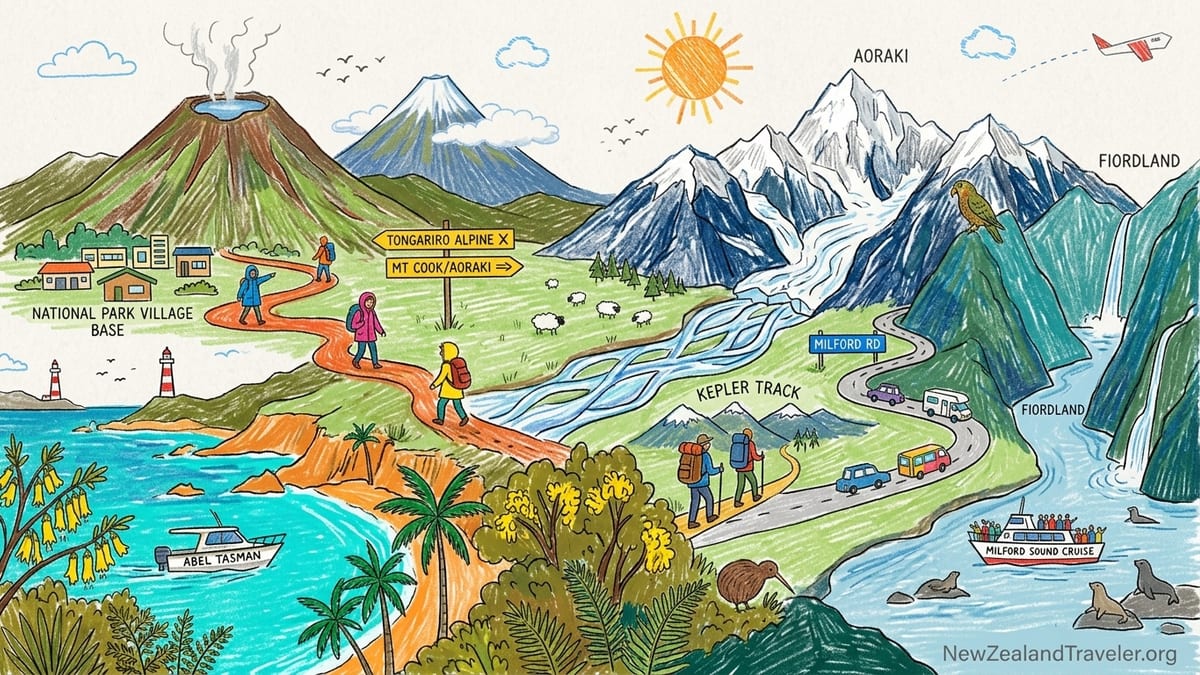
How to Choose Among New Zealand’s 13 National Parks
New Zealand officially has 13 national parks spread across both the North and South Islands, from Tongariro’s volcanic plateau in the central North Island to Rakiura on Stewart Island in the far south. Together they form the backbone of many itineraries, and a high proportion of international visitors now include at least one national park in their trip. Rather than ranking them from one to 13, it makes more sense to match each park to a travel style, whether that means easy coastal walks, alpine photography or multi-day wilderness tramps.
For most first-time trips of two to three weeks, travellers tend to focus on a core group of high-demand parks: Tongariro, Aoraki/Mount Cook, Fiordland, Abel Tasman, Mount Aspiring and Westland Tai Poutini. These six are relatively accessible from major routes and offer iconic New Zealand scenery that feels very different from one another. Around them sit seven more parks with lower visitor numbers but strong appeal for particular interests such as birdlife, caving, rafting or true off-grid wilderness.
As you read the sections below, think about three practical questions. First, how many days can you realistically spend in or near each park once you factor in drives and flights. Second, how comfortable are you with unsealed roads, mountain weather and long days on your feet. Third, do you want a park you can appreciate from the road or one where you must hike or paddle to reach the highlights. The answers will quickly narrow down which combination of parks fits your itinerary.
Car rental remains the most flexible way to string multiple parks together, especially on the South Island where public transport is limited outside main corridors like Christchurch to Queenstown or Queenstown to Te Anau. However, many marquee experiences, from Milford Sound cruises to the Tongariro Alpine Crossing, can be reached through day tours from nearby towns. In the sections that follow, each park profile notes whether having your own vehicle is strongly recommended or merely convenient.
Best Volcanic Landscapes
If you want to feel the raw geology of Aotearoa New Zealand, focus on the central North Island, where Tongariro and Egmont national parks are defined by active or recently active volcanoes. Both areas combine Maori cultural stories with striking cones, lava flows and crater lakes, yet the on-the-ground experience is quite different in each.
Tongariro National Park sits at the heart of the North Island and was the country’s first national park. Its signature experience is the Tongariro Alpine Crossing, a demanding one-day trek that passes steaming vents, mineral-blue crater lakes and views across the plateau. The park also includes the volcanoes Ruapehu and Ngauruhoe, with Whakapapa village, National Park Village, Ohakune and Turangi acting as practical bases. Two full days is the minimum worthwhile stop if you hope to tackle the Crossing and keep a weather backup; three gives time for shorter walks to Taranaki Falls or Tawhai Falls and a visit to the Tongariro National Park Visitor Centre. A car makes it easier to move between bases, but commercial shuttles operate for the Crossing and to some trailheads.
The volcanic experience is more compact in Egmont National Park around the near-perfect cone of Taranaki Maunga in Taranaki. Cloud often wraps the summit, but on clear days the ring road offers constant views, and short walks like the Pouakai Tarns track reward photographers with classic reflections of the mountain. New Plymouth is the main service town, with smaller bases such as Stratford and Oakura closer to trailheads. One or two days is usually enough for casual visitors, though summit attempts and the popular Pouakai Circuit require more time and solid backcountry skills. A car is very helpful here, as public transport to the park edges is limited and many car parks sit on narrow rural roads.
Whanganui National Park, although not volcanic in appearance, completes this central landscape story with deep forested valleys carved by the Whanganui River. Most people experience it not through tramping but by canoe journeys between Taumarunui and Pipiriki, often over two to three days with jet boat transfers. Whanganui town and Ohakune work as bases depending on which section you paddle. A car is not strictly necessary if you book a full outfitted trip that includes transfers, but it makes one-way logistics easier, especially for independent paddlers.
Best High-Alpine Scenery
For classic Southern Alps views, Aoraki/Mount Cook, Mount Aspiring and Arthur’s Pass national parks deliver glaciated peaks, hanging valleys and alpine tarns. These parks lie within a day’s drive of each other on the South Island, yet each has a distinct feel, from Aoraki’s high, hard granite walls to Arthur’s Pass’ road-accessible passes and waterfalls.
Aoraki/Mount Cook National Park is the country’s high-alpine showpiece, home to Aoraki / Mount Cook, New Zealand’s highest peak, along with major glaciers flowing into the turquoise waters of Lake Pukaki. The small Aoraki/Mount Cook Village sits inside the park and serves as the main base, reached by road from Tekapo or Twizel. Plan at least two nights, ideally three, so you can walk the Hooker Valley Track, visit Tasman Glacier viewpoints and take a scenic flight or glacier boat trip if weather and budget line up. Many headline views are available on easy tracks, so you do not need to be a mountaineer to appreciate the park, but conditions change quickly and sturdy footwear and extra layers are essential.
To the southwest, Mount Aspiring National Park bridges the regions around Wānaka, Makarora and the Haast Pass. This is a park for wide valleys, braided rivers and snow-streaked peaks rather than roadside viewpoints. Wānaka is the most comfortable base, with Glenorchy and Makarora also useful for particular trailheads. Allow two to four days if you want to combine famous day walks like the Rob Roy Glacier Track or the first section of the Routeburn with time by the lake in Wānaka. A car makes a major difference here because many tracks start at the end of gravel roads and shuttle services focus on tramping seasons and Great Walk logistics.
Arthur’s Pass National Park is the most accessible slice of the main divide from Christchurch. State Highway 73 and the TranzAlpine train both cross the park, meaning you can step from alpine village to high passes in a matter of minutes. Arthur’s Pass village functions as a compact base with basic services and an active Department of Conservation visitor centre. Travellers with one full day can walk to Devil’s Punchbowl Falls and drive to viewpoints at Otira Viaduct, while those with two or three days may add more strenuous routes like Avalanche Peak. A private car provides flexibility to stop at short walks along the highway, but the park is still feasible by combining the train or bus with guided day hikes from Christchurch.
Best Beaches and Coastal Landscapes
Abel Tasman National Park is New Zealand’s best known coastal park and often the first place visitors think of when imagining golden sand and clear, sheltered bays. The Abel Tasman Coast Track, one of the Great Walks, threads between beaches and forested headlands with huts and campsites along the way. Crucially, though, you do not have to walk the full multi-day route to enjoy it. Water taxis from Marahau and Kaiteriteri drop day visitors at various bays so they can combine short walks and beach time before being collected again. A minimum of two nights in Marahau, Kaiteriteri, Motueka or nearby Riwaka works well, with three nights giving time for both a boat and walking day and a shorter coastal stroll or kayaking trip.
Northwest of Abel Tasman lies Kahurangi National Park, a larger and wilder area that reaches from near Golden Bay down toward the Buller region. Its coastline is less manicured but still impressive, particularly around the Heaphy Track, which combines nikau palm-fringed beaches with limestone bluffs and inland forests. Collingwood, Takaka and Karamea act as bases for different corners of the park. Travellers interested in completing the Heaphy Track should plan four to five days and expect to arrange a shuttle or vehicle relocation, while those content with day walks around Flora Saddle or the Oparara Basin can sample the scenery from bases on either side. A car is strongly recommended since distances are long and public transport sporadic.
Rakiura National Park on Stewart Island offers a very different kind of coastal experience, closer to subantarctic than tropical. The park covers most of the island, with the small settlement of Oban providing accommodation, food and tours. Many visitors spend two or three days here, flying or taking the ferry from the Southland town of Bluff, then walking sections of the Rakiura Track, joining evening kiwi-spotting tours or taking boat trips around Paterson Inlet. Because almost all access is via Oban and the road network is tiny, you do not need a car on Stewart Island; instead, you explore on foot and by boat, which suits the slow, remote mood of the island.
Best Glaciers and Ice-Carved Valleys
Westland Tai Poutini National Park on the central West Coast and its neighbours Aoraki/Mount Cook and Mount Aspiring form the heart of New Zealand’s glacier country. Here, enormous bodies of ice have carved U-shaped valleys that now host temperate rainforest, river flats and lakes. Visiting this region gives you a sense of how dynamic the Southern Alps are, but it also requires some flexibility. Glacier fronts like Franz Josef and Fox have retreated significantly in recent years, changing how close you can walk and shifting the balance toward scenic flights and guided glacier hikes.
Westland Tai Poutini National Park revolves around the twin villages of Franz Josef / Waiau and Fox Glacier, roughly midway between Greymouth and Wānaka on State Highway 6. Many itineraries allow one night in each village or two nights in one base with a day trip to the other. Short valley walks lead toward the glacier viewpoints, while local operators offer heli-hiking and scenic flights that land on the ice. Prices for these flights are often several hundred New Zealand dollars per person, so they become a major budget decision. Without taking to the air, you still see spectacular views by combining the glacier walks with Lake Matheson near Fox and coastal stops such as Gillespies Beach. Because public buses are limited and departure times do not always match good weather windows, having a car is particularly helpful here.
Aoraki/Mount Cook, already discussed for its alpine scenery, is also a glacier destination, with the Tasman Glacier lake cruises and scenic flights that land on snowfields. If you are especially interested in glaciology or photography, combining Aoraki/Mount Cook with Westland Tai Poutini and driving over the passes between them creates a powerful theme for a week-long segment of a South Island trip. Similarly, Mount Aspiring’s Rob Roy Glacier Track lets day hikers look directly onto an icefall from a grassy basin, which feels more intimate than the large glacier valleys further north.
Arthur’s Pass contributes to this ice story with classic glacial landforms visible from the highway and tracks, although its glaciers themselves are less of a front-and-centre attraction for casual visitors. If you have already committed to glacier flights on the West Coast, you can treat Arthur’s Pass as a place to appreciate the overall landscape rather than a specific glacier experience.
Best Wildlife and Wilderness Experiences
Fiordland National Park on the southwest corner of the South Island is the flagship for both wildlife watching and deep wilderness. Its fiords, including Milford Sound / Piopiotahi and Doubtful Sound / Patea, shelter dolphins, fur seals and penguins, while the inland valleys host ancient beech forest and endemic birds. Te Anau is the main visitor base, with Milford Sound village providing limited accommodation for those who want to wake inside the fiord. For most travellers, three to four days in Te Anau allows time for at least one Milford Sound cruise, a section of a Great Walk such as the Kepler or Milford Track, and possibly a day trip to Doubtful Sound that combines a cruise on Lake Manapouri, a bus over Wilmot Pass and a second boat within the fiord.
Fiordland is a place where you do not have to be a serious tramper to feel remote. Driving the Milford Road from Te Anau to Milford Sound, with stops at Eglinton Valley, Mirror Lakes and the short walk to Key Summit, delivers world-class scenery in a single long day, especially if you combine it with a cruise. Overnight cruises in Milford or Doubtful Sound deepen the experience by letting you kayak in sheltered coves and listen to bird calls once day-boat crowds leave. Because accommodation inside the park is limited and weather is very changeable, it is worth booking cruises and tours well in advance for peak months between November and March, then building your Te Anau stay around those bookings.
Rakiura National Park is a top choice for birdlife, particularly those hoping to see wild kiwi. Guided night walks from Oban increase the chances of spotting these nocturnal birds on nearby beaches or forest tracks, and boat trips visit small islands where other native species have been given space to rebuild. Two or three nights gives you enough time to mix short walks on the Rakiura Track or local circuits with organised wildlife experiences. Visitors should be prepared for wet, cool conditions even in summer, with mud on many inland tracks and sandflies common near sheltered bays.
For less-visited wilderness on the South Island’s West Coast, Paparoa National Park combines coastal cliffs, limestone gorges and dense rainforest. Most international visitors see only the roadside viewpoints and short walks near Punakaiki’s pancake rocks, but the park extends far inland. The Paparoa Track, a newer Great Walk, runs between Smoke-ho car park near Blackball and Punakaiki over several days. Greymouth, Westport and Punakaiki itself work as staging bases depending on which section you want to tackle. A car or arranged shuttle is required for through-trips because public transport does not connect the track ends in a convenient way.
Best Great Walk Access and Easy Day Walks
New Zealand’s network of Great Walks passes through several national parks, making those parks particularly attractive to hikers who want to combine generally well-graded tracks, hut systems and outstanding scenery. Fiordland, Tongariro, Abel Tasman, Kahurangi and Paparoa all host Great Walks, while Aoraki/Mount Cook and others offer shorter day hikes that deliver similar quality without committing to nights in the backcountry.
In Fiordland, the Milford, Routeburn and Kepler tracks each have trailheads within or on the edge of the national park. The Milford Track typically takes four days, the Routeburn between two and three, and the Kepler three to four, depending on pace and side trips. Te Anau and Queenstown provide the main transport and gear bases, with local operators offering shuttles to the track ends and luggage storage. Great Walk bookings open in advance and popular summer dates can sell out quickly, so many travellers end up walking shorter sections as day hikes, such as the lakeside section of the Kepler from the Control Gates or the first hours of the Routeburn from the Divide.
Tongariro’s Northern Circuit and the Tongariro Alpine Crossing share much of their route, giving visitors the choice between the intense one-day experience and a slower three to four day circuit. National Park Village, Whakapapa and Turangi serve as staging points, with shuttles handling most access to the start and end of the Crossing and some sections of the circuit. For travellers who prefer easier outings, the park also has multiple short walks, waterfalls and viewpoints that leave directly from Whakapapa village.
Abel Tasman’s Coast Track, the Heaphy Track in Kahurangi and the Paparoa Track in Paparoa National Park round out the Great Walk portfolio. These coastal and forest routes are especially appealing to visitors keen on multi-day walks but hesitant about more technical alpine terrain. Local towns such as Motueka, Takaka, Karamea, Westport and Greymouth all have businesses focused on shuttles, boat transfers and gear rentals for these tracks. In each case, allow at least the official number of nights for a full Great Walk, plus a buffer night at either end in a nearby town.
Outside the Great Walk system, many parks still shine for short and easy tracks. Nelson Lakes National Park, for instance, centres on the beautiful lakes Rotoiti and Rotoroa, with St Arnaud as the main base. Half-day circuits such as the Lake Rotoiti lakeside track give alpine lake views without major climbing, making the park a relaxing stop for road-trippers heading between Blenheim or Nelson and the West Coast. Aoraki/Mount Cook’s Hooker Valley Track and Abel Tasman’s low-tide beach sections serve similar roles, providing big landscapes on well-formed family-friendly paths.
Best for Families and First-Time Visitors
For many families and first-time visitors, the ideal national park balances spectacular scenery with straightforward logistics. There should be a comfortable base town with a range of accommodation and food, easily accessed viewpoints that do not require long hikes and at least one standout activity that children or less active travellers can enjoy. Several parks meet this brief, with Abel Tasman, Tongariro, Aoraki/Mount Cook and Fiordland leading the way.
Abel Tasman is arguably New Zealand’s most family friendly park. Staying in Kaiteriteri or Marahau puts you close to sheltered swimming beaches, short sections of the Coast Track and water taxi and kayak operators that can tailor outings to different ages. Because services are concentrated and the terrain near the coast is not especially steep, it is quite feasible to enjoy the park without big packs or extended uphill grinds. Allow at least two nights, arriving from Nelson or the Marlborough region by car or shuttle, then plan one boat and walking day and one more relaxed beach-focused day.
Tongariro is an excellent choice for first-time visitors who want to experience New Zealand’s volcanic landscapes without venturing deep into backcountry. If the full Tongariro Alpine Crossing feels too demanding, you can still base in Whakapapa or National Park Village and explore short walks to waterfalls, viewpoints and historic sites, many under two hours return. Accommodation ranges from hostels and motels to higher-end lodges, and the towns on the park’s fringes offer supermarkets and gear rental shops that cater to hiking and skiing seasons. Two nights gives enough time for one longer outing and a series of shorter stops, with the option to add a third night as a weather backup.
Aoraki/Mount Cook works well for families who enjoy walking but prefer well-built tracks. The Hooker Valley Track, for example, is usually completed in around three hours return by visitors of moderate fitness and crosses swing bridges with constant mountain views. The village has a compact but capable set of services, including a grocery shop, cafes and accommodation ranging from backpacker lodges to upscale hotels. Because the access road from Tekapo or Twizel ends at the village, you do need either your own car or a seat on a scheduled bus, but once you arrive you can leave the vehicle parked and reach several trailheads on foot.
Fiordland can be more weather-challenging for families, since heavy rain is common and sandflies are a frequent complaint, but Milford Sound cruises and the scenic drive from Te Anau are still among the most rewarding single days you can spend in New Zealand. Many visitors base for two to three nights in Te Anau, booking a cruise that includes coach transport to Milford Sound if they prefer not to drive the winding road themselves. Short roadside walks and lookouts break up the journey and meet different energy levels, and in poor weather you can visit the Te Anau Bird Sanctuary or join a glow-worm cave tour instead.
Planning Your Route Around New Zealand’s National Parks
Once you have a sense of which parks suit your interests, the final step is to integrate them into a realistic route. On the North Island, a typical loop for travellers with a rental car might link Auckland to Rotorua and Taupō, then down to Tongariro National Park, with the option of detouring west to Taranaki and Egmont or south toward Whanganui. Allowing four to six days for this central section gives you flexibility to adjust for weather, especially if you aim to hike the Tongariro Alpine Crossing or attempt a summit in Egmont National Park.
On the South Island, most itineraries move along either a clockwise or anticlockwise loop between Christchurch and Queenstown or between Picton and Queenstown. A high-demand national park spine could include Abel Tasman and Kahurangi in the north, Westland Tai Poutini along the West Coast, then Aoraki/Mount Cook and Mount Aspiring inland before finishing with Fiordland. Fitting all of these into a two-week trip is ambitious, so many people choose three or four parks to explore more deeply. For example, one realistic two-week South Island route might include two nights near Abel Tasman, two at the West Coast glaciers, two at Aoraki/Mount Cook, two in Wānaka for Mount Aspiring, and three in Te Anau for Fiordland, with single-night transit stops in between.
Public transport and day tours allow those who do not drive to reach major parks like Tongariro, Aoraki/Mount Cook and Fiordland, but you may need to accept a narrower set of options and more time on coaches. Companies based in Auckland, Rotorua, Christchurch and Queenstown sell bundles that combine bus transfers and accommodation with key experiences such as Milford Sound cruises, Abel Tasman water taxi days or Tongariro Alpine Crossing shuttles. When comparing these options, look at whether they include early morning departures that reach parks before the main crowds, as this can be as important for your enjoyment as the exact price.
Whichever mode of transport you choose, factor New Zealand’s changeable weather into your plans. Even in the height of summer, Tongariro’s volcanoes can be obscured by cloud, Fiordland can receive heavy rain and the West Coast can experience low ceilings that ground scenic flights. Try to build two-night stays near your highest priority parks so you have at least one backup day, and resist packing your schedule so tightly that a single cancelled boat or flight unravels the rest of your trip. In shoulder seasons, shorter days and cooler temperatures make very early starts and layers of clothing even more important, particularly for alpine crossings and high viewpoints.
The Takeaway
New Zealand’s national parks cover a huge range of landscapes, from the volcanic plateau of Tongariro to the fiords of Fiordland, the alpine walls of Aoraki/Mount Cook and the golden bays of Abel Tasman. There is no single “best” park for every traveller, only parks that best match your interests, fitness, travel style and time frame. By grouping the 13 parks into themes like volcanic landscapes, high-alpine scenery, beaches, glaciers, wildlife and family-friendly access, you can build an itinerary that feels coherent and achievable rather than a rushed checklist.
If this is your first visit and you want a representative mix, combining Tongariro, Aoraki/Mount Cook, Abel Tasman, Westland Tai Poutini, Mount Aspiring and Fiordland will expose you to much of the country’s headline scenery in two to three weeks. With more time or a return trip, you can push into quieter parks such as Kahurangi, Paparoa, Nelson Lakes, Egmont, Whanganui and Rakiura, many of which reward slower travel and repeated visits. In every case, staying at least two nights near your chosen park base, keeping an eye on forecast conditions and pre-booking key shuttles and cruises will go a long way toward a smooth experience.
Above all, remember that the parks are living landscapes, culturally and ecologically significant to local communities and iwi as well as playgrounds for visitors. Travelling with flexibility, respect and realistic expectations will help ensure that your time among New Zealand’s mountains, forests and coasts feels less like a race between viewpoints and more like a series of grounded encounters with place. From a roadside lookout on the Milford Road to a quiet beach in Abel Tasman or a starlit sky in Aoraki/Mount Cook, the moments you remember will rarely depend on ticking off every park, but on choosing a few that you explored well.
FAQ
Q1. How many New Zealand national parks can I realistically visit on a two-week trip?
On a 14-day trip most travellers comfortably visit three or four national parks, with two or three nights near each key base such as Te Anau for Fiordland or Marahau for Abel Tasman.
Q2. Do I need a rental car to see the best of New Zealand’s national parks?
A rental car gives far more flexibility, especially on the South Island, but you can still reach headline areas like Tongariro, Aoraki/Mount Cook and Milford Sound through a mix of buses and guided day tours.
Q3. Which national park is best if I only have time for one?
If you can only choose one, Fiordland offers the biggest impact from road-accessible viewpoints and cruises, while Tongariro is the top choice if you want to focus on volcanic landscapes on the North Island.
Q4. How far in advance should I book Great Walks and popular activities?
For peak summer dates on Great Walks and experiences like Milford Sound cruises or glacier flights, booking months ahead is sensible, while shoulder-season trips may be more flexible but still benefit from advance planning.
Q5. Are there national parks suitable for young children or less active travellers?
Yes, Abel Tasman, Aoraki/Mount Cook, Tongariro’s short walks and lakeside tracks in Nelson Lakes all offer gentle, well-formed paths and boat or vehicle access to many viewpoints.
Q6. What is the best season to visit New Zealand’s national parks?
Summer from December to February brings the warmest temperatures and longest days, while late spring and early autumn can offer fewer crowds, cooler walking conditions and still-pleasant weather in most parks.
Q7. Can I visit glaciers in New Zealand without doing a heli-hike?
Yes, you can walk to valley viewpoints near Franz Josef, Fox Glacier and the Tasman Glacier lake, and combine these with short tracks and lakeside stops without stepping onto the ice itself.
Q8. Which parks are best for seeing native wildlife?
Fiordland and Rakiura are top choices for birds and marine life, while many other parks, including Paparoa and Whanganui, protect significant forest habitats where native species are slowly recovering.
Q9. Is camping inside the national parks easy to arrange?
Many parks have designated campsites and basic facilities, but you usually need to book in advance at popular spots, follow strict rules about fires and waste and be prepared for changeable weather.
Q10. How should I prepare for changeable weather in alpine parks?
Carry layered clothing, waterproofs, sturdy footwear, sun protection, snacks and extra water, and check local forecasts and any Department of Conservation advisories before setting out on longer walks.