


Every guide to New Zealand’s national parks seems to start with the same sentence: “Pick up your rental car and drive…” On my most recent trip I decided to flip that script. I put away the keys and tried to reach some of New Zealand’s most famous parks the way many visitors quietly wonder about but rarely find good information on: entirely by public transport, shuttles and water taxis. I wanted to know, in 2026, where car-free travel genuinely works, what it really costs, and at what point the last few kilometres from town to trailhead make a rental car the more honest answer.
The Planning Question Nobody Really Answers
The classic planning question for New Zealand is usually framed as “How many weeks of road trip can you fit in?” A more awkward and less glamorous question sits beneath it. If you do not want to drive, or you only want to rent a car for a few days, which national parks can you realistically experience using the country’s patchwork of intercity buses, local shuttles, water taxis and the occasional train? That practical, car-free question receives far less useful coverage than endless lists of loop drives, yet it shapes everything from your budget to your stress levels.
To get real answers I designed a trip that would deliberately stress the system. I refused to pick up a rental car at the airport. Instead I stitched together Intercity coaches, regional buses, private shuttles and water taxis to test access to multiple national parks. Along the way I tracked actual fares, departure windows, luggage rules and how hard it was to arrange one-way hikes when I could not simply leave a car at the far end.
What emerged was not the familiar conclusion that New Zealand is “impossible without a car.” It was subtler. Some parks, especially where private shuttle and boat networks are mature, work almost elegantly for car-free hikers. Others are let down not by huge distances, but by the final few kilometres between a small town and a remote trailhead. Understanding which is which before you book flights is the key to planning a smarter mix of public transport and short, targeted rentals.
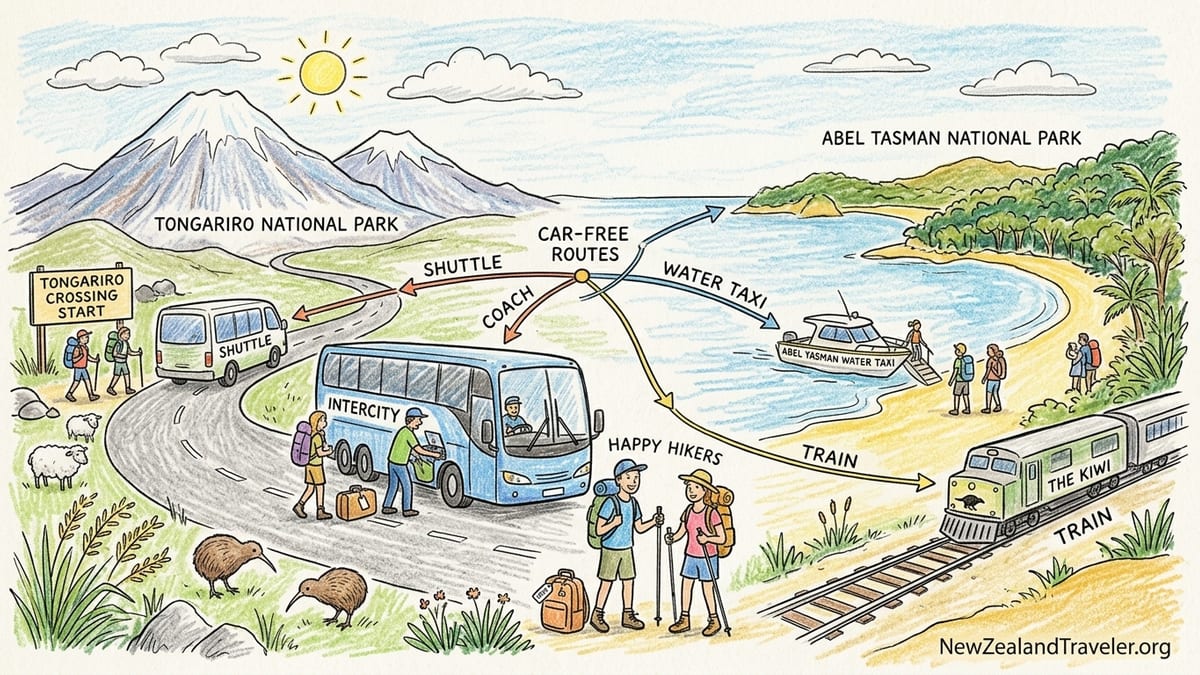
This article focuses on three types of experience. First, a park that is almost purpose-built for hikers without vehicles, Tongariro National Park and the Tongariro Alpine Crossing. Second, a coastal park where water taxis function like buses, Abel Tasman National Park. Third, several parks where access from town to trailhead was awkward enough that I would now recommend a short car rental instead of heroic shuttle-hopping. Together they illustrate where New Zealand’s growing transport web succeeds and where it still leaves car-free visitors standing at the roadside.
Getting to the Mountains on Buses and Shuttles: Tongariro in Practice
Tongariro National Park is often the first serious test of a car-free itinerary. The Tongariro Alpine Crossing is one of the country’s most famous day hikes, yet the start and end points lie on back roads that are a long way from any intercity bus stop. The good news is that in 2026 the shuttle ecosystem around the park is mature enough that determined non-drivers can make it work.
I based myself in National Park Village, which sits on the main rail and highway corridor between Auckland and Wellington. Intercity runs coach services that stop here on the Auckland to Wellington route, generally once or twice daily in each direction, and a typical Auckland to National Park fare booked in advance runs in the range of 60 to 90 New Zealand dollars one way depending on date and demand. That long bus ride became my substitute for the usual pick-up-a-car-at-Auckland-Airport story.
From the village I booked a Tongariro Alpine Crossing shuttle with a local operator. Several companies, including Tongariro Crossing Shuttles, Ruapehu Mountain Transport and Tongariro Track Transport, run return services from National Park Village to the Crossing trailheads. As of spring 2026, a return shuttle from the village costs about 55 to 75 dollars per person, depending on the company and pickup point, with first departures commonly around 5.30 to 6.30 in the morning and multiple afternoon collection times at the far end of the track.
The practical experience was efficient but structured. On my hiking day my shuttle collected me from outside my lodge just after 6 am, along with a mix of backpackers and domestic walkers. The driver gave a thorough safety briefing, checked everyone’s gear and made clear that if the Department of Conservation weather advisory turned negative, the company would cancel or shorten services. Shuttles will not run if high winds or ice make the route unsafe, which means your plans must flex around both the mountain forecast and the operator’s assessment.
Where Shuttle Support Made Car-Free Hiking Easy
Once the shuttle puzzle is solved, Tongariro becomes one of the easiest New Zealand parks to enjoy without a car. The Crossing itself is a one-way hike from Mangatepopo to Ketetahi, roughly 19 kilometres across volcanic saddles and past surreal crater lakes. Without a vehicle you avoid the notorious parking limits at Mangatepopo Road and the stress of retrieving a car at the end. The shuttle drops you at the start and picks you up near the finish, so logistically the one-way nature of the track is actually an advantage rather than a complication.
On my day, the operator gave us three afternoon pickup windows from the Ketetahi end, spaced about an hour apart. For a reasonably fit group the 6 am departure allowed plenty of time to complete the Crossing and still have a margin for weather or photo stops before the last bus. I walked out to the car park around 2.30 pm and waited less than 20 minutes before my shuttle arrived. Because the company ran several buses that afternoon, those who missed their original slot could join a later one if space allowed, for no extra charge.
Fares are not trivial, but they compare reasonably with the cost of fueling and parking a rental car for the day. By late 2026 most operators were charging somewhere in the mid-60 to mid-70 dollar range for park-and-ride style services, and around 55 dollars per person from National Park Village for a direct return shuttle. From Taupo or Turangi, where some travellers base themselves, one-way shuttle services to the track can reach into the 100 to 130 dollar bracket per person, so staying closer in National Park or Whakapapa keeps both price and early pickup times under control.
Luggage management worked better than I expected. Shuttle companies accept daypacks and normal tramping gear without issue, and my accommodation in National Park Village stored my main suitcase while I was on the mountain. Because I was not moving on that same evening I did not have to worry about finishing the Crossing late and still catching an onward bus. For car-free hikers this is an important lesson: treat the park as a base for two or three nights, not as a day stop on a continuous point-to-point itinerary.
Where Tongariro Transport Still Failed Me
While Tongariro shows how strong the shuttle model can be, my attempt to rely entirely on public transport also exposed its weak points. The first challenge was simply aligning the national coach network with the narrow weather windows on the mountain. Intercity’s timetable got me to National Park Village, but only on fixed days and times. If the forecast shifted late or shuttles were cancelled due to gale warnings, I could not easily shuffle my hiking day within a short stay.
The second challenge was flexibility around one-way hiking. Had I wanted to stay overnight at the Ketetahi side or add an extra local walk the next morning, my options without a car would have been limited. The shuttles are designed around the one classic route: village to trailhead in the morning, trailhead to village in the afternoon. They are very good at that, but less helpful if you want to improvise alternative exits, explore nearby short walks, or chase changing weather around the park.
Finally there was the issue of onward connections. The afternoon I finished the Crossing, the next long-distance coach north did not leave until the following day. There are no late-evening buses timed to connect with hikers coming off the mountain. To stay car-free I had to build overnight buffers into my schedule after serious hikes. This is manageable if you have two or three weeks in the country, but it makes national-park-hopping on a tight schedule difficult without at least a short car rental at one end.
Even with these caveats, I would happily return to Tongariro without a vehicle. As long as you are willing to give the park several days and to build weather cushions into your route, the combination of Intercity coaches and dedicated mountain shuttles can deliver an excellent, low-stress experience for a car-free visitor.
Abel Tasman: When Water Taxis Become Your Bus Network
If Tongariro is a shuttle park, Abel Tasman National Park is a water-taxi park. Here the coastline is the highway, and your “bus stops” are golden bays and headlands along the Abel Tasman Coast Track. Instead of driving to trailheads, car-free visitors rely on boats from small settlements like Kaiteriteri and Marahau at the park’s southeastern corner, and shuttles or buses at the northern end near Wainui or Totaranui.
To test this system in 2026, I travelled from Nelson to Kaiteriteri using a commercial bus transfer arranged through a water taxi company. One operator’s brochure listed a bus connection from Nelson to Kaiteriteri for around 40 to 50 dollars return, timed to meet a 9 am sailing. The bus collected passengers at central Nelson accommodation and the i-SITE visitor centre, then dropped us at the beach about fifteen minutes before boarding.
From Kaiteriteri I took a water taxi north to Bark Bay and walked south along the Coast Track to Anchorage before catching an afternoon boat back. Current one-way water taxi fares between Kaiteriteri or Marahau and mid-park beaches such as Anchorage or Bark Bay sit broadly in the low-60 dollar range for adults, rising to around 70 to 75 dollars for the longest legs to Awaroa or Totaranui. One price board in Marahau, for example, listed around 63 dollars to Anchorage, 67 to Bark Bay and 75 to Totaranui for adults, with trips of 45 to 105 minutes depending on distance and sea conditions.
Crucially for non-drivers, these boats run as frequent, semi-scheduled services in high season rather than bespoke charters. In summer I could choose from multiple morning departures out of Kaiteriteri and several afternoon pickups from different bays. This made it straightforward to design one-way walks, such as water taxi out and hike back to Marahau, or hiking point-to-point with a boat pickup mid-afternoon. Staff were used to passengers carrying multi-day packs, and the standard ticket included one bag up to about 20 kilograms, which comfortably covered my hut gear.
Where the Abel Tasman System Shines and Where It Stumbles
Abel Tasman is perhaps the clearest example in New Zealand of a national park where I would actively recommend remaining car-free. Once in the Nelson or Motueka area the combination of bus transfers, water taxis and track-end shuttles makes the main coastal track remarkably accessible without keys in your pocket. Companies based in Golden Bay even operate scheduled shuttles that link the northern trailhead at Wainui with places like Takaka, Marahau and Nelson, specifically to support one-way multi-day hikers who finish far from where they started.
During my trip I tested this by planning a three-day Wainui to Marahau itinerary. I used a shuttle from Nelson over Takaka Hill to Wainui, which cost just under 100 dollars one way, then walked south over several days and finished by rolling into Marahau on foot. From there a pre-booked late-afternoon water taxi took me back to Kaiteriteri, where I met the bus to Nelson. It felt like stitching together a coastal metro system, each leg timed to the next.
There were still constraints. In winter and the shoulder seasons, water taxi timetables thin out, and some companies suspend services on less popular days of the week. A June enquiry about services from Marahau to Totaranui, for instance, led to advice that I should contact operators directly to see which days they were running in the off-season. Late bookings close in and around public holidays or during the Christmas to New Year peak can also see the most convenient sailings sold out days in advance, especially for large groups.
Luggage created a slightly different challenge here than in Tongariro. While companies accepted one checked pack per person, there was little appetite for excess luggage that was not coming into the park. I solved this by leaving a small suitcase in storage with my Nelson accommodation, but travellers attempting to carry everything with them would find juggling town clothes, groceries and camping gear onto the boats more awkward. For longer multi-park trips, arranging storage between legs becomes part of the hidden workload of car-free travel.
When the Last Kilometres Really Do Need a Car
Having proven that Tongariro and Abel Tasman could work reasonably well without a vehicle, I turned my attention to other parks to see where the system broke down. Here the constraint was rarely the big intercity legs. Long-distance coach routes connect most major towns and cities in New Zealand, and in the North Island there is even a limited Hamilton to Auckland train service that is helpful for avoiding a car on that corridor. The difficulties emerged instead in the final ten to thirty kilometres from small gateway towns to remote trailheads.
In several cases, there were simply no scheduled shuttles on the days I could travel. I looked at walking routes in lesser-known national parks that began up forestry roads or side valleys. The only viable access without a car would have been to hitchhike or to pay for a private transfer that, once quoted, cost almost as much as three or four days of economy car rental. For example, a one-off return transfer quote of around 180 dollars for two people to a remote road-end made the mathematics tilt heavily toward renting a small hatchback for a long weekend instead.
Even in better-known regions the timing of local buses could be an issue. Around Queenstown and Wānaka, regional Orbus services help connect suburbs and nearby settlements, but they are not designed as trailhead shuttles. I found routes and timetables that worked well for reaching lakeside promenades or short walks, but not for early-morning starts in the higher country or one-way hikes that finished far from the bus stop. Here, organised day tours and guided hikes filled some gaps, but at the cost of independence and often at prices well above those for a DIY day out with a rental car.
Weather added another complication. Public transport works best when plans are predictable. In the mountains, however, a frontal change can cross the country in a day, closing ridgelines or river crossings while leaving lower tracks usable. With a car you might spontaneously switch to a different valley or park. When relying on fixed bus and shuttle bookings, I had to decide days ahead where I would be, then hope the forecast cooperated. On one occasion I sat out a nearly perfect day in town because my shuttle for the following morning could not be rescheduled, knowing that if the weather turned I might lose my only realistic shot at a particular walk.
One Park Car-Free vs a Multi-Park Car-Free Itinerary
By the midpoint of the trip a clear pattern had emerged. Planning to be car-free for one major national park, such as Tongariro or Abel Tasman, is entirely feasible. You can base yourself in a nearby town, use specialised shuttles or water taxis, and accept that your days will hinge on a fixed pickup timetable. Add an extra day on each side of your main hike to absorb weather and transport disruptions, and the experience is rewarding and low-stress.
Attempting to remain car-free for an entire multi-park itinerary across both islands is a different story. The primary challenge is not that it is impossible to reach each park, but that stacking all the necessary buffers together eats time. A day to reach the gateway town, a spare day to wait out bad weather, a day to actually hike, and a day to align with the next intercity bus rapidly transform a week of walking into a fortnight of stop-and-start travel.
Cost comparisons also shift over a long trip. Individual shuttles and water taxis feel affordable when you view each in isolation. Sixty dollars here, seventy there, another eighty or ninety for a long bus connection. After a month of car-free national park visits your transport line item may rival or exceed what you would have spent renting a modest car for the same period, especially if you are travelling as a couple or a small group and can divide rental and fuel costs between you.
What I found most limiting, though, was the reduced ability to link one park to another with satisfying one-way journeys. New Zealand’s landscape invites through-trips: coast to alpine, forest to fiord. Without a car you are often forced to turn those into out-and-back loops, simply because there is no easy way to retrieve luggage or move on from a remote end point. This clipped the wings of my ambition more than once, and eventually convinced me that a hybrid strategy would produce a richer trip than either pure public transport or a car kept on hire throughout.
The Smart Compromise: Mixing Buses, Trains and Short Rentals
The most constructive conclusion from this experiment is not that you should surrender and rent a car for the full length of your stay. It is that in New Zealand in 2026, a blended approach usually makes the most sense. Cross long distances on buses or, where they exist, regional trains. Use shuttles and boats in the parks that support them well. Then rent a car in short, surgical bursts for the places where the last off-pavement kilometres are otherwise too hard or expensive to reach.
For example, you might travel by intercity coach from Auckland to National Park Village, spend several days hiking in Tongariro using local shuttles, then continue by bus to Wellington and cross to the South Island by ferry. From Nelson you could reach Abel Tasman entirely with bus transfers and water taxis, enjoying hut-to-hut coastal walking without touching a steering wheel. Only after you have explored those relatively car-free friendly parks would you pick up a two or three day rental to reach trailheads in more remote areas, returning the vehicle as soon as you come back to town.
This approach not only reduces overall costs, it also cuts the stress and environmental impact of driving on unfamiliar, often narrow roads for weeks on end. It allows you to spend long stretches of your trip concentrating on the views rather than the next passing lane, while still preserving the ability to respond flexibly when forecast charts and bus timetables refuse to align. In my own case I ended the trip feeling far less drained than on previous all-driving visits, and no less satisfied with the quality of the hikes I had been able to access.
There are some practical tricks that make this strategy work better. Booking intercity legs a week or two ahead usually keeps fares in the lower bracket. Choosing accommodation within easy walking distance of bus stops and shuttle pickup points saves money on taxis. Most of all, building deliberate idle days into your plan, especially in mountain regions, turns weather disruptions from crises into quiet reading afternoons in front of a hostel fire.
The Takeaway
New Zealand’s national parks in 2026 are not off-limits to visitors who do not want to drive. They are, however, uneven in how well they support a fully car-free trip. Based on this journey I would happily visit Tongariro National Park and Abel Tasman National Park again without a vehicle, relying on a combination of long-distance buses, dedicated shuttles and water taxis. In both places the infrastructure has evolved specifically around hikers, and while you sacrifice some spontaneity, you do not sacrifice the core experience.
For other parks, especially those where trailheads sit far up side roads with no regular shuttle service, I would now plan on short, carefully timed car rentals. Hiring a vehicle for two or three days out of a regional centre can often cost no more than stitching together private transfers, and it restores the freedom to adjust to weather and trail conditions without being tied to a single fixed pickup window.
The real art lies in resisting the instinct to default to a car from the airport all the way to your final departure. A smarter itinerary treats New Zealand’s transport network like a toolkit. Use buses or trains for the long hauls, boats and park shuttles where they exist, and reserve driving for the “last kilometre” problems that public transport still cannot solve cheaply or reliably. Done well, this approach keeps your costs under control, your environmental footprint smaller, and your attention focused where it belongs: on steaming volcanic craters, luminous beech forests and empty golden coves, rather than the rental counter queue.
If you are planning your own trip, start by identifying which parks you most want to visit, then research not just how to drive between them, but how close New Zealand’s evolving network of buses, trains and shuttle services can already take you. From there, add in targeted rentals only where the map genuinely goes blank. You may discover, as I did, that you can see far more of the country car-free than the standard itineraries suggest.
FAQ
Q1. Can I visit Tongariro National Park without renting a car?
Yes. You can reach National Park Village on intercity buses and use dedicated Tongariro Alpine Crossing shuttles from the village or nearby towns to access the trailheads, though you should allow extra days for weather and shuttle cancellations.
Q2. How much should I budget for shuttles to the Tongariro Alpine Crossing?
As of late 2026, return shuttles from National Park Village to the Crossing typically cost in the range of 55 to 75 New Zealand dollars per person, with higher prices for services starting in Taupo or Turangi.
Q3. Is Abel Tasman National Park practical to visit without a car?
Yes. Abel Tasman is one of the easiest New Zealand parks to visit car-free, using bus transfers from Nelson or Motueka to Kaiteriteri or Marahau, then water taxis and track-end shuttles to move along the coast track.
Q4. Do Abel Tasman water taxis run year-round?
Water taxis run most frequently in the summer months, with several departures a day. In winter and shoulder seasons services may be reduced or run only on certain days, so advance enquiries and bookings are important.
Q5. How expensive are Abel Tasman water taxis?
One-way adult fares in 2026 are generally in the low-60 dollar range for shorter trips from Kaiteriteri or Marahau to mid-park beaches like Anchorage, and can reach around 70 to 75 dollars for the longest sectors to Totaranui.
Q6. Can I do one-way multi-day hikes without a car?
On the Tongariro Alpine Crossing and Abel Tasman Coast Track, yes, thanks to shuttles and water taxis that connect track ends to nearby towns. In more remote parks, arranging one-way hikes without a car is often difficult or requires expensive private transfers.
Q7. Is it cheaper overall to travel car-free in New Zealand’s national parks?
For a short trip focused on one or two parks, travelling car-free can be cost-competitive, especially for solo travellers. On longer, multi-park itineraries, cumulative shuttle, bus and boat fares can approach or exceed the cost of renting a car for parts of the trip.
Q8. What are the biggest drawbacks of a fully car-free national parks trip?
The main drawbacks are reduced flexibility around weather, limited ability to change parks at short notice, and challenges reaching trailheads that sit far beyond any regular bus or shuttle routes.
Q9. When does it make sense to rent a car?
Renting a car makes sense for a few targeted days when you want to reach remote trailheads, explore several smaller parks in one region, or when private transfers to a single road-end would cost nearly as much as a short rental.
Q10. What is the best overall strategy for combining public transport and driving?
A balanced approach works best: use buses or trains for long-distance travel between regions, rely on shuttles and water taxis in parks that support them, and schedule short car rentals only where the last kilometres to the trailhead are impractical or too costly to cover any other way.