


New Zealand’s South Island has two headline rail experiences: the TranzAlpine across the spine of the Southern Alps and the Coastal Pacific tracing the island’s northeast shore. Together they create a remarkably scenic way to cross the island without spending the whole trip behind the wheel. Used well, they can anchor a wider itinerary that links Christchurch with the West Coast glaciers, Kaikōura’s marine life and the Marlborough Sounds ferry gateway at Picton.
Understanding the South Island’s Two Signature Scenic Trains
The TranzAlpine and Coastal Pacific are both operated by Great Journeys New Zealand, the scenic arm of KiwiRail. They are not commuter trains but full-service tourist services with reserved seats, large panoramic windows, café service and open-air viewing carriages. Both run in daylight only and are designed so you do not miss the best scenery in the dark.
The TranzAlpine runs between Christchurch and Greymouth, crossing the Canterbury Plains, climbing through the Waimakariri Gorge and Arthur’s Pass, then descending through beech forest to the West Coast. The journey takes about 4.5 to 5 hours one way, usually with a morning departure from Christchurch and a mid-afternoon arrival in Greymouth. Most travelers use it as a springboard to Franz Josef and Fox glaciers or to loop back to Christchurch by road or coach.
The Coastal Pacific operates between Christchurch and Picton, generally in the summer half of the year, with a journey time of just over 5 hours. It follows State Highway 1 for much of the way but often closer to the shoreline than the road, especially around Kaikōura where the line is perched just above the Pacific Ocean. For many visitors, this train is the most relaxed way to connect with the Interislander or Bluebridge ferries that run between Picton and Wellington.
Tourism New Zealand consistently promotes both routes as “great journeys” of the South Island, but they offer different landscapes, trip patterns and itinerary possibilities. Understanding those differences is the key to deciding which line to prioritize and how to avoid simply riding out and back for the sake of it.
Where Each Train Runs and What You See From Your Seat
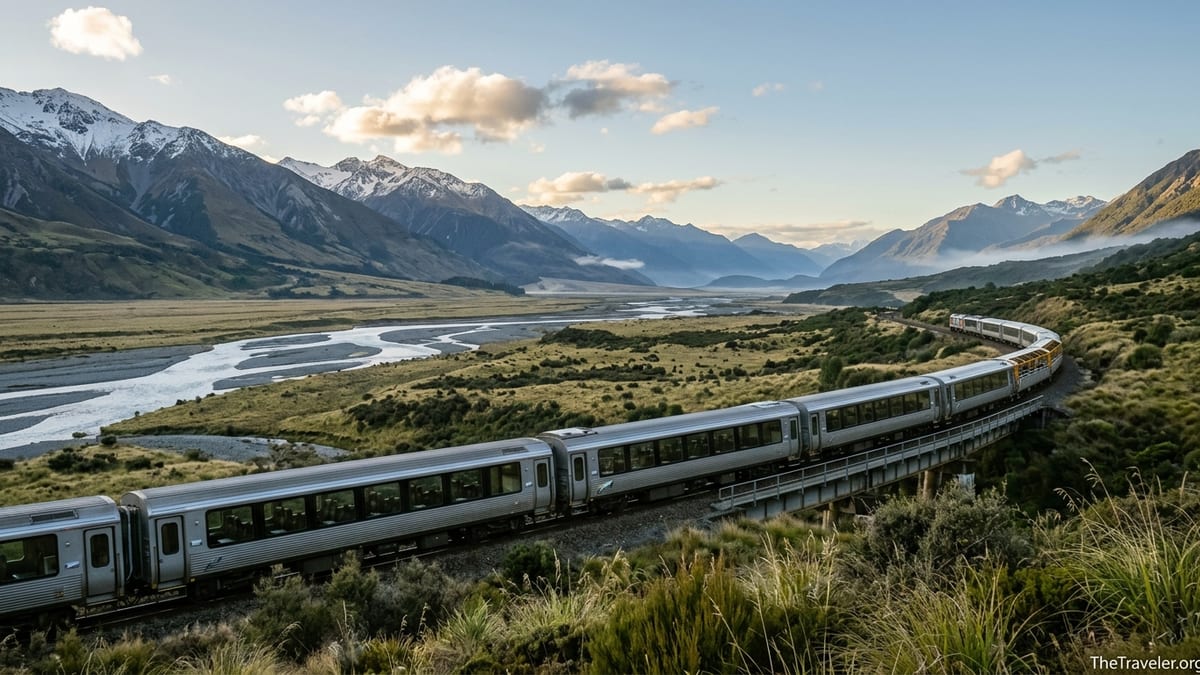
The TranzAlpine is all about big mountain drama. Leaving Christchurch, the train rolls across flat farmland before entering the foothills, where braided rivers such as the Waimakariri cut silver channels across wide gravel beds. From Springfield onwards, the line climbs into the Southern Alps through a series of tunnels and viaducts. The highlight is the section around Arthur’s Pass and the Otira Tunnel, with steep-sided valleys, beech forest and, on clear days, snow-dusted peaks even in spring and autumn.
Because the TranzAlpine crosses the island, you experience a tangible change in climate and vegetation. The drier, blond tussock of the eastern high country gives way to the lush, mossy greens of the West Coast. On arrival in Greymouth, many travelers comment that it feels like stepping into another region entirely, even though they have not left the island. On rainy days, the waterfalls that streak down the cliffs can be just as memorable as the blue-sky views.
The Coastal Pacific, by contrast, is about sea, sky and wine country. North of Christchurch the train passes through farmland and vineyards before reaching the Kaikōura coast. Here the tracks squeeze between cliffs and ocean, often with only a narrow strip of rocks between the train and the waves. On a typical day you might spot fur seals on the rocks, seabirds riding the wind and, with luck, even dusky dolphins or migrating whales out to sea. After Kaikōura, the line bends inland through rolling hills towards Blenheim’s Marlborough wine region, then on to Picton, gateway to the Marlborough Sounds and the North Island ferries.
Both trains use modern AK-class carriages with very large side and roofline windows, so any seat delivers good views. Each carries an open-air viewing carriage where photographers can avoid reflections and feel the wind, which is particularly appealing on the Coastal Pacific’s Kaikōura section and on the TranzAlpine between Springfield and Arthur’s Pass. For the most dramatic vistas on the TranzAlpine, many passengers gravitate to the open car as the train approaches the Waimakariri Gorge, while on the Coastal Pacific it becomes busy during the coastal stretch north and south of Kaikōura.
Duration, Frequency, Seating and Onboard Experience
Both services are designed as single-day journeys in each direction. The TranzAlpine typically operates daily year-round, taking around 4.5 to 5 hours one way. The Coastal Pacific usually runs several days a week and is strongly seasonal, often operating from around October to April, with a journey of just over 5 hours. Exact departure days and times change occasionally, so it is important to check the current Great Journeys New Zealand timetable when planning.
Standard “Scenic” class offers 2+2 reclining seats with generous legroom, tray tables and overhead luggage racks. Most travelers are content with this class, especially for one-way journeys. “Scenic Plus” is a premium option introduced on both trains, with slightly wider seats in a dedicated carriage, fewer passengers and an elevated food and wine experience served at your seat. On a typical TranzAlpine departure, Scenic Plus passengers might receive multiple small courses showcasing Canterbury and West Coast produce, while on the Coastal Pacific the focus is often on Marlborough wines and seafood-inspired tasting plates.
Every train carries a café carriage serving barista coffee, tea, New Zealand wines and beers, and simple meals such as pies, sandwiches and cheese plates. Prices are comparable to what you would pay in a café in Christchurch or Queenstown, rather than airline-style markups. Announcements are made throughout the journey to highlight key landmarks, and an audio commentary channel is usually available via seatback or personal devices.
The open-air viewing carriage is shared by all classes and usually has waist-height sides and no glass, making it the best place for photography. It can become crowded near the scenic highlights, especially in peak holiday periods, so a practical tip is to head there a little before you expect the views to peak. For example, on the Coastal Pacific, many experienced travelers move there shortly before Waipara so they are in position when the coastline appears, while on the TranzAlpine they time their visit around Cass and the approach to Arthur’s Pass.
Luggage, Practicalities and When the Train Beats Driving
Luggage on the TranzAlpine and Coastal Pacific is handled much like on a short-haul flight. Each passenger can bring small bags into the carriage to store overhead or at their feet, while larger suitcases are checked into a luggage van at no extra charge, subject to size and weight limits that broadly mirror airline economy allowances. Sporting equipment such as skis or bikes may be carried for a fee on certain departures, but space is limited and advance arrangements are often required, so it is wise to check the latest policy if you are planning a cycling or ski trip.
From a practical point of view, taking the train can be easier than driving if you are tired after a long-haul flight, not confident on narrow New Zealand roads, or visiting in winter when alpine passes can experience snow and ice. For instance, the TranzAlpine allows you to cross the Southern Alps without facing the sometimes-challenging road over Arthur’s Pass, while still enjoying the scenery. Likewise, the Coastal Pacific spares you a full day’s driving up State Highway 1, which can be tiring for visitors unused to driving on the left or sharing the road with heavy trucks.
The train particularly makes sense when you factor in the value of your time and the cost of car hire. In peak summer, renting a car in Christchurch and dropping it in Greymouth or Picton can incur one-way fees, and demand often pushes rental prices up. In contrast, a rail ticket locks in your travel cost and avoids the need to find parking in city centers. Seniors, families with children and solo travelers frequently report that the ability to relax, walk around and enjoy a glass of wine without worrying about driving is worth the premium over bus travel.
That said, the train is not always cheaper than self-driving, especially for groups that can share the cost of a rental car. The value proposition comes from comfort and the scenic experience rather than pure transport efficiency. Many visitors therefore combine a one-way train with a rental car for the rest of their itinerary, using the train for the most spectacular section and driving where flexibility matters most.
Building TranzAlpine into a Wider South Island Itinerary
Because the TranzAlpine is a relatively short journey, it fits easily into a broader itinerary that loops around the South Island. A common pattern is to begin in Christchurch, take the morning TranzAlpine to Greymouth, collect a rental car at the station and drive south along the West Coast that same afternoon to Hokitika or Franz Josef. From there travelers continue by road to Wanaka and Queenstown, then return to Christchurch via the inland route through Tekapo and Lake Pukaki.
Another approach is to use the TranzAlpine as an outward leg only, returning to Christchurch overland via Arthur’s Pass by bus or rental car, or by taking a domestic flight from Hokitika back to Christchurch at the end of a West Coast road trip. This allows you to experience both the rail and road perspectives on the Alps without simply retracing your steps. For example, one popular 5 to 7 day loop involves Christchurch, TranzAlpine to Greymouth, driving to Franz Josef, continuing via Haast Pass to Queenstown, then flying back to Christchurch or onward to another city.
Rail-and-hotel packages can simplify logistics. Various New Zealand specialists and Great Journeys New Zealand itself sell bundles that pair a TranzAlpine ticket with accommodation in Greymouth or the glacier towns, sometimes including a rental car or coach transfers. Typical inclusions might be one night in a mid-range Greymouth hotel, breakfast, and a sightseeing add-on such as a glowworm cave tour or a visit to the Treetop Walkway near Hokitika. These packages are most useful for first-time visitors who prefer fixed arrangements and a single point of payment.
In most cases, it makes more sense to travel the TranzAlpine one way and continue your journey, rather than riding out to Greymouth and back the same day. A same-day return can be done and is occasionally marketed as a “there and back” scenic excursion, but you will be repeating the same views in reverse and spending close to 10 hours on the train. Unless you are a rail enthusiast or very short on time, a one-way ride integrated into a loop gives you more variety for the same or slightly higher cost.
Using the Coastal Pacific for Coastal Scenery and North–South Connections
The Coastal Pacific is at its best when used as part of a north–south journey between the North and South Islands or as a comfortable coastal link between Christchurch and Kaikōura. Many travelers sail on the morning Interislander or Bluebridge ferry from Wellington to Picton, walk directly to Picton station with their luggage, and continue to Christchurch on the afternoon Coastal Pacific. In the opposite direction, a morning departure from Christchurch delivers you to Picton in time for a late-afternoon ferry to Wellington, creating a full but manageable day of sea and rail travel.
Kaikōura is the other key stop on the line. Rather than riding the train all the way to Picton or Christchurch in one go, some visitors break the journey for one or two nights to take a whale-watching cruise, dolphin swim or coastal walk. For example, you might travel Christchurch to Kaikōura by train, stay two nights to allow for weather contingencies on marine tours, then continue to Picton by train and sail to Wellington. Rail-and-hotel packages often combine Coastal Pacific tickets with accommodation and pre-booked whale or dolphin excursions, streamlining what can be a busy stretch of planning.
The northern part of the route passes through the Marlborough wine region. While the train does not stop at every small town, it runs close to Blenheim, and some packages include transfers for vineyard tours or wine tasting. In practice, however, travelers who are serious about Marlborough wineries often prefer to base themselves in Blenheim or Renwick with a rental car or bicycle and treat the train primarily as a scenic transfer into or out of the region.
As with the TranzAlpine, a same-day return on the Coastal Pacific is possible, but for most visitors a one-way trip tied to a ferry crossing or a Kaikōura stopover is more rewarding. Riding Christchurch to Picton and back on consecutive days is rarely the best use of time unless your primary interest is the train itself. Instead, the Coastal Pacific shines as a relaxed, camera-friendly way to cover a long coastal driving day while linking key North and South Island destinations.
TranzAlpine vs Coastal Pacific: Which Route and Direction to Choose
Choosing between the TranzAlpine and Coastal Pacific often comes down to your itinerary, your scenery preferences and the time of year. If your South Island plan already includes Franz Josef, Fox Glacier or the West Coast, the TranzAlpine is a natural fit and offers some of the most concentrated alpine scenery in New Zealand. If your route involves crossing to or from Wellington by ferry, or you have a strong interest in Kaikōura’s marine life, the Coastal Pacific may be the better choice.
Some travelers manage to ride both trains on a single trip by linking them through Christchurch. For instance, you might arrive in Christchurch, ride the TranzAlpine to Greymouth and continue by bus or car to Queenstown, then fly to Wellington and finish with a Picton to Christchurch Coastal Pacific trip before departing. Another option is to arrive by ferry in Picton, take the Coastal Pacific south to Christchurch, then continue another day on the TranzAlpine to Greymouth and fly out from the West Coast or return via road.
Direction can slightly influence the experience. On the TranzAlpine, the westbound journey from Christchurch to Greymouth is the classic direction, with the build-up from plains to high country and then lush forest. Eastbound is equally scenic but front-loads the mountain views. On the Coastal Pacific, many photographers like traveling northbound from Christchurch to Picton so that the sun is more often behind the train during the key coastal sections, though actual conditions vary by season and weather. In practice, seat assignment and time of day matter less than allowing yourself enough time in Kaikōura or Picton at each end.
If you have to choose only one line, and your goal is the most spectacular “scenery per hour,” many experienced travelers lean toward the TranzAlpine because of its concentrated alpine landscapes. If your primary need is a comfortable way to move between the islands or you prefer sea and wildlife, the Coastal Pacific is more practical. In all cases, building one-way journeys that lead naturally into road trips or ferry connections tends to deliver more satisfying itineraries than simple out-and-back rides.
Rail Packages, Booking Tips and Seasonal Considerations
Great Journeys New Zealand and various tour operators sell rail-and-hotel packages that bundle train tickets with accommodation and, in some cases, transfers and excursions. Examples include overnight stays in Greymouth or Kaikōura linked to TranzAlpine or Coastal Pacific tickets, as well as longer multi-day itineraries that combine both trains with the Interislander ferry and coach travel. These packages can be good value when booked well in advance, particularly in high season when hotel prices spike.
For independent travelers, booking directly with the train operator allows you to choose between Scenic and Scenic Plus and to see live availability. Prices are dynamic and often higher in late December and January, during school holidays and major events. Shoulder seasons such as October–November and March–April can offer a good balance of availability, slightly lower fares and generally pleasant weather, though alpine conditions can be unpredictable at any time of year.
When booking, think about how the train fits into your transport chain. If you are connecting with the Wellington–Picton ferry, allow a generous buffer in case of delays, as rough weather or operational issues can affect both ferries and trains. If you are collecting a rental car at Greymouth, Kaikōura or Picton, check depot opening hours so you are not rushed or left waiting if the train arrives a little late. In peak periods it is sensible to reserve cars and key excursions at the same time as your train ticket rather than leaving them to chance on arrival.
Clothing and comfort also merit a little planning. Air-conditioning on board keeps the interior at a comfortable temperature, but conditions outside can vary rapidly, especially on the TranzAlpine where you might step from a warm carriage into chilly mountain air in the viewing car. Layered clothing, sunglasses, sunscreen and a light rain jacket are useful on both routes. For photographers, a lens cloth is handy to clear spray or fingerprints from windows, although the open-air coach remains the best place for reflection-free shots.
The Takeaway
Viewed simply as transport, the TranzAlpine and Coastal Pacific are comfortable long-distance trains that save you a full day of driving. Viewed as experiences, they are among the most memorable ways to see the South Island, placing you eye-level with braided rivers, mountain passes, vineyards and a wild Pacific shoreline without the stress of the road.
The smartest itineraries use each train once, in the direction that best matches your broader route, then continue by road, ferry or plane. A one-way TranzAlpine can launch a West Coast loop, while a one-way Coastal Pacific can bookend a ferry crossing or a Kaikōura stopover. In both cases you avoid repetitive out-and-back journeys and turn the train into a highlight rather than simply a scenic detour.
Allow yourself enough time to use the open-air viewing carriage, sample local food and drink on board and connect the journey with real stops on the ground, whether that means a glacier hike, a whale-watching cruise or a lazy day in Marlborough wine country. If you plan around those anchors rather than just filling gaps in your calendar, South Island rail travel becomes a framework for the entire trip.
FAQ
Q1. How long do the TranzAlpine and Coastal Pacific journeys take?
The TranzAlpine usually takes about 4.5 to 5 hours between Christchurch and Greymouth, while the Coastal Pacific takes just over 5 hours between Christchurch and Picton, depending on the timetable.
Q2. Is it better to ride the TranzAlpine or Coastal Pacific if I only have time for one?
If you want dramatic alpine scenery or are heading towards the West Coast glaciers, the TranzAlpine is often the better choice. If you need to connect to or from Wellington by ferry or are focused on coastal views and Kaikōura wildlife, the Coastal Pacific may fit your plans more naturally.
Q3. Should I book a same-day return or travel one way and continue by road?
Most travelers get more value from a one-way train journey combined with a road trip, ferry or flight than from a same-day return. Riding out and back repeats the same scenery and can make for a very long day on board, whereas continuing by road lets you explore towns and landscapes in more depth.
Q4. Do I need to reserve seats in advance?
Yes. Both trains are reserved-seat services and can sell out, especially in summer and around public holidays. Booking in advance secures your preferred date and class and helps with planning connections for rental cars, ferries or flights.
Q5. What are the luggage limits on these trains?
Passengers can bring small bags into the carriage and typically check larger suitcases into a luggage van, with weight and size limits roughly similar to airline economy allowances. If you are traveling with oversized items such as bikes or skis, check the latest rules before you book.
Q6. Is Scenic Plus worth the extra cost?
Scenic Plus offers a quieter carriage, more spacious seating and a multi-course food and wine experience. It can be worthwhile if you value comfort and dining as part of the journey, particularly on special occasions, but many travelers are perfectly happy in standard Scenic class and choose to spend more time in the open-air viewing coach.
Q7. Which side of the train has the best views?
Views are excellent on both sides and the open-air viewing carriage is available to everyone, so side matters less than you might expect. On specific sections one side can be closer to the coast or a river, but you can always move to the viewing carriage during the most scenic stretches.
Q8. Can I get off at Kaikōura or Greymouth and continue another day?
Yes. Many travelers break their journeys, for example staying in Kaikōura for whale watching or in Greymouth before continuing to the glacier towns. You simply book separate tickets for each train leg and arrange local accommodation and onward transport.
Q9. Are these trains suitable for families with children?
Families regularly use both trains. The ability to walk around, visit the café, and stand in the open-air carriage often suits children better than a long car journey, though you should bring snacks, small games or devices to keep younger kids occupied between scenery highlights.
Q10. How do rail-and-hotel packages work and who are they best for?
Rail-and-hotel packages bundle train tickets with accommodation and sometimes excursions, simplifying logistics and payments. They work well for first-time visitors, those short on planning time or anyone who prefers a set structure, while independent travelers may prefer to book trains, hotels and rental cars separately for maximum flexibility.