


New Zealand’s South Island rewards slow, thoughtful travel. Distances look short on the map, but mountain passes, narrow highways and photo stops turn “quick hops” into substantial days. This guide focuses on what actually fits into one trip, using Christchurch and Queenstown as anchors, so you can design a South Island loop that feels relaxed rather than rushed.
How South Island distances really work
The South Island is bigger than many visitors expect, and its roads are slower. For example, the direct drive between Christchurch and Queenstown via the Mackenzie Country and Lindis Pass is around 480 kilometres and typically takes 5.5 to 6.5 hours of driving without extended stops. Add in time at Lake Tekapo’s lakefront, a late lunch in Twizel, fuel and supermarket stops, and that “six-hour” day often stretches to eight hours door to door.
Mountain and coastal routes add further complexity. The drive from Christchurch across Arthur’s Pass to Hokitika on the West Coast, then down to Franz Josef, commonly runs to seven hours of pure driving for a visitor who is new to New Zealand conditions, even though local estimates are lower. Likewise, Queenstown to Franz Josef via the Haast Pass is a magnificent but long day; once you factor in road works, one-lane bridges and scenic stops at places like the Blue Pools and Thunder Creek Falls, it is rarely less than six to seven hours of actual driving.
Milford Sound is another route that often surprises people. Te Anau to Milford Sound is about 120 kilometres, and official guidance suggests allowing around two hours of driving each way in good conditions. In reality, most independent travellers should plan three hours each way to allow for traffic, photo stops at places like Mirror Lakes and the Eglinton Valley, and potential delays at the Homer Tunnel. Trying to do this as a same-day return from Queenstown adds another four hours of highway driving and creates a very long, often uncomfortable day.
When you add these realistic drive times together, it becomes clear that a single two-week trip cannot comfortably include Christchurch, Abel Tasman, the full West Coast glaciers, Aoraki / Mount Cook, Wānaka, Queenstown, Milford Sound and the deep south without multiple one-night stops and long days behind the wheel. The art of planning a South Island itinerary lies in choosing one or two “anchor” regions and drawing a sensible loop around them.
Choosing your anchor: Christchurch or Queenstown
Most international visitors to the South Island arrive through Christchurch or Queenstown. Christchurch is the larger airport with more domestic connections and often lower airfares from Auckland or Wellington. It makes sense as a starting point if you want to include the east coast, the Kaikōura coast, Marlborough wine country or Abel Tasman at the top of the island. A common pattern is to land in Christchurch, spend a recovery night in the central city or near Hagley Park, then drive inland toward Tekapo once you are rested and familiar with New Zealand road rules.
Queenstown, by contrast, works best as an anchor for an alpine and fiord-focused trip. Fly in, spend several nights in or around Queenstown, and build side trips to Wānaka, Glenorchy and possibly Milford Sound or Doubtful Sound from there. Many rental car and campervan companies allow free or low-cost one-way hires between Christchurch and Queenstown, so you can drive in one direction only and avoid backtracking. For instance, a common real-world approach is to fly into Christchurch, road-trip via Lake Tekapo and Aoraki / Mount Cook to Queenstown over three or four days, then fly out of Queenstown without returning north.
Your anchor choice also dictates your likely loop. From Christchurch, logical circuits include a northern loop via Kaikōura, Blenheim and Nelson, or a central loop via Tekapo, Aoraki / Mount Cook, Wānaka and Queenstown. From Queenstown, realistic loops focus on Central Otago, Fiordland and possibly the West Coast as far as the glaciers. Trying to force both anchors into a short itinerary, such as flying into Christchurch, looping through Nelson and Abel Tasman, dropping down to the West Coast, and exiting via Queenstown within 10 days, usually results in too many one-night stays and long driving days.
Before committing to a route, check when you are travelling. In winter, flights to and from Queenstown can be affected by fog or snow, and roads like the Crown Range or Lindis Pass may require chains. In the peak Christmas period, Christchurch rental depots can be busy, and one-way fees for dropping a car in Queenstown may be higher. These practicalities sometimes make it more sensible to design a loop that returns to your arrival city rather than insisting on a one-way route.
When to include (or skip) the West Coast
The West Coast is one of the South Island’s most distinctive regions, with temperate rainforest, wild beaches and famous glacier towns like Franz Josef and Fox Glacier. However, including the coast adds substantial driving. A classic Christchurch to Queenstown route via the West Coast goes Christchurch – Arthur’s Pass – Hokitika – Franz Josef – Haast Pass – Wānaka – Queenstown. Even with a direct focus on transit rather than long hikes, this pattern needs at least five nights to feel comfortable for most visitors.
The Arthur’s Pass section alone is a full travel day. Arthur’s Pass village sits roughly 154 kilometres west of Christchurch and about 105 kilometres east of Greymouth. In practice, a visitor might leave Christchurch at 9 am, stop for coffee in Springfield, walk the short Devils Punchbowl track at Arthur’s Pass, photograph Otira Viaduct and arrive in Hokitika around 4 pm. That leaves only a little time for the Hokitika Gorge or the beach at sunset before an early night ahead of the drive south to Franz Josef the next morning.
If you are travelling in late autumn or winter, the West Coast also introduces more weather risk. Heavy rain is common and can lead to surface flooding or slips that briefly close State Highway 6. In peak summer, accommodation in Franz Josef and Fox Glacier can sell out weeks ahead, particularly for motels and mid-range hotels within walking distance of the village centres. For example, a couple arriving in early January without a booking may find that the only remaining rooms are high-end lodges significantly above their budget, or basic backpacker dorms.
For a first trip of around 10 to 12 days, the West Coast deserves a spot only if you are willing to give it at least two nights between Hokitika and the glacier region and accept some longer driving days. If you have just a week and your priority is Aoraki / Mount Cook, Queenstown and Milford Sound, you are often better skipping the coast this time and returning on a future visit. That choice reduces backtracking and keeps your loop focused around the central spine of the Southern Alps.
Fitting in Aoraki / Mount Cook and the Mackenzie Country
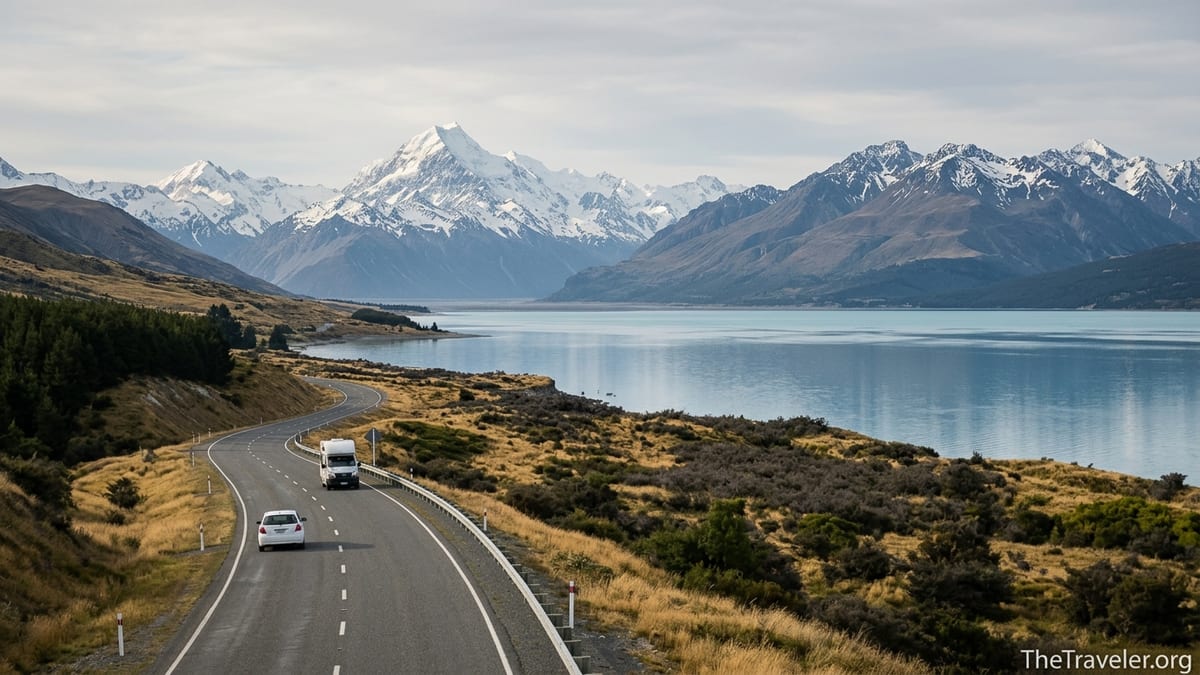
Aoraki / Mount Cook and the Mackenzie lakes of Tekapo and Pukaki sit almost on a natural line between Christchurch and Queenstown, making them relatively easy to include in many itineraries. The key decision is how many nights to allocate. Many travellers try to pass through in a single day, stopping briefly at Tekapo’s Church of the Good Shepherd for photos and continuing directly to Queenstown. That is feasible, but it means you will miss Mount Cook Village entirely and likely arrive in Queenstown in the evening after a long day of driving.
Allowing one night in Tekapo and one in Mount Cook Village changes the feel of the trip. For instance, a realistic three-day pattern is Christchurch to Tekapo on day one, Tekapo to Mount Cook Village on day two with time for the Hooker Valley Track or Tasman Glacier viewpoints, then Mount Cook to Queenstown or Wānaka on day three. In summer, this gives you the opportunity to enjoy Tekapo’s lakefront in the evening, perhaps visiting the hot pools, and to stargaze under the Aoraki Mackenzie International Dark Sky Reserve, which is a major highlight in its own right.
Weather flexibility is important in the Mackenzie area. Cloud can obscure mountain views entirely for a day at a time, particularly in spring and early summer. Visitors who schedule just a lunchtime stop often leave without ever seeing Aoraki’s summit. With at least one overnight in or near Mount Cook Village, you have two or more windows to walk or take a scenic flight if conditions allow. Many guided activities, such as glacier heli-hikes, will rebook you for the following morning if poor weather forces a cancellation, but this only works if your itinerary has that spare morning.
If your total South Island trip is seven days or less, it can make sense to prioritise the Mackenzie Country over more distant regions like Abel Tasman. Flying into Christchurch, driving to Tekapo for two nights, continuing to Queenstown for three nights including a day trip to Milford Sound or a cruise on Lake Wakatipu, then flying out of Queenstown is a compact but satisfying loop with limited backtracking and manageable driving days.
Milford Sound and Fiordland: day trip or overnight?
Milford Sound sits within Fiordland National Park, one of the wettest and wildest corners of New Zealand. While the cruise itself is typically less than two hours, the logistics of reaching the fiord are demanding. From Queenstown, the road distance is roughly 290 kilometres each way. Even with favourable traffic it usually takes close to four hours to reach Milford Sound, and the same again to return. This makes a same-day self-drive day trip from Queenstown eight hours of driving, plus cruise check-in and sightseeing stops.
For many travellers, a more realistic pattern is to base in Te Anau, the small lakeside town that serves as the gateway to Fiordland. The Te Anau to Milford Sound drive is around two hours in ideal conditions, but visitor information and local operators advise allowing at least two and a half to three hours each way in your planning. That buffer gives you time to stop at the Eglinton Valley, the Chasm or Lake Gunn, and to manage any chain fitting or road-control delays in winter. A common real-world example is to overnight in Te Anau before and after your Milford day, leaving at 8 am for an 11 am cruise, and returning in daylight even during shorter winter days.
Coach and cruise packages from both Queenstown and Te Anau remove the stress of driving a narrow, winding alpine road that frequently experiences heavy rain, ice and, in winter, avalanche-control closures. These tours are more expensive than a simple fuel and cruise ticket, but they can be worthwhile if you are unused to mountain driving on the left. Many visitors book a mid-range operator that offers smaller boats and complimentary tea or coffee. Boarding in Te Anau often costs a little less than Queenstown-based packages and keeps your day shorter and more relaxed.
If your South Island itinerary is fewer than 10 days, you may need to decide between spending two nights in Te Anau for Milford Sound and allocating those nights to other highlights such as Abel Tasman or extra time in Queenstown and Wānaka. There is no objectively correct choice. The key is to avoid overloading your schedule with both long alpine drives and back-to-back activity days. When considering a deep south loop that includes both Milford Sound and the Catlins, remember that each additional region brings not just distance but also the risk of losing a full day to heavy rain, especially in Fiordland’s wet climate.
Abel Tasman and the top of the South: when it belongs in your loop
The Nelson and Tasman regions at the northern tip of the South Island offer a very different atmosphere to the alpine interior. Think sheltered bays, vineyard lunches and coastal walking in Abel Tasman National Park. However, travelling from Christchurch or Queenstown to this area takes longer than many people expect. Christchurch to Nelson via the Kaikōura coast is roughly a full day of driving with scenic stops, and Nelson to Queenstown via the West Coast or inland passes usually occupies most of another day.
As a result, Abel Tasman fits best into longer itineraries of around two weeks or more, or into trips that focus purely on the northern half of the South Island. For example, a realistic Christchurch-based loop could run Christchurch – Kaikōura – Blenheim or Renwick for Marlborough wine country – Nelson or Motueka – Abel Tasman – Hanmer Springs – back to Christchurch. This circuit offers marine wildlife encounters in Kaikōura, cellar doors in Marlborough and water taxis to golden-sand beaches in Abel Tasman, all with manageable daily drives of three to five hours.
Including Abel Tasman on the same trip as both the West Coast glaciers and Milford Sound is technically possible, but it forces multiple long days behind the wheel. Consider a traveller who lands in Christchurch, heads to Kaikōura, then on to Nelson and Abel Tasman for coastal hiking. From there they drive to the West Coast via Murchison and Westport, continue down to Franz Josef, then over the Haast Pass to Queenstown and on to Te Anau for Milford Sound. That route may look efficient, but in practice it creates several seven-hour driving days and leaves little flexibility if heavy rain closes the coast road for a few hours.
If you have 10 to 12 days and a strong preference for beaches and wine over glaciers and fiords, a northern-focused loop that omits Queenstown entirely can be a good choice. This might surprise friends who assume Queenstown is non-negotiable, but it can deliver a calmer trip: two nights in Kaikōura, two in Marlborough, three around Nelson and Abel Tasman, plus recovery time in Christchurch. You can always plan a dedicated alpine and Fiordland trip beginning in Queenstown in the future.
Designing logical loops and avoiding backtracking
The most efficient South Island itineraries form rough circles or horseshoe shapes. A common horseshoe is Christchurch – Tekapo – Aoraki / Mount Cook – Wānaka – Queenstown, with a flight out of Queenstown. This pattern has only one substantial backtrack: the short return from Mount Cook Village to the main highway near Lake Pukaki. Drive times are moderate, typically three to four hours on each travel day, and you gain multiple nights in places with good activity options and services.
By contrast, routes that zig-zag in and out of the mountains tend to create hidden duplication. For instance, flying into Christchurch, driving to Tekapo, back to Christchurch, then down to Dunedin, across to Queenstown, and up to Mount Cook repeats substantial stretches of road on the Canterbury Plains and wastes time in transit. Similarly, starting in Queenstown, driving to Franz Josef on the West Coast, returning to Queenstown, then heading to Te Anau and Milford Sound copies a long section of highway around Lake Wakatipu and the Upper Clutha that you only need to drive once on a better-planned loop.
One practical way to spot backtracking is to sketch your route on a paper map or use an offline mapping app and trace each driving leg with a highlighter. If you see bold double lines, consider whether a one-way rental could allow you to begin in Christchurch and end in Queenstown, or vice versa, instead of returning to your starting point. In many cases, paying a modest one-way fee works out cheaper than the extra fuel, added nights and fatigue of unnecessary back-and-forth driving.
Another tactic is to cluster overnight stays around regional hubs. For example, spending three nights in Queenstown rather than one night each in Queenstown, Wānaka and Te Anau can reduce the number of check-ins and repacking sessions while still allowing day trips to Glenorchy, Arrowtown or even a coach and cruise excursion to Milford Sound. For visitors with limited time, building in longer stays in well-connected towns often creates a more satisfying experience than chasing a perfectly “efficient” line on the map.
Weather buffers, seasons and overnight placement
South Island weather varies sharply by region. The West Coast and Fiordland receive high annual rainfall, while Central Otago and the Mackenzie Basin are comparatively dry and can feel almost semi-arid in summer. Winter brings snow to alpine passes and occasional frosts and icy roads in inland basins. These patterns matter when you place your overnight stops. Allowing at least one spare day in weather-sensitive areas gives you room to reshuffle plans if a storm front moves through.
For instance, in July, you might find the Milford Road closed for avalanche control on the morning of your planned cruise. If you have two nights in Te Anau, you can slide your cruise to the next day without losing the experience entirely. Similarly, in November, heavy rain on the West Coast can make short walks like the Franz Josef Glacier lookout track unpleasant or unsafe due to rising streams. With a two-night stay in Franz Josef, you can spend the wettest hours at the hot pools or in a café and still walk the valley the following morning when conditions improve.
Season also influences how far you can comfortably drive in a day. In December and January, long daylight hours mean you can safely arrive in a new town at 7 or 8 pm and still check into your accommodation in daylight. In June or July, sunset around 5 pm in many parts of the South Island makes late arrivals more stressful, especially on unfamiliar rural roads with limited street lighting. When planning a winter itinerary, aim for shorter legs, such as Christchurch to Tekapo instead of pushing straight through to Queenstown in one day.
Finally, place your overnights in towns with the services you are likely to need. On a family trip in a rental car, that might mean choosing Tekapo over smaller nearby settlements so you have ready access to a supermarket, playground and medical centre. On a campervan holiday, spending the night in Wānaka rather than at a remote roadside freedom-camping spot may give you easier access to dump stations and powered sites, especially in high season when DOC campsites close to major attractions can fill by mid-afternoon.
The Takeaway
Planning a South Island itinerary is less about ticking off every famous name and more about building a route that matches your time, season and driving comfort. Use Christchurch or Queenstown as your anchor, draw a logical loop that favours three- and four-hour drive days, and resist the urge to dart across the island repeatedly. Aoraki / Mount Cook and the Mackenzie Country sit naturally between the two main gateways, while the West Coast, Abel Tasman and Fiordland each deserve enough nights to justify the extra distance.
When in doubt, choose fewer regions and spend more time in each. That might mean accepting that you will not see Abel Tasman on the same trip as Milford Sound, or that you will treat the West Coast glaciers as the centrepiece of a future visit. Building in weather buffers, prioritising safe daytime driving and basing yourself for multiple nights in hubs like Queenstown, Te Anau or Nelson will create a calmer, more memorable journey than any attempt to sprint from highlight to highlight. The South Island rewards those who slow down and stay flexible.
FAQ
Q1. Is it realistic to drive from Christchurch to Queenstown in one day?
Yes, it is physically possible in a day via Tekapo and Lindis Pass, but you should plan for 6 to 7 hours of driving plus stops. Many travellers prefer to break the trip with an overnight in Tekapo or Mount Cook Village so they arrive in Queenstown rested and in daylight.
Q2. How many days do I need for a Christchurch to Queenstown road trip including Mount Cook?
A comfortable minimum is three to four days: one night in Tekapo, one in Mount Cook Village, and one or two in Queenstown at the end. This allows time for short hikes, weather delays and relaxed driving rather than rushing past key sights.
Q3. Should I visit both Abel Tasman and Milford Sound on my first South Island trip?
Only if you have at least two weeks and enjoy longer driving days. For trips of 10 days or less, most visitors are better choosing either a northern loop that includes Abel Tasman or a southern loop that focuses on Queenstown, Wānaka and Fiordland.
Q4. Is it safe to drive to Milford Sound in winter?
It can be, but winter conditions often include ice, snow and reduced visibility. If you lack alpine driving experience, consider staying in Te Anau and taking a coach and cruise package rather than driving yourself, especially between May and September.
Q5. How long should I stay in Aoraki / Mount Cook Village?
One night is the bare minimum to walk a short track and see the mountains in changing light. Two nights are ideal, giving you a buffer if cloud or rain hides the peaks on one of your days and time for a longer hike or scenic flight if conditions are good.
Q6. Is the West Coast worth the extra driving time?
Yes, if you have enough days. With at least two nights between Hokitika and the glacier region, the West Coast delivers rainforest, wild beaches and close-up glacier views. On shorter trips, adding it often creates rushed, tiring itineraries with too much time on the road.
Q7. Can I base in Queenstown and still visit Wānaka and Glenorchy?
Yes. Many travellers stay three or four nights in Queenstown and make day trips to Wānaka, Glenorchy or Arrowtown. This approach reduces packing and unpacking and still lets you experience nearby lakes and walking tracks without changing accommodation every night.
Q8. What is a good length for a South Island road trip?
Around 10 to 14 days is a sweet spot for many visitors. Ten days allows a focused loop between Christchurch and Queenstown with a few major highlights, while two weeks opens up options such as Abel Tasman or the West Coast without constant long driving days.
Q9. Do I need to book accommodation in advance?
In peak season from late December to February and during school holidays, it is wise to book key stops like Tekapo, Mount Cook Village, Queenstown, Franz Josef and Te Anau several weeks ahead. In shoulder seasons you may find more flexibility but should still reserve popular weekends.
Q10. Is it better to rent a car or a campervan for the South Island?
Both work, but cars are easier to drive and park and often cheaper once you factor in fuel. Campervans offer flexibility and the appeal of camping near scenic areas but require more planning for powered sites, dump stations and slower travel speeds on winding roads.