


The inland drive from Christchurch to Queenstown via Lake Tekapo and Aoraki/Mount Cook is one of the South Island’s signature road trips. Tourism New Zealand now promotes this exact route as a dedicated itinerary for exploring the Mackenzie Basin’s turquoise lakes, alpine peaks and dark skies. This guide breaks the journey into manageable sections, compares a fast one-day dash with a slower multi-day adventure, and highlights real-world distances, driving times, stargazing options and practical considerations for both car and campervan travelers.
Christchurch to Queenstown: Distance, Driving Time and Route Overview
On paper, the direct inland route from Christchurch to Queenstown via Lake Tekapo and the Mackenzie Basin is around 480 to 500 kilometers, depending on your exact start and end points and whether you detour to Aoraki/Mount Cook. The core drive uses State Highway 1 south out of Christchurch, then State Highway 79 and State Highway 8 through Geraldine, Fairlie, Lake Tekapo, Lake Pukaki and Twizel, before continuing over the Lindis Pass to Cromwell and finally Queenstown. Without stopping, most navigation apps estimate the journey at roughly 6 to 7 hours in a car. In reality, very few travelers should treat it as a non-stop drive.
Between fuel breaks, food stops, photo opportunities and slow sections over the Lindis Pass, many visitors report that a “simple” Christchurch to Queenstown day on this route can easily stretch to 8 or 9 hours door to door. Winter conditions can add more time, especially if there is ice or snow in the Mackenzie Basin or on the higher parts of SH8. If you are arriving on a long-haul flight into Christchurch and are not yet comfortable driving on the left, it is rarely wise to attempt the full distance to Queenstown on the same day.
The most common way to break the journey is to stop overnight at Lake Tekapo or in the nearby Mackenzie Basin town of Twizel. Both are small by international standards but have motels, lodges and holiday parks that cater specifically to road-trippers. For those able to spare more time, detouring off SH8 along State Highway 80 to Aoraki/Mount Cook Village adds about a 110 kilometer round trip from the SH8 junction at Lake Pukaki and is widely considered one of the most rewarding side trips in New Zealand.
Because the roads are fully sealed and suitable for standard rental cars and campervans, this route is accessible to first-time visitors as long as you treat the distance with respect. Think of the 6 to 7 hour estimate as a base figure. Add at least 1 to 2 extra hours for normal sightseeing and short walks, and more again if you plan to linger at viewpoints, take photographs at Lake Tekapo church, or fit in a short hike near Mount Cook.
Christchurch to Lake Tekapo and the Mackenzie Basin
The first significant leg is Christchurch to Lake Tekapo, around 230 to 260 kilometers depending on whether you follow SH1 then SH79 via Geraldine or take the Inland Scenic Route that meanders through smaller Canterbury towns. Most rental companies and local tourism brochures quote an indicative driving time of about 3 to 3.5 hours in good weather. That figure assumes steady driving with only short breaks, so a more realistic window for visitors is 4 to 5 hours including coffee stops and photo pauses.
Many travelers stop at Geraldine for a stretch and supplies. It is a small farming town with supermarkets, bakeries and cafes where you can stock up on groceries if you plan to self-cater in Tekapo or Mount Cook. Fairlie, about 30 minutes further, is another common break point; its local bakery is well known among domestic road-trippers and can be heaving on summer weekends. Prices for a basic bakery lunch in these towns are broadly in line with New Zealand averages, although cafe meals in tourist seasons can edge higher.
After Fairlie, the road climbs into the Mackenzie Basin and the scenery changes quickly from dairy pasture to tussock-covered hills and big skies. The last 45 minutes into Lake Tekapo often takes longer than you might expect because drivers pull over frequently to capture the first turquoise glimpses of the lake. It is worth reserving some time simply to stop at the main lakefront in Tekapo and at least one of the pullouts as you descend toward town.
Even if you are pushing through to Queenstown the next day, overnighting in Tekapo breaks up the drive and allows you to arrive early enough for stargazing. Typical mid-range motels and lodges in Tekapo are priced comparably with similar tourist towns in New Zealand, while holiday parks on the lakefront cater to campervans with powered sites and communal facilities. Because Tekapo is compact, you can walk from most accommodations to the main lakefront eateries and the famous stone church within 10 to 20 minutes.
Detouring to Aoraki/Mount Cook: Worth the Extra Time?
From Lake Tekapo it is about 90 minutes of driving to reach the turnoff for Aoraki/Mount Cook at the southern end of Lake Pukaki, then roughly another 50 minutes along State Highway 80 to Mount Cook Village. This makes the full return detour from Tekapo approximately 4 to 5 hours of driving, before you even continue onward to Queenstown. On a map that can look like a significant backtrack, but in practice this is one of the most celebrated sections of the whole South Island and many locals consider it unmissable if your schedule allows.
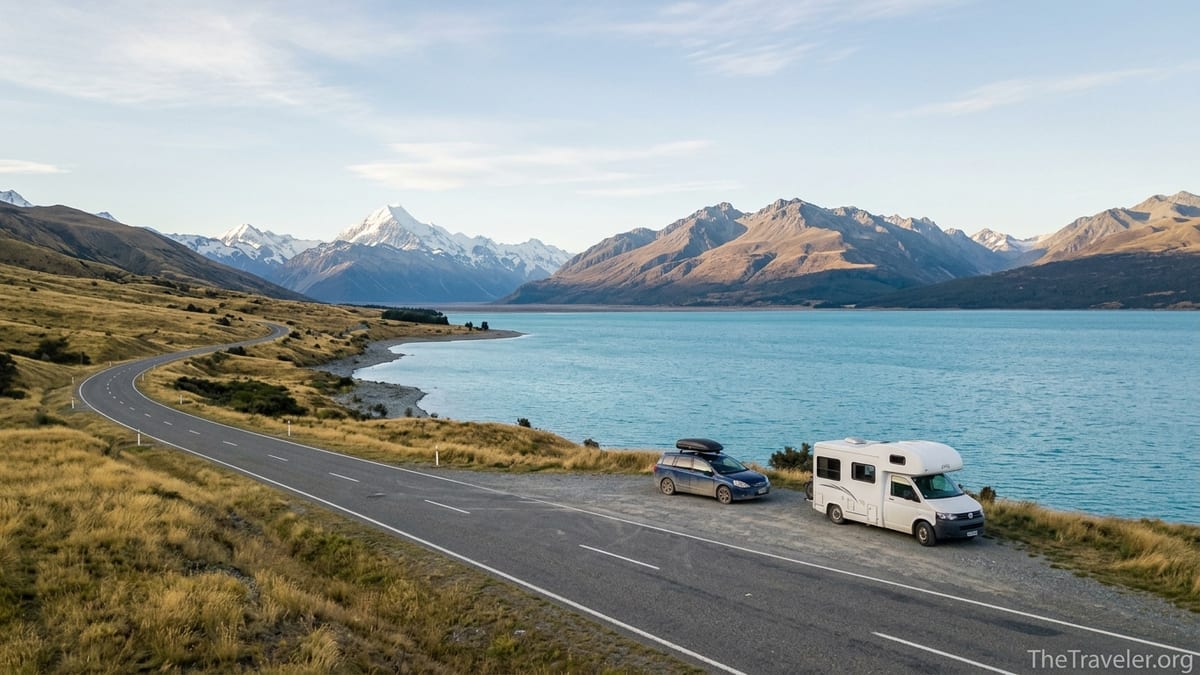
The road along Lake Pukaki is one of New Zealand’s classic scenic drives, with repeated views of Aoraki/Mount Cook at the far end of the milky-blue water on clear days. First-time visitors often find themselves pulling over at several different laybys just to photograph the changing vantage points. On busy summer days you will share the road with tour coaches and motorhomes, yet the sheer size of the landscape usually prevents it from feeling crowded.
Whether Mount Cook deserves a full overnight stay or simply a daytime detour depends on your fitness, interests and overall itinerary. If you enjoy walking, staying at least one night in Mount Cook Village is strongly recommended so you can hike the Hooker Valley Track or other short trails without having to rush back to the car. The Hooker Valley Track, for example, is a well-formed path that most visitors complete in around 3 hours return, not including time for photographs at the swing bridges and glacier lake viewpoint. Doing that on the same day as a full Christchurch to Queenstown drive would be exhausting at best and unsafe at worst.
If your time is limited, it is still possible to drive from Tekapo to Mount Cook Village, enjoy a shorter walk such as the Kea Point Track or Tasman Glacier view, and then continue back out to SH8 and on toward Queenstown the same day. In that case, you should expect the Tekapo–Mount Cook–Queenstown combination to take most of the daylight hours, especially if you factor in breaks in Twizel, on the Lindis Pass, and near Cromwell. For families driving with children or for anyone piloting a larger campervan, it usually feels more relaxing to assign Mount Cook its own night rather than squeezing it into a long transit day.
Stargazing Around Lake Tekapo and the Dark Sky Reserve
Lake Tekapo and the wider Mackenzie Basin sit within the Aoraki Mackenzie International Dark Sky Reserve, which is recognized as one of the best stargazing regions in the Southern Hemisphere. The area’s combination of clear nights, low light pollution and dry air attracted the University of Canterbury to build the observatory on Mount John, overlooking Tekapo. Today, visitors can join nighttime tours operated in partnership with the observatory that combine laser-guided sky talks and telescope viewing when conditions allow.
As of 2026, organized stargazing experiences in Tekapo typically run in the evening and late at night, with some tours linking the sky show to hot pools or indoor presentations when weather intervenes. For example, commercial operators in town offer packages known locally for combining telescope sessions with a soak in outdoor hot pools, and they have begun using immersive 360-degree imagery as a backup when cloud cover blocks direct viewing. These products are popular with international tour groups and often sell out during peak periods around Christmas, New Year and the southern summer school holidays.
Travelers on tighter budgets or those who prefer a quieter experience can simply walk to the southern end of the lakefront or find a safe roadside pullout away from town lights and look up unaided. On clear moonless nights it is easy to see the Milky Way stretching across the sky, and constellations like the Southern Cross appear bright to the naked eye. In winter, overnight temperatures can fall well below freezing, so packing thermal layers, gloves and a wool hat makes the difference between a magical hour under the stars and a very short outing.
If stargazing is a priority, plan your Tekapo night early in the trip so that you have some flexibility in case weather forces a change. Some visitors book a room with lake views or a campground spot specifically to allow them to step outside if the sky clears unexpectedly. Because the town is small, even a motel car park can provide a worthwhile view, making Tekapo a natural overnight stop rather than a simple fuel-and-food break on the way south.
State Highway 8: Lake Pukaki, Twizel, Lindis Pass and Cromwell
From Tekapo, SH8 continues through the Mackenzie Basin past Lake Pukaki and Twizel before climbing toward the Lindis Pass and eventually reaching Cromwell. Tekapo to Twizel is an easy drive of about an hour, yet most travelers take longer because of the temptations to stop at Lake Pukaki viewpoints. On fine days a popular roadside stop near the lake outlet offers postcard views of Aoraki/Mount Cook, along with simple facilities and usually at least one coffee cart or food truck in high season.
Twizel itself is a low-rise service town built originally for the region’s hydroelectric projects and now functioning as a base for anglers, cyclists and road-trippers. Fuel prices here and in Tekapo can be higher than in Christchurch or Queenstown, but the convenience of filling up before tackling the Lindis Pass is worth the small premium. Supermarkets and takeaways in Twizel allow self-catering travelers to restock without needing to detour into larger centers.
Beyond Twizel, the scenery becomes increasingly rugged as SH8 approaches the Lindis Pass, one of the South Island’s most photographed alpine highways. This section can be slow going in winter if there is snow or black ice, and road crews sometimes require chains to be carried or fitted on the highest parts after heavy falls. Campervan drivers in particular should take their time here, using slower vehicle bays to allow faster cars to pass and stopping only in designated pullouts where the shoulder is wide and flat.
After descending from the pass, SH8 reaches the fruit-growing hub of Cromwell, where many travelers pause for coffee, groceries or seasonal fruit from roadside stalls. From Cromwell, it is usually around 50 to 60 minutes to central Queenstown via the Kawarau Gorge on State Highway 6, again longer if you pause for photos at the river bridges or visit one of the region’s wineries or bungy sites. By the time you roll into Queenstown, even a nominally “short” Tekapo to Queenstown day can feel full, especially if you factored in stops at lakes, passes and viewpoints along the way.
One-Day Transit vs Multi-Day Journey
It is physically possible to drive from Christchurch to Queenstown via Tekapo in a single day, even allowing for meal breaks and routine sightseeing. Many bus companies and escorted coach tours do exactly that, leaving Christchurch in the early morning, pausing at Tekapo and Lake Pukaki, and reaching Queenstown by early evening. For independent travelers in hire cars or campervans, however, compressing everything into one day often means sacrificing stargazing, short walks and the relaxed pace that makes this route special.
A one-day transit might suit returning visitors who have already spent time at Tekapo and Mount Cook, or travelers on a tight schedule who simply need to relocate from Christchurch to Queenstown between bookings. In that case, leaving Christchurch no later than 8 am, limiting stops to brief photo and restroom breaks, and arriving in Queenstown around 5 to 7 pm is a realistic plan in good summer weather. Careful attention to fatigue is essential, particularly for drivers unused to long distances on two-lane rural highways.
Turning the drive into a two or three night journey unlocks a very different experience. A typical two-night version could look like Christchurch to Tekapo on day one, Tekapo to Mount Cook and back to either Tekapo or Twizel on day two with stargazing at night, then onward to Queenstown on day three via the Lindis Pass and Cromwell. A three-night variation might allow one night in Tekapo, one in Mount Cook Village and a final one in Wanaka before completing the last short hop to Queenstown, spreading the driving across shorter, more scenic days.
Extending the itinerary also reduces your exposure to weather-related disappointments. For example, if a cold front brings clouds and rain on your first Tekapo night, having a second night in the Mackenzie Basin doubles your chances of clear skies. Similarly, booking two nights at Mount Cook Village gives you a better shot at catching the peaks free of cloud at some point, which is especially valuable if you are keen to photograph the alpine scenery or join a boat tour on a glacier lake.
Car and Campervan Considerations on SH8
Both standard rental cars and self-contained campervans can complete the Christchurch to Queenstown route via Tekapo and SH8, and the road surface is sealed the entire way. That said, there are meaningful differences in how the journey feels depending on your vehicle type. In a small car, the 6 to 7 hour base driving time is manageable, and you will have more flexibility to pull into smaller laybys or turnoffs. Fuel consumption will also be lower, which matters given regional variations in petrol prices.
In a campervan or motorhome, your daily driving distances should generally be shorter to avoid fatigue, particularly for visitors who are inexperienced with larger vehicles. Many rental motorhome companies in New Zealand advise aiming for no more than 3 to 4 hours of actual driving on most days, which means that splitting this route into multiple legs is strongly recommended. A realistic campervan itinerary might involve Christchurch to Tekapo on day one, Tekapo to Mount Cook and back to Twizel or Omarama on day two, then Omarama to Queenstown on day three with generous breaks on the Lindis Pass.
Freedom camping rules are tightly enforced along this corridor, and most international visitors choose to stay in established holiday parks or Department of Conservation campgrounds. Lake Tekapo and Twizel both have full-service holiday parks with powered sites, showers and kitchens, while Mount Cook Village and the wider national park area offer more basic campgrounds in spectacular settings. Booking powered sites in advance is wise during peak season, particularly between late December and February when domestic and international road-trippers converge.
Winter adds another layer of planning. Rental terms often require you to carry snow chains on this route between the Mackenzie Basin and Queenstown, even if you ultimately do not need to fit them. Practice putting chains on before you leave Christchurch or Tekapo so that you are not learning at the side of the road in freezing conditions. Pay attention to local advisories at i-SITE visitor centers and fuel stations, which display up-to-date information about road works, ice and any chain restrictions on the Lindis Pass and Crown Range alternatives.
The Takeaway
Driving from Christchurch to Queenstown via Lake Tekapo, the Mackenzie Basin and Aoraki/Mount Cook is far more than a simple transfer between two South Island hubs. While the direct inland route can technically be driven in one long day, most travelers find the journey much richer and safer when spread over at least one or two nights, with Lake Tekapo and Mount Cook Village serving as natural bases. The turquoise lakes, dark skies and mountain views along SH8 reward unhurried exploration and repeat stops.
Mount Cook is not just a minor detour but a destination in its own right, meriting a dedicated overnight stay for anyone interested in walking, alpine scenery or simply experiencing New Zealand’s highest peaks up close. Stargazing around Tekapo is world-class, whether you opt for a guided observatory tour or an independent session under the Milky Way by the lakeshore. Factoring these highlights into your schedule turns a necessary relocation into one of the most memorable stretches of your South Island trip.
Whether you choose a compact rental car or a larger campervan, the key is to respect the distance, account for weather and daylight, and accept that real-world driving times will exceed the optimistic figures on your navigation screen. Prepare for variable fuel prices, pack extra layers for chilly evenings, and leave room in your itinerary for unscripted stops when a particular viewpoint, roadside café or quiet bay along Lake Pukaki catches your eye.
Handled thoughtfully, the Christchurch to Queenstown road trip via Lake Tekapo becomes a backbone for a broader South Island journey, linking urban renewal in Christchurch with the alpine energy of Queenstown through some of the island’s most distinctive landscapes. Take your time, travel during daylight, and let the Mackenzie Basin’s big skies and wide horizons set the pace.
FAQ
Q1. How long does it really take to drive from Christchurch to Queenstown via Lake Tekapo?
In clear summer conditions, most independent travelers take around 8 to 9 hours door to door including fuel, food and photo stops, even though maps might suggest only 6 to 7 hours of pure driving.
Q2. Is it safe to drive this route in one day after a long-haul flight?
It is technically possible but not recommended. Jet lag, unfamiliar roads and a 7 to 9 hour journey make for a tiring combination, so many visitors stay in Christchurch the first night and drive to Tekapo or Mount Cook the following day.
Q3. Should I stay overnight at Lake Tekapo or push on to Queenstown?
If your schedule allows, staying at least one night in Tekapo is wise. It breaks the drive, gives you a chance to enjoy the lakefront and stargazing, and reduces fatigue compared with driving straight through to Queenstown.
Q4. Does Aoraki/Mount Cook deserve an overnight stay or just a quick detour?
Travelers interested in walking or photography usually find an overnight stay in Mount Cook Village worthwhile so they can hike tracks like the Hooker Valley without rushing. If your time is very limited, a daytime detour from Tekapo or Twizel still offers impressive views but will make for a long day behind the wheel.
Q5. What is special about stargazing at Lake Tekapo?
Lake Tekapo sits within the Aoraki Mackenzie International Dark Sky Reserve, meaning very low light pollution and a high number of clear nights. You can either join a guided observatory tour with telescopes or simply find a safe dark spot by the lake and enjoy the Milky Way with the naked eye.
Q6. Are the roads between Christchurch, Tekapo, Mount Cook and Queenstown fully sealed?
Yes, the standard route via SH1, SH79, SH8 and the Mount Cook access road is fully sealed and suitable for regular rental cars as well as campervans. Unsealed side roads do exist in the region, but you can complete the whole itinerary on sealed highways.
Q7. Is this route suitable for campervans and motorhomes?
It is very popular with campervans, provided you plan shorter daily distances and are comfortable handling a larger vehicle on two-lane highways and alpine passes. Staying in holiday parks or established campgrounds each night is the simplest approach for most visitors.
Q8. When is the best time of year to do this road trip?
The route is drivable year-round, but late spring to early autumn generally offers longer daylight hours and easier conditions. Winter can be beautiful with snow on the peaks, though you will need to be prepared for ice, occasional chain requirements and colder nights, especially if camping.
Q9. Do I need to book accommodation in advance along this route?
From late December through February and during New Zealand school holidays, booking ahead in Tekapo, Mount Cook Village and Queenstown is strongly advised. Outside peak periods you may find more flexibility, but popular motels and holiday parks can still fill quickly during clear-sky stargazing windows and long weekends.
Q10. Can I do the Christchurch to Queenstown trip by bus instead of driving?
Yes, several companies run coach services linking Christchurch, Lake Tekapo, Twizel and Queenstown on this inland route. Buses typically operate as full-day journeys with short sightseeing stops, and you can also combine them with local tours or shuttles once you reach Mount Cook or Queenstown.