


On New Zealand’s South Island, the glaciers of Franz Josef, Fox and Aoraki/Mount Cook sit close enough to the road that you can glimpse them from the valley floor. Yet the most memorable experiences still happen high on the ice, reached by helicopter. With a booming market for twin-glacier flights, snow landings and heli-hikes, choosing the right tour can be confusing, especially once you factor in fitness, cost and the ever-changeable alpine weather. This guide breaks down the main ways to experience the ice and helps you decide whether to simply admire the glaciers from below or commit to a full helicopter adventure.
Understanding South Island Glacier Country
The South Island’s glacier country stretches along the spine of the Southern Alps, with two main hubs on the West Coast at Franz Josef and Fox Glacier, and a third at Aoraki/Mount Cook on the eastern side. Franz Josef and Fox are famous for their steep, fast-moving ice tumbling almost down to temperate rain forest, while Aoraki/Mount Cook offers access to the vast Tasman Glacier, the longest in New Zealand. In practice, most visitors experience these landscapes either on short walks from the valley floor or through guided helicopter-based trips.
Classic guided walks that once reached the lower ice have largely disappeared as the glaciers have retreated and the terrain has become too unstable for unguided approaches. That change is one reason helicopter tourism has grown so strongly around these valleys. Today the standard way to physically stand on glacier ice in Franz Josef, Fox or Aoraki/Mount Cook is to fly there, whether on a quick snow landing or a longer heli-hike combining a flight, guided time on the ice and a pickup at the end.
Most visitors base themselves in Franz Josef village or Fox Glacier township on the West Coast, or in Aoraki/Mount Cook Village further east. Each has a slightly different feel. Franz Josef feels busier, with more accommodation and tour desks on the main street. Fox is quieter and closer to iconic viewpoints such as Lake Matheson. Aoraki/Mount Cook has a remote alpine vibe, with the Hermitage Hotel and a handful of motels and lodges clustered beneath New Zealand’s highest peaks.
Across all three areas, the common threads are fast-changing weather, strict aviation safety standards and a competitive tourism market. In practical terms that means frequent weather cancellations, solid safety briefings, and a wide menu of products ranging from relatively affordable valley walks to premium-hour helicopter safaris that cover multiple glaciers in one flight.
Scenic Helicopter Flights and Snow Landings
Pure scenic flights are the most common entry point into South Island glacier aviation. Operators based in both Franz Josef and Fox typically offer short flights of around 20–25 minutes that include one snow or ice landing, plus longer 30–40 minute itineraries that traverse both glaciers and often crest the Main Divide for a closer view of Aoraki/Mount Cook. In Aoraki/Mount Cook itself, companies such as The Helicopter Line and Southern Lakes Helicopters focus on flights over the Tasman Glacier and surrounding peaks, again with a mid-flight landing when conditions permit.
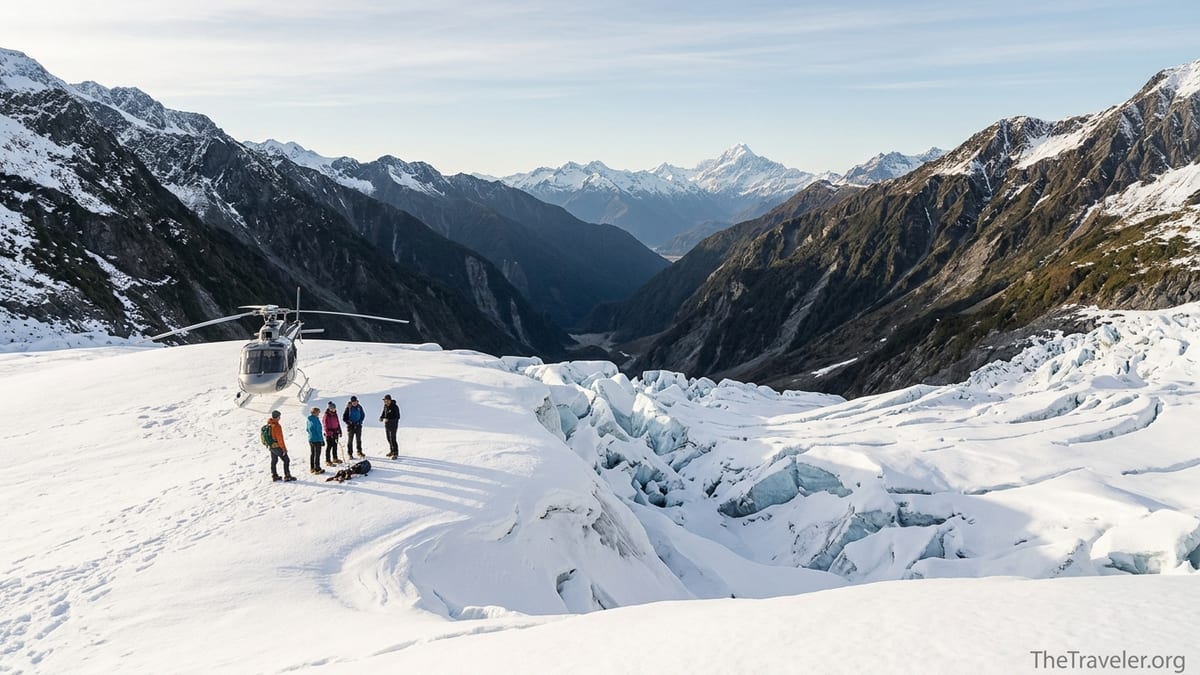
A typical short flight from Franz Josef might follow the glacier valley, trace over the fractured icefall, then set down on a snowfield above the crevasses. Many operators describe landings of roughly 6 to 10 minutes, which is just enough time to step into the snow, take photos with the helicopter in the background and soak up the scale of the ice. Because the time on the ground is brief and guests stay close to the aircraft, these trips suit a wide range of ages and fitness levels. If you can climb in and out of a helicopter and walk a few steps on uneven snow, you are generally able to participate.
Price-wise, recent rate sheets for West Coast operators show short scenic flights with a single landing often starting in the high 300s to low 400s New Zealand dollars per adult, with longer twin-glacier or “grand circle” options reaching the high 600s. At Aoraki/Mount Cook, flights over the Tasman Glacier with an alpine landing sit in a similar band. These figures shift seasonally and between companies, so treat them as ballpark numbers rather than fixed tariffs, but they illustrate the jump from free valley walks to a premium flightseeing experience.
Weather remains the biggest variable. Low cloud over the glacier or strong winds at landing altitude can ground helicopters for hours or days. It is not unusual for an entire day’s flight schedule to be cancelled in shoulder seasons, with guests either rebooked later in their stay or refunded according to the operator’s policy. Flexibility matters: if a blue-sky morning appears after two grey days, companies will often compress multiple departures into that clear window, so being in town and ready to go is a real advantage.
Heli-Hikes: Walking on the Glacier
Heli-hikes combine the aerial thrill of a scenic flight with the slower, more immersive pace of a guided glacier walk. In Franz Josef, Franz Josef Glacier Guides offers a flagship heli-hike that begins with a short five-minute transfer by helicopter up onto the ice, followed by around two hours of guided exploration before the pick-up. Fox Glacier Guiding runs similar products that land on different parts of Fox Glacier, taking advantage of slightly more predictable landing zones and, in many seasons, more reliable weather windows.
On a typical heli-hike, you are provided with boots, crampons, waterproof overtrousers and jackets, and sometimes walking poles. Guides cut steps into the ice with tools, manage group spacing around crevasses and lead you through features such as blue ice caves and narrow slots when conditions allow. Time on the ice often totals two to three hours within an overall tour length of around four hours, once you include check-in, gear fitting, safety briefings and the helicopter flights.
Fitness expectations are higher than for a simple snow landing. Franz Josef Glacier Guides suggests that if you can walk comfortably for up to two hours you are likely to cope well with their heli-hike. The terrain itself can be steep, uneven and slippery, and guests must be able to climb steps cut into the ice and move confidently while wearing crampons. Operators may impose age or weight limits and sometimes decline customers with mobility issues or significant heart and respiratory conditions, so it is important to read the fine print and be honest about your abilities at check-in.
Heli-hikes represent one of the most expensive glacier products, reflecting the longer guiding time and higher staffing ratios. Current price ranges commonly sit in the mid 600s to low 800s New Zealand dollars per adult, depending on operator, season and inclusions. For that investment you gain far more time on the ice than a short snow landing, and a much deeper understanding of glacier textures, melt patterns and the subtle blue light that filters through the ice. For many visitors, this is the single South Island splurge they remember most vividly years later.
Guided Valley Walks and Non-Flight Options
Not everyone wants, or can afford, to fly. The good news is that both Franz Josef and Fox Glacier offer valley walks that provide satisfying glacier views without leaving the ground. The popular Franz Josef Glacier Valley Walk follows a maintained track along the riverbed to a viewpoint opposite the terminal face, while the Fox Glacier South Side Walk offers similar perspectives. Conditions in the river valleys change frequently after heavy rain, and the Department of Conservation occasionally shortens or closes tracks for safety, so check locally before setting off.
These walks do not let you step onto the glacier itself. Instead, you view the ice from a safe distance, often several hundred metres away across unstable moraine slopes and active river channels. Expect walk times of 1.5 to 3 hours return depending on the route and your pace. Good walking shoes, a waterproof jacket and an awareness that West Coast rain can arrive quickly are more important than specialist gear, though trekking poles can be useful on rough sections.
Several companies around Fox also offer guided e-bike and hike combinations that ride guests partway up the valley on electric bikes before a short guided walk to a viewpoint. These trips add interpretation about the landscape, Maori history and glacial retreat, while still stopping short of the ice itself. Compared with helicopter tours, they sit at the lower end of the price scale, closer to a typical half-day guided hike in other New Zealand destinations.
In Aoraki/Mount Cook National Park, there is a different non-flight experience: boat trips on the terminal lake of the Tasman Glacier. These excursions involve a short guided walk to the lakeshore and a cruise among icebergs calved from the glacier front. You still do not stand on the glacier, but the close-up view of floating ice and the stark, rock-covered lower glacier offers a dramatic contrast to the bright blue seracs you see higher up during flight-based tours.
Aoraki/Mount Cook and the Tasman Glacier
While Franz Josef and Fox are the names most people know, Aoraki/Mount Cook and the Tasman Glacier offer a very different style of glacier encounter. The Tasman is broader and less steep than the West Coast glaciers, with extensive areas of gently undulating “white ice” higher up. That makes it ideal for heli-hikes that prioritise longer, more relaxed exploration on the surface rather than dramatic cliffs of ice.
At Aoraki/Mount Cook, heli-hikes are typically run by Alpine Guides in partnership with helicopter operators such as The Helicopter Line. A standard Tasman Glacier heli-hike involves two helicopter legs: a flight from Mount Cook Airport up onto the glacier, around two hours of guided walking, and a return flight to the valley. Equipment including boots, crampons or snowshoes, waterproof clothing and sometimes harnesses is supplied. Some Queenstown and Tekapo-based companies sell packages that combine a fixed-wing scenic flight over the Southern Alps, a helicopter transfer onto the glacier and guided time on the ice before returning by plane.
Physically, the Tasman heli-hike is still a genuine alpine walk, but some travellers find the mellower gradients less intimidating than the steeper West Coast icefalls. Fitness expectations are similar: you should be comfortable walking for a few hours on uneven terrain and climbing small hills. Because Aoraki/Mount Cook lies deep in the mountains, the weather can be fickle, with multi-day storms that ground aircraft. When clear, though, the setting beneath New Zealand’s highest summit is spectacular, and the sight of multiple glaciers spilling off the Main Divide in every direction can feel more expansive than the narrower valleys of Franz Josef or Fox.
Prices for Tasman heli-hikes typically sit in the same band as West Coast equivalents, often in the high 600s to mid 800s New Zealand dollars per adult, reflecting the dual helicopter legs and specialist guiding. Scenic flights with a shorter landing on the Tasman or nearby snowfields are slightly cheaper, while small-plane flights without landings are usually the most affordable way to gain an aerial overview of Aoraki/Mount Cook and the surrounding glaciers.
Weather, Duration and How Many Nights to Book
For any helicopter-based glacier trip, weather is the single biggest factor that will shape your experience. Cloud can obscure landing sites, wind can make high-altitude operations unsafe, and heavy rain can fill crevasses with water and destabilise snow bridges. It is common for operators in Franz Josef, Fox and Aoraki/Mount Cook to cancel or delay flights at short notice, even on days that look reasonable from the township. Safety margins are deliberately conservative, and companies will err on the side of caution rather than risk getting a helicopter stranded on the ice.
Because of that, most local operators advise booking your tour for the first full day you are in town, and then allowing at least one extra night as a buffer. In practice, this means planning two to three nights in Franz Josef or Fox Glacier if a heli-hike or scenic flight is a top priority, and a similar cushion around Aoraki/Mount Cook if you are aiming for a Tasman Glacier landing. Travellers regularly report cases where their first booking was cancelled, but a clear weather window opened on the second or even third day, allowing the trip to go ahead.
Typical durations also matter for scheduling. A short scenic flight with one snow landing might take 20–30 minutes in the air and roughly an hour door to door including check-in and safety briefing. Heli-hikes are longer, with many West Coast operators blocking four hours for the full experience and Mount Cook providers allowing similar or slightly longer windows. Tasman Glacier boat trips and valley walks usually fit into half a day. Understanding these run times helps you avoid stacking major commitments too tightly, particularly if you are driving long distances between overnight stops.
If your schedule is rigid and you cannot build in a buffer, focus on experiences that are less weather-sensitive, such as valley walks, Tasman Glacier lake cruises or small-plane flights that do not require a landing. These still have some weather vulnerability, but they can sometimes operate in conditions that are marginal for helicopter landings on snow.
Costs, Value and Choosing Between Ground and Helicopter
From a budgeting perspective, the choice between viewing the glaciers from the ground and paying for a helicopter comes down to how highly you value time on the ice itself. Valley walks and roadside viewpoints are free, except for your time and fuel. In Fox Glacier, for instance, you can drive to the Lake Matheson car park and, after an easy loop walk, photograph Mount Tasman and Aoraki/Mount Cook reflected in calm water without spending anything on tours. In Franz Josef, a simple stroll to the Sentinel Rock or Callery Gorge viewpoints offers satisfying glimpses of the glacier and its valley.
Helicopter experiences, by contrast, quickly become one of the more expensive line items on a New Zealand itinerary. If you opt for a 25-minute twin-glacier flight from Fox that circles both Fox and Franz Josef with a brief snow landing, you might spend roughly the same as two nights in a midrange motel. A full heli-hike at Franz Josef or on the Tasman Glacier can cost as much as a rental car for several weeks. The key question is whether walking on glacier ice, hearing the quiet creak beneath your crampons and feeling the sudden chill inside an ice cave are worth that premium for you personally.
If you are unsure, one strategy is to start with a scenic flight that includes a snow landing rather than committing immediately to a heli-hike. This gives you a short but genuine taste of standing on the snow or ice, along with sweeping views of the mountains, at a lower price and with minimal fitness demands. After that, you can decide whether a full heli-hike elsewhere in your trip, perhaps on the Tasman Glacier, feels justified.
For families with young children, travellers who dislike heights or those on tighter budgets, sticking to ground-based glacier encounters can still feel richly rewarding. You might, for example, mix a free Franz Josef valley walk with a paid Tasman Glacier lake cruise and a night in Aoraki/Mount Cook Village, creating a varied glacier-themed itinerary without ever stepping into a helicopter. Conversely, if this is a once-in-a-lifetime South Island trip and you have built in two or three weather-flexible days, many independent travellers consider a heli-hike or extended twin-glacier flight to be money well spent.
Matching Tours to Your Fitness and Risk Tolerance
Selecting the right glacier experience is not just about budget. It also requires an honest assessment of your fitness, mobility and appetite for weather-related uncertainty. Scenic flights with short snow landings suit almost anyone who can manage a few steps on uneven terrain and climb in and out of the aircraft unaided. These flights are also easiest for those anxious about heights, as you remain close to the helicopter and are not traversing steep ice slopes.
Heli-hikes on Franz Josef, Fox or the Tasman Glacier demand more. Expect to climb stairs in heavy boots, walk on sloping ice, squeeze through narrow features and follow guide instructions closely. Operators may cancel or modify trips based on recent rainfall, ice stability and group ability. If you struggle with steep city sidewalks, have significant knee issues or are recovering from injury, a heli-hike may feel more like an ordeal than an adventure. In that case, consider a snow landing flight or Tasman Glacier lake cruise as a lower-impact alternative.
Risk tolerance also plays into how much of your itinerary you anchor around a single weather-dependent activity. Booking a heli-hike as the centrepiece of a two-day detour off the main tourist route can be thrilling if it works, but disappointing if low cloud lingers and the helicopters stay on the ground. To reduce stress, some travellers spread their glacier-related bets, perhaps reserving a Tasman heli-hike at Aoraki/Mount Cook and staying flexible for a shorter scenic flight from the West Coast if another clear day appears.
Regardless of the option you choose, read cancellation policies carefully before paying. Many companies on the West Coast and at Aoraki/Mount Cook refund fully if they cancel due to weather, but apply stricter rules if you cancel or fail to show. Some bundle their helicopter products with accommodation, especially around Aoraki/Mount Cook, which can offer convenience but may also involve different change conditions. Booking directly with the operator often gives clearer communication if the weather forecast shifts at short notice.
The Takeaway
A visit to South Island glacier country can be as simple as a roadside photo stop or as involved as a multi-day stay built around a heli-hike. Franz Josef and Fox Glacier remain the classic West Coast bases for short scenic flights, snow landings and increasingly popular twin-glacier itineraries, while Aoraki/Mount Cook and the Tasman Glacier offer more expansive, high-alpine surroundings. All three areas now rely heavily on helicopter access for anyone wanting to actually stand on glacier ice.
For many travellers, the most balanced approach is to allow two or three nights in at least one glacier hub, schedule a helicopter experience early in the stay to leave room for weather shuffles, and fill any spare time with valley walks, viewpoints and lake cruises. Whether you choose a relatively affordable ground-based itinerary or invest in a premium heli-hike, the key is matching your expectations, fitness and budget to the realities of an alpine environment where the weather, not the brochure, sets the final schedule.
FAQ
Q1. Do I need to take a helicopter to actually stand on a glacier in Franz Josef or Fox?
In practical terms, yes. Due to retreat and unstable terrain, standard walking tracks no longer lead safely onto the ice, so commercial access is now by helicopter for both short snow landings and longer heli-hikes.
Q2. How many nights should I stay in Franz Josef or Fox Glacier for a heli-hike?
Plan at least two, and ideally three, nights. Book your heli-hike or scenic flight for the first full day and use the extra nights as a buffer in case weather forces postponements.
Q3. What is the difference between a snow landing flight and a heli-hike?
A snow landing flight is mainly about the views, with a brief stop on a snowfield for photos. A heli-hike includes a similar flight plus guided walking on the glacier for around two hours, using crampons and specialist equipment.
Q4. Which is better for reliability, Franz Josef or Fox Glacier?
Conditions vary, but many travellers and guides note that Fox Glacier landings can be slightly more reliable in marginal weather, due to different landing zones. That said, both valleys experience frequent weather cancellations.
Q5. How does Aoraki/Mount Cook compare to Franz Josef and Fox for glacier tours?
Aoraki/Mount Cook offers access to the broad Tasman Glacier and multiple surrounding icefields, with a more expansive, high-alpine feel. Franz Josef and Fox provide steeper, more dramatic icefalls closer to the coast and rain forest.
Q6. Are glacier helicopter tours suitable for people with limited fitness?
Short scenic flights with snow landings usually are, as long as you can walk a few steps on uneven snow. Heli-hikes require moderate fitness, good balance and comfort walking for a couple of hours on rough terrain.
Q7. How much do helicopter glacier tours typically cost?
Recent prices often start in the high 300s to low 400s New Zealand dollars for short flights with one landing, and rise into the high 600s or more for longer twin-glacier flights or full heli-hikes with extended time on the ice.
Q8. What should I wear and bring on a heli-hike?
Wear warm layers, thermal or hiking socks and sun protection. Operators usually provide boots, crampons, waterproof outerwear and sometimes gloves, but you should bring your own sunglasses, hat, camera and any personal medications.
Q9. What happens if my glacier flight is cancelled due to weather?
If the operator cancels for safety reasons, they will usually offer to move you to a later departure or provide a refund according to their policy. This is why having extra nights in glacier country is so valuable.
Q10. Is it worth paying for a helicopter if I am on a tight budget?
It depends on your priorities. Free valley walks and viewpoints give excellent glacier views, but a helicopter trip is the only realistic way to stand on the ice. Many travellers treat one flight or heli-hike as a single big splurge in an otherwise budget-conscious itinerary.