


Exploring New Zealand’s South Island by campervan or motorhome is one of the great road trips of the world, but it is not the same as doing it by car. Campsite power, dump stations, self-containment warrants and winter driving conditions all shape where you can go, how far you can comfortably drive in a day, and what kind of vehicle you should hire. This guide focuses specifically on campervan and motorhome travel in 2026, with current freedom camping rules, practical loop ideas, and concrete examples to help you design a realistic itinerary.
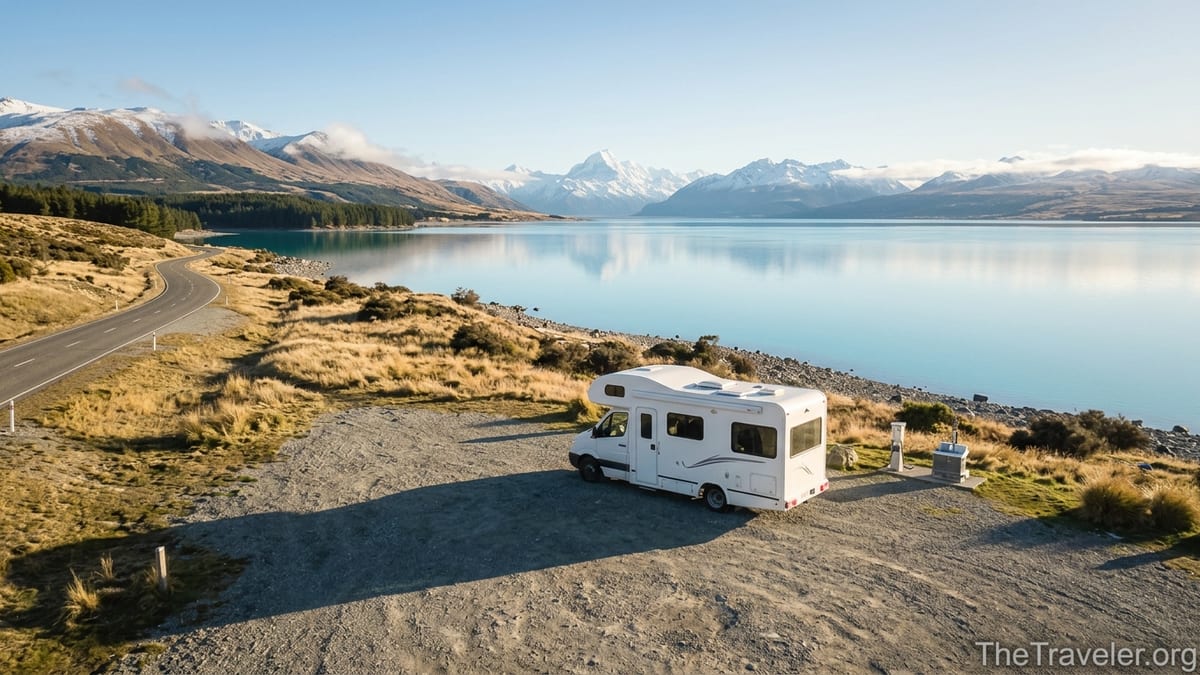
Christchurch vs Queenstown Pickup and One-way Rentals
Most South Island campervan journeys start in either Christchurch or Queenstown. Christchurch is the larger hub, with more rental depots and often lower daily rates because fleets are based there. For example, several major hire brands cluster around Christchurch Airport, within a 5 to 10 minute shuttle ride, while Queenstown depots are spread between Frankton and the industrial area near the airport and may charge a premium in peak seasons. Starting in Christchurch works well if you want to loop via Kaikōura, the West Coast and back through Tekapo or Mount Cook.
Queenstown works best if your focus is the Southern Lakes, Fiordland and perhaps a short West Coast leg. For a 10- to 14-day trip in a campervan, a common pattern is Christchurch to Queenstown one way, taking in Arthur’s Pass and the West Coast glaciers, then returning the vehicle in Queenstown and flying out. One-way fees vary, but it is common to see a surcharge in the range of a few hundred New Zealand dollars on smaller vans, and sometimes more for large motorhomes, especially in summer when fleets are under pressure.
Think about where you actually want to drive a motorhome. If you collect in Christchurch and immediately head to Queenstown on State Highway 1 and then via the Lindis Pass, you will miss much of the West Coast and some of the best coastal DOC campsites. Conversely, picking up in Queenstown and finishing in Christchurch lets you finish with easier driving on the Canterbury Plains after tackling the tighter lakes and alpine roads while you are still fresh. When comparing quotes, look beyond daily price and check whether your ferry, extra driver, bedding and camping chairs are included, as these quickly add up for two to four people.
In winter, June through August, Queenstown pickups are popular for ski and snow trips, but they also mean you start immediately on icy, sometimes chain-controlled roads. A cautious strategy is to collect in Christchurch, spend a night or two at a nearby holiday park such as those in North Christchurch or South Brighton to get used to the vehicle, then head inland once you are comfortable handling the size and weight of your van.
Choosing Campervan Size and Understanding What Is Awkward
South Island roads look big on a map but can feel small behind the wheel of a 7.2-metre motorhome. As a rule of thumb, campervans under about 6 metres (such as the common two-berth and three-berth models built on Toyota Hiace or similar) are the easiest to manoeuvre into DOC campsites, supermarket car parks and tight lakefront pull-offs. Once you move into a four-berth or six-berth coachbuilt motorhome, with dual rear wheels and over-cab beds, you need to think more carefully about where you drive and where you stop.
Some South Island roads are straightforward even in large rigs. The main highway from Christchurch to Dunedin, the Canterbury Plains around Ashburton, and the stretch from Christchurch to Tekapo are wide, well-marked and have a good shoulder in many places. In contrast, the road from Te Anau to Milford Sound, the Crown Range Road between Queenstown and Wānaka, and parts of the West Coast from Greymouth south to Haast can feel narrow, winding and can have steep drop-offs or rock faces on the edge. Large motorhomes can manage these roads, but overtaking becomes difficult and reversing into small lay-bys or DOC sites demands confidence.
Town layouts matter too. Queenstown’s central streets, especially around the waterfront, are awkward for long vehicles, and parking a big motorhome here in high season can be stressful. It is often easier to base yourself at a holiday park in Frankton or along the lakeshore and use public buses or a short taxi ride into town. Older town centres such as Akaroa, with tight corners and angled parking, can be fiddly for a six-berth motorhome. In contrast, modern supermarket car parks in places like Rolleston, Cromwell or Blenheim usually have long bays or edges where you can park a longer rig without hassle.
When choosing size, balance comfort against flexibility. A smaller, high-top campervan might feel cramped on rainy evenings, but it will let you use more DOC campsites with compact access tracks and less formal parking. A large motorhome gives you indoor seating, a bigger kitchen and often a dedicated bathroom but may restrict you to holiday parks, formal DOC sites and easier roads. For couples outside of school holidays, a three-berth or compact four-berth often hits the sweet spot between comfort and access.
Understanding South Island Campsites, Power and Dump Stations
On the South Island you will find three main overnight options for campervans: commercial holiday parks, DOC conservation campsites and legal freedom camping areas. Holiday parks, such as those clustered around Christchurch, Tekapo, Queenstown and Nelson, usually offer powered sites, hot showers, kitchens and sometimes extras like hot tubs, children’s playgrounds or ski-drying rooms. It is common to pay roughly the price of a budget motel room for two adults on a powered site in peak season, especially in popular tourist hubs.
DOC campsites range from serviced campgrounds with flush toilets and kitchens to very basic road-end clearings with long-drop toilets and limited parking. On the South Island, you will find DOC sites sprinkled along the West Coast, around the Marlborough Sounds, in the Mackenzie Basin and around Fiordland and Mount Aspiring National Park. Many DOC sites do not have powered stands, so even in a certified self-contained motorhome you may need to plan a powered night in a holiday park every few days to recharge house batteries, especially in winter when solar input is low.
Dump stations are critical for anyone with a toilet and greywater tanks. Holiday parks almost always have a dump point, and many towns provide public dump stations at service areas or near visitor centres. For instance, you will typically find dump facilities on the outskirts of larger towns such as Christchurch, Nelson, Queenstown and Invercargill, often co-located with fuel stations or refuse centres. When planning your route, look at where these sit relative to DOC sites. A common real-world pattern is to spend a night or two at a DOC campsite beside a lake, then stop at the next town’s dump station and supermarket on the way to your next overnight stop.
Because facilities vary, using a dedicated camping app or planning tool that distinguishes between powered and non-powered sites, notes dump stations and shows up-to-date reviews is extremely helpful. Before committing to a late-night arrival, check whether gates close at certain hours and whether winter maintenance affects water supply or toilet blocks. Some high-altitude DOC sites or smaller holiday parks reduce services outside the main summer months.
Freedom Camping and 2026 Self-containment Rules
Freedom camping in New Zealand is tightly regulated, and by 2026 the rules are stricter than many older blog posts suggest. National legislation defines where local authorities can allow or prohibit freedom camping, and councils across the South Island use bylaws to either ban or limit it in popular areas. Some councils allow vehicle-based freedom camping only in signposted locations; others ban it entirely within certain town boundaries and along key lakefronts. Even where national rules allow it, you must obey the signs on the ground or risk fines.
Self-containment certification is central to these rules. New regulations introduced through the Self-contained Motor Vehicles Legislation Act and follow-on regulations tightened what counts as a self-contained vehicle and introduced a newer, stricter warrant system that has been phasing in over recent years. In practical terms, for many areas you now need a certified self-contained vehicle with a fixed toilet and sufficient capacity for fresh and waste water for several days in order to freedom camp legally. Older blue self-containment warrants issued under the old standard have either already expired or are being phased out, with newer green-style warrants recognised under the updated system. Because the transition has involved several dates and grace periods, always ask your rental company exactly what certification your van carries and how long it is valid for.
Freedom camping rules are not uniform across the island. For example, popular tourist districts such as Queenstown Lakes and Mackenzie have produced detailed brochures and maps that show legal camping locations, restricted zones and recommended holiday parks and DOC sites. These change as bylaws and policies are updated, and councils often consult on new rules before each summer. For that reason, treat any printed map or third-party app as a starting point, not a guarantee, and cross-check against the latest council information when you enter a new district.
The safest approach is to use legal freedom camping as a bonus rather than the backbone of your trip. Plan for most nights in DOC sites or holiday parks, then add the occasional night at a signposted lakeside car park or riverside lay-by where your vehicle’s self-containment allows it and local bylaws permit it. Always arrive early at popular free sites in peak summer, avoid putting out chairs or awnings in small car parks, keep waste fully contained, and leave no trace. If you are at all uncertain whether overnighting is allowed at a particular spot, move to a formal campground instead of risking an infringement notice and a spoiled holiday.
Practical Loop Ideas for 10–14 Days
For a first-time South Island campervan trip, a 10- to 14-day loop is realistic without turning every day into a long haul. One classic loop starts and ends in Christchurch, heading north to Kaikōura, then across to Nelson and the Marlborough region, down the West Coast to the glaciers and Haast, then back inland via Wānaka, Tekapo or Mount Cook and the Mackenzie Basin. In a campervan, this loop works well because towns like Kaikōura, Murchison, Westport, Greymouth, Franz Josef, Wānaka and Tekapo all have a mix of holiday parks, DOC sites and fuel options, and the driving legs can be kept to three to five hours.
Another popular pattern is Christchurch to Queenstown one way. You might drive Christchurch to Arthur’s Pass and stay at a DOC site in the beech forest, then continue to Hokitika and Franz Josef Glacier for a powered night, cross Haast Pass to Wānaka, and finish with a couple of nights in Queenstown or nearby Arrowtown. This route keeps you off the Crown Range if you are nervous about steep alpine roads, as you can use the gentler route via Cromwell. For larger motorhomes, skipping the narrow, twisty detours to small West Coast side valleys can make driving more relaxing.
If you prefer to focus on the deep south and Fiordland, consider a Queenstown loop via Te Anau, Invercargill, the Catlins and Dunedin, then back inland via the Waitaki Valley, Oamaru and back to Queenstown or Christchurch. In a campervan, this route offers a mix of coastal DOC sites, town holiday parks and small rural campgrounds attached to pubs or sports clubs. The Catlins, in particular, has several small, low-key campgrounds close to waterfalls and beaches, but access roads can be narrow and potholed, so take extra time in large rigs and avoid rushing to remote bays late in the afternoon.
When planning daily distances, do not be fooled by short kilometre counts. The stretch from Te Anau to Milford Sound can easily take two hours or more one way, without heavy traffic, because of its winding nature, scenic stops and potential winter chain controls. Similarly, the coastal section between Greymouth and Haast passes through multiple short one-lane bridges and narrow gorges where you may be slowed by trucks and other motorhomes. Build in short days followed by longer stays in key places like Wānaka, Te Anau or Nelson so you can rest, do laundry and enjoy the landscape instead of constantly packing up.
Grocery, Fuel and Winter Driving Strategy
In a campervan you are effectively running a small apartment on wheels, so grocery and fuel planning matters. Supermarkets are concentrated in larger towns such as Christchurch, Blenheim, Nelson, Greymouth, Queenstown, Wānaka, Dunedin and Invercargill. In between, small Four Square or independent stores can be noticeably more expensive and have limited fresh produce. Many travellers stock up at a full-sized supermarket near their pickup point, then top up every few days in regional centres. For example, starting in Christchurch you might do a large shop in the city, a top-up in Greymouth, then another in Wānaka or Queenstown.
Fuel is widely available on main highways but thins out in remote areas such as the West Coast between Haast and Makarora or in Fiordland. Tank up before leaving larger centres, especially in diesel motorhomes where tanks are large but consumption is higher. It is wise not to let your tank drop below half when heading into remote stretches, particularly in winter when unplanned detours or weather closures may have you idling in traffic or backtracking to alternative routes. Some stations are unmanned 24-hour card pumps, so carry at least one card that works widely in New Zealand.
Winter adds extra complexity. The South Island’s alpine passes, including the Lindis Pass between Omarama and Wānaka and the road to Milford Sound, are regularly affected by snow, ice and occasional closures. Rental contracts often specify that you must carry snow chains between certain dates and may prohibit driving on certain roads, such as the Crown Range, in icy conditions. Practice fitting the chains in a dry car park before you need them. If you have never driven in snow, consider booking your Milford Sound experience as a coach and cruise from Te Anau or Queenstown instead of driving your own motorhome on State Highway 94.
Daily timing matters in winter. Roads are coldest and iciest at dawn, especially in shaded valleys around Tekapo, the Lindis and the approaches to Arthur’s Pass. Planning to drive the trickier sections late morning to mid-afternoon, when the sun has hit the road and road crews have had time to grit or clear snow, reduces risk. Build in flexibility so that if the transport agency closes a pass or issues strong wind warnings for high-sided vehicles, you can wait a day at a holiday park with power rather than push on. Always check the latest highway conditions before departing each day.
Holiday Parks vs DOC Sites vs Freedom Camping: Real-world Mix
Most campervan travellers end up using a mix of holiday parks, DOC campsites and a handful of legal freedom camping sites. A realistic pattern for a two-week South Island trip might be four or five nights in holiday parks with full facilities, five to six nights in DOC campsites and one or two carefully chosen nights at legal freedom camping locations. For example, you might enjoy a powered, serviced site at a holiday park near Christchurch on your first night to organise your gear, then move to a lakeside DOC campsite near Tekapo or Wānaka, then follow that with a free overnight stay in a signposted car park where your self-contained van is permitted.
Powered sites in holiday parks are especially valuable on cold or wet nights when you want to run electric heaters and charge devices. In mid-summer, on the other hand, you may be content at unpowered DOC sites with lake swimming and outdoor cooking. Families with young children often prefer holiday parks near Queenstown, Nelson or Hanmer Springs because of playgrounds and laundry, while couples in smaller vans appreciate the quiet of DOC sites up side valleys and along gravel roads, accepting basic facilities in exchange for starry skies.
Freedom camping should be approached with care. Some lakeside car parks on the Mackenzie lakes or around the West Coast are officially designated for self-contained vehicles, but they can fill early in January and February, and rangers regularly check warrants and compliance. Treat these spots as a privilege, not a right. Arrive early, park neatly, keep slides and awnings in if space is tight, and be ready to move on if signs or rangers indicate a change. If you find your intended freedom camping area full or closed, having a backup holiday park or DOC site identified in advance makes the decision easy.
Whatever mix you choose, pay close attention to local signage. A green self-containment warrant does not override a council bylaw that prohibits overnighting at a particular roadside reserve or beachfront. Councils and DOC routinely update rules and post them at car park entrances and visitor centres. Before each leg, especially when crossing into a new district such as Westland, Queenstown Lakes or Mackenzie, check the latest information and adjust your overnight plans if necessary.
FAQ
Q1. Is it better to start a South Island campervan trip in Christchurch or Queenstown?
Both work, but Christchurch usually has more rental choice and slightly lower prices, while Queenstown is better if you want to focus on the Southern Lakes and Fiordland with less driving.
Q2. How many days do I need for a South Island campervan loop?
Allow at least 10 days for a basic loop and 14 days if you want to include both the West Coast and Fiordland without driving long hours every day.
Q3. Do I need a self-contained campervan to travel the South Island?
You can use non-self-contained vans in holiday parks and some DOC sites, but a certified self-contained vehicle is increasingly required to freedom camp legally in many popular areas.
Q4. What is the difference between holiday parks and DOC campsites?
Holiday parks are commercial campgrounds with powered sites, hot showers and kitchens, while DOC campsites are usually more basic, in scenic locations, with simpler facilities and often no power.
Q5. Is winter driving in a campervan safe on the South Island?
It can be, provided you monitor road conditions, carry and know how to fit snow chains, avoid early-morning ice on alpine passes and are prepared to delay travel when snow or high wind warnings are issued.
Q6. Can I freedom camp anywhere in a self-contained motorhome?
No. You must follow local council bylaws and signs. Many town centres, lakefronts and roadside reserves have specific bans or only allow overnighting in designated areas.
Q7. How often will I need a powered campsite?
In summer many travellers alternate between powered and non-powered nights every few days, while in winter you may want power more often to run heating and keep batteries topped up.
Q8. Are large six-berth motorhomes too big for South Island roads?
They can drive all major highways, but some narrow, winding roads and tight town centres are awkward. Extra care is needed on roads like the Milford Road, Haast Pass and around Queenstown.
Q9. How should I plan for fuel and groceries on a campervan trip?
Fill up and do major grocery shops in larger centres such as Christchurch, Nelson, Greymouth, Wānaka and Queenstown, then top up in smaller towns so you are never short in remote stretches.
Q10. Should I book campsites in advance?
In peak summer and around popular spots like Queenstown, Tekapo and the West Coast glaciers, booking holiday parks and bookable DOC campsites in advance is strongly recommended, especially for powered sites.