


Far beyond New Zealand’s tourist trail, the Subantarctic Islands offer one of the world’s most concentrated wildlife spectacles. Rugged, wind-scoured and tightly protected, these islands are only accessible on small expedition ships with permits, and in 2026–27 a growing number of operators are marketing them as premium, wildlife‑focused voyages. Understanding how these cruises work, what they really visit and why they cost so much is essential before you book.
Where You Are Going: The Subantarctic Circuit Explained
New Zealand’s Subantarctic Islands sit in the Southern Ocean, roughly 400 to 700 kilometres south of the South Island. The main groups visited by expedition ships are the Snares, Auckland Islands and Campbell Island, often sold together as “New Zealand’s Subantarctic Islands.” These voyages are frequently compared with a mini‑Galapagos because of the high density of endemic plants and seabirds in a compact area.
The Snares, usually the first stop south of New Zealand, are closed to landings. Ships conduct Zodiac cruises along the coastline to look for Snares crested penguins, New Zealand fur seals and vast seabird colonies. Auckland Islands, including Enderby Island, allow strictly controlled landings where visitors walk through megaherbs and tussock to watch New Zealand sea lions and mixed penguin colonies. Further south, Campbell Island offers boardwalk hikes past nesting southern royal albatross and, on some routes, rare birds such as Campbell Island teal.
Some 2026–27 itineraries extend beyond New Zealand’s territory to include Australia’s Macquarie Island. This long, low island is famous for enormous king and royal penguin colonies and is often described by guides as the single best penguin destination outside the Antarctic Peninsula. Reaching Macquarie usually adds several days at sea, a higher price tag and more complex permitting, which is why it is typically bundled into longer “New Zealand and Australia’s Subantarctic Islands” or Ross Sea itineraries.
All of these islands are national nature reserves or protected areas with strict access limits. Landings are only possible as part of permitted expedition cruises, and visitor numbers on shore at any one time are tightly capped. That exclusivity is a major part of the experience and one of the reasons these trips feel more like scientific field journeys than conventional cruises.
Departure Ports, Ships and Expedition Style in 2026–27
Most New Zealand Subantarctic itineraries in 2026 and 2027 depart from Dunedin or Invercargill / Bluff on New Zealand’s South Island. Locally based Heritage Expeditions, for example, operates 12‑day “Beyond Fiordland” voyages round‑trip from Bluff that combine Fiordland, Stewart Island, the Snares, Auckland Islands and Campbell Island. Prices for late‑December 2026 departures on their Heritage Adventurer ship start just over 8,000 to 10,000 US dollars per person in the least expensive shared cabins, depending on early booking offers and cabin type.
International expedition companies also use Dunedin as a gateway for Subantarctic cruises. Aurora Expeditions features 15‑day Subantarctic journeys in early January 2026 on the polar‑class Douglas Mawson, marketed specifically as “Australia and New Zealand’s Subantarctic Islands,” while French‑flag line Ponant offers 14‑night “Expedition to New Zealand’s Subantarctic Islands” voyages on Le Soléal round‑trip from Dunedin in December 2026 and January 2027. Published lead‑in rates for these international products are typically in the mid‑20,000 US dollars per person range for an ocean‑view or balcony cabin, rising significantly for suites.
The expedition style is consistent across operators. Ships carry around 100 to 150 passengers, ice‑strengthened hulls and a fleet of Zodiacs. Days follow an expedition rhythm rather than a fixed cruise schedule: early‑morning wake‑up calls, Zodiac cruises before breakfast when conditions are calmest, guided hikes or boardwalk walks, and onboard lectures on ecology, history and conservation. There are no casinos, production shows or formal nights. Instead, the focus is on time ashore and unstructured wildlife watching from decks, with flexibility to shift plans if wind and swell dictate.
Voyages that include Macquarie Island or continue on to the Ross Sea often run 17 to 28 days and may start or finish in Queenstown, Invercargill or even Ushuaia in South America. For instance, combined products in December 2026 bundle a Subantarctic loop with Macquarie into a 17‑day Queenstown‑to‑Queenstown sailing, while longer 28‑day Ross Sea expeditions add the Snares, Auckland Islands, Macquarie, the Ross Ice Shelf and Campbell Island in one extended Southern Ocean circuit. These longer itineraries are typically priced upward of 25,000 to 35,000 US dollars per person.
Life On Board: Sea Days, Zodiacs and Landings
Expect a mix of intense landing days and quieter sea days. From Bluff or Dunedin, ships usually reach the Snares overnight, then move on to the Auckland Islands and Campbell Island over the following week. When an island is within reach, the team aims for two off‑ship excursions daily, but this can change quickly with Southern Ocean weather. On rough days you may remain on board, listening to lectures, attending photography workshops or simply watching albatrosses surfing the wind off the bow.
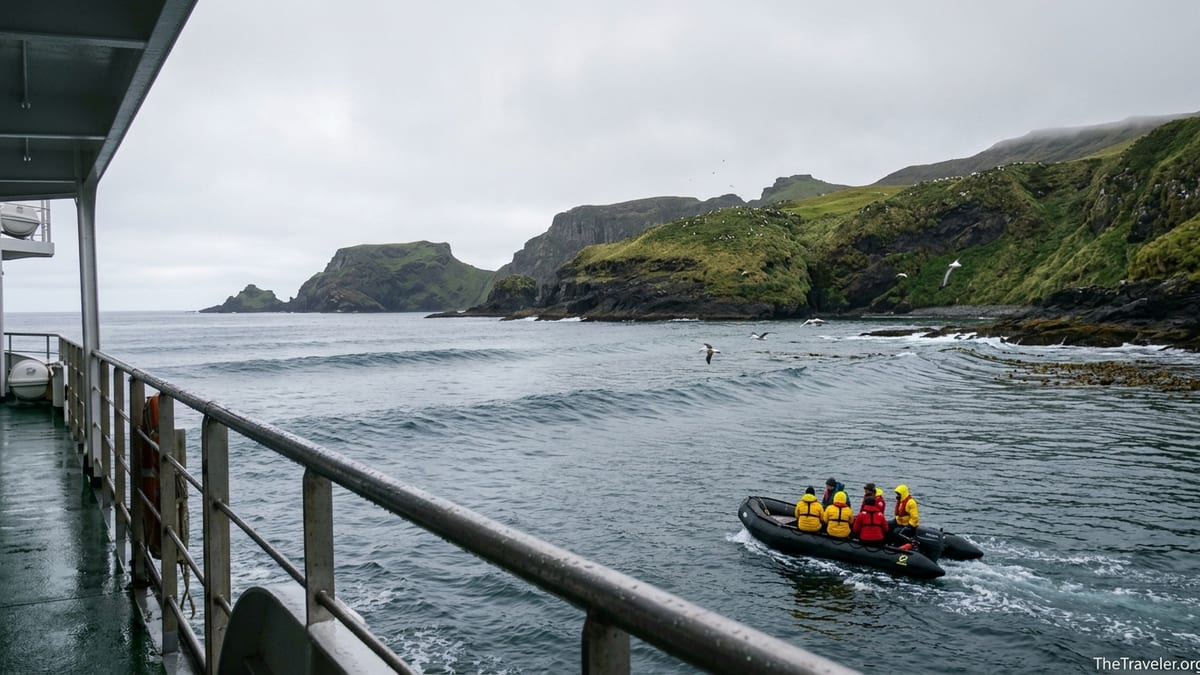
Zodiac operations are key to the Subantarctic experience. At the Snares, for example, all wildlife viewing is done from Zodiacs, with drivers navigating kelp‑lined channels beneath hanging forests while passengers in waterproof gear scan for Snares crested penguins leaping from the surf. At Enderby Island in the Auckland group, Zodiacs ferry small groups from ship to shore for several hours of walking on established tracks, often with time to sit quietly near New Zealand sea lion haul‑outs while guides ensure the 10‑metre distance rules are respected.
Campbell Island landings frequently involve a Zodiac ride to a small jetty followed by a boardwalk hike up to viewpoints such as the Col Lyall saddle, where southern royal albatross nest close to the trail. Landing sites and routes are prescribed by permits. Groups may stagger landing times so that numbers on shore never exceed legal limits, which is why even ships carrying 130 to 140 guests can maintain a low‑impact feel.
Days entirely at sea are most common on longer loops that include Macquarie Island or the Ross Sea. Between New Zealand’s Subantarctic Islands and Macquarie there is typically a full day or more without land in sight. These passages are not wasted: guests often describe them as some of the best times to photograph wandering and light‑mantled sooty albatrosses, petrels and occasional whales from the open decks while the expedition team offers informal identification sessions and bridge visits.
Wildlife Highlights: Penguins, Albatrosses and Beyond
Wildlife is the primary reason to sail to the Subantarctic. Each island group has its specialties, and most itineraries are timed for the height of the austral summer, from late November through January, when breeding activity is at its peak. The Snares host hundreds of thousands of seabirds, including the endemic Snares crested penguin whose small colonies can be seen from Zodiacs tucked into the coast. You may also see New Zealand fur seals and occasionally pods of dolphins bow‑riding the ship while albatrosses wheel overhead.
The Auckland Islands, particularly Enderby Island, are a stronghold for New Zealand sea lions, and landing here offers some of the most memorable wildlife encounters in the region. Passengers commonly watch large males sparring in the surf while females and pups rest higher on the beach. Yellow‑eyed and Auckland Island penguins are often seen moving between nest sites and the ocean, while skuas and giant petrels patrol overhead. Botanically, the islands are famous for megaherbs such as Anisotome and Pleurophyllum whose oversized leaves and flowers create a primeval feel along the walking tracks.
Campbell Island is synonymous with albatross. The island supports a major breeding population of southern royal albatross nesting on ridges and slopes that can be seen at close but carefully managed range from the boardwalk. Guests often spend long sessions quietly watching these huge birds, with wingspans approaching three metres, courting, preening or launching into the wind. Other highlights include rare endemic ducks and snipe, plus elephant seals hauled out on beaches.
Macquarie Island, when included, adds the spectacle of huge penguin colonies that feel like a condensed version of South Georgia’s famed rookeries. Shore excursions here often visit king penguin colonies numbering in the tens of thousands, intermixed with royal, gentoo and rockhopper penguins. Australian Antarctic Division and historical huts add a human dimension, and many itineraries aim to walk guests through active research and conservation stories that mirror the strict protection regimes in New Zealand’s Subantarctic reserves.
Cabins, Comfort Levels and Physical Requirements
Subantarctic voyages are firmly in the expedition category, but comfort levels have risen. Ships such as Heritage Adventurer, Aurora’s Douglas Mawson and Ponant’s Le Soléal offer a range of cabin types from compact porthole rooms to balcony suites. On many 12‑ to 15‑day New Zealand‑only itineraries, the lowest‑priced shared cabins may start around 8,000 to 12,000 US dollars per person, with balcony cabins often double that. On mixed New Zealand–Macquarie itineraries and Ross Sea voyages, suite prices can easily exceed 30,000 to 40,000 US dollars per person.
Choosing a cabin is partly about budget and partly about how you handle motion. Lower‑deck cabins midship generally move less and may be a better choice for travellers concerned about seasickness on the open Southern Ocean. Balcony cabins are appealing for private wildlife watching, but consider that you will spend much of your time in public deck areas or in Zodiacs, and cabins are primarily for sleeping, warming up and reviewing images between excursions.
Physically, you do not need to be an athlete, but a basic level of mobility is important. Passengers must be able to manage steep gangway steps, climb in and out of Zodiacs, and walk for one to three hours over uneven ground or boardwalks while wearing layered clothing and rubber boots. On some landings, especially at Enderby Island and Campbell Island, you may encounter mud, boggy sections or slippery timber boardwalks. Operators usually grade hikes from easy to challenging, and there is often a shorter option or a more static photography‑focused group.
Prospective travellers with knee, hip or balance issues should discuss suitability with the operator before booking. Some expedition companies require a medical questionnaire or doctor’s letter for guests above a certain age. It is also worth asking how many expedition staff are on board relative to the number of guests, as a higher guide‑to‑guest ratio makes it easier to split into ability‑based groups on shore.
Weather, Seasonality and Why These Cruises Are Expensive
The Subantarctic cruising season is short. Most voyages operate between late November and February, when daylight is long and temperatures are at their mildest. Even then, expect daytime air temperatures in the single digits to low teens Celsius, cold wind that amplifies the chill, and frequent rain or drizzle. Conditions can change rapidly from flat calm and sunlit seas to gale‑force winds and horizontal sleet in a matter of hours.
This harsh environment is part of the appeal but also a key reason for the high cost. Ships must be ice‑strengthened, with redundant safety systems and experienced polar crews. Operating in such remote waters, far from ports and search‑and‑rescue resources, requires extra fuel reserves, conservative routing and robust logistics support. New Zealand’s Subantarctic Islands are protected as national nature reserves under strict legislation, with permit fees and mandatory Department of Conservation staff on board selected voyages adding to operator costs.
The itineraries also involve long transit distances with relatively few commercial passengers. Unlike large mainstream cruise ships that can carry thousands of guests and generate revenue through casinos, retail and shore excursions, Subantarctic vessels typically carry around 100 to 150 people and include Zodiac landings, lectures, meals, loaned boots and sometimes parkas in the base fare. When you divide operating costs, permit fees, fuel, insurance and staff salaries by such a small number of guests over a short season, per‑person prices naturally rise.
For travellers, the key is to view pricing in context. A 12‑day New Zealand‑only loop starting around 8,000 to 12,000 US dollars per person is expensive compared with a coastal cruise, but competitive with similarly remote expedition products in the Arctic or Antarctic Peninsula. Longer Subantarctic plus Macquarie or Ross Sea voyages priced at 25,000 to 35,000 US dollars per person sit at the premium end of the market but deliver some of the rarest wildlife experiences available on any commercial cruise.
New Zealand–Only Itineraries vs Voyages Including Macquarie Island
One of the first choices prospective passengers face is whether to book a New Zealand–only Subantarctic itinerary or a longer voyage that also includes Macquarie Island. New Zealand–only routes, such as 12‑day loops taking in Fiordland, Stewart Island, the Snares, Auckland Islands and Campbell Island, offer a compact experience that fits into a two‑week holiday window and focuses on endemic New Zealand wildlife and landscapes. They also limit sea days, with many nights spent sheltered in fiords or between relatively close island groups.
In contrast, itineraries branded “Galapagos of the Southern Ocean” or “Australia and New Zealand’s Subantarctic Islands” that include Macquarie typically run 15 to 17 days. They add at least one or two long sea passages in the open Southern Ocean and substantially expand the penguin highlights. At Macquarie you are likely to see large king, royal, gentoo and rockhopper penguin colonies in one voyage, complementing the Snares, Auckland Island and Campbell species. For keen birders and photographers, this added diversity often justifies the extra time and money.
Price differences are significant. As of the 2026–27 season, indicative lead‑in fares for New Zealand–only Subantarctic journeys may start around the high four‑figure to low five‑figure range in US dollars, while comparable ships on New Zealand plus Macquarie itineraries are typically priced from the mid‑teens upwards, with suites much higher. Longer Ross Sea expeditions that use the Subantarctic Islands and Macquarie as stepping stones often exceed 30,000 US dollars per person.
Another consideration is comfort with rough seas. The more time a voyage spends in the open Southern Ocean, the greater the chance of encountering heavy swell. Travellers who are unsure about their sea legs may prefer the shorter New Zealand‑focused itineraries, which still cross exposed waters but often include more sheltered sections. Those who have already visited the Antarctic Peninsula or South Georgia and are chasing new species and landscapes may find the New Zealand–plus–Macquarie combination a more compelling “once in a lifetime” investment.
Permits, Landing Rights and Itinerary Flexibility: What to Check Before Booking
Because all New Zealand Subantarctic Islands are strictly protected, landing permissions and operational flexibility are central issues when choosing a voyage. Only a limited number of commercial operators hold permits to land passengers each season, and permits usually specify which sites can be visited, how many guests can go ashore at one time and what conditions must be met. You should always confirm that your chosen operator is explicitly permitted to land at key sites such as Enderby Island in the Auckland group and Campbell Island, rather than only cruise offshore.
Ask how many actual landings the itinerary is planning and how many are Zodiac‑only cruises. For example, some schedules clearly note that the Snares are a Zodiac‑cruising destination, while Auckland Islands and Campbell Island include landings subject to weather. Clarify whether park rangers or Department of Conservation staff will be on board, how biosecurity checks are handled and what happens if one or more landings cannot proceed because the swell is too high. Reputable expedition companies will be frank that landings are always weather‑dependent and cannot be guaranteed.
Itinerary flexibility is a feature, not a flaw, of these voyages. On a 12‑day loop there might be three or four Subantarctic landing days planned, with backup options if conditions close a particular bay. On longer New Zealand plus Macquarie itineraries and Ross Sea routes, Expedition Leaders often build “buffer” days into the schedule to preserve chances for key landings. When comparing options, look for language that describes a flexible route with alternative anchorages rather than a rigid port list more typical of mainstream cruises.
Finally, verify what is and is not included in the fare. Some 2026–27 products include charter flights to or from Queenstown, hotel nights before embarkation, and all landing fees, while others charge extra for pre‑night accommodation, transfers or specialty activities such as kayaking. Travel insurance with emergency evacuation cover is typically mandatory for these remote regions and should be budgeted for separately. Asking detailed questions at the booking stage reduces the risk of misunderstandings once you are far from shore.
The Takeaway
Cruising New Zealand’s Subantarctic Islands is not an ordinary holiday. It is a focused wildlife expedition into one of the last great oceanic wildernesses, delivered on small ships under some of the world’s strictest conservation regulations. For travellers willing to endure long sea days, changeable weather and a premium price tag, the reward is rare access to places that only a few thousand people see each year.
New Zealand–only itineraries offer a concentrated introduction to the Snares, Auckland Islands and Campbell Island, with strong chances to see endemic penguins, prolific albatross and charismatic New Zealand sea lions within a manageable two‑week window. Longer routes that add Macquarie Island or the Ross Sea extend both the commitment and the payoff, layering on vast king and royal penguin colonies and deeper Southern Ocean immersion.
The key to choosing well is to match the voyage to your interests, time, budget and tolerance for rough water. Look closely at departure ports, ship size, cabin location, landing permits and contingency plans. If you approach the decision with the same care that operators apply to their permits and logistics, you will step ashore on windswept headlands and black‑sand beaches knowing exactly why you have come so far.
FAQ
Q1. When is the best time of year to cruise New Zealand’s Subantarctic Islands?
The main season runs from late November to February, when daylight is long, temperatures are relatively mild and most seabirds and penguins are actively breeding.
Q2. How long are typical Subantarctic expedition cruises?
New Zealand–focused itineraries are usually 10 to 14 days, while voyages that also include Macquarie Island or the Ross Sea range from about 15 to 28 days.
Q3. Do all cruises land on every island, including the Snares?
No. The Snares are generally visited by Zodiac only, with wildlife viewing from the water. Landings usually take place at selected sites in the Auckland Islands and on Campbell Island.
Q4. How rough are the seas on these voyages?
The Southern Ocean can be very lively, with strong winds and large swells. Most guests experience some motion, but modern ships, stabilisers and good seasickness management help considerably.
Q5. What level of fitness do I need for a Subantarctic expedition cruise?
You should be able to manage stairs, climb into Zodiacs and walk for one to three hours on uneven ground or boardwalks while wearing layered clothing and rubber boots.
Q6. Why are Subantarctic cruises more expensive than regular cruises?
Short seasons, small ships, remote operations, strict permits and the inclusion of Zodiacs, guides and landings in the fare all push up per‑person costs.
Q7. How do New Zealand–only itineraries compare with those that include Macquarie Island?
New Zealand–only voyages are shorter and cheaper, focusing on endemic species, while trips including Macquarie are longer, pricier and add vast king and royal penguin colonies.
Q8. Can bad weather cancel my planned landings?
Yes. All landings are weather‑ and swell‑dependent. Operators build flexibility into itineraries, but specific sites can never be guaranteed in advance.
Q9. What kind of clothing and gear should I bring?
Plan for cold, wet and windy conditions: waterproof outer layers, warm mid‑layers, thermal base layers, hats, gloves and quick‑drying socks. Many ships loan rubber boots and sometimes parkas.
Q10. Are children welcome on Subantarctic expedition cruises?
Policies vary, but many operators set minimum ages, often around 8 to 12 years, and advise that these remote, weather‑dependent trips are best suited to mature, nature‑focused travellers.