


Aotea / Great Barrier Island feels like a world away from Auckland, yet it is only a short hop across the Hauraki Gulf. Tourism New Zealand highlights it as a year-round, off-grid adventure destination, reachable by both ferry and flight. In practice, the way you choose to arrive will shape almost every part of your stay, from how much luggage you can bring to how independent you are once you land. This guide breaks down the real-world pros and cons of ferries and flights so you can choose the best route for your style of trip and time of year.
Understanding Aotea’s Off-Grid Reality
Before you even look at timetables, it helps to understand the nature of Aotea / Great Barrier Island. With no mains power, limited mobile coverage in pockets, and dark, star-filled skies, the island runs on solar, generators and rainwater tanks rather than city infrastructure. Many visitors come specifically for that feeling of remoteness and simplicity, but it also means there is no public transport network waiting when you arrive and local services can book out during busy periods.
Tourism and local visitor information sites stress that everything from accommodation to rentals and shuttles should be arranged in advance, particularly in the summer peak and school holidays. There are no banks or large chain supermarkets, and many small operators are family run, so capacity is naturally limited. How you arrive, and whether you bring your own vehicle or rely on local transport, will determine how flexible you can be once you are here.
Because Great Barrier is off-grid, power and water are precious. Some holiday homes restrict heavy power users like hairdryers and expect guests to conserve water, especially in dry spells. Arriving by ferry with a fully loaded vehicle or flying in with a single backpack will change what you can realistically bring, from extra food to camping gear, and how self-sufficient you can be in an environment where you cannot simply pop to a big-box store.
Thinking through the island’s off-grid nature first will help you decide whether you want the freedom of your own wheels and supplies, which points toward the ferry, or the light-footprint efficiency of flying in and using local rentals and shuttles.
Ferry From Auckland: Journey, Ports and Sea Conditions
The ferry from Auckland to Great Barrier Island is currently operated by SeaLink, running from a wharf near the central city waterfront, around Wynyard Quarter. Sailings go to Tryphena on the island’s southern side for most services, with some seasonal trips to Port Fitzroy on the west coast. The voyage is usually around four to five hours each way, depending on the sailing and conditions, so you should treat it as half a day of travel rather than a short hop.
Because Aotea sits on the outer edge of the Hauraki Gulf, the crossing can be very different from the sheltered commuter ferries closer to Auckland city. On calm summer mornings the trip can feel like a leisurely coastal cruise, with views of Rangitoto, Little Barrier and the Coromandel Peninsula. In fresh south-westerlies or after a storm, the open-water section can be choppy, with noticeable swell. SeaLink recommends allowing flexibility around bad-weather days in winter, as sailings can be delayed or cancelled when conditions deteriorate.
Check-in times for the ferry are earlier than most people expect. Foot passengers are usually asked to check in about an hour before departure, while vehicles must arrive earlier again to be loaded in time. For a morning departure from Auckland, that often means leaving accommodation in the city around sunrise. On the way back, afternoon or evening sailings can see you arriving into Auckland after dark, which is worth considering if you still have a long drive ahead.
Ferries are not high-frequency services. In shoulder seasons there may only be several sailings per week, and even in busy periods there are typically only one or two sailings on any given day. If your schedule is tight or you need to connect with long-haul flights, this limited timetable is a major factor when weighing up ferry versus flying.
Flying to Great Barrier: Airlines, Airports and Flight Time
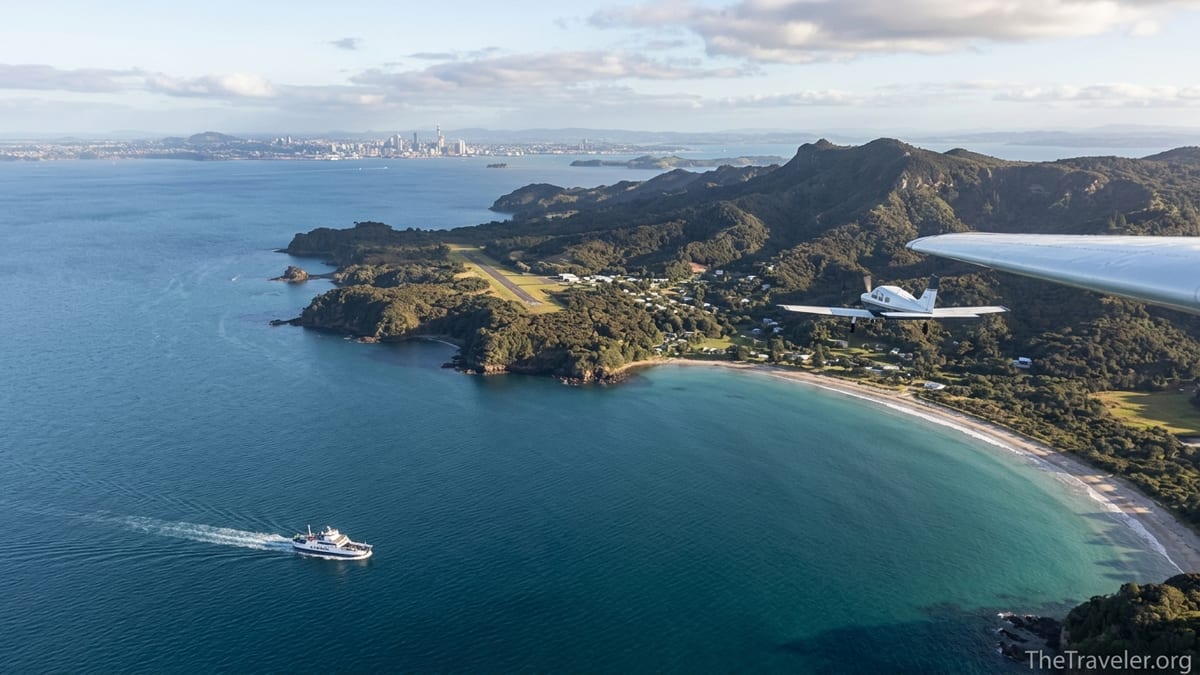
Flying is the fastest way to reach Aotea, with scheduled services taking about 30 minutes in the air from Auckland. The main carriers serving the island include Barrier Air from Auckland Airport’s domestic terminal and North Shore Aerodrome, and other small operators that run services from suburban airfields depending on the season. On the island, flights arrive at Great Barrier Aerodrome at Claris, a small but busy airfield close to the main east-coast beaches and a short drive from Medlands and Tryphena.
From central Auckland, travel time to the airport you depart from makes a difference. Flying from Auckland Airport usually means at least 45 to 60 minutes of road or bus travel in traffic from downtown, plus check-in time. Some services from North Shore Aerodrome can be more convenient for people staying on the North Shore or Hibiscus Coast, with shorter surface travel and easier parking, but those trips generally still require a car or taxi.
The flying experience itself is part of the trip. Small turboprop or single-engine planes seat roughly 8 to 15 passengers, and on a clear day you will have sweeping views down the Hauraki Gulf to the island’s ridges and beaches. Because aircraft are small and operate under visual conditions, schedules can be affected by low cloud, high winds or poor visibility more quickly than big-jet services. In strong crosswinds or heavy rain, flights can be delayed, combined or rescheduled, especially in winter.
Frequency is one of flying’s biggest advantages. On busy summer days there can be multiple departures in each direction, particularly between Auckland Airport and Claris, with earlier and later options to match ferry connections, inter-island flights or check-in times for popular accommodations. For many travellers, that flexibility is what makes flying the default choice for short breaks and weekend escapes from the city.
Luggage, Gear and Bringing a Car
Your baggage needs and whether you want to bring a vehicle are key decision points. Ferry travel is the only realistic option if you need your own car or campervan on the island. SeaLink accommodates cars, 4WDs, trailers and sometimes even small trucks, charging by length and passenger numbers. For example, a typical city SUV with two adults and two children will be priced differently from a compact hatchback with a solo traveller, so families often find that taking a car becomes competitive in cost once several return airfares and on-island rental fees are added up.
On the ferry, luggage allowances are generous compared with flying. You can pack chilly bins, camping gear, surfboards, extra food and bulky items that would be awkward or impossible on a small aircraft. Many regular visitors load up with supermarket supplies in Auckland to supplement the island’s smaller, often more expensive stores. For a week-long family stay in a holiday house, the ability to bring multiple bins of food, bikes and fishing gear can be decisive.
Flights to Great Barrier, by contrast, impose strict weight and size limits. Small aircraft have tight payload margins, so typical checked baggage allowances are often around 15 to 20 kilograms per person, including hand luggage, and there may be surcharges for extra weight that still must fit within the plane’s capacity. Surfboards and large camping packs sometimes require prior arrangement and can be declined on very full flights. If you travel light with a daypack and a small duffel, this is usually no issue; if you want to bring extensive gear, it quickly becomes a constraint.
Because there is no vehicle ferry alternative on the day for flyers, once you land you must rely on local car rentals, shuttles, bikes or e-scooters. That can be wonderfully simple for a long-weekend beach break with just a carry-on, but less ideal for a multi-week, gear-heavy adventure or a family group that wants to move at its own pace.
Where You Arrive and Onward Transport on the Island
If you arrive by ferry into Tryphena, you step straight onto the island’s southern coastal road, close to accommodation clusters around Tryphena, Pah Beach and Shoal Bay. Many holiday homes, lodges and campgrounds in this area are within a 10 to 20 minute drive of the wharf. If you have brought your own vehicle, you simply roll off and drive. If you have not, local shuttle operators generally meet the ferry and can drop you at pre-booked accommodation for a fee, but they may not have space for last-minute passengers in peak season.
Ferry arrivals into Port Fitzroy, more common in certain seasons or for specific sailings, place you on the western side of the island, handy for yacht harbours, DOC campgrounds and the famed bush tracks around Whangaparapara and Windy Canyon. However, Port Fitzroy is far from the main east-coast beaches and Claris, so you need either your own car on the ferry or a prearranged shuttle to cross the island’s winding, partly unsealed roads.
Flying into Claris positions you centrally for many of the island’s most popular spots. Rental car desks and bike hire options are usually available right by the aerodrome, and pre-booked shuttles wait at the small terminal to take guests to Medlands, Tryphena, Okupu or more remote lodges. Given there is no regular public bus service, visitor advice emphasises booking your ground transport before you depart Auckland. In busy times, walking off the plane without a plan can leave you waiting hours for a spare seat in a shuttle or paying high rates for an ad hoc taxi-style transfer.
The way you arrive affects your daily rhythm once you are on Aotea. Self-drivers can linger at remote bays, chase good surf or reposition easily for hikes like the Aotea Track or Mount Hobson. Those relying on shuttles often structure days around fixed pick-up times and may focus on a smaller area close to their accommodation. Neither is better in absolute terms, but they support different styles of holiday.
Costs, Time and When a Car Ferry Makes Sense
Costs fluctuate with fuel prices and demand, so it is best to check current fares rather than rely on fixed figures, but some patterns are clear. For solo travellers or couples on short visits of two or three nights, flying is often comparable in cost to the ferry, once you factor in the value of saved time. A return ferry ticket for a foot passenger can be cheaper than a return flight, but four to five hours each way at sea plus check-in time turns a weekend into an extended commute. Many Aucklanders treat the flight as worth the premium for a Friday afternoon departure and a near-full weekend on the island.
For families, groups of friends, or trips of a week or more, taking a vehicle on the ferry becomes more attractive. While the upfront cost of a return car ferry booking is significant, dividing it between four or five people and comparing it to the combined cost of multiple return airfares and a multi-day on-island car rental can tip the balance. The calculation is even more favourable if you already own a suitable vehicle and want to bring bulky gear, food and toys that would otherwise add rental or freight costs.
Time is the other major factor. If you live within easy reach of central Auckland and are happy to treat the sea crossing as part of the holiday, the ferry can be relaxing. You can read, watch the islands slide by, and arrive in Tryphena with your vehicle ready to go. If, however, you are flying into Auckland internationally and trying to fit Aotea into a tight North Island itinerary, routing straight from Auckland Airport to a 30-minute flight to Claris can save most of a day of connections and waiting.
In simple terms, bringing a vehicle by ferry is usually worth considering for longer, gear-heavy trips, especially for families or small groups who value independence and plan to explore the full spread of the island. Flying and renting locally is more efficient for short breaks, light travellers, or those who are happy to focus on one or two areas without needing to zigzag across the island daily.
Weather, Sea Conditions and Reliability
Weather affects both ferries and flights, but in different ways. On the water, strong winds and swell are the main concerns. In mid-winter, deep low-pressure systems can send big seas across the Hauraki Gulf, prompting operators to cancel or reschedule ferry sailings for safety and comfort. Even when services run, passengers prone to motion sickness may find the open-water sections uncomfortable on rough days, particularly in exposed seating areas on deck.
In summer and settled shoulder seasons, the sea is often calm enough that motion is minimal, and the ferry becomes a scenic cruise. Many regular visitors specifically choose early-morning sailings, when wind is typically lighter, to reduce the chance of choppy water. Travel sickness medication, ginger tablets or acupressure bands are common preparations among those who know they are sensitive to movement.
For flights, wind and visibility are key. The short runway at Claris, the hilly terrain and the small size of the aircraft mean airlines must operate within stricter weather margins than large jet services. Strong crosswinds, low cloud or heavy rain can ground or delay flights. While pilots and airlines are experienced in local conditions, it is wise to allow some flexibility at the start and end of your trip, particularly in winter and early spring when weather is most changeable.
In practice, neither option is immune to disruption, so the safest planning approach is to avoid rigid, same-day long-haul connections where a missed service would have major knock-on effects. If you must catch an international flight, consider returning to Auckland the day before, whether you arrive by ferry or plane, and overnight in the city before your onward departure.
How Your Arrival Method Shapes Your Trip
Arriving on the car ferry with your own vehicle sets you up for an independent, road-trip-style holiday. You can detour to lesser-visited bays, carry mountain bikes for the island’s many gravel roads, and move between walking tracks and beaches without watching the clock. For example, a couple planning to hike the Aotea Track over three days might use their car to leave food supplies at different accommodations, then spend extra days afterwards exploring Port Fitzroy and Whangapoua Bay without needing separate transfers.
Flying in and relying on local rentals or shuttles is better suited to focused stays. A solo traveller staying at a lodge in Medlands might hire an electric scooter to get to the beach and a nearby café, using guided tours or pre-booked shuttles for bigger excursions such as a dark sky tour or Mount Hobson hike. This approach keeps packing light and avoids navigating narrow, sometimes unsealed roads if you are not confident driving.
Your choice also influences how off-grid your experience feels. With a car full of supplies from Auckland supermarkets and gear for every eventuality, you may find you spend more time self-catering at your holiday home and less time visiting local shops and eateries. If you arrive by air with only a small bag, you are more likely to lean on island stores, cafés and tour operators, which can be a richer way to connect with the local community but may be a bit more expensive overall.
Consider your tolerance for slow travel and logistics too. Some visitors relish the ritual of an early start, the long sea crossing, and rolling off the ferry into island life. Others want the immediacy of a short flight and to be on the beach within an hour or two of leaving the city. There is no single best method: it is about aligning transport with the pace and style of holiday you have in mind.
What to Book First and Peak-Season Strategy
Local visitor resources emphasise booking well ahead in busy periods, especially from late December through January, long weekends and during major island events such as running races or festivals. Aotea’s small population and limited infrastructure mean there is a finite number of beds, rental vehicles and shuttle seats. The island can and does fill up.
For peak-season trips, start with accommodation and island transport, then lock in your way of getting there. If you plan to bring a car on the ferry in late December, you should think in terms of months rather than weeks in advance. Car spaces on peak sailings are limited and often sell out well before foot-passenger tickets. It is common for would-be visitors to find that while smaller holiday houses are still available, they cannot get a car onto their preferred ferry date.
If you intend to fly and rent a car or e-bike on arrival, confirm the rental first. There are only so many vehicles on the island and they can be fully booked during holidays. Once you have secured wheels, book flights that match your check-in time at both ends. On very busy days, extra flight capacity may be added by airlines, but this is not guaranteed, and last-seat prices can be high.
At other times of year, the order can be more flexible, but it is still sensible to at least pencil in your preferred ferry or flight before paying for non-refundable accommodation. Outside of the height of summer, a good rule of thumb is to secure transport several weeks ahead, check cancellation terms, and keep an eye on weather forecasts in the days before you travel.
The Takeaway
The choice between ferry and flight to Aotea / Great Barrier Island comes down to how you like to travel. The ferry offers a slower, more scenic approach, ideal if you want to bring your own vehicle, lots of gear and perhaps spread your visit over a week or more. It suits families, groups and repeat visitors who treat the crossing as part of the adventure and value independence once they arrive.
Flights, on the other hand, are all about efficiency and flexibility. They get you from Auckland to Claris in around half an hour in the air, making weekend escapes and short breaks realistic even from overseas arrivals. Flying works best for light packers, couples and solo travellers ready to work with local rentals, shuttles and guided tours rather than relying on their own car.
Whichever route you choose, remember that Great Barrier’s off-grid character and limited infrastructure mean planning ahead is crucial, especially in peak season. Decide early whether you need a vehicle, be realistic about your luggage and gear, and book both transport and accommodation well in advance. With those details sorted, you can relax and focus on what Aotea does best: wild coastlines, star-filled night skies and the sense of being a long way from everyday life, despite coming from just over the horizon.
FAQ
Q1. Is it faster to take the ferry or to fly from Auckland to Great Barrier Island?
Flying is significantly faster. The flight from Auckland to Claris takes about 30 minutes in the air, while the ferry crossing from central Auckland to Tryphena usually takes four to five hours, plus check-in time at each end.
Q2. When is it worth bringing my own car on the ferry?
Bringing a car makes sense for longer trips, generally a week or more, especially for families or small groups who plan to explore much of the island and carry bulky items like camping gear, surfboards and food supplies. For short, light trips, flying and renting locally is usually more efficient.
Q3. Can I take my car on a flight to Great Barrier Island?
No. The small aircraft serving Great Barrier Island carry passengers and luggage only. If you want a vehicle on the island you must either bring your own on the ferry or hire one from a local rental operator once you arrive.
Q4. How strict are luggage limits on flights to Great Barrier?
Luggage limits on small aircraft are tighter than on larger domestic flights. Typical allowances are around 15 to 20 kilograms per person including hand luggage, with possible surcharges for extra weight and space-dependent acceptance of bulky items like surfboards.
Q5. What should I book first for a peak summer trip?
In peak periods, secure your accommodation and on-island transport first, particularly car rentals or spaces for your vehicle on the ferry. Once those are confirmed, book flights or ferry tickets that match your arrival and departure dates.
Q6. Is there public transport on Great Barrier Island once I arrive?
There is no regular public bus network. Visitors rely on rental cars, bikes, electric scooters, pre-booked shuttles, taxis and occasional services such as mail runs. It is important to arrange your transport before you arrive.
Q7. How do weather conditions affect ferries and flights?
Strong winds and swell can delay or cancel ferries, especially in winter, and may cause seasickness for sensitive passengers. Flights are affected by wind and visibility; small aircraft may be delayed or rescheduled in strong crosswinds, low cloud or heavy rain.
Q8. Which arrival point is better for beaches and walks?
Claris, the main airfield, is central for east-coast beaches like Medlands and for many walking tracks. The Tryphena ferry terminal is convenient for southern bays and nearby hikes, while Port Fitzroy arrivals suit those heading to western harbours and bush walks.
Q9. Are there shops and ATMs on the island if I travel light?
There are small local stores and cafés scattered around the island, but no banks and only limited options for cash withdrawals. Most places accept cards, yet carrying some cash is still wise. Travelling light is possible, but do not expect big-city shopping.
Q10. Is Great Barrier Island suitable for a weekend break from Auckland?
Yes, particularly if you fly. A Friday afternoon flight and Sunday return give a solid two days on the island. The ferry can also work for a long weekend, but the longer crossing means more of your time is spent in transit.