


Driving New Zealand’s North Island from Auckland to Wellington is one of the country’s classic journeys. The temptation is to cram in every famous bay, volcano and wine region, but distances and backtracking can quickly turn a dream trip into a blur of highway. This guide explains how to build a realistic route along the main Auckland–Waikato–Rotorua–Taupō–Tongariro–Wellington spine, then shows where it makes sense to branch off to the Coromandel Peninsula, Northland and the Bay of Islands, Taranaki and Hawke’s Bay, without exhausting yourself or your budget.
How Tourism New Zealand Thinks About North Island Itineraries
Tourism New Zealand currently encourages visitors to think in ranges rather than in one giant “do it all” loop. Most official route ideas are grouped into three bands: roughly 3–7 days, 8–14 days, and 15 days or more. In practice, that means you are choosing between tasting a region or two in under a week, connecting the big highlights over one to two weeks, or taking on a more in-depth journey that allows for detours and slower days. Trying to squeeze far northern beaches, central volcanoes and the lower island into the shortest band is where many plans become unrealistic.
Look at what local tour operators and coach companies actually run and you see the same pattern. A popular 7-day guided North Island tour between Auckland and Wellington might only include Rotorua, Taupō, Tongariro National Park and one extra cultural or wine stop, for around NZD 3,500 including accommodation and most activities. That price tag reflects the amount of driving, guiding and logistics required even without adding the remote corners of Northland or both coasts. It is a strong signal that building a sensible route is about making sharp choices, not stringing every famous name together.
Independent road trippers often start by copying two or three itineraries and merging them. The result can be a map that swings from Cape Reinga at the top of Northland to Napier on the east coast, drops across to Mount Taranaki on the west, then races south to Wellington. On paper it fits. On the ground, it can mean back-to-back 5 to 6 hour driving days with little time left for hot pools, short walks, or the Māori cultural experiences that make the North Island special. Using the Tourism New Zealand bands as a framework helps keep ambition in check.
Before you sketch routes, it helps to accept one key reality: unless you have 4 to 6 weeks, you will not “see” all of the North Island. The strongest trips commit to either the far north or the deep central and lower island, with perhaps one coastal side trip. That focus not only reduces fatigue but also lowers practical costs, from rental car days and fuel to one-way domestic flights and extra nights in transit towns.
The Classic Spine: Auckland to Wellington via Rotorua, Taupō and Tongariro
The backbone of most North Island itineraries is the direct run from Auckland to Wellington through the central volcanic plateau. The simplest version follows State Highway 1 for about 650 to 680 kilometres between the two cities, with a direct driving time of roughly 8.5 hours if you did it all at once. Turn it into a holiday instead of a haul, and you break the journey with overnight stops around Hamilton or Waitomo, Rotorua, Taupō and near Tongariro National Park before rolling into Wellington’s harbour-side streets.
From Auckland, many self-drivers point the car south to the Waikato region. Hamilton itself is a university town with river paths and gardens, but for visitors the bigger draws are nearby experiences like Hobbiton Movie Set near Matamata or the Waitomo glowworm caves. A realistic pattern is to leave central Auckland after breakfast, drive around two and a half hours to Matamata for the midday Hobbiton tour, then continue one more hour to Rotorua for dinner. Trying to cram Hobbiton and Waitomo caves plus Rotorua in a single winter day often means driving in the dark for long stretches.
Rotorua usually earns at least one full day because it condenses geothermal parks, Māori culture and easy lake activities into a small area. You might spend a morning at Te Puia or Wai-O-Tapu, where boardwalks wind past boiling mud pools and colourful silica terraces, then soak at a commercial hot pool complex like Polynesian Spa in the evening. Entry prices for major geothermal attractions typically sit in the NZD 40 to 70 range for adults, and a family of four can easily spend NZD 150 or more in a single day once food and extras are added. Building in a slower pace here means those costs translate into experiences rather than rushed snapshots.
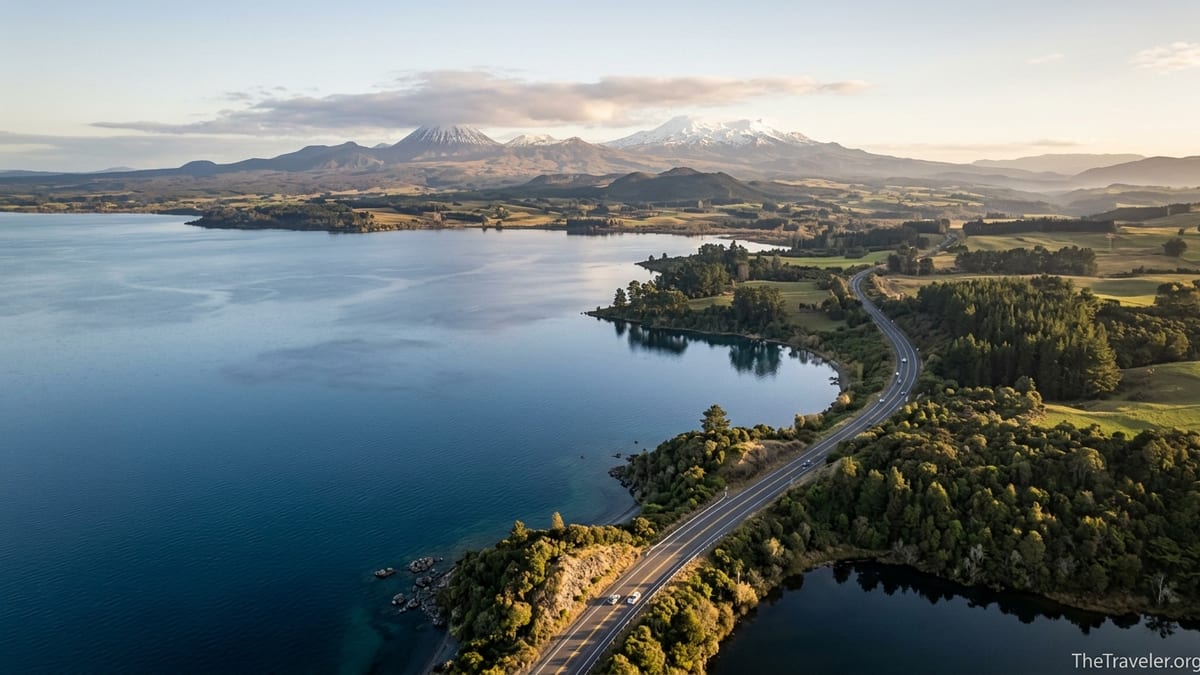
From Rotorua it is around an hour to an hour and a half to Taupō, depending on stops. Lake Taupō is a natural place to pause again, offering lakefront walks, boat trips to see the Ngatoroirangi Mine Bay Māori rock carvings, and side trips to Huka Falls or nearby hot streams that remain free to access. Continuing south, Tongariro National Park is about a further 1.5 to 2.5 hours’ drive depending on where you stay, with alpine villages like Whakapapa and National Park Village providing bases for day hikes, winter skiing, or scenic chairlift rides on Mount Ruapehu. Official guidance describes Tongariro as 4 to 5 hours by road from either Auckland or Wellington, which makes it a natural mid-point rather than a casual side stop.
Building Realistic Routes in the 3–7, 8–14 and 15+ Day Bands
Thinking in ranges instead of fixed day counts makes it easier to shape the classic spine to your own style. At the shortest end, in the 3–7 day band, an Auckland to Wellington road trip works only if you are happy to prioritise transit over depth. A common pattern might be a night in Auckland, then Rotorua and Taupō or Tongariro, and a final night or two in Wellington, with one or two key paid experiences such as a geothermal park or a half-day Māori cultural evening. These compressed trips often skip branch destinations altogether to avoid driving high-mileage loops.
In the 8–14 day range, you can usually afford a more relaxed version of the spine and one or two detours. For example, you might start with a couple of nights in Auckland, including a day trip by ferry to Waiheke Island’s vineyards, then follow the Waikato–Rotorua–Taupō–Tongariro progression down the island. With around ten to twelve days, you could add either a Coromandel beach escape or a Northland excursion at the beginning, or perhaps a Taranaki or Hawke’s Bay loop partway through, without driving all day every day. Travellers in this middle band often find it easiest to fly into Auckland and out of Wellington on a multi-city ticket, avoiding the time and fuel cost of circling back.
Once you reach 15 days or more in the North Island, it becomes feasible to connect two branches as long as you stay disciplined. One real-world example is a three-week independent itinerary that spends roughly a week between Auckland, Northland and the Bay of Islands, another week exploring the geothermal spine and Tongariro, then several nights each in Hawke’s Bay and Wellington. Even here, coaches, local advisors and trip reports consistently warn against trying to add Mount Taranaki plus both coasts without dropping something else or extending the trip further. Time needs to be left for weather-related changes, rest days, and spontaneous detours, such as stopping at a short riverside walk you spot on a roadside sign.
Across all three bands, the acid test for realism is your ratio of activity hours to driving hours. If you are consistently in the car for four or more hours every day, and paying for two or three ticketed attractions on top of that, fatigue and budget pressure mount quickly. A well-structured North Island itinerary usually includes several days where you move very little by car, perhaps walking around Wellington’s waterfront or cycling a section of the Great Lake Trail near Taupō, balanced by a few longer transfer days where the road itself is the main event.
Coromandel and Northland: Beautiful but Backtracking if You Are Short on Time
Coromandel Peninsula and Northland, including the Bay of Islands and the long reach toward Cape Reinga, are two of the most seductive names that appear on maps as you plan routes from Auckland. Both offer dramatic coastlines, golden beaches and relaxed small towns. Both also sit off the straight line between Auckland and Wellington, which makes them prime culprits in overstuffed itineraries. Choosing one as a focus, especially in the 3–7 or 8–14 day ranges, often delivers a much better experience than attempting both.
The Coromandel Peninsula sits a relatively manageable drive from Auckland. Depending on traffic and your exact destination, you might spend two and a half to three hours reaching Thames or Whitianga, with the route across the Kopu–Hikuai road taking you to east coast favourites like Tairua and Whangamatā. Many New Zealanders treat Coromandel as a long-weekend escape, booking a holiday park cabin near Hahei to visit Cathedral Cove or digging their own hot pool in the sand at Hot Water Beach. If you are building an itinerary around the Auckland–Rotorua–Wellington spine, Coromandel works best as an opening chapter before you swing south through the Bay of Plenty to Rotorua, avoiding a full return to Auckland.
Northland and the Bay of Islands require more commitment. It is about three to four hours’ drive from Auckland to Paihia in the Bay of Islands in good conditions, with additional time if you press further north to Ahipara, Ninety Mile Beach or Cape Reinga. Many organised tours make a point of staying at least two nights in the Bay of Islands to allow for a cruise to the hole-in-the-rock formations, a visit to the Waitangi Treaty Grounds, and time in small historic towns like Russell, reached by a short vehicle ferry. Pushing all of that into a single night stay leaves you rushed and vulnerable to cancellations if a boat trip is called off due to weather.
The backtracking problem arises when travellers attempt to combine both Coromandel and Northland on a short itinerary before dropping down the centre of the island. On the map it can look like a gentle loop. In reality it means driving north from Auckland to the Bay of Islands, then returning past Auckland again to reach the Coromandel turnoff, then swinging back inland through the Waikato to link up with Rotorua. Local advisors on travel forums often comment that this pattern fills your days with motorway time rather than beaches and walks. Unless you are in the 15+ day band and genuinely enjoy driving, it is usually wiser to choose either “Far North plus central spine” or “Coromandel plus central spine,” not both.
Adding Taranaki or Hawke’s Bay Without Breaking the Trip
South of the central plateau, the North Island bows out to the west around Taranaki and to the east toward Hawke’s Bay. Both regions reward a detour with distinctive scenery and food culture. The key is to route them cleverly so that they form a curve rather than a zigzag, and to accept that each adds at least one extra long driving day to your Auckland–Wellington journey.
Taranaki is dominated by the near-perfect volcanic cone of Mount Taranaki and the surrounding Egmont National Park. The hub city of New Plymouth has built a reputation for good dining and its coastal walkways. Reaching Taranaki requires leaving the classic spine somewhere around Te Kuiti or Taumarunui and angling southwest, or dropping down from the Tongariro region via Whanganui. Either way, you are looking at several hours of extra driving on top of the central route. For example, a real-world itinerary might drive Taupō to New Plymouth in around four and a half hours, spend two nights there for short hikes like the Pouakai Tarns track and gallery visits, then continue south another four hours to Wellington. That pattern adds depth without bouncing back and forth across the island.
Hawke’s Bay, anchored by Napier and Hastings, sits on the east coast and is known for vineyards, art deco architecture and generally sunnier, drier weather than the central plateau. To include it, many road trippers drive southeast from Taupō to Napier, a route that takes roughly two hours in good conditions. They might spend two or three nights using a bicycle to tour cellar doors, joining a guided art deco walking tour in central Napier, and sampling the weekend farmers’ market in Hastings. From there, the onward drive to Wellington via the Wairarapa vineyards around Martinborough is another three and a half to four hours, turning the journey into a scenic east coast arc rather than a straight inland plunge.
Trying to include both Taranaki and Hawke’s Bay on a short North Island trip multiplies long driving legs. You might find yourself doing Taupō to New Plymouth, then cutting diagonally across the island again to reach Napier before finally turning south to Wellington. That routing can mean three consecutive days of three to five hours on the road. For some visitors, especially those used to long highway stretches at home, that is acceptable. For many, it undermines the point of coming to New Zealand, where a two-hour walk through native forest or a lingering lunch at a winery can be the highlight of an entire trip.
Wellington and One-Way Routes vs Loops Back to Auckland
How you end your North Island trip influences everything that comes before it. Many international visitors fly into Auckland and out of Wellington on a single ticket, or continue from Wellington to the South Island by ferry and domestic flight. That pattern lends itself to a one-way Auckland to Wellington route along the spine, with or without branches. In these cases, your focus is on choosing where to turn off and rejoin the core, not on circling back.
Wellington itself deserves more credit than it sometimes gets on rushed itineraries. Two nights in the capital allows for a relaxed wander along the waterfront, time at Te Papa, the national museum, and an evening ride on the historic cable car up to the Botanic Garden. Film fans often add a visit to Wētā Workshop or a movie at one of the city’s boutique cinemas. If you have structured your trip sensibly, Wellington becomes a place to slow down at the end, returning your rental car before exploring the compact central city on foot rather than spending your last day on the road.
Loops that return to Auckland are best reserved for visitors who have both the time and a particular reason to finish where they started, such as dropping a campervan back to a specific depot or catching a long-haul flight that only departs from Auckland. A common mistake is to design a two-week loop that runs Auckland–Northland–central spine–Wellington–Taranaki–Coromandel–Auckland. While it technically fits on a calendar, almost every travel day ends up being three to five hours of driving, with fuel, ferry crossings and parking adding up. Given that domestic flights between Wellington and Auckland are frequent and often reasonably priced when booked ahead, a point-to-point route is usually kinder on both your energy levels and your wallet.
Regardless of whether you loop or run one-way, factor in real-world constraints like seasonal daylight and weather. In winter months, central plateau roads near Tongariro and the Desert Road can experience snow and ice, sometimes triggering closures or chain requirements. In summer, holiday traffic can slow the approach to beach towns such as Whitianga or Paihia significantly. Building short “buffer” days into your itinerary, where your only fixed commitment is reaching a town an hour or two away, helps you absorb these hiccups without missing a pre-paid experience or arriving at your accommodation late at night.
The Takeaway
The strongest North Island itineraries from Auckland are not the ones that tick every regional box, but those that follow a clear spine and add only the detours that genuinely fit your time band. The Auckland–Waikato–Rotorua–Taupō–Tongariro–Wellington route is popular for good reason: it threads together geothermal landscapes, lakes, Māori culture, alpine scenery and a vibrant capital in a logical line. Each branch you consider, whether Coromandel’s beaches, Northland’s bays, Taranaki’s volcanic cone or Hawke’s Bay’s vineyards, should be weighed against the driving time it adds and the experiences you would need to drop elsewhere.
Tourism New Zealand’s own grouping of itineraries into 3–7, 8–14 and 15+ day ranges is a useful reality check. In the shortest bracket, resist the urge to go both far north and deep south. In the middle range, pick one or two branches that turn your trip into a story rather than a checklist. Once you have 15 days or more, you can start to weave loops that include two or even three additional regions, as long as you accept a few extended driving days and leave space for rest, weather and serendipity.
Above all, remember that New Zealand rewards those who travel slowly. Whether you are soaking in a Rotorua hot pool as steam rises into cool evening air, pausing at a roadside lookout over Lake Taupō, or following a Māori guide through native forest, the memories that stay with you will rarely be from the driver’s seat.
FAQ
Q1. Is it realistic to drive from Auckland to Wellington in one day as a tourist?
It is physically possible, with a direct driving time of around 8 to 9 hours, but for most visitors it is not enjoyable. You would have little time to stop at places like Rotorua, Taupō or Tongariro, and driving several unfamiliar hours in the dark at the beginning or end of the day adds stress. Breaking the journey with at least one overnight stop turns the road into part of the holiday instead of a long transfer.
Q2. How many days do I really need for the classic Auckland–Rotorua–Taupō–Tongariro–Wellington route?
Many travellers find that about a week allows them to experience the main highlights without racing. That might mean one or two nights in Auckland, one in Rotorua, one in Taupō or Tongariro and two in Wellington, with time for one or two geothermal parks, a lake activity and a short walk in the national park. With more time you can simply stretch those stays rather than adding too many extra regions.
Q3. Should I choose Coromandel or Northland if I only have limited time?
If you are in the 3–7 or 8–14 day range, it is usually better to choose one. Coromandel fits more neatly into an Auckland–Rotorua–Wellington spine because you can continue south via the Bay of Plenty, while Northland and the Bay of Islands require you to go north first and then return past Auckland. Either offers beautiful beaches and coastal scenery, so your choice can be based on specific interests like Cathedral Cove and Hot Water Beach in Coromandel, or historic sites and island cruises in Northland.
Q4. Is it possible to visit both Taranaki and Hawke’s Bay on the same North Island trip?
Yes, it is possible, but it makes most sense when you have 15 days or more. Combining both regions will add several long driving legs, such as crossing from the central plateau to New Plymouth and later turning back toward Napier before heading to Wellington. If your time is shorter, picking one of these regions often leads to a more relaxed trip and gives you a reason to return.
Q5. Do I need a four-wheel drive vehicle for the North Island road trip?
For the classic Auckland–Rotorua–Taupō–Tongariro–Wellington route and side trips to Coromandel, Northland, Taranaki or Hawke’s Bay on sealed roads, a standard two-wheel drive rental car is usually sufficient. Most major attractions and towns are connected by paved highways. A four-wheel drive may be useful only if you plan on specific unsealed back roads, remote beach access or certain seasonal ski field roads, and those are typically marked in rental agreements.
Q6. How should I plan for fuel and food costs on this route?
Fuel prices in New Zealand can feel high compared with some countries, and smaller towns along the route may have more expensive service stations than major centres. As a rough planning tool, many visitors budget enough to fill a mid-size rental car every few days, then adjust once they see real prices. For food, expect to pay city café prices in most tourist hubs, with simple lunches like a sandwich and coffee often reaching NZD 20 to 30 per person. Self-catering with supermarket groceries helps keep costs under control on longer trips.
Q7. Is public transport a viable option for this kind of North Island itinerary?
Intercity buses and a few coach tour operators do connect Auckland, Rotorua, Taupō, Tongariro towns and Wellington, and some travellers successfully stitch together a route using these services plus local shuttles. However, public transport makes it harder to reach side-trip regions such as Coromandel beaches, parts of Northland, or rural wineries in Hawke’s Bay. If you prefer not to drive, look at guided small-group tours or focus on fewer hubs with good day-trip infrastructure.
Q8. When is the best time of year to drive the central North Island route?
Summer and early autumn, from roughly December to April, offer longer daylight, generally more stable weather and easier driving conditions, though popular spots can be busy and accommodation costs higher. Winter brings snow to the central plateau and ski season to Mount Ruapehu, which appeals to some travellers but also increases the chance of road warnings or closures near Tongariro. Shoulder seasons can be a sweet spot if you are flexible and prepared for cooler, changeable weather.
Q9. Can I include both the far north and the lower North Island in a short trip?
Trying to cover both the far north around the Bay of Islands and Cape Reinga, and the full central and lower North Island down to Wellington, in under a week or so forces you into constant long drives. You might find yourself spending most of your days on highways with only brief stops at the very attractions you came to see. It is usually better to choose either a “Far North focused” itinerary that turns back to Auckland, or a “Central and South” trip that runs from Auckland to Wellington, especially if this is your first visit.
Q10. How far in advance should I book accommodation and key activities?
In peak periods such as the New Zealand summer school holidays or major event weekends in cities like Wellington or Napier, popular motels, holiday parks and key activities can book out weeks or months ahead. It is wise to secure accommodation in places like Rotorua, Taupō and Tongariro as soon as your dates are firm, especially if you want specific room types. Activities such as Hobbiton tours, guided geothermal walks or Tongariro shuttles also benefit from advance booking, while everyday things like casual dining can usually be left to the day.