


Boiling mud pools, vivid mineral terraces and geysers erupting against a backdrop of native bush are some of the most memorable sights on New Zealand’s North Island. The challenge for many travelers is not finding geothermal experiences, but choosing between the many parks clustered around Rotorua and Taupō. With admission prices, walking distances and family needs to weigh up, it rarely makes sense to buy tickets to every attraction. This guide compares the major geothermal parks so you can confidently pick one or two that fit your time, budget and interests.
Understanding North Island Geothermal Landscapes
New Zealand’s central North Island sits on the Taupō Volcanic Zone, a geologically active corridor stretching from White Island offshore to south of Lake Taupō. Here, magma sits closer to the surface than in most parts of the world, heating underground water and creating the steam vents, hot springs and geysers that define Rotorua and Taupō. Visitors experience this in different ways, from short boardwalk loops through steaming craters to half-day hikes in lush valleys scarred by past eruptions.
In simple terms, geysers are hot springs that erupt. Superheated water and steam build up in a chamber underground and then shoot out through a narrow vent, sometimes reaching many metres into the air. By contrast, colourful pools like Rotorua’s Champagne Pool or Orakei Korako’s Emerald Terrace are more static features where minerals and heat-tolerant microbes create vivid oranges, greens and blues around the water’s edge. Both are products of the same volcanic forces, but they feel very different in person, and that distinction is useful when deciding which parks to visit.
Because the region is compact, it is easy to overbook geothermal attractions. Many itineraries include a Rotorua-based park, a hot pool soak and sometimes a stop between Rotorua and Taupō such as Orakei Korako. In reality, most travelers only need one in-depth geothermal walk, plus a soak at a separate spa if desired. The key is choosing parks that complement each other rather than repeat the same mix of steaming vents, short walks and visitor centres.
Think of the parks in two broad categories: feature-focused sites where the highlight is a specific geyser or colourful terrace, and immersion-style sites where you spend longer walking through a wider landscape. Matching these types to your interests, mobility and schedule will help you avoid attraction fatigue while still feeling you have “done” New Zealand’s geothermal heartland.
Rotorua’s Flagship Parks: Te Puia, Wai-O-Tapu, Waimangu and Hell’s Gate
Te Puia sits on the edge of Rotorua and combines New Zealand’s largest active geyser, Pōhutu, with a strong Māori cultural component. A typical daytime visit involves a 60 to 90 minute guided walk through the Te Whakarewarewa geothermal valley, viewing geysers, mud pools and terraces, plus entry to the New Zealand Māori Arts and Crafts Institute and a kiwi conservation house. Evening packages add a cultural performance and hāngī-style dinner. This makes Te Puia a logical choice if you want geothermal scenery and an introduction to te ao Māori in a single ticket.
About a 20 to 30 minute drive south of the city, Wai-O-Tapu Thermal Wonderland is the park most associated with surreal colours. The Champagne Pool, Artist’s Palette and neon-green Devil’s Bath are among the most photographed geothermal features in the country. Well-marked walking loops range from roughly 30 to 75 minutes, so you can tailor the visit to your energy level, but much of the value is visual rather than cultural. Families often time their visit to coincide with the late-morning activation of Lady Knox Geyser, a managed eruption reached by a short drive from the main entrance.
Waimangu Volcanic Valley, slightly further along the same highway, offers a more expansive, nature-heavy experience. The main valley walk is around 3.6 kilometres one way on wide gravel and boardwalk paths, with shuttle buses connecting points so you can shorten or lengthen your walk. The valley was created by the 1886 Mount Tarawera eruption, and several features such as Frying Pan Lake and Inferno Crater sit within regenerating native bush. Many visitors add a boat cruise on Lake Rotomahana to see geothermal activity along the lake edge, turning this into a half-day outing where the emphasis is on landscape and ecology rather than a single star feature.
Hell’s Gate, on the eastern side of Rotorua, combines a compact geothermal walk with a spa famous for its mud baths and sulfur pools. The walking track is shorter than Waimangu or Wai-O-Tapu and focuses on intense, steaming mud fields and hot water cascades. After the loop, most guests change into swimwear to soak in shared mud baths for a set time, followed by access to sulfur hot pools with views across the geothermal field. This dual format appeals to travelers who want an active but not overly long walk, followed immediately by a therapeutic soak in conditions that feel rugged and elemental rather than resort-like.
Taupō’s Alternatives: Orakei Korako and Craters of the Moon
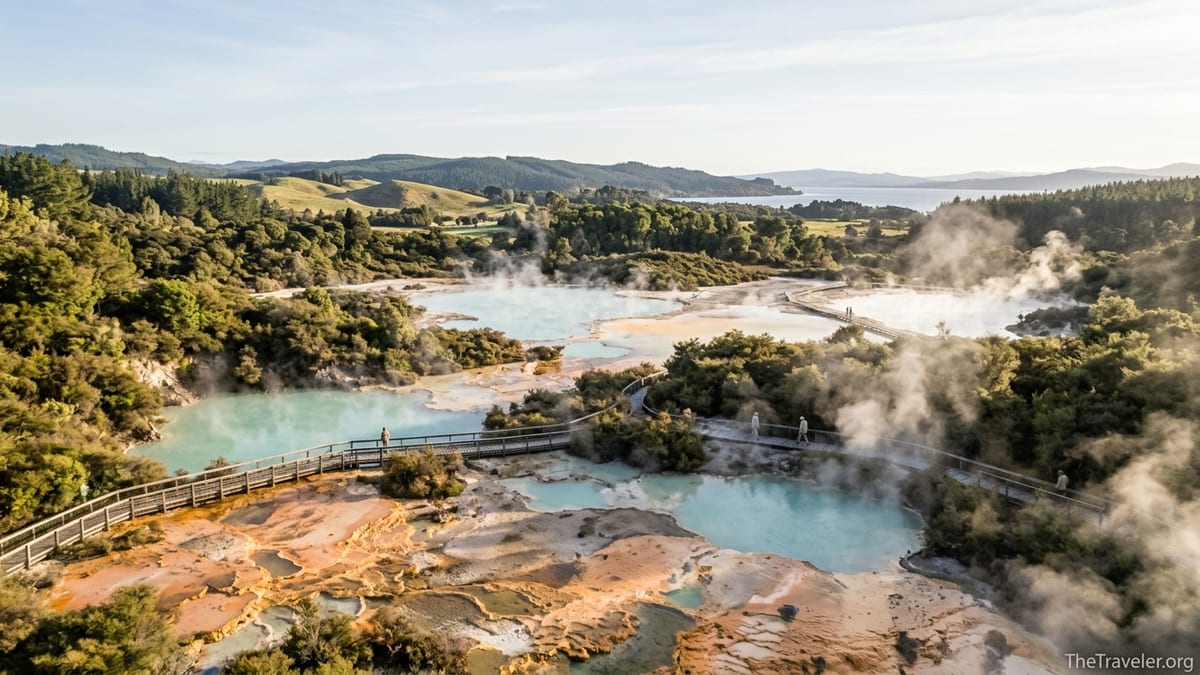
Between Rotorua and Taupō, Orakei Korako offers one of the region’s most dramatic combinations of terraces and pools without the urban development that surrounds Rotorua’s in-town sites. Reached by a short detour off State Highway 1, the park begins with a brief boat ride across the river to the geothermal field. Once there, raised boardwalks lead visitors past steaming vents, bubbling mud and broad silica terraces streaked in orange, yellow and white. Walk times vary, but most people spend about 60 to 90 minutes exploring at a relaxed pace, stopping frequently for photographs.
Orakei Korako’s appeal lies in its sense of isolation and the way the terraces drop into the surrounding bush. On a misty morning the entire valley can feel otherworldly, with steam drifting across the river and the sound of boiling water echoing up the slopes. There is minimal built-up infrastructure beyond paths and viewing platforms, so the focus is squarely on geology and scenery rather than cultural performances, though interpretive panels explain the Māori history of the area.
Closer to Taupō township, Craters of the Moon provides a budget-friendly introduction to geothermal landscapes. The main loop walk is about 2.7 kilometres and takes around 45 minutes on easy boardwalks and compact gravel, with an optional short climb to a higher lookout. Visitors pass low craters, fumaroles and steaming ground rather than tall terraces or large geysers, so the scale is more modest but still engaging. The lower admission price compared with Rotorua’s marquee parks makes it attractive for families or anyone wanting a quick geothermal fix before or after exploring Lake Taupō.
For Taupō-based travelers, a practical pattern is to pair Craters of the Moon with a lake cruise or a visit to the town’s hot-water lakefront shallows rather than driving back to Rotorua for another geothermal park. Those driving between the two centres often choose either Orakei Korako or a Rotorua attraction, not both, unless they have a particular interest in geothermal geology and plenty of time.
Experiences Compared: Geysers, Colours, Walking Time and Accessibility
If your priority is seeing a powerful geyser, Te Puia is the most reliable choice. Pōhutu Geyser erupts frequently and often reaches impressive heights, so visitors have a strong chance of witnessing an eruption during a standard visit. Wai-O-Tapu’s Lady Knox Geyser is activated at a scheduled time using surfactant, which guarantees an eruption but makes the experience feel more managed and less spontaneous. Orakei Korako, Waimangu and Craters of the Moon do not feature tall, regularly erupting geysers as their central draw.
For vivid colours, Wai-O-Tapu and Orakei Korako stand out. Champagne Pool’s deep turquoise water ringed by orange sinter and the luminous green Devil’s Bath at Wai-O-Tapu, plus the cascading silica terraces at Orakei Korako, provide the most striking photographs. Hell’s Gate leans more toward textures and raw power, with thick grey mud and aggressive steam, while Waimangu’s Inferno Crater and Frying Pan Lake add pockets of turquoise and milky blue set within softer, green surroundings.
Walking time and accessibility vary considerably. Te Puia’s guided circuits can be tailored for different mobility levels, and much of the core area is on solid, gently graded paths suitable for most visitors who can manage moderate walking. Wai-O-Tapu and Orakei Korako involve more steps and undulating paths, which can be tiring for small children or anyone with limited mobility, particularly in hot, sulfurous conditions. Waimangu’s valley walk is longer but relieved by shuttle buses, making it a good option for reasonably active travelers who like to walk but do not want a strenuous hike.
Craters of the Moon is among the easiest for those seeking a short, low-impact outing, as the main loop is relatively flat and designed to be accessible for a wide range of ages. Hell’s Gate’s geothermal walk is compact but includes some uneven, natural surfaces. When deciding, consider not only the raw distance but also the smell of sulfur, the potential heat on exposed paths and the cumulative effect of walking several geothermal parks in consecutive days.
Māori Culture, Spas and Mud Bathing
Not all geothermal parks integrate Māori culture to the same degree. Te Puia is explicitly both a geothermal valley and a Māori cultural centre, with a carved meeting house, performances, guided storytelling and the Māori Arts and Crafts Institute where you can observe carvers and weavers at work. Evening packages that combine a guided tour, cultural performance and hāngī-style dinner create a structured introduction to Māori culture that many first-time visitors to Aotearoa value.
Waimangu and Wai-O-Tapu present their landscapes primarily through geological and environmental interpretation, though both acknowledge Māori place names and stories in signage and guide material. Orakei Korako also includes some cultural context but does not offer performances or large-scale cultural programming. Craters of the Moon is more of a straightforward nature walk, focused on the geothermal phenomena created by the broader Wairākei field.
For spa and mud experiences, Hell’s Gate is the standout among the geothermal parks, offering dedicated mud baths followed by sulfur spa pools overlooking the steaming valley. Visitors typically book combined passes that include the geothermal walk and spa time, so you move from viewing bubbling mud to immersing yourself in it. In Rotorua, many travelers also compare this with stand-alone spa facilities in town, such as lakeside hot spring complexes, which lack their own geothermal walks but offer a wider variety of pools and often quieter relaxation zones.
Those staying in Taupō can access lakefront hot-water shallows where warm geothermal streams meet the cool lake, as well as local hot pool complexes. These complement, rather than duplicate, parks like Orakei Korako and Craters of the Moon. A practical strategy is to separate your “walking through geothermal valleys” experience from your “soaking in hot mineral water” time, rather than expecting a single park to excel equally at both.
Family Suitability and Photography Considerations
Families with young children often prioritise short walking distances, clear safety barriers and affordable entry. Craters of the Moon and Te Puia both fit this brief reasonably well. Craters of the Moon offers a relatively low-cost loop that can be completed in under an hour and features plenty of steam and bubbling vents to keep children engaged. Te Puia adds variety with kiwi viewing and cultural elements that break up the geothermal focus, although ticket prices are higher and guided tours follow a set rhythm that may not match every child’s pace.
Wai-O-Tapu and Orakei Korako are excellent for older children and teenagers who enjoy dramatic visuals, but the smell of sulfur can be strong and the paths more exposed to sun and weather. Waimangu’s longer valley route is well suited to families who like walking and have at least half a day to spare; the shuttle buses provide flexibility for tired legs. Hell’s Gate is best for families with children old enough to follow safety instructions carefully, as the geothermal features are intense and the mud baths require calm behaviour around hot, slippery surfaces.
From a photography perspective, Wai-O-Tapu and Orakei Korako offer the boldest colours and most recognisable images, especially under bright but slightly overcast skies that reduce harsh reflections. Te Puia provides strong compositions of Pōhutu Geyser framed by terraces and carved structures, particularly in the golden hour when steam catches the light. Waimangu’s longer trails reward photographers who enjoy layering foreground vegetation with steaming lakes and distant ridgelines, while Hell’s Gate lends itself to close-up shots of churning mud and mineral formations.
Practical tips include bringing a lens cloth for condensation, as steam can quickly mist camera lenses and phone screens. Sturdy footwear is important; while you are not walking off-track, boardwalks and paths can be damp and slightly slippery. In sulfur-rich environments, some travelers prefer using a weather-sealed camera body or being prepared to wipe down equipment afterwards, though for most visitors a smartphone or small camera used sensibly is sufficient.
How Many Geothermal Parks Do You Really Need?
For a typical North Island holiday of 7 to 14 days, most travelers will be well served by visiting one substantial geothermal park plus one additional, contrasting experience. More than that can feel repetitive unless you have a strong interest in geology or are deliberately exploring the region in depth. Because the ticket prices at marquee parks add up quickly for couples and families, choosing carefully can free budget for activities such as lake cruises, canopy walks or cultural evenings.
If Rotorua is your base and you want a balanced overview in a single ticket, Te Puia is often the best “one-stop” choice thanks to its combination of a major geyser, mud pools, cultural content and kiwi viewing. Travelers who are less interested in performances and more drawn to vivid colours and walking often choose Wai-O-Tapu or Waimangu instead. Wai-O-Tapu delivers maximum visual impact in a relatively compact visit, whereas Waimangu offers a quieter, more immersive half-day with a strong sense of landscape history.
Hell’s Gate works well for those who specifically want the novelty of a mud bath alongside a geothermal walk; it pairs neatly with a different park like Waimangu or Craters of the Moon, because its focus is more on spa and tactile experience than on extensive trails. Around Taupō, Craters of the Moon is a sensible option if you have limited time or are watching costs, while Orakei Korako rewards those willing to make a small detour and devote around two hours to a more substantial walk and ferry ride.
Travelers driving between Rotorua and Taupō might reasonably plan just one paid geothermal park between the two centres, then add free geothermal touches such as lakefront hot-water spots, public footbaths or short walks to steaming vents. The key is to aim for variety: for example, pairing a culture-rich geyser park like Te Puia with a nature-heavy valley like Waimangu, or matching a colourful terrace site such as Orakei Korako with a relaxed soak at a town spa. That way you leave the region feeling you have seen both the drama and the quieter side of its volcanic heart.
The Takeaway
New Zealand’s central North Island offers more geothermal experiences than most trips can accommodate, so focusing on your priorities is essential. Decide whether your main motivation is to see a powerful geyser, photograph surreal colours, walk through an evolving volcanic landscape, connect with Māori culture or sink into a mud bath. Once you are clear on those goals, choosing one or two parks becomes far easier than trying to fit in every name you have heard.
In broad terms, Te Puia is the strongest all-rounder for visitors based in Rotorua, Wai-O-Tapu and Orakei Korako excel in colourful terraces and photographic impact, Waimangu is the choice for longer, scenic walks in a living valley and Hell’s Gate is unmatched if you want to combine a geothermal stroll with therapeutic mud bathing. Around Taupō, Craters of the Moon and lakefront hot-water spots offer accessible, good-value alternatives that are particularly appealing for families and road-trippers.
Whatever combination you choose, remember that geothermal sights are only one part of the story. Combining a park visit with quiet time in native forest, on the lake or at a cultural event will give you a more rounded sense of the region. By resisting the urge to tick off every geothermal park and instead choosing thoughtfully, you will leave Rotorua and Taupō with vivid memories rather than a blur of steam and sulfur.
FAQ
Q1. If I only have time for one geothermal park in Rotorua, which should I choose? Te Puia is the most versatile single choice, combining New Zealand’s largest active geyser, a compact geothermal valley, Māori cultural performances and craft demonstrations, plus a kiwi viewing area, so you experience several highlights in one visit.
Q2. How many geothermal parks should I plan for on a typical North Island trip? Most travelers will find that one major geothermal park plus one contrasting experience, such as a different style of valley walk or a mud bath spa, is enough without feeling repetitive.
Q3. What is the best option for vivid colourful pools and terraces? Wai-O-Tapu near Rotorua and Orakei Korako between Rotorua and Taupō are the top choices for bright mineral colours, including Champagne Pool and broad silica terraces that photograph particularly well.
Q4. Which geothermal attraction is best if I am staying in Taupō and do not want to drive far? Craters of the Moon is close to Taupō township, offers a straightforward 45 minute loop walk on easy paths and provides a good introduction to steaming craters and vents at a relatively modest cost.
Q5. Where can I experience Māori culture alongside geothermal features? Te Puia is the leading option for combining geothermal sights with Māori cultural performances, storytelling and visits to the Māori Arts and Crafts Institute, making it ideal if you want both aspects in a single outing.
Q6. Which geothermal parks are most suitable for young children? Te Puia and Craters of the Moon are often the easiest with younger children because walks are relatively short and varied, while Waimangu suits families who enjoy longer but manageable walks with shuttle options for tired legs.
Q7. I want a mud bath and hot pools rather than a long walk. Where should I go? Hell’s Gate near Rotorua is the most focused on mud and sulfur spa experiences, offering a short geothermal walk followed by dedicated mud baths and hot pools overlooking the steaming landscape.
Q8. Are the geothermal parks accessible in bad weather? Light rain and cool temperatures can actually enhance the steam effects, but heavy rain or strong winds make paths less pleasant and can affect visibility, so it is wise to carry a rain jacket and check local conditions on the day.
Q9. Do I need to book geothermal parks in advance? Booking ahead is recommended in peak holiday periods or when adding extras such as cultural dinners or spa sessions, while basic daytime entry to many parks is often available on arrival outside of the busiest weeks.
Q10. Can I visit both Rotorua and Taupō geothermal sites on the same day? It is physically possible to combine, for example, a morning at Te Puia and an afternoon stop at Craters of the Moon or Orakei Korako while driving between the towns, but most travelers will enjoy their trip more by focusing on one substantial park and allowing unhurried travel time.