


Driving from Auckland to Wellington through the centre of New Zealand’s North Island packs geothermal pools, film sets, glowworm caves and volcanic peaks into one compact journey. With smart routing, overnight stops and a clear plan for your rental car or campervan, this stretch of State Highway 1 and its side roads becomes a memorable road trip rather than a long haul between cities.
Why drive from Auckland to Wellington through the middle of the North Island
The most direct Auckland to Wellington drive takes around eight to nine hours of pure driving, but treating it as a two to five day road trip through the island’s core landscapes is far more rewarding. Instead of skirting the coast, you follow the “thermal corridor” through Hobbiton and Rotorua, then track around Lake Taupō and into Tongariro National Park before rolling south to the capital.
This central route connects several of New Zealand’s headline experiences without major detours. In practical terms, that means you can leave Auckland after breakfast, be standing in front of Bag End at the Hobbiton Movie Set near Matamata by late morning, soak in Rotorua hot pools that evening, cruise across Lake Taupō the next day and sleep beneath the volcanic silhouettes of Tongariro or Ruapehu before continuing to Wellington.
New Zealand’s national tourism promotions often highlight Auckland–Rotorua–Taupō–Wellington as a logical spine for first‑time visitors. It also pairs naturally with a South Island itinerary, since you can drop a one‑way rental car in Wellington, walk onto the Cook Strait ferry as a foot passenger, and pick up another vehicle at Picton on the far side.
Because this route uses well‑maintained highways with frequent fuel stops and motels, it works for nervous international drivers as well as experienced road‑trippers. The key is spacing out drive days and being realistic about how much sightseeing you can fit between Auckland and Wellington in the time you have.
Key route choice: Hobbiton via Matamata or Waitomo Glowworm Caves
The first big decision is how you leave Auckland on day one. Both the Hobbiton Movie Set near Matamata and the Waitomo Glowworm Caves sit roughly two to three hours south of Auckland by car, but on different branches of highway. You can in theory do both in one long day, yet many travellers find that rushing between a three‑hour cave tour and a two‑to‑three‑hour guided film set visit feels compressed.
The Hobbiton route follows State Highway 1 south, then cuts across the Waikato farmland toward Matamata. Driving directly from central Auckland to the Shire’s Rest visitor centre near Matamata typically takes about two to two and a half hours in light traffic. Travellers often stop for coffee in the Waikato town of Cambridge or at a roadside café near Tirau before joining an afternoon Hobbiton tour and then continuing about an hour on to Rotorua for the night.
The Waitomo option branches off earlier toward the King Country. From Auckland to the Waitomo village car parks you should allow around two and a half hours of driving, more if you are unfamiliar with New Zealand’s winding rural roads. A classic day combines the main Waitomo Glowworm Cave boat tour or the Ruakuri Cave walk with lunch at the Waitomo village café. Later in the afternoon, you continue roughly two hours across to Rotorua via Ōtorohanga and the so‑called Thermal Explorer Highway.
If you are a devoted Lord of the Rings fan, routing via Matamata and Hobbiton early in the trip makes emotional sense. You can spend the morning on the road, take a midday or early afternoon movie set tour, and still arrive in Rotorua before dark. If you are more interested in nature than film locations, the underground glowworm constellations at Waitomo, along with short bush walks in the limestone country around the caves, may be the better first‑day focus.
Building a point‑to‑point itinerary with overnight stops
Most visitors spread the Auckland to Wellington drive across three to five days. A typical relaxed three‑night itinerary might look like this: Auckland to Rotorua on day one via either Matamata or Waitomo, Rotorua to Taupō on day two, Taupō to Tongariro or National Park Village on day three, then Tongariro to Wellington on day four.
On day one, picking up a rental car from a central Auckland depot around 8 am puts you at either Hobbiton or Waitomo late morning. After the tour and lunch, you continue to Rotorua, usually arriving around 5 pm. With this schedule you have enough time in the evening to check into accommodation, grab dinner along Eat Streat in central Rotorua and perhaps visit a hot pool complex such as the Polynesian Spa before bed.
Day two is deliberately shorter in the car so you can enjoy geothermal and cultural experiences. After breakfast, visit a geothermal park just outside Rotorua, then drive around one hour south to Taupō. The highway skirts steaming hillsides and lakes, so allowing time for short stops is worthwhile. In Taupō you can walk to Huka Falls lookout, take an afternoon lake cruise out toward the Māori rock carvings near Mine Bay, or simply sit along the lakefront with takeaway fish and chips while watching the sun set behind the central plateau.
Day three pushes deeper into Tongariro National Park. The drive from Taupō to Whakapapa Village on the western side of the park is around one and a quarter to one and a half hours, depending on traffic. Staying in or around Whakapapa or National Park Village positions you close to short alpine walks and, in winter, to the Whakapapa or Tūroa ski fields. On the final day, it is roughly a four and a half to five hour drive from the Tongariro area down through Taihape, Bulls and the Kāpiti Coast into central Wellington, not counting café and fuel stops.
Highlights along the Rotorua, Taupō and Tongariro corridor
Rotorua is the geothermal and cultural anchor of this road trip. In practical terms, that means steam vents puffing beside suburban streets, the fragrant smell of sulphur and plenty of structured activities. Families often spend an afternoon at Skyline Rotorua riding the gondola and luge tracks, while couples might prioritise a spa complex overlooking Lake Rotorua. In the evening, several Māori cultural experiences combine a hangi buffet dinner with traditional performance and storytelling.
The road from Rotorua to Taupō passes several worthwhile roadside stops. Many travellers schedule a morning visit to a geothermal park on the outskirts of Rotorua where boardwalks thread through bubbling mud pools and vividly coloured hot springs. Later, south of Rotorua, the highway descends toward Taupō with regular viewpoints over forests and lakes. Because the pure drive time is only around an hour, you can comfortably divert to attractions without risking night driving.
Lake Taupō itself is the largest lake in New Zealand and feels more like an inland sea, with small waves breaking on pumice stone beaches. The lakeside town has a compact centre with supermarkets, motels and lakefront bars. A common pattern is to arrive in Taupō by early afternoon, visit Huka Falls just north of town for the short walk to the viewpoints, then join a late‑afternoon lake cruise or sailing trip that takes in the rock carvings and returns in time for dinner.
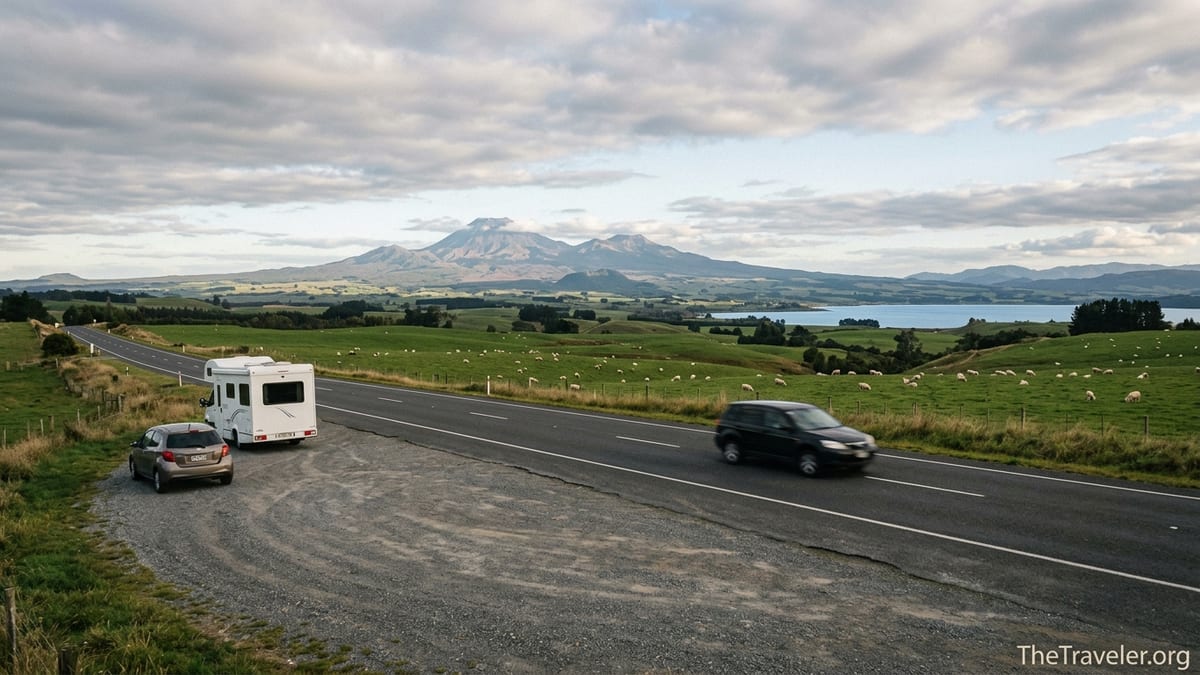
Further south, Tongariro National Park delivers classic North Island mountain scenery. Even for travellers who are not attempting the full Tongariro Alpine Crossing, there are accessible short walks around Whakapapa Village and the Taranaki Falls circuit that provide views of Mount Ruapehu and the other volcanoes. In clear weather, the drive between the plateau towns and the park entrances offers open vistas that contrast sharply with the rolling farmland further north.
Choosing between car and campervan on this route
Both conventional rental cars and campervans work well between Auckland and Wellington, but the experience differs. A mid‑size rental car from an international firm at Auckland Airport often costs less per day than a self‑contained campervan, especially once you factor in fuel. Petrol prices in New Zealand are relatively high, and larger motorhomes burn more per kilometre than compact hatchbacks.
With a car, you book separate accommodation in each stop, from simple motels in Taupō to lakeside holiday parks in Rotorua and lodges in Tongariro National Park. This can be ideal if you prefer proper beds, heating and private bathrooms. It also keeps you flexible: if heavy rain is forecast in Tongariro, for instance, you can adjust your bookings and spend an extra night in Rotorua or Taupō instead.
Campervans appeal to travellers who like the freedom of carrying their bed and kitchen with them. On this route, holiday parks with powered sites are common in Rotorua, Taupō and around the Tongariro area, many with communal kitchens and hot showers. However, you need to be comfortable with narrow bridges, higher vehicle profiles in crosswinds and stricter speed limits for large vehicles on some sections of highway. In shoulder seasons, chilly nights on the volcanic plateau can also make a well‑insulated van or access to a powered heater important.
One compromise some travellers adopt is to rent a smaller self‑contained camper or pop‑top van rather than a full motorhome. This reduces fuel use and makes parking in compact town centres such as Rotorua and Taupō easier while still allowing you to sleep on board at campgrounds.
Optional detours: Hawke’s Bay wine or Martinborough and the Wairarapa
If you have extra days, two of the strongest side trips from the core Auckland–Rotorua–Taupō–Tongariro–Wellington line are Hawke’s Bay and the Wairarapa wine country around Martinborough. Each adds driving but offers distinctive food and wine experiences that break up the volcanic landscapes.
The Hawke’s Bay detour usually branches off from Taupō. Instead of continuing south toward Tongariro, you head east over the hills to Napier and Hastings. This drive typically takes around two hours in good conditions. Many itineraries build in at least one night in Napier’s art deco streets, using it as a base for cycling between vineyards or visiting cellar doors by shuttle. From Hawke’s Bay, you then rejoin the route to Wellington by driving south to Waipukurau and on through the Wairarapa, a full day of driving with stops.
The Martinborough option suits those who want to keep the main central plateau route but add wine country near the end. After descending from the Tongariro area to the Kāpiti Coast and passing through the small city of Paraparaumu, you can continue straight into Wellington or detour over the Remutaka Hill Road into the Wairarapa. Martinborough is a compact town ringed by vineyards, and many visitors rent bikes to cycle between wineries. Staying a night here breaks the final stretch into two short drives and lets you arrive in Wellington rested rather than at the end of a long day behind the wheel.
Because both Hawke’s Bay and Martinborough add distance and time, they make the most sense on itineraries of at least a week for the North Island or for repeat visitors who have already seen the classic Rotorua and Taupō sights. For a first‑time trip with only three or four days between Auckland and Wellington, most travellers are better off focusing on the central spine rather than trying to touch every region.
One‑way rentals, drop‑off fees and round‑trip planning
Planning this drive as a one‑way rental from Auckland to Wellington is straightforward but requires attention to car hire terms. Major rental companies usually allow you to collect a vehicle in Auckland and drop it in Wellington, but they may apply a one‑way fee, especially in high season. This can range from a modest surcharge to a noticeable extra line on your invoice, though special offers sometimes waive it to encourage one‑way travel.
One common pattern is to land in Auckland, spend a night in the city without a car, then collect the vehicle the next morning and head south. At the southern end, you aim to drop the car at a Wellington city or ferry‑terminal depot in the late afternoon of your final driving day. If you plan to continue to the South Island, you can coordinate your drop‑off time with a late‑afternoon or early‑evening Cook Strait ferry sailing, walking on with your luggage and picking up a new rental car in Picton.
If your flights both arrive in and depart from Auckland, your planning changes. In this case you can still drive to Wellington and back, but many visitors instead choose a loop. One example: Auckland to Rotorua via Hobbiton, across to Napier in Hawke’s Bay, then up the east coast via Gisborne and back to Auckland, skipping Wellington altogether. Another approach is to drive Auckland to Wellington over several days, fly back to Auckland on a domestic flight and return the rental car in Wellington, avoiding the long northbound drive.
For travellers who do need to drive back to Auckland, consider varying your route to avoid simple repetition. You might drive south through Rotorua, Taupō and Tongariro, then return north via the west coast through Whanganui and New Plymouth, or vice versa. Alternatively, you can use the faster inland roads on the return leg, limiting stops to one overnight halfway, such as in Taupō or Hamilton, to keep the experience from feeling like a pure transit day.
The Takeaway
Turning the Auckland to Wellington journey into a central North Island road trip transforms what could be a long day in the car into a string of distinct experiences. The choice between routing via Hobbiton or via Waitomo on day one shapes the flavour of your trip from the outset, while Rotorua, Taupō and Tongariro provide a natural sequence of geothermal activity, lake scenery and alpine landscapes.
By allowing at least three nights between the two cities, choosing a vehicle type that matches your comfort level and building in optional detours only when time genuinely permits, you can keep daily drives manageable and still cover the North Island highlights. Whether you drop a one‑way rental in Wellington and sail south, or loop back to Auckland along a different corridor, this central route offers a concise introduction to the country’s volcanic heartland and some of its most recognisable sights.
FAQ
Q1. How many days do I need for an Auckland to Wellington road trip via Rotorua and Taupō? Most travellers find three to five days works well. Three nights lets you stay in Rotorua, Taupō and the Tongariro area before driving into Wellington on the final day.
Q2. Is it realistic to visit both Hobbiton and Waitomo on the same day when driving south? It is possible but feels rushed. You would need an early start from Auckland, a morning cave tour, then an afternoon Hobbiton tour and a later drive to Rotorua. Many visitors choose one highlight and enjoy a more relaxed first day.
Q3. Do I need to book Hobbiton Movie Set tours in advance for a road trip? Booking ahead is strongly recommended, especially in summer and around public holidays. Time slots can sell out and having a confirmed tour time helps you plan your driving day.
Q4. What is the safest driving season for the Tongariro and Ruapehu section of the route? Late spring, summer and early autumn usually offer clearer roads and more predictable weather. In winter, snow and ice are possible on higher sections, so you need to check conditions and allow extra time.
Q5. Are there enough fuel and food stops between Taupō and Wellington? Yes. The route passes regular service stations and small towns such as Turangi, Taihape, Bulls and Levin where you can refuel, buy snacks or sit down for a café meal.
Q6. Is driving a campervan more difficult than a car on this itinerary? Campervans are bulkier and slower on hills and in crosswinds, so you need to allow more time and be comfortable with a larger vehicle. The main highways are suitable, and holiday parks along the route make overnighting straightforward.
Q7. Can I do the Auckland to Wellington drive in one day if I am short on time? You can, but it means eight to nine hours of driving plus brief breaks, using the more direct highways and skipping major sightseeing. For most visitors, overnighting at least once, for example in Taupō, makes the journey safer and more enjoyable.
Q8. How do one‑way rental car fees affect this road trip? Some rental companies charge extra to drop a car in Wellington after collecting it in Auckland, especially in peak periods. Checking this fee when you book helps you compare one‑way versus round‑trip costs accurately.
Q9. Is it better to start the road trip immediately on arrival in Auckland or stay a night first? After a long international flight, staying at least one night in Auckland before driving south is usually wiser. It lets you rest, adjust to local time and get used to the idea of driving on the left before tackling highways.
Q10. What should I do if bad weather is forecast for the Tongariro National Park part of the route? Consider adjusting your schedule, such as adding a night in Rotorua or Taupō and shortening your stay in the mountains. Many road‑trippers keep plans flexible so they can shuffle nights if alpine walks or views are likely to be affected by cloud, rain or snow.