


Planning a North Island itinerary can feel like solving a beautiful puzzle. From black-sand surf beaches to steaming geothermal valleys, wine country to alpine volcanoes, New Zealand’s North Island packs a huge amount into manageable driving distances. The challenge is deciding what to include, especially on a short first trip of 7 to 14 days. This guide focuses on the island’s headline regions and helps you match them to your interests, travel style and time frame.
How to Use This North Island Destination Guide
Rather than ranking places, this guide helps you choose the right mix of beaches, geothermal areas, volcano hikes, cities and wine regions. It compares 12 key North Island stops: Auckland, Bay of Islands, Coromandel, Hobbiton and Matamata, Waitomo, Rotorua, Taupō, Tongariro, Mount Maunganui, Taranaki, Hawke’s Bay and Wellington. For each, you will find the main reason to visit, the travellers who will enjoy it most, a realistic minimum stay, approximate driving distances to the next logical stop, and whether it deserves a place on a short first-time itinerary.
Distances in this article are approximate and based on typical self-drive routes. For example, the drive from Auckland to Rotorua usually takes around three hours, depending on traffic, roadworks and weather. Many visitors pick up a rental car at Auckland Airport, loop clockwise through Coromandel, Rotorua, Taupō and Tongariro, then either head out to Hawke’s Bay and down to Wellington or cut back to Auckland.
Prices mentioned are indicative only and tend to change seasonally. As a rough guide, expect many popular paid experiences, such as Hobbiton Movie Set tours or guided glowworm caves in Waitomo, to fall in the NZD 80 to 150 range per adult. Simple accommodation like motels or holiday parks can range from around NZD 120 to 250 per night for a double room in busy periods.
City Foundations: Auckland and Wellington
Auckland is the main gateway to the North Island and a natural starting or ending point. The primary reason to visit is its harbour-and-volcano setting and food scene rather than famous monuments. Ideal travellers include urban explorers who enjoy neighbourhood-hopping, families wanting gentle warm-up days after a long-haul flight, and anyone planning day trips to nearby islands such as Waiheke for vineyards or Rangitoto for a short volcanic hike. A minimum useful stay is two nights so you have at least one full day to see central neighbourhoods like the waterfront, Ponsonby or Britomart and perhaps take a harbour ferry.
Auckland links conveniently to almost every other destination in this guide. It is about a three-hour drive to both Coromandel town and Rotorua, two and a half to Waitomo, four to the Bay of Islands and roughly five to Tongariro. On a short first trip, Auckland easily earns a place, but you can limit it to one or two days if you are more interested in nature than cities. For example, some visitors arrive, sleep near the airport to recover from jet lag, then head straight for the Bay of Islands or Coromandel the next morning.
Wellington at the southern tip of the island offers compact culture, a working harbour and access to the ferry to the South Island. The key reasons to come are its national museum, Te Papa, the café and craft beer scene, and its walkable hillside neighbourhoods connected by steep streets and the famous red cable car. Ideal visitors include culture lovers, food and drink enthusiasts and travellers continuing to the South Island by car ferry. Many people find one or two nights sufficient to visit Te Papa, stroll the waterfront promenade and enjoy a few meals and bars around Courtenay Place or Cuba Street.
The drive from Wellington to Tongariro National Park is around four to five hours, and from Wellington to Hawke’s Bay around three and a half to four hours. On a short North Island-only trip that starts and ends in Auckland, you can skip Wellington if time is tight. However, if you are connecting to the South Island or enjoy cities, it is a worthy finale, especially when combined with wine tasting in nearby Wairarapa on the way in or out.
Beach Time: Bay of Islands, Coromandel and Mount Maunganui
The Bay of Islands, several hours north of Auckland, is all about sheltered bays, island-dotted horizons and maritime history. Travellers who love boat trips, swimming with dolphins in season, coastal walks and laid-back small towns tend to enjoy it most. Paihia and Russell are the main bases, with short cruises that visit highlights such as the Hole in the Rock. A minimum useful stay is two nights so you can take at least one half-day boat tour and still have time for a sunset walk or a visit to the Waitangi Treaty Grounds. From Auckland, the drive to Paihia usually takes around three and a half to four hours in good conditions.
The Coromandel Peninsula, east of Auckland, appeals to travellers seeking scenic beaches, forested hills and a relaxed, slightly bohemian atmosphere. Well-known spots include Hot Water Beach, where visitors dig their own thermal pools in the sand near low tide, and Cathedral Cove, an iconic rock arch reached by boat, kayak or walking track when conditions and access rules allow. Beach lovers, photographers and road trippers who do not mind winding roads will get the most from Coromandel. One or two nights is a practical minimum; three gives time to explore multiple bays and short walks. The drive from Auckland to the eastern beaches such as Hahei or Whitianga often takes about three hours, depending on the route.
Mount Maunganui, near Tauranga, combines a broad surf beach, sheltered harbour, and a short summit hike on the volcanic headland known locally as “the Mount.” It suits families, beginner surfers and anyone wanting an easy, highly accessible beach stop. You can walk around or up the Mount in one to two hours, browse cafés on Maunganui Road and soak in the nearby saltwater hot pools. One or two nights is usually enough unless you want several days on the sand. Driving times between Mount Maunganui and Rotorua are about one hour, and to Hobbiton around one and a half, which makes it an efficient beach detour on a central North Island loop.
For a short first visit focused mainly on natural highlights, most travellers pick either the Bay of Islands or Coromandel as their primary beach destination, not both, to avoid long backtracking drives. Mount Maunganui often works best as a convenient overnight between Rotorua and the Coromandel or as a quick seaside break rather than a major focus of the trip.
Geothermal & Cultural Heartland: Rotorua and Taupō
Rotorua is the geothermal and Māori cultural hub of the North Island. Steaming vents, bubbling mud pools and colourful silica terraces can be seen in geothermal parks such as Wai-O-Tapu and Waimangu, both a short drive south of town. Visitors can walk boardwalk loops past rainbow-coloured hot pools or take boat cruises on crater lakes. Rotorua also hosts several evening cultural experiences where guests watch kapa haka performances and share hāngī-style meals cooked in earth ovens or steam. Many first-time visitors consider these experiences the most memorable introduction to Māori culture on their trip.
Families, photographers, culture seekers and those happy with slightly sulfurous air enjoy Rotorua. A realistic minimum stay is two nights so you can visit at least one geothermal valley, perhaps ride the Skyline gondola and luge, and attend a cultural evening without rushing. From Rotorua, it is roughly one hour to Taupō, two to Waitomo and just over three to Auckland, which makes it a central node on most itineraries. On a short trip, Rotorua almost always deserves inclusion because it combines geothermal activity, lakes, mountain biking in the Whakarewarewa Forest and cultural depth in one place.
Taupō, an hour south of Rotorua, sits on the shore of Lake Taupō, the country’s largest lake, formed by a massive volcanic eruption thousands of years ago. The town is a base for lake cruises, trout fishing, jet boating to the base of Huka Falls and scenic flights over the volcanic plateau. Adventure travellers and outdoorsy couples will appreciate Taupō’s options, from skydive operators to hot stream bathing at places such as Otumuheke Stream in Spa Thermal Park. A one- or two-night stay gives time for a cruise, a short walk and a visit to nearby hot pools or viewpoints.
Taupō also works as a staging point for Tongariro National Park. The drive from Taupō to the park’s main villages is roughly one and a quarter to one and a half hours. Travellers often base in Taupō and book a shuttle for the Tongariro Alpine Crossing, especially in summer months when the one-way logistics are easier from town. On a tight schedule that includes both Rotorua and Tongariro, you could stay one night in Taupō or simply stop for lunch and viewpoints en route to the park.
Volcano Country: Tongariro and Taranaki
Tongariro National Park, in the central North Island, is the country’s oldest national park and a UNESCO-listed dual World Heritage area, recognised for both its volcanic landscapes and cultural significance. The main draw is the Tongariro Alpine Crossing, a demanding day hike of about 19 kilometres that traverses crater basins, passes bright alpine lakes and descends through forest. In good weather, the trail offers views of Mount Ngauruhoe, which appeared as a stand-in for a fictional volcano in a major film trilogy. Hikers and fit travellers who are comfortable with changing mountain weather, exposed sections and steep descents are best suited to the Crossing.
A minimum useful stay at Tongariro is two nights, particularly if you want a weather buffer. Accommodation is centred in villages such as National Park, Whakapapa and Turangi. Shuttles to the Crossing trailheads typically cost the equivalent of several tens of dollars per person, with departures timed to suit average walking speeds. From Rotorua, allow about two and a half hours’ drive to the Whakapapa side of the park; from Wellington or Auckland, plan on four to five hours. On shorter itineraries, Tongariro is worth including if hiking a world-class alpine trail is a top priority; otherwise, you might focus on Rotorua and Taupō for easier access to lakes, shorter walks and hot springs.
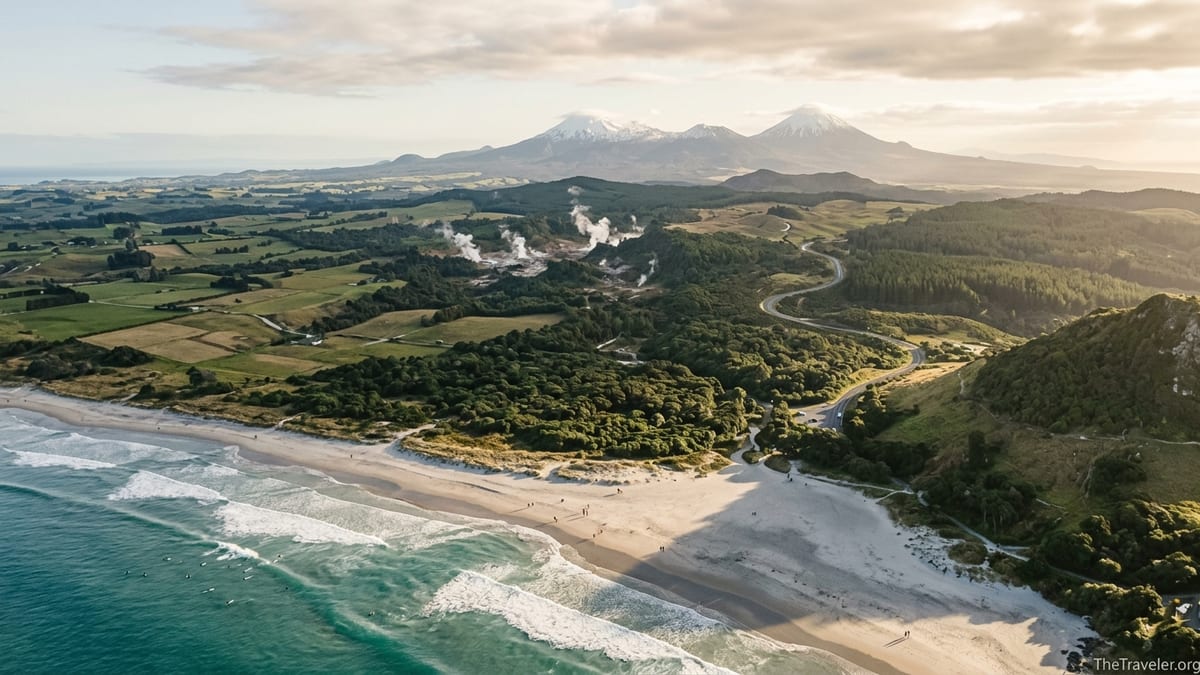
Mount Taranaki, further west, is another perfectly shaped volcanic cone offering superb day hikes and photography. The surrounding region feels less visited than Rotorua or Taupō, which appeals to independent travellers and hikers seeking quieter trails. New Plymouth is the main base, with the coastal walkway, galleries and surf beaches complimenting the mountain. The walks in Egmont National Park range from gentle forest loops to serious summit attempts that require preparation, good weather and alpine awareness.
From Tongariro, driving to New Plymouth typically takes around three hours, making Taranaki more of an optional branch than a stop on the main loop. For many first-time visitors with only one or two weeks, reaching Taranaki means sacrificing time elsewhere. It particularly suits returning visitors or those whose main interest is hiking less crowded, dramatic volcanic terrain. A two-night stay allows one full day on the mountain and another to explore the coast or wait out poor weather.
Icons & Underground Worlds: Hobbiton, Matamata and Waitomo
Hobbiton Movie Set, near Matamata, has become one of the country’s best-known man-made attractions. The main reason to visit is to see the detailed film set, including round-doored hobbit holes built into grassy hillsides, a mill pond and the Green Dragon Inn. Fans of the associated book and film series will find the experience particularly enchanting, but even travellers with only casual interest often enjoy the level of craftsmanship. Guided tours last around two hours and are the only way to access the site. Tickets typically cost in the low to mid hundreds for a family or a bit under NZD 100 per adult for standard tours, with more for evening banquets or special experiences.
Matamata is around two hours south of Auckland, just over an hour from Rotorua and similar from Hamilton. Many visitors stop for a single night or even visit as a detour while driving between Auckland and Rotorua or Tauranga. On a short first trip, Hobbiton is worth including if someone in your group is a keen fan or if you are already passing close by. If your budget or schedule is tight and you are not invested in the films, you might instead give the extra half-day to Rotorua’s geothermal parks or Tongariro’s walks.
Waitomo, southwest of Hamilton, is famous for its glowworm caves. The most popular experiences are short walking or boat tours through limestone caverns lit by thousands of tiny bioluminescent insects that resemble constellations on the cave ceiling. More adventurous visitors can choose black-water rafting, which involves floating on inner tubes, crawling through narrower passages and sometimes abseiling or climbing. Standard glowworm cave tours often cost around NZD 60 to 100 per adult, with more technical caving trips higher.
Waitomo suits families, photographers, geology enthusiasts and adventure seekers. Many travellers spend just one night, arriving in the afternoon, exploring a cave next morning and then continuing south. Driving time from Auckland is about two and a half hours and from Rotorua roughly two hours. On a first-time itinerary that already includes Rotorua, Taupō and Tongariro, you might treat Waitomo as a half-day detour between Auckland and the central plateau, deciding based on your interest in caves versus other activities such as extra time at hot springs.
Wine, Food & Art Deco: Hawke’s Bay
Hawke’s Bay, on the east coast, is one of New Zealand’s major wine regions and a sun-soaked agricultural hub. Napier, the main city, is renowned for its concentration of 1930s Art Deco architecture rebuilt after a devastating earthquake. Visitors can join guided Art Deco walking tours through the compact centre, admire pastel facades along Marine Parade and then venture into the surrounding countryside for wine tasting. The region is known for red blends, syrah and chardonnay, with dozens of cellar doors offering tastings, outdoor seating and platters. Cycle trails connect many wineries, and casual bike hire is widely available.
Ideal travellers for Hawke’s Bay include food and wine enthusiasts, cyclists who enjoy easy, mostly flat day rides and those interested in architecture and history more than high-adrenaline adventure. A minimum useful stay is two nights, giving one day for Art Deco and waterfront exploring and another for a wine or cycling tour. Indicative prices for guided half-day wine tours sit in the low hundreds of dollars for two adults, including tastings, though self-drive tasting with a simple spit-bucket routine is also common for those willing to limit alcohol intake and drive carefully.
Driving distances position Hawke’s Bay as a link between Taupō or Tongariro and Wellington. From Taupō, the road to Napier usually takes around two hours; from Wellington, the drive north through the ranges is about three and a half to four hours. On a short, nature-focused first trip, Hawke’s Bay can be optional. However, if food, wine and small-city culture are high priorities, it is a compelling inclusion, especially in the warmer months between October and April when outdoor dining and coastal cycling are at their best.
Travellers sometimes choose between Hawke’s Bay and the Wairarapa wine region near Wellington. Hawke’s Bay offers a larger concentration of vineyards, more cycle trails and the distinct Art Deco character of Napier, while Wairarapa has charming small towns and excellent pinot noir. If your route already passes conveniently through Napier on the way between the central North Island and Wellington, Hawke’s Bay usually gives the richer mix of experiences for the extra driving time.
Putting It Together: Matching Destinations to Your Interests
For beach-focused travellers, the key decision is whether to go north to the Bay of Islands or east to the Coromandel and Mount Maunganui. The Bay of Islands offers sheltered waters and historic sites like Waitangi, best for boating and island-hopping. Coromandel and Mount Maunganui provide more surf beaches and scenic headlands, better suited to road trippers who enjoy viewpoint stops and short coastal walks. On a 10-day trip, many visitors choose one main beach region plus a shorter seaside pause at Mount Maunganui.
If geothermal wonders and Māori culture are your highest priorities, Rotorua is essential, with Taupō as an easy add-on for lake views and waterfalls. For hiking enthusiasts, Tongariro and Taranaki stand out, but including both on a short trip can feel rushed. A common compromise is to centre hiking time on the Tongariro Alpine Crossing and shorter walks in the national park, leaving Taranaki for a future visit. Meanwhile, food and wine enthusiasts might allocate two or three nights to Hawke’s Bay and perhaps an extra day in Wellington or Auckland to explore local restaurant scenes, night markets and craft breweries.
Film fans and families may want to work Hobbiton and Waitomo into the route. These are straightforward to slot between Auckland and Rotorua or between Auckland and the central plateau. For example, one popular pattern is Auckland to Hobbiton for a midday tour, continuing to Rotorua by evening, and then on to Taupō and Tongariro. Glowworm cave visits from Waitomo can be paired with a drive on to Taranaki or back toward Auckland, depending on your loop.
On a very short first visit of about seven days, a concentrated central loop can still capture a lot: Auckland, Hobbiton, Rotorua, Taupō and Tongariro, with either Coromandel or the Bay of Islands at the start or end. For a 10- to 14-day itinerary, it becomes easier to add Hawke’s Bay and Wellington and possibly a side trip to Mount Maunganui. The key is to choose a handful of regions that match your interests rather than trying to tick every famous name.
The Takeaway
The North Island’s variety is both its greatest asset and its main planning challenge. Fortunately, the main highlights are linked by manageable drives, allowing you to build a route around what you enjoy most. Beaches and laid-back seaside towns are well served by the Bay of Islands, Coromandel and Mount Maunganui, while Rotorua, Taupō and Tongariro anchor the geothermal and volcanic heartland. Cities like Auckland and Wellington bookend the experience with food, culture and practical flight connections.
When choosing between destinations, focus on a few clear priorities: do you dream more about soaking in hot pools and exploring Māori culture, hiking past emerald lakes in a national park, tasting syrah and chardonnay among vineyard rows, or cruising among islands and dolphins? Once that hierarchy is clear, use the minimum stay and distance notes here to string together three or four key stops that fit your timeframe. Leaving “somewhere for next time” is part of the North Island’s enduring appeal.
Whichever combination you choose, build in a little flexibility for weather, especially for alpine hikes and beach days, and consider mixing busy hubs with quieter regions so you have time to rest between big experiences. With thoughtful planning, a first journey through New Zealand’s North Island can feel both relaxed and deeply varied, giving you a strong sense of its coasts, volcanoes, cultures and small-city charms.
FAQ
Q1. How many days do I need to see the main highlights of New Zealand’s North Island?
Most travellers find 10 to 14 days allows time for Auckland, Rotorua, Taupō, Tongariro and one beach or wine region without feeling constantly rushed.
Q2. Is it better to visit the Bay of Islands or the Coromandel Peninsula on a first trip?
The Bay of Islands is ideal for sheltered boat trips and island scenery, while Coromandel suits road trippers who prefer varied beaches and forested headlands; choose based on that preference.
Q3. Do I need a rental car to explore these North Island destinations?
A rental car offers the most flexibility and is the easiest way to link places like Rotorua, Taupō and Tongariro, though there are tour buses and shuttles on popular routes.
Q4. Is the Tongariro Alpine Crossing suitable for beginners?
The Crossing is a demanding alpine day hike with steep sections and changeable weather; fit beginners can complete it in good conditions, but it is not a casual stroll.
Q5. Can I visit Hobbiton and Waitomo Caves on the same day from Auckland?
Yes, it is possible as a long day trip or organised tour, but it makes for a packed schedule; many travellers prefer to overnight in or near Rotorua to break up the driving.
Q6. When is the best time of year to visit Rotorua and Taupō?
Rotorua and Taupō are year-round destinations; summer offers lake activities and long evenings, while winter brings crisp days and cosy hot pool visits.
Q7. Is Hawke’s Bay worth the detour if I am not a big wine drinker?
Hawke’s Bay still offers Art Deco architecture, coastal cycle trails and sunny weather, but wine is a major draw, so non-drinkers may prefer to prioritise Rotorua, Taupō or Tongariro.
Q8. How far in advance should I book accommodation in peak season?
From late December to February, it is wise to book popular spots such as Coromandel, Bay of Islands and Tongariro accommodation several months ahead, especially around public holidays.
Q9. Is Wellington essential on a North Island-only trip?
Wellington is rewarding for museum visits and food, but if you are very short on time and starting and ending in Auckland, you can reasonably skip it to focus on central and northern regions.
Q10. What is a good first-time North Island route for one week?
A practical one-week loop is Auckland, Hobbiton, Rotorua, Taupō and Tongariro, plus either a quick Bay of Islands or Coromandel visit if driving days and energy allow.