


New Zealand’s North Island is built for slow road travel, and a rental campervan or motorhome lets you wake up beside lakes, hot springs or surf beaches without repacking a suitcase every day. Planning is different from an ordinary car trip, though. Vehicle size, powered sites, dump stations and local freedom‑camping rules all shape what a realistic route looks like. This guide focuses on travelers collecting a campervan in Auckland and touring toward Coromandel, Rotorua, Taupō and Wellington, with concrete examples to help you plan days that feel relaxed, not rushed.
Starting in Auckland: Where to Pick Up and Sleep First Night
Most visitors collect their campervan or motorhome close to Auckland Airport, where brands like Maui, Britz, Jucy and Travellers Autobarn cluster around industrial streets a 5 to 15 minute shuttle ride away. If you arrive on a long‑haul flight, avoid driving straight into rush‑hour traffic. Many depots suggest aiming for a late morning or early afternoon pickup so you have time for a full handover, stock the fridge at a supermarket in Mangere or Manukau, then drive a short distance to your first powered site.
For a gentle first night, look at holiday parks within an hour of the airport rather than pushing deep into the Coromandel. Options travellers commonly use include Takapuna Beach Holiday Park on the North Shore or Ōrewa Beach Holiday Park about 40 minutes north, both with powered sites, hot showers and a dump station. To the south, Miranda Holiday Park near the Firth of Thames offers mineral hot pools and roomy powered sites that work well if you are pointing toward the Coromandel Peninsula the next morning.
Parking a large motorhome overnight on Auckland city streets is rarely relaxing. Time‑limited parking, narrow one‑way lanes and low trees make it awkward. For a first day in the country, it is worth paying for a holiday park with flat, clearly marked sites where you can practice reversing, plugging into power and filling the fresh‑water tank without an audience of impatient commuters.
Before leaving Auckland, download at least one campsite app that works offline. Apps and websites such as Campermate, Rankers or local map tools listing holiday parks, DOC campsites and dump stations make on‑the‑spot decisions much easier when you are still getting used to distances and driving times.
Choosing Your Route: One‑Way to Wellington or Auckland Loop
From Auckland, you essentially have two North Island campervan strategies: a one‑way trip to Wellington or a loop that returns to Auckland. One‑way rentals often carry a relocation fee, especially in summer, but they let you spend more time going south without backtracking. A common 10 to 14 day itinerary runs Auckland – Coromandel – Rotorua – Taupō – Tongariro – Wellington, then you drop the vehicle near Wellington Airport before flying out or crossing to the South Island as a foot passenger.
An Auckland loop suits trips of 7 to 12 days and keeps rental costs a little lower, as you avoid one‑way fees and sometimes get better daily rates. A practical loop route might look like Auckland – Coromandel – Rotorua – Taupō – Napier or Taranaki – Waitomo – back to Auckland. The key when looping is to avoid long forced driving days. For example, instead of driving all the way from Coromandel Town to Rotorua in one go, break it in Whangamatā or Waihi Beach where there are several holiday parks with powered sites and good beach access.
If you are nervous about city driving in a larger motorhome, a one‑way rental that finishes in Wellington can be appealing. Wellington’s central city is compact but hilly, with tight parking; many travellers choose to stay at a waterfront or city‑edge holiday park and use buses or walking to explore. For those doing a loop, consider leaving the campervan at a campground like Wellington’s lower Hutt or seaside holiday parks and taking public transport into the CBD, rather than threading a 7‑metre vehicle through inner‑city parking buildings.
Whichever route you choose, remember that North Island distances look short on the map but can be slow. A day that looks like “only” 250 kilometres may easily take five to six hours including fuel, supermarket and photo stops. Plan at least two nights in Rotorua and two in the Taupō area so you are not constantly in motion.
Campervan vs Motorhome: Size, Layout and When a Car Is Easier
Rental fleets on the North Island range from small hi‑top campervans based on Toyota or Nissan vans to larger coach‑built motorhomes on Fiat or Mercedes chassis. A 2‑berth hi‑top is typically around 5 metres long with basic cooking and a bed but limited bathroom facilities. Larger 4 to 6‑berth motorhomes can be 6.5 to 7.5 metres long, with a fixed bed, separate dining area, shower and flushing toilet. Bigger feels luxurious when parked but can be tiring in tight towns like Coromandel, Whitianga or older parts of Wellington.
If your plan involves many narrow or unsealed roads, a smaller vehicle or even a regular rental car plus cabins or motels can be more practical. For example, the famous 309 Road between Coromandel Town and Whitianga is about 22 kilometres of gravel, with single‑lane corners, steep sections and logging traffic. Rental contracts often ban large motorhomes from this road entirely, and even when allowed it is not a relaxing drive for first‑time visitors. In contrast, motorists in standard cars often enjoy it as a scenic detour to Kauri groves and waterfalls.
On the main tourist routes between Auckland, Rotorua, Taupō and Wellington, a 6‑berth motorhome is fine if you allow time and accept that you will cruise under the speed limit on hilly sections. Where large vehicles feel awkward is in compact supermarket car parks, older service stations with tight pumps and older lakefront streets that were designed long before campervans became popular. Whenever possible, choose petrol stations with drive‑through layouts on state highways and park at the far edges of supermarket car parks so you can drive forward out of the space instead of reversing around pedestrians with trolleys.
For couples who value flexibility over space, a smaller self‑contained campervan or a normal car plus holiday park cabins often works out cheaper and easier. A mid‑size rental car can slip into tight roadside viewpoints, up residential streets to trailheads and through inner‑city parking garages where motorhomes are prohibited. This is especially useful in Wellington, where steep streets and wind can make manoeuvring a tall vehicle stressful.
Campsite Types: Holiday Parks, DOC Sites, Freedom Camping and Power
On the North Island you will mostly sleep at three kinds of places: commercial holiday parks, Department of Conservation (DOC) campsites and designated freedom‑camping areas. Holiday parks are the most straightforward option for first‑time campervan travellers. Brands such as TOP 10 and independent parks around Orewa, Coromandel Town, Mount Maunganui, Rotorua and Taupō typically offer powered and unpowered sites, communal kitchens, showers, laundries, playgrounds and usually a dump station. In 2024 and 2025, travellers commonly report powered sites around 60 to 100 New Zealand dollars per night for two adults in peak summer, often less shoulder season.
DOC campsites are simpler but can be memorably scenic. Around Rotorua and Taupō, for example, DOC operates lake‑edge camps where you might trade hot showers for direct access to swims and stargazing. Many DOC sites are unpowered, and some work on a first‑come, first‑served basis paid via honesty box or online booking. A DOC campsite pass can offer good value if you plan multiple nights on public conservation land, but check exactly which North Island sites are included and what facilities they provide, as most expect you to be largely self‑sufficient.
Freedom camping refers to parking overnight on certain public land outside formal campgrounds. Rules have tightened in recent years. On council‑managed land in many districts you now need a certified self‑contained vehicle with a fixed toilet to use most freedom‑camping zones, and some councils have banned freedom camping entirely in popular coastal or urban areas. You will see roadside signs specifying “No camping,” “Self‑contained vehicles only” or listing time limits. Violating local bylaws can result in on‑the‑spot fines, so treat signs and parking‑ranger advice seriously.
Powered sites are worth booking regularly, especially if your campervan has electric heating, a microwave or you rely on mains power for charging camera gear and laptops. New Zealand campgrounds use blue, weatherproof caravan plugs rather than standard household sockets, and rental companies provide a compatible lead. Use powered nights to run the heater, recharge batteries fully, cook long meals and do laundry. Solar panels and house batteries on modern vans stretch your off‑grid time but are not a complete replacement for plugging in every few days, particularly in winter or cloudy conditions.
Understanding New Freedom‑Camping Rules and Self‑Containment
New Zealand is in the middle of tightening its freedom‑camping laws, and it is important that North Island visitors understand the basics. A headline change is that from June 2026, vehicles need a new “green warrant” style certification to count as self‑contained for most council‑managed freedom‑camping spots. Portable toilets in the cupboard no longer qualify; the toilet must be fixed to the vehicle and meet specific waste‑storage requirements. Many rental motorhomes already comply, but older vans and budget conversions may not, which limits where you can legally stay for free or low cost.
DOC land has its own rules, separate from council bylaws. At some North Island DOC campsites, non‑self‑contained vehicles and tents are allowed, while at others signs specify self‑contained vehicles only. Sleeping in a normal car outside a designated campground is increasingly treated as freedom camping and subject to the same requirements as campervans, especially near towns or popular beaches. The safest assumption is that if there is any doubt, you should stay in a commercial campground or book a DOC site where your vehicle type is clearly permitted.
Local councils such as those in Gisborne, Whangārei or Wairarapa publish freedom‑camping maps listing specific car parks, reserves or rural lay‑bys where self‑contained vehicles may stay, often with limits like “maximum two nights” or specified hours. Many are simple sealed parking areas with toilets but no showers or power. They are useful for one‑night stopovers between longer stays in holiday parks. Always arrive with grey‑water tanks empty and fresh water filled, as there may be no tap or dump station on site.
Because these rules evolve, treat printed guidebooks as general background rather than gospel. Before you rely on a freedom‑camping area in your itinerary, check a recent app, the relevant council’s website or information boards at local i‑SITE visitor centres. This matters especially if you are travelling over Christmas and New Year, when enforcement is stricter and many small towns are under pressure from high visitor numbers.
Practicalities on the Road: Dump Stations, Groceries and Fuel
Managing water, waste and groceries is at the heart of a smooth campervan trip. Dump stations for grey water and toilet cassettes are widely available at holiday parks and in many towns on the North Island. Larger chains like TOP 10 and Kiwi‑style parks almost always have a dump station on site, and local councils provide public dump points at some service centres or near sewage treatment plants. Rental companies will charge steep fees if you return a vehicle with full tanks, so get comfortable using dump stations early in the trip.
Plan dump‑station stops around longer driving days. For example, if you leave Rotorua for Taupō, you can empty and refill at a Rotorua holiday park before departure, drive the easy 80 kilometre run, then go two or three nights at a DOC lakeside campsite without services if your tanks are large enough. Public dump points are sometimes free, occasionally coin‑operated. Expect to supply your own hose and gloves, which most rentals include. Always use the dedicated dump hatch, never general storm‑water drains.
For groceries, the North Island’s main chains are Pak’nSave, New World and Countdown, with Four Square and local dairies as smaller options in rural towns. Prices vary, but stocking up in larger centres such as Auckland, Hamilton, Tauranga, Rotorua and Taupō is usually cheaper and gives you better choice than tiny coastal towns. Many travellers aim for one “big shop” every four or five days and then top up with bread, milk and produce locally. Choose supermarkets with open, drive‑through car parks rather than multi‑storey parking buildings that exclude tall vehicles.
Fuel is easy to find on the main Auckland – Hamilton – Rotorua – Taupō – Wellington corridor, but some coastal or central plateau stretches have longer gaps. Motorhomes consume more fuel than cars, and windy Coromandel or central North Island roads can increase that. A practical habit is to refill when you hit half a tank, especially if you are heading into more remote areas such as north Coromandel, the western side of Lake Taupō or the section between Turangi and Waiouru where weather can close roads in winter.
Campervan‑Friendly Routes through Coromandel, Rotorua, Taupō and Wellington
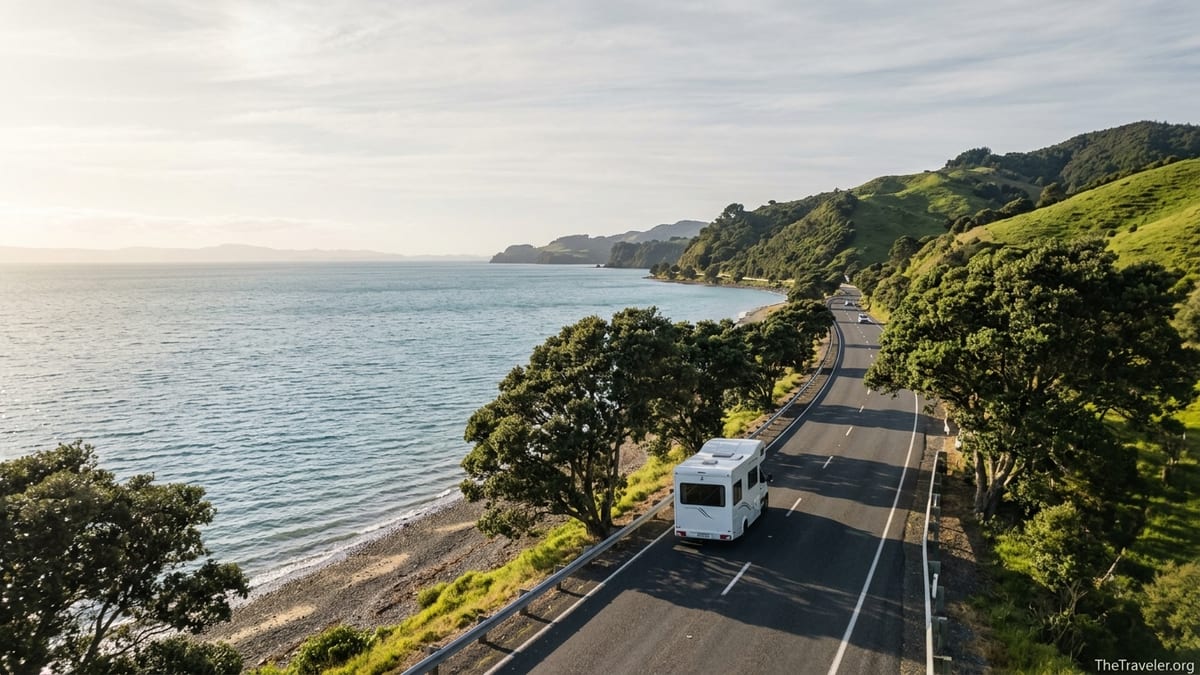
The classic North Island loop from Auckland threads through the Coromandel Peninsula, Rotorua’s geothermal zone, the lakes and volcanic plateau around Taupō and the cultural and political hub of Wellington. In a campervan or motorhome, some sequences and roads make the journey gentler. From Auckland to Coromandel, a common first day is Auckland to Thames or Miranda for a night, then around the western side of the peninsula on State Highway 25 to Coromandel Town. This coastal highway is sealed but narrow and winding in places, with bayside pohutukawa trees close to the edge. Take your time, use slow‑vehicle bays and stop at small settlements like Tapu or Te Puru rather than trying to make big distances.
From Coromandel Town, many campervan travellers avoid the gravel 309 Road in favour of staying on State Highway 25 through the interior to Kūaotunu and Whitianga or looping south via Thames and then across to Whangamatā and Waihi Beach. Whitianga, Hahei, Hot Water Beach, Tairua and Whangamatā all have holiday parks with powered sites and reasonable walking access to beaches. Booking ahead is important in December and January, when New Zealand families tow caravans to the same spots year after year.
From the eastern Coromandel or Bay of Plenty coast, you can drop south toward Rotorua via Tauranga. Rotorua has multiple holiday parks close to geothermal attractions, mountain‑bike trails and the lakefront. Staying two or three nights lets you day trip to geothermal valleys, soak in lakefront hot pools or visit redwood forests without constantly moving the campervan. Many visitors then drive to Taupō, an approximately 80 kilometre stretch of mostly straightforward highway that feels easy in a large vehicle. Lakefront holiday parks in Taupō and nearby towns like Turangi cater heavily to motorhomes, with drive‑through powered sites, dump stations and sometimes hot tubs or thermal pools.
Continuing south, SH1 runs from Taupō across the central plateau toward Wellington. Campervan‑friendly overnight options include holiday parks at Turangi, around Tongariro National Park villages like Whakapapa or National Park, and town‑edge parks further south near Bulls, Levin or the Kāpiti Coast. Rather than driving Taupō to Wellington in a single long day, consider breaking it in Tongariro National Park to walk short volcanic trails or ride a chairlift, then overnight again near the Kāpiti Coast beaches before arriving in Wellington.
In Wellington itself, large motorhomes are better based at holiday parks on the outskirts or across the harbour, with public transport or rideshares into the city. The waterfront and hillside streets have limited long‑vehicle parking, and strong winds on the harbour can make high‑sided vehicles feel twitchy. Travellers in normal rental cars, by contrast, can usually find multi‑storey car parking near Te Papa and the waterfront and are more inclined to stay in compact inner‑city hotels instead of campgrounds.
Roads and Situations Where a Normal Rental Car Wins
While campervans excel for lakeside DOC sites and beach holiday parks, there are North Island scenarios where a regular rental car simply works better. Narrow, unsealed or very steep roads are prime examples. Beyond the 309 Road in Coromandel, other roads where large motorhomes feel out of place include some gravel headland access roads north of Colville, remote bays east of Ōpōtiki, certain forest access tracks around Rotorua and side roads into small surf beaches along the Wairarapa or Taranaki coasts. Rental contracts often exclude these roads for large vehicles anyway.
Snow and ice are another factor. The Desert Road section of SH1 between Waiouru and Rangipo occasionally closes in winter. While closures affect all vehicles, drivers in heavy motorhomes may be more nervous on frosty mornings or when wind gusts hit open plateau sections. A mid‑size rental car with modern stability control and good tyres is easier to position inside lanes and to park safely if conditions deteriorate.
Parking in older town centres and visiting city attractions can also favour a car. Central Napier, downtown Wellington and parts of inner Auckland have heritage streets with angled or short parking spaces, height‑restricted car parks and busy roundabouts. If your North Island plans lean heavily toward galleries, urban dining and wine tastings, a car plus cabins, motels or apartments will usually feel smoother and can be more economical than a full‑size motorhome, especially once you add daily campground fees to the higher rental and fuel costs.
That said, many travellers happily accept these trade‑offs because they value having their bed, kitchen and luggage with them at all times. A hybrid approach is possible: rent a campervan for one section, such as Auckland – Coromandel – Rotorua – Taupō, then switch to a car in a larger centre for a more city‑focused leg toward Wellington or Hawke’s Bay, returning to camper travel later if you continue to the South Island.
The Takeaway
A North Island campervan or motorhome trip from Auckland is not just about drawing a line on the map. It is about matching your vehicle size, driving confidence and appetite for rustic nights with the right mix of holiday parks, DOC campsites and, where legal, freedom‑camping areas. Coromandel’s winding bays, Rotorua’s geothermal valleys, Taupō’s wide lake and Wellington’s harbour can all fit comfortably into a 10 to 14 day itinerary if you resist the urge to cram in every detour.
For many first‑time visitors, the sweet spot is a modest self‑contained van, regular powered nights at commercial holiday parks, and a handful of DOC or basic lakeside camps to feel the stars and silence. Keep an eye on evolving freedom‑camping rules, build in time for supermarket and dump‑station stops, and do not be afraid to skip narrow gravel roads that look tempting on the map but stressful behind a big steering wheel. Done well, a North Island campervan journey will feel less like a logistics exercise and more like a rolling series of small, lived‑in landscapes between Auckland and Wellington.
FAQ
Q1. Do I really need a self‑contained campervan for a North Island road trip?
It depends where you plan to stay. If you stick mostly to commercial holiday parks and some DOC campsites that allow tents and non‑self‑contained vehicles, a basic camper or even a normal car plus cabins can work. If you want to use freedom‑camping areas on council land or certain DOC sites that specify self‑contained vehicles only, you will need a properly certified vehicle with a fixed toilet that meets the newer standards.
Q2. How far in advance should I book holiday parks in peak season?
For the Christmas and New Year period and long summer weekends, aim to book popular North Island holiday parks at least two to three months ahead, especially in Coromandel, Bay of Plenty, Rotorua, Taupō and the Kāpiti Coast. Outside peak dates you can often book a few days in advance or even same day, but do not rely on last‑minute availability at iconic beach towns in late December or early January.
Q3. How often do I need a powered site if my campervan has solar panels?
In summer, many travellers with decent solar and good house batteries can go several days off‑grid, particularly if they avoid using electric heaters and microwaves. In practice, most still choose a powered site every two or three nights to run high‑draw appliances, recharge devices fully and do laundry. In winter or in cloudy weather you may need power more often, as solar generation drops and you use more lighting and heating.
Q4. Are North Island roads safe for large motorhomes?
Yes, main highways between Auckland, Rotorua, Taupō and Wellington are sealed and suitable for large rental motorhomes, provided you drive conservatively and allow extra stopping distance. The roads that feel uncomfortable in big vehicles tend to be narrow, winding or unsealed side roads such as the 309 Road in Coromandel or some remote coastal access roads. Sticking to state highways and well‑used regional routes keeps the driving straightforward.
Q5. Can I park my campervan overnight on city streets in Auckland or Wellington?
Overnight street parking rules vary, but in practice it is rarely pleasant or convenient to sleep in a campervan on city streets. Time limits, local bylaws, noise and a lack of level spots all work against you. Most visitors use suburban or waterfront holiday parks and then take public transport or rideshares into the centres of Auckland and Wellington, which is usually more relaxing and avoids parking headaches.
Q6. How expensive are powered sites compared with DOC campsites?
Commercial holiday park powered sites for two adults in popular North Island areas often run in the rough range of 60 to 100 New Zealand dollars per night in peak season, sometimes less in shoulder periods. DOC campsites are usually cheaper per night, particularly at basic or standard sites, but they often have fewer facilities and no power. When comparing costs, factor in showers, laundry, kitchens and convenient dump stations that come with many holiday parks.
Q7. What happens if I freedom camp where it is not allowed?
If you park overnight in a prohibited area or in a place reserved for self‑contained vehicles when your van is not compliant, you risk being woken by council officers and issued an infringement fine. Rangers in busy coastal regions pay close attention during summer. Beyond the fine, irresponsible camping can lead to more restrictions for everyone, so it is both a legal and an ethical issue. Always check local signs and information before staying.
Q8. Is it realistic to drive from Taupō to Wellington in one day in a campervan?
It is physically possible, but it makes for a long and tiring day, especially in a large motorhome. Many travellers prefer to break the journey with at least one overnight stop, commonly around Tongariro National Park villages or further south near the Kāpiti Coast. This keeps daily driving to more relaxed chunks and allows time for short walks or scenic stops instead of a rushed dash.
Q9. Are gravel roads always banned in rental campervan contracts?
Not always, but many rental companies restrict larger motorhomes to sealed roads or named exceptions. Smaller campervans may be allowed on some well‑formed gravel roads, but damage from loose metal or underbody strikes is often not covered by insurance. It is essential to read your contract carefully and ask the depot staff about specific roads like the 309 Road, remote bays or forest tracks before you plan them into your itinerary.
Q10. When would you recommend choosing a normal rental car instead of a campervan?
A normal car can be better if you are focusing on cities, tight coastal roads or winter travel where you prefer solid heating and hotel comforts after dark. It also suits travellers who want to drive unsealed byways that are off‑limits to motorhomes, or who feel anxious about manoeuvring a tall, heavy vehicle. In these cases, combining a rental car with cabins, motels or apartments around the North Island can deliver much of the same freedom with fewer driving and parking compromises.