


Driving the North Island of New Zealand is one of the most rewarding ways to see the country, but it is not a place where you simply plug a destination into a GPS and go. Distances can look short on the map yet still take far longer than you expect, thanks to winding state highways, mountain passes, one-lane bridges and scenery that begs for frequent stops. This guide focuses on building a realistic, flexible road-trip plan, comparing the main North Island route styles and explaining how to link them together without endless backtracking.
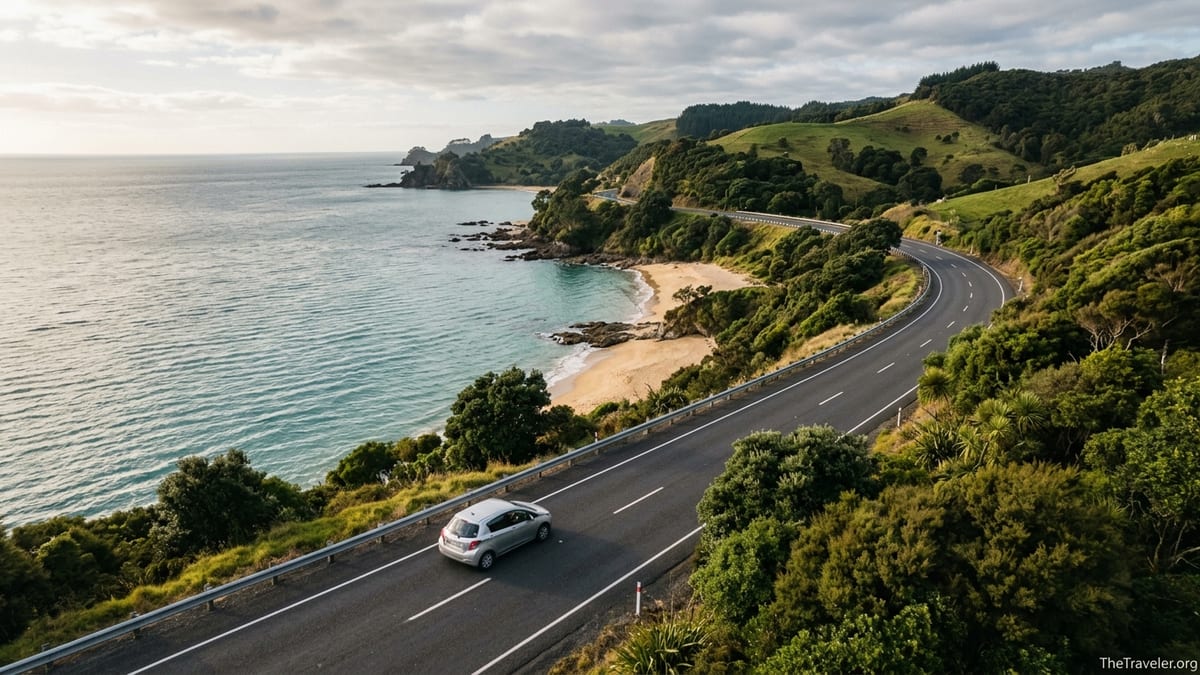
How Long North Island Drives Really Take
On paper, the direct Auckland to Wellington run along State Highway 1 is around 650 kilometres and often advertised as about eight to nine hours of driving without stops. In practice, visitors should rarely plan to cover more than four to five hours of actual wheel time in a single day, especially on their first days of driving on the left. Between Auckland and Rotorua, for example, maps may show roughly three hours, but traffic leaving the city, roadworks and photo stops around places like the Hobbiton turnoff can easily stretch that into most of a day.
North Island roads are predominantly two-lane highways with frequent curves, hill sections and occasional slow vehicles such as logging trucks and campervans. A seemingly modest 200 kilometre leg between Rotorua and Napier across the inland ranges can still take three to three and a half hours in good conditions, more if there is heavy rain or if you pull over for lookouts and short walks. It is sensible to add at least 20 to 30 percent extra time to whatever your navigation app predicts, and then another half-hour buffer if you are travelling in peak summer.
Weather and daylight make a real difference to how enjoyable a drive feels. The Desert Road section of State Highway 1 south of Lake Taupō, which passes the volcanoes of Tongariro National Park, can feel straightforward on a clear summer afternoon but far more demanding in winter when there may be ice, fog or even snow closures. Similarly, coastal sections in Northland or around Taranaki can be prone to strong wind and rain. Build your itinerary so that you rarely need to arrive after dark and can skip or shorten a leg if conditions deteriorate.
Backtracking is best handled at the planning stage. Instead of driving Auckland to Rotorua, then returning all the way to the city to reach the Coromandel Peninsula, you can shape a loop that runs Auckland to Coromandel, on to Tauranga or Rotorua, then continues south. Likewise, consider whether a one-way rental between Auckland and Wellington will cost less overall than a cheaper round-trip car that forces you to repeat the same long inland stretch twice.
Rental Cars, One-way Hires, Fuel and Parking
Most visitors pick up a rental car at Auckland Airport or in central Auckland, where major brands such as Avis, Budget, Hertz, Thrifty and local firms like Ezi and Apex all operate. Compact petrol hatchbacks are usually the best value for North Island touring: they are easier to park in small towns, use less fuel and manage winding roads more comfortably than large vans. Automatic transmission is standard. As a rough guide, a compact car in high season might range from moderate to expensive per day, including basic insurance, while off-peak shoulder seasons often see significantly lower rates.
One-way rentals between Auckland and Wellington are common and can make route planning far more efficient. Many companies allow Auckland to Wellington or the reverse without an extra fee if the hire is at least a few days, although surcharges are more likely during the busiest summer weeks or for very short hires. When pricing your trip, compare the total cost of a one-way rental plus a flight back to your starting city with the fuel and extra days needed to drive back. For example, two extra days of car hire, fuel and accommodation to return to Auckland may outweigh a simple domestic flight from Wellington.
Fuel is a major budget factor. Petrol prices in New Zealand have tended to be high in recent years and can fluctuate a lot, with some stations in remote areas charging noticeably more than city outlets. A small hatchback might sip around six to eight litres per 100 kilometres under mixed driving, while larger SUVs and campervans can consume far more. Many travellers reduce costs by filling up at supermarket-branded stations in cities and bigger towns, and by topping up in Taupō, Rotorua or Whangārei before heading into more remote stretches such as the East Cape, the central plateau or parts of Northland.
Parking is generally straightforward in smaller centres such as Rotorua, Napier, New Plymouth or Paihia, where you will usually find a mix of free and low-cost council parking near main sights. Auckland and Wellington have more expensive central parking, with hourly fees in popular downtown car parks and limited on-street spaces. When booking accommodation in cities, it is worth checking whether parking is included or discounted. In Wellington, for instance, many hotels in the compact CBD either charge separately for valet parking or direct guests to nearby parking buildings, while some motels in suburbs such as Kilbirnie or Newtown offer free off-street spaces and easy bus connections into the centre.
Auckland to Wellington Through the Volcanic Centre
The classic North Island road trip runs from Auckland to Wellington via Rotorua, Taupō and the volcanos of Tongariro National Park. This route follows State Highway 1 and 5 through the geothermal heartland and is ideal for travellers who want hot pools and volcanic landscapes without complex navigation. A typical sequence might run Auckland to Rotorua, Rotorua to Taupō, Taupō to Tongariro or directly to Wellington, with optional stops at Waitomo Caves or the surf town of Raglan if you choose a small detour.
Auckland to Rotorua is usually about three hours of driving via State Highway 1 and 2, or slightly longer if you divert via Matamata for Hobbiton. From Rotorua to Taupō, allow around an hour and a half, leaving time to stop at geothermal areas such as Wai-O-Tapu or the steaming cliffs at Waimangu, and to view Huka Falls just north of Taupō. Many visitors underestimate how much there is to do here, from boat cruises on Lake Taupō to short walks on the Tongariro lakeside, so plan at least one overnight stop between Auckland and Wellington, and two or three nights if you enjoy hiking or hot springs.
South of Taupō, the highway climbs across the central plateau. On a clear day, the views of Mount Ruapehu and its neighbours are spectacular, and it is easy to add a short walk on the Tongariro Alpine Crossing trail or a chairlift ride at Whakapapa ski area in summer. The drive from Taupō to Wellington via this inland route can be done in about five to six hours of pure driving, but most travellers break it up with a coffee stop in Turangi and a lunch break further south, perhaps in Taihape or Bulls. You can also divert to the art deco town of Whanganui on the west coast if you prefer to avoid the busier final approach into Wellington via the Kapiti Coast.
This volcanic-centre route is the simplest foundation for many itineraries because it connects easily with side trips. For instance, a Northland extension can loop back into Auckland and then follow this path south, while a Pacific Coast or Taranaki circuit can rejoin it at Taupō or Whanganui. By keeping this spine in mind, you can experiment with alternative legs and still end up in Wellington on schedule.
Auckland Loop via Coromandel and Rotorua
If you have time for a loop that starts and ends in Auckland, the Coromandel Peninsula and Rotorua make a rewarding combination. This style of trip suits travellers who prefer beaches and short walks over long highway days. A practical sequence begins with Auckland to the Coromandel Peninsula, then continues around the Bay of Plenty coast to Tauranga and on to Rotorua, before returning to Auckland via Matamata or Hamilton. This allows you to experience both the laid-back seaside towns and the geothermal heartland without repeating many kilometres.
Driving from Auckland to the Coromandel Peninsula typically involves crossing the Hauraki Plains toward Thames and then following coastal and hill roads up the peninsula. While distances are modest, the road between Thames and Coromandel Town is narrow and winding, with constant views over the Firth of Thames. Even if your map suggests a two-hour trip, you will likely take longer with stops at viewpoints and one-lane bridge sections near small inlets. Once on the eastern side, beach settlements such as Whitianga, Hahei and Whangamatā offer sheltered bays, short coastal hikes and holiday-park style accommodation.
From the eastern Coromandel, you can drop south along the coast toward Waihi Beach and Tauranga. This section again mixes rolling farmland with curving stretches that slow average speeds. Tauranga is also where you encounter tolled sections if you use the Tauranga Eastern Link or the Takitimu Drive routes, although there are straightforward free alternatives signposted as routes via Te Puke or through the city. From Tauranga to Rotorua takes roughly an hour and a quarter, rising inland past kiwifruit orchards and forests before dropping into the sulphur-scented basin of Rotorua.
To avoid backtracking, complete the loop by continuing from Rotorua back to Auckland rather than returning to the Coromandel. You might return via Matamata, visiting the Hobbiton Movie Set on the way, or via Hamilton with a stop at Hamilton Gardens. This style of loop works particularly well for travellers who prefer to base themselves in just three or four hubs, such as Whitianga, Rotorua and Auckland, and do day trips from there instead of packing up every morning.
Adding a Northland Extension
For travellers with at least ten to fourteen days, extending your North Island road trip north of Auckland into Northland can be extremely rewarding. This region includes the Bay of Islands, the Kauri forests and the remote tip at Cape Reinga. A simple pattern is to leave Auckland and drive to the Bay of Islands hub of Paihia, continue to Cape Reinga, then return south via the west coast, where you can visit giant kauri trees in the Waipoua Forest before rejoining the main highway back to Auckland and continuing toward the centre of the island.
The drive from central Auckland to Paihia typically takes about three to four hours, depending on traffic leaving the city. Soon after the northern suburbs, you have the option of using New Zealand’s main electronic toll road, the Northern Gateway, which bypasses the coastal town of Orewa. The toll is modest but fully electronic, with no cash booths; you either register your rental car details online or rely on your rental company to charge tolls to the card on file. Alternatively, you can follow the older coastal route through Orewa and Waiwera, adding around ten minutes but saving the toll and gaining sea views.
From Paihia to Cape Reinga is a longer stretch, often taking about three hours each way, especially if you include a detour to beaches around Doubtless Bay or a short walk among the coastal dunes. Some visitors choose to base themselves in Kerikeri or Mangonui for a night rather than doing the full round trip in a single day. Returning south, the west-coast road through the Waipoua Forest is narrower and slower, and it pays to allow time for photo stops and short walks to the towering kauri trees. Eventually you rejoin State Highway 1 near Dargaville or Wellsford and can continue to Auckland.
Timing is vital when adding Northland to an itinerary that also includes the volcanic centre or the Pacific Coast. A common and efficient pattern is to fly into Auckland, spend a night in the city to recover from jet lag, drive a loop through Northland over three to five days, then pass back through Auckland to swap luggage or vehicles if necessary before heading south through Rotorua and Taupō toward Wellington. By treating Auckland as a hub between the northern and central parts of your trip, you minimise backtracking and avoid trying to cover extreme distances in a single push.
Pacific Coast Route to Hawke’s Bay
The Pacific Coast Highway describes a series of roads tracing the eastern side of the North Island, and one of the most practical sections for visitors runs from the Bay of Plenty through to the wine country of Hawke’s Bay. Rather than driving directly from Rotorua or Tauranga to Taupō and then across to Wellington, you can choose to drop down the coast through Whakatāne, Ōpōtiki and, for those with more time, the remote East Cape, before cutting inland to Gisborne, Napier and Hastings. This adds distance but rewards you with quieter beaches, Māori cultural sites and vineyard landscapes.
From Tauranga to Whakatāne, allow around an hour and a half, with the option of detouring to Ōhope Beach for a seaside break. Beyond Ōpōtiki, the road around the East Cape is particularly slow and winding, often with sea on one side and high cliffs or farmland on the other. While the full loop can be done in a long day of driving, most travellers sensibly break it with at least one overnight in a small settlement like Te Araroa or Tokomaru Bay. This is not a route for those in a hurry, but it is ideal for visitors who value empty beaches and local encounters over a tight schedule.
If your time is more limited, an easier version of the Pacific Coast route simply runs Rotorua to Whakatāne and then cuts inland to Gisborne and Napier without circling the entire cape. The inland road still winds through ranges and forest but avoids the slowest one-lane bridge sections near the coast. From Gisborne to Napier, expect about three and a half hours of driving, longer if you stop at lookout points or cellar doors in the surrounding hills. Many travellers then spend two or three nights in Napier or nearby Havelock North, combining art deco architecture with visits to Hawke’s Bay wineries and cycle trails.
To avoid backtracking, finish this Pacific Coast segment by continuing from Hawke’s Bay to Wellington rather than returning to Rotorua or Auckland. The drive from Napier to Wellington commonly takes around four to five hours, heading via small Wairarapa towns such as Waipukurau, Dannevirke, Masterton and Featherston before crossing the winding Remutaka Hill into Wellington. It is perfectly reasonable to include a night in a Wairarapa village like Martinborough if you enjoy wine tasting and want to shorten the final day’s drive.
Longer Circuits Through Taranaki
The Taranaki region, dominated by the near-symmetrical volcano of Mount Taranaki, sits on the west coast between the central plateau and the Tasman Sea. It can be neatly incorporated into a North Island circuit that runs from Auckland to Rotorua and Taupō, then heads west to New Plymouth before looping down the coast to Whanganui and finally Wellington. This circuit gives a strong sense of the North Island’s variety, from geothermal lakes to black-sand surf beaches, without repeating large sections of road.
From Taupō, one option is to drive west toward Te Kuiti and the Waitomo Caves before continuing to the coast, then follow State Highway 3 south through farm country to New Plymouth. Alternatively, you can drop south to Whanganui first, then trace the Surf Highway up to New Plymouth, returning via the inland route. In either direction, the roads include frequent bends, one-lane bridges over rivers and sections where speed limits drop when passing through towns. It is not difficult driving in fine weather, but it is slower than the raw distance might suggest, and you should allow at least four to five hours for Taupō to New Plymouth with sightseeing stops.
New Plymouth itself works well as a two-night base. From here, you can circle Mount Taranaki on the Surf Highway, visit coastal walkways and art galleries, or try short hikes in Egmont National Park. In good weather, the side roads into the national park are manageable in a normal rental car, though they can be narrow and steep. After exploring the region, continue south toward Hāwera and Whanganui, then choose whether to rejoin the main State Highway 1 corridor near Bulls or stay on quieter coastal roads through towns like Foxton. Either way, you eventually funnel into the Kapiti Coast motorway system north of Wellington.
When combining Taranaki with other route styles, pay attention to how many times you are crossing the country east to west. For instance, if you are already planning to go from Rotorua to Napier and then down to Wellington, it may be too ambitious to also divert from Taupō to New Plymouth and back unless you have at least three additional days. A more relaxing alternative is to pick either the Pacific Coast to Hawke’s Bay or the Taranaki loop, then leave the other for a future South Island or return trip.
Road Conditions, Tolls, One-lane Bridges and Safety
New Zealand’s North Island road system mixes modern motorways near major cities with older two-lane highways elsewhere. Outside the Auckland and Wellington regions, you should assume that most of your driving will be on undivided roads, often with only a painted centre line and occasional passing lanes. Many rural routes still rely on one-lane bridges, where traffic from one side must give way to the other. These are clearly signposted; a white rectangle with black arrows indicates priority. If in doubt, stop and let oncoming vehicles cross first, especially when locals are towing trailers or driving heavy trucks.
There are currently only a small number of toll roads in the North Island and they are all electronic. The Northern Gateway north of Auckland, the Tauranga Eastern Link and the Takitimu routes near Tauranga are the ones most visitors encounter. Tolls are charged by automatic cameras and billed either to an online account or, in the case of many rental cars, to the credit card linked to your booking. The costs are modest per trip but unpaid tolls can quickly lead to administrative fees from rental companies. If you wish to avoid tolls, there are signposted alternative routes that pass through small towns and add only a short amount of time.
Speed limits on open roads are usually 100 kilometres per hour, dropping to 50 or 60 through settlements and lower again near schools or roadworks. Enforcement by mobile speed cameras and police is taken seriously. Because of the curves, you will often find that driving at the posted maximum is neither comfortable nor necessary. Many visitors find that holding a steady 80 to 90 kilometres per hour on winding sections is safer and less tiring. Plan for this in your timing: a two-hour leg at 100 kilometres per hour on a straight motorway may stretch to three hours when curves and slower traffic are involved.
Safety margins are especially important in winter or on days when heavy rain is forecast. Sections such as the Desert Road near Tongariro, the hill between Napier and Taupō, parts of the East Cape and the west-coast roads through Taranaki can be affected by slips, surface flooding or ice. Check local travel advisories before setting off, and consider keeping at least one flexible day in your itinerary that you can use when weather interferes. Being willing to stop early in a town like Taupō, Whanganui or Napier rather than pressing on in poor conditions is one of the best safety decisions you can make.
The Takeaway
A successful North Island road trip is less about ticking off every possible sight and more about shaping a logical route that matches your time, interests and driving comfort. The volcanic heartland between Rotorua, Taupō and Tongariro is the natural backbone of most itineraries, with choices to add a Coromandel and Bay of Plenty loop, a Northland extension, a Pacific Coast journey to Hawke’s Bay or a west-coast circuit through Taranaki. By thinking in terms of these route styles, you can join them like building blocks instead of lacing together a string of long, exhausting drives.
Work with realistic driving times, remembering that four to five hours of wheel time is a full day once you add photo stops, café breaks and short walks. Aim to avoid backtracking by planning one-way rentals where it makes sense, using Auckland as a hub when linking Northland with the central plateau, and continuing forward from places like Hawke’s Bay or Taranaki rather than returning inland to the same junctions. Allow for the character of New Zealand roads, with their one-lane bridges, changing weather and rare but important toll sections, and treat each driving leg as part of the experience rather than an obstacle between highlights.
For many travellers, the most memorable moments of a North Island drive are not the big-ticket attractions but the small ones: a coffee stop in a tiny town on the way to Wellington, a sunset picnic on an almost-empty East Cape beach, or a misty morning driving past steaming hillsides near Rotorua. Build enough space into your plan to enjoy those unscripted pauses, and the North Island will reward you with a road trip that feels both manageable and memorable.
FAQ
Q1. How many days do I need for an Auckland to Wellington road trip?
For a simple Auckland to Wellington drive via Rotorua and Taupō, plan at least five to seven days so you can spend two or three nights in the geothermal and lake region and still have time for short walks and city sightseeing.
Q2. Is it better to rent a car or a campervan on the North Island?
A car is usually easier for first-time visitors because it is more maneuverable on narrow, winding roads and cheaper to fuel and park. Campervans suit travellers who value freedom camping-style stays and do not mind slower driving and more challenging parking.
Q3. Are North Island roads difficult for drivers used to the right-hand side?
Most visitors adjust quickly, but narrow two-lane highways, one-lane bridges and tight curves can be tiring. Plan short first driving days, avoid night driving, and consider staying just outside big-city centres until you are comfortable with left-side traffic.
Q4. Do I really need a one-way rental between Auckland and Wellington?
No, but a one-way rental often saves time and backtracking. If your itinerary naturally finishes in Wellington, hiring in Auckland and dropping the car in Wellington, then flying back to Auckland, can be more efficient than driving the same inland route twice.
Q5. How expensive is fuel on the North Island?
Fuel is relatively expensive by global standards and can be pricier in remote areas than in major centres. Budget-conscious travellers often choose smaller cars, fill up in bigger towns like Auckland, Rotorua and Taupō, and avoid unnecessary detours.
Q6. Are there many toll roads and can I avoid them?
There are only a few electronic toll roads, mainly north of Auckland and around Tauranga. They are easy to pay through rental companies or online, and there are clearly signposted free alternative routes if you prefer to avoid the tolls.
Q7. How far can I comfortably drive in one day?
Four to five hours of actual driving is a comfortable maximum for most visitors on North Island roads, leaving time for photo stops, meals and short walks. Longer legs are possible but can feel rushed or tiring, especially on winding sections.
Q8. Is it safe to drive the Desert Road and East Cape in winter?
These routes can be safe in settled weather but are more exposed to snow, ice and heavy rain. Check weather and road condition updates on the day you travel and be ready to delay or reroute if conditions look poor, especially after heavy storms.
Q9. How can I avoid backtracking on my North Island itinerary?
Use Auckland as a hub, plan one-way rentals when ending in Wellington, and link route styles in a logical sequence. For example, you might loop Northland from Auckland, then head south through Rotorua and Taupō, and finish with either a Pacific Coast or Taranaki circuit before ending in Wellington.
Q10. Do I need to book accommodation in advance on a North Island road trip?
In peak summer and during long holiday weekends, booking ahead is strongly recommended in hotspots like Coromandel, Rotorua, Taupō and the Bay of Islands. Outside those periods you may find same-day options, but pre-booking at least your key stops keeps driving days flexible and less stressful.