


If you are planning a North Island itinerary around Auckland and Rotorua, it is very common to face a tough choice: head north to the Bay of Islands or south and east to the Coromandel Peninsula. Both regions offer golden beaches, island-dotted horizons and classic New Zealand summer towns, yet they feel surprisingly different on the ground. With limited days, most travelers cannot comfortably fit both into a sensible route. This guide compares the two in real, practical terms so you can pick the one that fits your time frame, interests and driving tolerance.
Driving Time and Trip Logistics From Auckland
On a tight schedule, driving time is often the deciding factor. The Bay of Islands sits in Northland, roughly 225 to 240 kilometers north of central Auckland by State Highway 1. In light traffic, the drive to Paihia or Waitangi typically takes about 3 to 3.5 hours, but it can stretch closer to 4 hours in holiday peaks when the road north of Warkworth slows. Many visitors report that a Friday afternoon departure in summer can easily add 45 minutes or more to the journey.
The Coromandel Peninsula is closer in pure distance, but the roads are narrower and twistier. Driving from central Auckland to the popular eastern beaches around Hahei, Cathedral Cove and Hot Water Beach is usually about 2.5 to 3 hours, depending on whether you go via Thames or the inland route through the Hauraki Plains. The final approach to Hahei involves hilly, winding roads where you will likely average far below highway speeds, so planners often add a buffer of at least 30 extra minutes beyond what navigation apps suggest.
From a wider route perspective, Coromandel integrates neatly into a classic Auckland–Coromandel–Rotorua loop. After exploring Cathedral Cove and Hot Water Beach, you can continue south via Whitianga, Tairua and the Pacific Coast Highway, then cut inland through the Waikato to Rotorua. This avoids backtracking and keeps driving stages to roughly 2.5 to 3.5 hours each. By contrast, the Bay of Islands requires a deliberate out-and-back trip north; you must drive back towards Auckland before continuing south, meaning extra hours behind the wheel if you are also committed to Rotorua or Taupō.
In practice, this means that for a one-week North Island trip focused on Auckland and Rotorua, Coromandel adds a neat 2 to 3 day coastal segment with minimal detour. The Bay of Islands suits itineraries where Northland is a main goal in itself, or where travelers are comfortable devoting at least 2 full days to the region plus the longer driving legs in and out.
Beaches and Seascapes: Islands vs Headlands
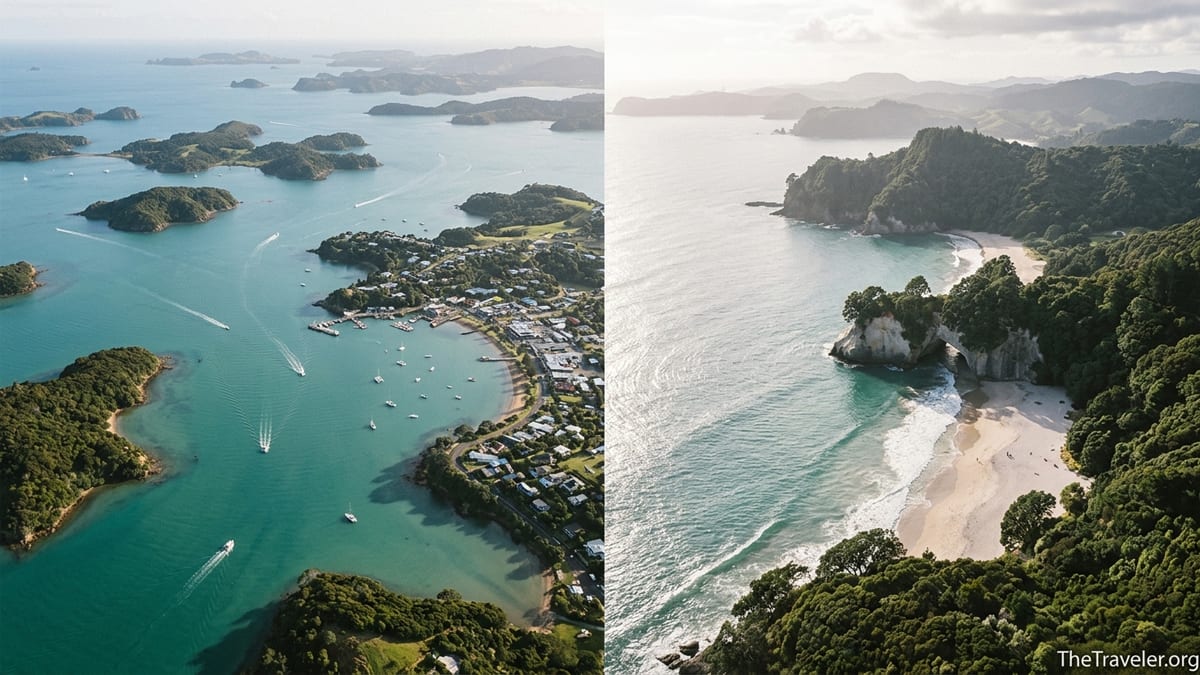
Both regions deliver the classic combination of pale sand, clear water and bushy headlands, but the feel is quite different. The Bay of Islands is all about sheltered bays and offshore islands. In towns like Paihia and Russell, you look out across a broad, calm bay studded with green islands. Local beaches such as Paihia Beach, Long Beach in Russell or Te Tii Bay at Waitangi tend to be gently shelving and family friendly, ideal for swimming, paddleboarding and relaxed picnics rather than dramatic surf.
Coromandel’s east coast has a more rugged, sculpted look that many visitors associate with New Zealand beach postcards. Cathedral Cove near Hahei, within the Te Whanganui o Hei Marine Reserve, frames a perfect white sand cove under a huge natural arch and steep cliffs. Nearby Hot Water Beach offers a long sweep of sand with surf on one side and, at low tide, pockets of geothermal hot water rising through the sand where visitors dig their own soaking pools. Further down the coast, Whangamatā and Whangapoua combine pine-fringed dunes, offshore islands and reliable waves that attract surfers as well as families.
For pure variety in a compact area, Coromandel arguably wins. Within a short drive, you can move from sheltered coves to surf beaches, from crowded holiday settlements to almost empty stretches such as New Chums Beach, which requires a short, sometimes muddy track and a tidal crossing. The Bay of Islands shines more through its island-dotted panorama than individual headline beaches. You will find plenty of pleasant sand for swimming and sandcastles, but much of the region’s magic appears once you get out on the water.
Weather can also factor into the decision. Northland, including the Bay of Islands, is marginally more sub-tropical and often slightly warmer and more humid than Coromandel, particularly in shoulder seasons. In practice, though, both regions are summer favorites for Aucklanders, and specific conditions during your travel week will matter more than the averages when it comes to beach days.
Boat Trips, Island Cruises and Marine Wildlife
If you want to be out on the water as much as possible, the Bay of Islands is hard to beat. Paihia and Russell are major hubs for dolphin watching tours, island-hopping cruises and day trips to iconic rock formations. Many operators run full-day trips that call at wildlife-rich islands, include snorkeling or stand-up paddleboarding, and often search for common dolphins or bottlenose dolphins along the way. Some itineraries visit Urupukapuka Island, where you can walk short clifftop tracks with sweeping views over the bay before returning by boat in the afternoon.
There are also faster options such as rigid-hulled inflatable boat tours that zip out toward the outer bay, historically including the famous Hole in the Rock at Motukōkako. Families often choose slower, larger catamarans that provide shelter, on-board barista coffee and space for children to move about. Prices vary by season and inclusions, but as of 2026 a typical shared day cruise with snorkeling gear and island landing generally runs in the moderate price range for New Zealand day tours, competitive with popular excursions in Rotorua or Queenstown.
Coromandel’s water-based activities are more concentrated around a few headline spots. Sea kayak tours from Hahei beach to Cathedral Cove glide beneath cliffs and through sea caves when conditions allow, often stopping for snorkeling within the marine reserve where you may see snapper, stingrays and colorful reef fish. On calmer days, the water can be remarkably clear and turquoise. A local water taxi provides a practical alternative for those who want to reach Cathedral Cove by sea without a long walk, especially now that walking-track access and parking arrangements have seen periodic changes and restrictions in recent years.
While you can certainly find boat charters out of Coromandel Town, Whitianga and Tairua for fishing or scenic trips, the scale is smaller than in the Bay of Islands. If marine wildlife and classic island cruising are the heart of your wish list, the Bay of Islands typically offers more choice, higher frequency of departures and a stronger sense of spending the day at sea rather than fitting a short paddle or cruise around other land activities.
Māori History, Waitangi and Cultural Experiences
For travelers interested in New Zealand’s story and Māori culture, the Bay of Islands is a clear standout because it includes Waitangi, widely referred to as the birthplace of the nation. At the Waitangi Treaty Grounds, a short drive or 25 minute walk from central Paihia, visitors enter a landscaped headland overlooking the bay where the Treaty of Waitangi was first signed on 6 February 1840 between representatives of the British Crown and Māori rangatira. The site today includes two modern museums, the historic Treaty House, a richly carved meeting house and one of the world’s largest ceremonial waka taua, or war canoes.
A standard visitor pass typically bundles a guided tour of the grounds with a cultural performance featuring waiata, haka and explanations of carving and weaving traditions, along with access to the museums. Many travelers regard this half day as one of the most meaningful experiences of a North Island trip, giving context to everything from contemporary politics to place names encountered across the country. In nearby Russell, Kerikeri and Hokianga, you can also visit early mission stations, churches and pā sites that reflect deep layers of Māori and early European history.
Coromandel has its own strong Māori heritage, especially around the Mercury Bay area associated with early Polynesian settlement and Captain Cook’s 18th century landings. However, the visitor infrastructure is far less concentrated than at Waitangi. You may encounter Māori place names and local stories on short walks and at viewpoints, and some small operators weave cultural narratives into eco-cruises or kayak tours, but there is no single, comprehensive complex equivalent to the Treaty Grounds.
As a result, travelers whose primary question is “Where will I best understand Aotearoa’s history and Te Tiriti o Waitangi?” will almost always find their answer in the Bay of Islands. Coromandel can complement those learnings with landscapes and casual encounters, but it is seldom a replacement for the depth of interpretation, taonga (treasures) and living culture accessible in and around Waitangi and Russell.
Hiking, Short Walks and Outdoor Adventure
Both regions are good for short walks rather than serious backcountry tramping, although each has a different flavor. In the Bay of Islands, many easy coastal walks link between small bays and lookouts. The Paihia to Opua Coastal Walk, for instance, follows boardwalks, bush tracks and beach sections with constant harbor views, while Flagstaff Hill above Russell offers a steep but quick climb to one of the most historically charged viewpoints in the country, associated with the early conflicts that followed the signing of the Treaty.
Longer day hikes and multi-day tracks exist inland across Northland, but they are less central to a typical Paihia-based visit than boating. Travelers often use their walking time as gentle add-ons to a day at sea, combining a short island track on Urupukapuka or Motuarohia with swimming and picnics. For many families and casual hikers, this balance works well, especially in warmer months when long, exposed hikes can be tiring.
Coromandel invites a more trail-focused style of visit. While headline coastal tracks to Cathedral Cove have shifted around temporary route closures and reroutes, the broader peninsula is dense with walking options. The Coromandel Coastal Walkway near the northern tip is a full day hike that traces cliffs and farmland between Stony Bay and Fletcher Bay, with transport shuttles available for one-way walkers. Inland, the Pinnacles Track climbs through regenerating kauri forest to a rocky summit with a hut and ladders that rewards sunrise or sunset hikers with panoramic views over the peninsula and the Pacific.
Even on shorter stays, you can fit in forest loops to old kauri trees, beach-to-headland strolls near Whangamatā and Whitianga, and low tide explorations of Hot Water Beach’s unique geothermal sands. Visitors should be prepared for winding access roads and, in summer, crowded car parks at the most popular trailheads. However, those keen on a mix of ocean views and moderate hiking will usually find Coromandel more satisfying than the Bay of Islands, where boating tends to overshadow land-based adventure.
Accommodation, Town Atmosphere and Road Trip Convenience
In the Bay of Islands, Paihia is the main hub with a classic holiday-town feel: a strip of motels, backpacker hostels, small hotels and waterfront apartments, plus cafes, fish and chip shops and booking kiosks for cruises. Russell, reached by passenger or vehicle ferry, has a more heritage-style atmosphere with historic pubs and wooden guesthouses. Kerikeri, slightly inland, offers quieter lodges and orchard stays. Prices rise sharply in late December and January, and popular sea-view motels and mid-range hotels can book out months ahead, especially over New Zealand school holidays.
Coromandel accommodation is more scattered but equally seasonal. Hahei and Hot Water Beach have campgrounds, holiday parks, bachs (holiday homes) and a few lodges, many of which require minimum stays in peak periods. Whitianga, Whangamatā and Pauanui function as larger service towns with supermarkets, multiple holiday parks and motels. If you are planning a self-drive trip, Coromandel’s dispersed settlements can make it easier to build a flexible road trip, staying one or two nights in a series of beach towns as you loop around the peninsula.
In terms of pure road-trip convenience, Coromandel aligns well with a broader North Island circuit. A common pattern sees travelers collect a rental car in Auckland, drive to Hahei for 2 nights, continue south to Rotorua or Tauranga, then return to Auckland via the Waikato. Each segment stays under 4 hours’ drive, and there is almost no backtracking. The Bay of Islands, by contrast, works best as a dedicated side trip from Auckland. Many visitors either spend 2 to 3 nights in Paihia at the start of their holiday to decompress after a long flight, or head north later in the itinerary once they have ticked off other regions.
If you only have 5 or 6 driving days in total and want to include Rotorua, Hobbiton or Taupō, the extra hours of backtracking from Northland can feel inefficient. However, if you have 10 days or more and are comfortable with larger driving days, combining the Bay of Islands with central North Island highlights is entirely doable, particularly in shoulder seasons when traffic is lighter and accommodation is more flexible.
How Many Days Each Region Deserves
For most itineraries, the Bay of Islands deserves at least 2 full days, ideally 3. With only 2 full days, a common pattern is to devote one day to a comprehensive island cruise or dolphin watching tour and another half day to the Waitangi Treaty Grounds, leaving spare hours for a short walk or a ferry jaunt to Russell. A 3 night stay allows more relaxed pacing, extra beach time, or an additional excursion such as a solid half day drive over to Hokianga Harbour for giant sand dunes and West Coast sunsets.
Coromandel repays anywhere from 2 to 4 days, depending on how far you want to roam. With 2 nights based in Hahei or Whitianga, many travelers manage a Cathedral Cove visit, a correct-tide session at Hot Water Beach and at least one inland lookout or forest walk. Stretching to 3 or 4 nights lets you add the northern Coromandel around Coromandel Town, the Driving Creek Railway and pottery complex, or the remote coastal scenery around Port Jackson and Port Charles. Because it sits on the way towards the central North Island when following the Pacific Coast Highway, adding an extra day here usually does not feel like a major detour.
When time is very limited, such as a 3 or 4 day side trip from Auckland alone, both regions can be visited as one-night-one-full-day destinations. However, many locals and frequent visitors caution that one night in either Coromandel or the Bay of Islands often feels rushed once you account for driving and check-in schedules. If you must compress, consider focusing your efforts on one iconic experience, such as a full-day Bay of Islands cruise or a Cathedral Cove and Hot Water Beach combo, rather than attempting to string several minor stops together.
Season also influences how much time feels right. In mid-summer, beach towns across both regions are busy and social, with night markets, food trucks and lively holiday parks. Spending at least 2 or 3 nights allows you to settle into that holiday rhythm. In cooler months, you may be content with shorter stays focused on scenic drives, walks and cultural visits rather than long beach days.
Who Should Choose Which: Practical Recommendations
For short trips built around Auckland with perhaps a quick detour to Rotorua, Coromandel generally offers the smoother fit. Its beaches and walks are within a 3 hour drive, and you can credibly do a two-night Coromandel stay plus a two-night Rotorua stay in a week without feeling rushed. Travelers who prioritize iconic coastal scenery, Instagram-friendly viewpoints and a mix of short hikes and beach time tend to come away extremely satisfied with a Coromandel-focused itinerary.
Beach-focused travelers who simply want to relax on soft sand and swim in relatively sheltered water could enjoy either region, but the Bay of Islands offers more options for families who like mellow, safe-feeling bays with nearby cafes and boat ramps. Coromandel’s east-coast surf breaks can be livelier for confident swimmers and surfers, while spots like Hahei, Cooks Beach and Buffalo Beach in Whitianga provide gentler conditions. Those particularly drawn to the idea of digging their own natural hot pool at Hot Water Beach, or paddling a kayak beneath Cathedral Cove’s arch, will naturally skew towards Coromandel.
Families often choose based on driving tolerance and activity style. If your children handle a 3.5 hour drive well and you like the idea of one big boat day combined with accessible culture, the Bay of Islands is an excellent choice, with compact towns and plenty of playgrounds and ice cream stops. If you prefer shorter hops between multiple beach towns and the flexibility to adjust plans around weather, Coromandel’s loop structure and range of accommodation types may work better. In both regions, supermarkets, medical centers and basic services are readily available in main hubs such as Paihia, Kerikeri, Whitianga and Thames.
History and culture enthusiasts should almost always prioritize the Bay of Islands. Waitangi provides a depth of interpretation and taonga under one admission ticket that is difficult to match elsewhere, and nearby Russell and Kerikeri add further layers of early contact history. Coromandel is best for visitors who see landscapes themselves as the story: ancient forests, rugged headlands, small towns that swell with summer crowds, and a slower, coastal rhythm that pairs nicely with thermal wonders in Rotorua and volcanic landscapes further south.
Finally, travelers planning a longer Northland journey, perhaps combining the Bay of Islands with Waipoua Forest, Hokianga Harbour and even Cape Reinga, should not feel pressured to squeeze in Coromandel as well. Northland alone can easily fill a week or more with forest walks to giant kauri, sandboarding on Te Paki dunes, and exploring both the Bay of Islands and Ninety Mile Beach. In such cases, the Bay of Islands becomes an anchor point in a broader northern odyssey, while Coromandel waits for a future trip built around the Pacific Coast Highway and the central North Island.
FAQ
Q1. If I only have three full days from Auckland, should I choose the Bay of Islands or Coromandel?
With just three full days, Coromandel usually fits more neatly because the driving is slightly shorter and it can be combined with another nearby stop like Rotorua without backtracking. The Bay of Islands is still possible but works best if you are happy to spend a higher share of your time on the road.
Q2. Which region has the better beaches overall?
Coromandel generally offers more variety and several of the North Island’s most photogenic beaches, including Cathedral Cove and Hot Water Beach. The Bay of Islands has plenty of pleasant, family-friendly bays but its real strength lies in island-dotted seascapes and boating rather than individual headline beaches.
Q3. Where will I find the best boat trips and island cruises?
The Bay of Islands wins for boat-based activities. Paihia and Russell host numerous daily cruises, dolphin watching tours and island-hopping trips, many of which include snorkeling and short island walks. Coromandel has good kayak tours and a few scenic cruises, but not on the same scale.
Q4. Which destination is better for learning about Māori history and the Treaty of Waitangi?
The Bay of Islands is clearly stronger for history and culture. The Waitangi Treaty Grounds offer museums, guided tours and cultural performances that give visitors a deep introduction to New Zealand’s founding document and Māori–Crown relations.
Q5. Is Coromandel really easier to combine with Rotorua than the Bay of Islands?
Yes. Coromandel sits naturally on a loop that can run Auckland to Hahei and Whitianga, then south through the Bay of Plenty and into Rotorua. The Bay of Islands requires an out-and-back journey north, so you must drive past Auckland again before heading to Rotorua or Taupō.
Q6. How many nights should I plan in each region?
Most travelers find that two to three nights in the Bay of Islands allows for a full boat day and a meaningful visit to Waitangi. In Coromandel, two to four nights works well, depending on whether you also want to explore the northern peninsula and inland walks like the Pinnacles.
Q7. Which region is better for families with young children?
Both can work well. The Bay of Islands offers gentle, sheltered beaches and plenty of easy boat trips, while Coromandel provides a mix of calm bays and fun attractions like Hot Water Beach. Families who dislike long drives may find Coromandel’s shorter stages between towns more manageable.
Q8. Are driving conditions difficult in either region?
Highways to both regions are sealed and well maintained, but Coromandel’s coastal and inland roads are notably twisty and can be slow going. The route to the Bay of Islands is more straightforward, though it can be busy in holiday periods. Allow generous time and avoid driving tired, especially after long flights.
Q9. Can I visit both Coromandel and the Bay of Islands in one week?
It is possible, but you will spend a lot of time driving, especially if you also want to include Rotorua or other central North Island highlights. Many experienced travelers recommend choosing one coastal region and exploring it more deeply rather than rushing through both.
Q10. For a longer Northland-focused journey, does Coromandel still make sense?
If you are planning a week or more in Northland, including Waipoua Forest, Hokianga Harbour and Cape Reinga, it often makes sense to skip Coromandel this time and devote your days to the northern loop. You can save Coromandel for a future trip built around the Pacific Coast Highway and the central North Island.