


New Zealand’s North Island can feel overwhelming on a first trip. On one compact landmass you have Pacific beaches, live volcanoes, geothermal pools, Māori cultural hubs, serious wine regions and two major cities. The key to a satisfying first visit is not seeing everything, but choosing a driving route that links the landscapes and cultures that matter most to you without spending the whole holiday in the car.
How the North Island Fits Together
Think of the North Island as three overlapping storylines: the volcanic heart in the middle, beach-fringed peninsulas along the coasts, and cities and wine regions stitched along the edges. Most first-time itineraries end up tracing a rough loop between Auckland and Wellington that dips into this volcanic core, detours to at least one stretch of coast, and pauses for wine and culture along the way.
At the centre, roughly between Rotorua, Taupō and Tongariro National Park, you find geothermal fields, crater lakes and active volcanoes. Rotorua smells faintly of sulphur and bubbles with hot pools, while nearby Taupō sits on the edge of a huge volcanic caldera that is now a lake. South of Taupō, cone-shaped peaks like Tongariro and Ruapehu dominate the horizon and host one of the country’s most famous day hikes, the Tongariro Alpine Crossing.
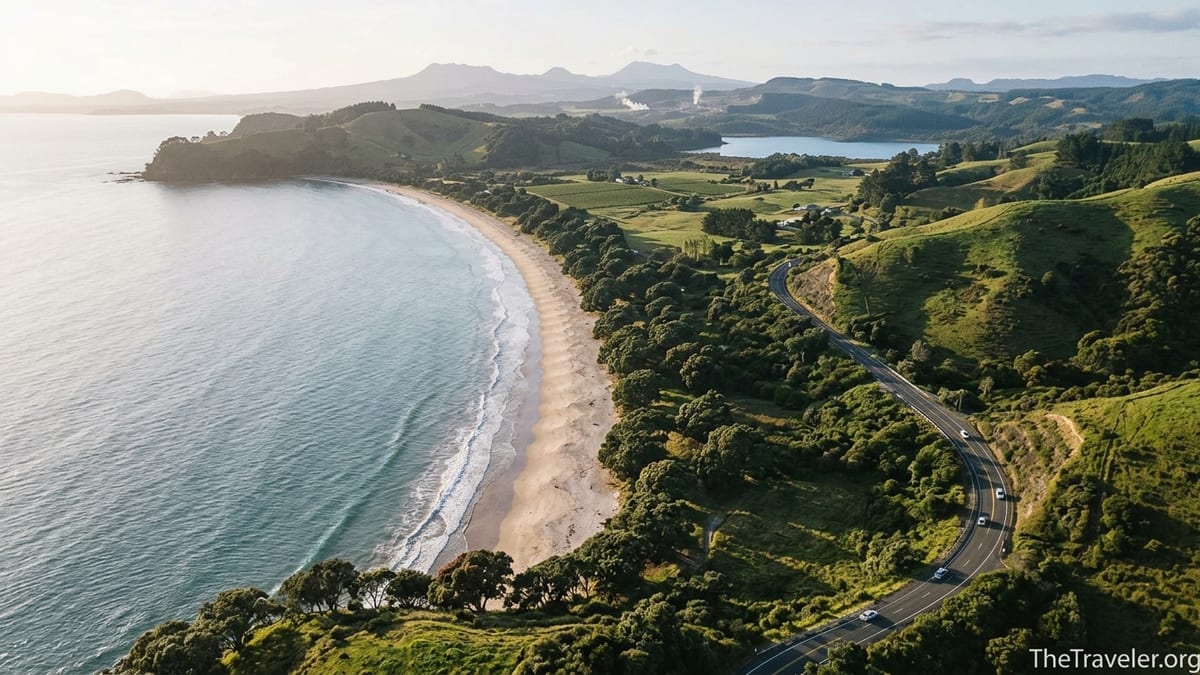
On the coasts, Northland and the Bay of Islands fan out north of Auckland with subtropical harbours and historic Māori and colonial sites, while the Coromandel and Bay of Plenty offer golden-sand surf beaches and relaxed towns like Whitianga and Mount Maunganui. Out east, Hawke’s Bay combines sun-drenched vineyards with Pacific bays, and on the southwest edge Taranaki wraps a ring road around another perfect volcanic cone.
Anchoring all of this are Auckland and Wellington. Auckland is the likely arrival point, a spread-out harbour city built on old volcanic cones, while Wellington bookends the bottom of the island with museums, hillside suburbs and the main ferry link to the South Island. Between them sit wine towns such as Napier and Martinborough and cave country in the Waikato. The trick is choosing which of these threads to follow in the time you have.
How Long Do You Need and Where Should You Focus?
For a first North Island trip, most visitors have somewhere between 7 and 14 days. In seven days you can manage a focused loop from Auckland through Rotorua, Taupō and Tongariro to Wellington, or a beach-and-geothermal circuit that returns to Auckland. With 10 to 14 days you can add Northland and the Bay of Islands or Hawke’s Bay and Taranaki without making each day a long drive.
If you have only a week and want a good overview, a classic route runs Auckland – Rotorua – Taupō – Tongariro – Wellington. That uses the central volcanic spine as your main story and gives you geothermal pools, lake and mountain vistas, plus both cities. It suits travellers who value varied landscapes and Māori culture over beach time. Expect total driving of around 850 to 900 kilometres, broken into legs of 3 to 5 hours on main highways.
If beaches are non-negotiable, you might dedicate your first trip to the upper half of the island instead, focusing on Auckland, Coromandel, Bay of Plenty and either Rotorua or Northland. This keeps most drives under three hours and lets you actually sit on the sand in places like Hahei or Paihia. It also suits families who want time in holiday parks, fish-and-chip shops and easy coastal walks rather than full-day alpine hikes.
With two weeks or more, you can reasonably add a wine region such as Hawke’s Bay or Wairarapa and even loop around Mount Taranaki. Many visitors underestimate how slow New Zealand roads can be, so use online maps as a guide but add at least 20 to 30 percent to whatever time estimate you see. A 300 kilometre leg here may be a full day’s travel once you add fuel, food and viewpoint stops.
Driving Basics and Typical Distances
The North Island is built for road tripping, but it is not built for rushing. Outside the main highways, roads are often narrow and winding, with many one-lane bridges and few overtaking lanes. Speed limits on open roads are commonly 100 km/h, yet real-world averages are often closer to 70 to 80 km/h once you factor in terrain, traffic and small towns.
Some key driving legs shape most itineraries. Auckland to Rotorua is about 230 kilometres and usually takes around three hours via the Waikato plains. Rotorua to Taupō is a short hop of about 80 kilometres, roughly an hour, which makes it an easy day even with a stop at a geothermal attraction on the way. From Taupō to Wellington via the Desert Road and Kapiti Coast is around 370 kilometres and usually takes just over five hours of pure driving in good conditions, so many travellers break it with an overnight stop near Tongariro or in a central North Island town.
Coastal detours add variety but also distance. Auckland to the Bay of Islands hub of Paihia, for example, is roughly 230 kilometres and often takes three to four hours one way, depending on Auckland traffic and how often you stop at beaches or viewpoints. Auckland to Coromandel Town or Hahei is similar in distance, but the final hour is slower, with winding coastal roads that reward patience with views of pohutukawa-framed bays.
Plan your days as if you will spend more time outside the car than inside it. A realistic pattern for a first-timer might be one leg of 3 to 4 hours every second day, leaving alternate days for local drives of under an hour. Rental cars can be compact hatchbacks, automatic SUVs or campervans. Daily rental rates vary by season, but many visitors in recent years have paid the equivalent of a mid-range hotel night per day for a standard car, before fuel and insurance. Fuel costs fluctuate, but expect long rural stretches without major supermarkets or discount stations, so topping up in larger centres such as Hamilton, Rotorua or Napier is sensible.
Auckland, Northland and the Bay of Islands
Auckland will likely be your gateway, and how long you stay depends on what you want from cities. One or two nights is usually enough for first-time visitors keen to prioritise natural scenery. That still leaves time for a harbourfront walk, a ferry ride to a nearby island such as Waiheke for vineyard lunches, or a climb up a volcanic cone like Mount Eden for city views.
From Auckland, driving north into Northland opens up a different climate and pace. Reaching Paihia or Russell in the Bay of Islands usually takes around three to four hours without long stops, making it a manageable day immediately after you recover from a long-haul flight. Here, beaches, island cruises and historic Māori and colonial sites combine. A common pattern is two or three nights in Paihia, with one day sailing or taking a dolphin-watching cruise, and another day visiting the Waitangi Treaty Grounds and nearby Kerikeri for stone store heritage buildings and citrus orchards.
If you push further north, you are rewarded with more remote landscapes such as Ninety Mile Beach and Cape Reinga, where the Pacific and Tasman Seas meet, but this adds several more hours of driving and often an extra night or two. For a first trip of 10 days or less it is usually best to choose either Northland and Bay of Islands or the Coromandel peninsula as your main beach region, rather than attempting both.
Route-wise, Northland can be a simple out-and-back from Auckland or part of a broader loop. Some travellers head from Auckland to Bay of Islands, then return south and continue to the Coromandel, but that creates long days behind the wheel. A more comfortable plan for limited time is Auckland – Bay of Islands – Auckland – Rotorua, accepting that you will repeat one highway section but keep drive durations humane.
Coromandel, Waikato and the Geothermal Heartland
East and south of Auckland lies the Coromandel Peninsula and the Waikato region, a mix that links beaches, rolling farmland and glow-worm caves with geothermal plateaus. Driving from Auckland to the Coromandel’s east coast (for example, to Hahei or Whitianga) usually takes about 2.5 to 3 hours, with the last hour along twisting roads that hug forested ranges. Visitors often base themselves for two or three nights to enjoy Cathedral Cove boat tours, coastal walks and relaxed beach towns.
From the Coromandel, it is possible to drive across the peninsula and through the Waikato to Rotorua in a single day. Coromandel to Rotorua is commonly around 3 to 4 hours via state highways that cut through pastoral landscapes and towns like Paeroa and Matamata. Many travellers stop at an organised movie-set tour near Matamata on this leg, combining a fantasy film location with the real-world dairy country that surrounds it.
The Waikato also houses the Waitomo Caves area, where you can float through glow-worm-lit caverns on guided raft trips or walk through limestone formations. Driving from Auckland to Waitomo is about 200 kilometres, roughly two and a half hours, while Waitomo to Rotorua is around 160 kilometres, also close to two and a half hours. Fitting Waitomo, Matamata and Rotorua into one day quickly becomes rushed, so most itineraries pick only one of these diversions between Auckland and Rotorua.
Rotorua and neighbouring lakeside settlements such as Lake Tarawera and Lake Rotoiti form the heart of the geothermal region. Here you can visit thermal parks with vividly coloured pools, watch geysers erupt and soak in hot mineral baths that range from simple public pools to private spa complexes overlooking native bush. Māori culture is particularly accessible, with evening cultural performances and hangi-style feasts at several venues. Two or three nights in Rotorua is usually enough for a first visit, giving you a full day for geothermal sites and another for forests, lakes or Māori experiences.
Taupō, Tongariro and the Central Volcanoes
About an hour south of Rotorua, Taupō sits on the shore of a huge caldera lake formed by an ancient volcanic eruption. The town itself is compact and easy to navigate, with lakefront paths, cafes, skydiving operators and boat trips to Māori rock carvings on nearby cliffs. The short drive from Rotorua allows you to include a stop at a geothermal park along the way, then still arrive in Taupō with time for a late afternoon cruise or a visit to a viewing platform above a powerful waterfall just north of town.
Many visitors treat Taupō as either a one-night stop between Rotorua and Tongariro or a two-night base for fishing, mountain biking and hot pools. It fits naturally into a route that emphasises volcanic landscapes, because the highway south towards Tongariro quickly climbs onto the volcanic plateau, with views of multiple cones on a clear day. From Taupō to the main village gateways of Tongariro National Park, such as National Park Village or Whakapapa, the drive is around 90 minutes.
Tongariro National Park is where the North Island’s volcanic story peaks, both literally and figuratively. The Tongariro Alpine Crossing is widely promoted as one of the country’s top day hikes, but it is a serious mountain walk rather than a casual stroll. The track crosses an exposed alpine saddle between volcanic peaks, and official guidance stresses that weather can change rapidly. In the main hiking season, typically from around October to late autumn, many visitors book shuttle buses from nearby villages, because parking at the trailheads is limited and time restricted.
Even if you do not tackle the full Crossing, the park is worth at least one night for short hikes to waterfalls, lava fields and ski village viewpoints. In winter, the slopes of Mount Ruapehu become a focus for skiing and snowboarding when conditions allow, while in shoulder seasons you may find snow on the peaks and crisp air on lower walks. A simple Auckland to Wellington route that includes Rotorua, Taupō and Tongariro typically involves around three to four hours of driving every second day, with this volcanic plateau section providing many reasons to linger.
Taranaki, Hawke’s Bay and the Wine Regions
While not every first-time visitor reaches Taranaki or Hawke’s Bay, both regions provide a different flavour of the North Island if you have the time. Taranaki, on the west coast, is dominated by Mount Taranaki, a near-symmetrical volcanic cone encircled by a ring road that connects surf beaches, dairy farms and the city of New Plymouth. From Tongariro or the central plateau, it is a long but scenic drive of around four to five hours to New Plymouth, often broken with a stop in smaller towns for cafes and fuel.
Taranaki rewards visitors with coastal walkways, gardens and a sense of being slightly off the main tourist trail. Surfers can seek out breaks along the coast, while walkers head for day hikes in Egmont National Park, which surrounds the mountain. Given its position, Taranaki works best on a loop that either begins or ends in Auckland, for example Auckland – Waitomo – New Plymouth – Tongariro – Rotorua – Auckland, rather than on a straight line between Auckland and Wellington.
On the eastern side, Hawke’s Bay is one of New Zealand’s prominent wine regions, known for its sunshine, red blends and Art Deco architecture in Napier. Driving from Taupō to Napier is roughly 140 kilometres and often takes about two hours along a highway that has seen upgrades in recent years but can still be affected by weather. Once there, travellers typically spend two or three nights, cycling between cellar doors, strolling seaside promenades and exploring nearby hill country lookouts.
South of Hawke’s Bay, another smaller but influential wine area lies in the Wairarapa, within reach of Wellington. Towns like Martinborough specialise in boutique wineries clustered close enough that you can walk or cycle between tastings. Many Wellington visitors with a car set aside a day trip or an overnight visit here, crossing the Remutaka Hill Road for around an hour to reach vineyard country. Choosing between Hawke’s Bay and Wairarapa for a first trip usually comes down to whether your main route already passes Taupō. If it does, Hawke’s Bay feels like a natural detour. If your time is tighter and you are based in Wellington, Wairarapa may be more efficient.
Bay of Plenty and Wellington: Beaches to Capital Culture
The Bay of Plenty region stretches along the North Island’s northeastern coast, offering a mix of surf beaches, kiwifruit orchards and medium-sized cities. Mount Maunganui, near Tauranga, is a classic New Zealand beach town, with an extinct volcanic cone at the end of a long sandy beach. It works well as a two or three night pause between Coromandel and Rotorua, or between Auckland and the central plateau, giving you relaxed days of swimming, coastal walks and cafe-hopping.
Driving from Auckland to Tauranga typically takes about three hours, while Tauranga to Rotorua is around an hour, making this one of the gentler transitions between coast and geothermal interior. For families, mixing a few days by the beach with a few days among geysers and hot pools can help balance more energetic activities with downtime. Bay of Plenty also has smaller beach settlements such as Ōhope near Whakatāne for those who prefer quieter stays.
At the southern tip of the island, Wellington brings the journey back to urban culture, but on a compact, walkable scale. The drive from Taupō or Tongariro to Wellington is often the final leg of a north–south itinerary, taking around five to six hours depending on stops. Arriving via the Kapiti Coast gives passengers on the left side of the car long views of offshore islands and beaches before the road curves into the city alongside the harbour.
Wellington itself repays at least two nights, especially if you have spent days in smaller towns beforehand. The national museum, independent cinemas, craft beer bars and hillside cable car all sit within relatively easy reach of most central hotels. With more time, you can add a day trip to a predator-fenced eco-sanctuary in native bush or cross the Remutaka ranges to Martinborough for wine tasting. If you plan to continue to the South Island by ferry, build in buffer time for potential weather or mechanical delays affecting sailings.
Putting It All Together: Sample First-Timer Routes
A short but balanced introduction to the island in 7 to 8 days might look like this: arrive in Auckland and spend one night adjusting to time zones; drive to Rotorua for two nights of geothermal and Māori experiences; continue to Taupō for one night by the lake; head to Tongariro for one or two nights depending on whether you attempt a major hike; then finish with two nights in Wellington before flying onward. Most driving days on this route are in the range of 3 to 5 hours, broken by viewpoints and cafes.
With 10 to 12 days and a preference for beaches and hot pools, you could plan Auckland one night, then Coromandel for three nights, Bay of Plenty for two, Rotorua for two and Taupō for one, finishing back in Auckland. This loop stays mostly in the island’s upper half, keeps drives largely under three hours, and builds in repeated chances for ocean swims, coastal hikes and hot spring soaks. It sacrifices Wellington and the more dramatic alpine aspects of Tongariro, but for some travellers that is an acceptable trade.
If wine and varied landscapes are priorities and you have about two weeks, consider a route such as Auckland for one or two nights, Coromandel or Bay of Islands for three, Rotorua and Taupō for three combined, Taupō to Napier for two or three in Hawke’s Bay, then drive south via small towns or the Wairarapa to finish with two nights in Wellington. This route weaves together beaches, geothermal terrain, lake views, vineyards and both main cities without requiring you to double back often.
The important thing is to decide what to leave out. On a first trip, it is entirely normal to skip Taranaki, Northland, or even Hawke’s Bay in favour of a more relaxed pace. New Zealand rewards slow travel. Choosing two or three anchor regions and linking them with manageable drives usually leads to deeper experiences than racing to tick every famous name off a list.
The Takeaway
New Zealand’s North Island is not just a collection of attractions but a connected set of landscapes, stories and cultures. Beaches, geothermal pools, Māori marae, vineyards, volcanoes and harbour cities all lie within a day’s drive of each other, but trying to see them all at once is rarely satisfying. The routes that work best for first-time visitors accept the island’s slower driving conditions and emphasise a few key themes rather than constant movement.
Start by choosing your priorities: do you care more about hot pools and Māori culture, or about empty surf beaches and vineyard lunches, or about alpine-style hiking on volcanic slopes. Once you know that, sketch a route that links two cities at most, keeps typical drives around three to four hours, and allows at least two nights in each stop. From Auckland to Wellington and back again, you can always return for a second journey to fill in the gaps.
In practice, that might mean one trip built around Auckland, Rotorua, Taupō and Tongariro, and another focused on Northland, Coromandel, Bay of Plenty and Hawke’s Bay. Either way, the North Island’s compact size and varied terrain make it ideal for a road journey where each new stretch of highway reveals a different version of Aotearoa, from steaming geothermal vents to quiet vineyard rows and windswept city harbours.
FAQ
Q1. Is the North Island enough for a first trip to New Zealand?
For many visitors with 7 to 14 days, focusing only on the North Island is a smart choice. You can experience cities, geothermal areas, Māori culture, beaches and wine regions without rushing between islands.
Q2. How many days should I allow to drive from Auckland to Wellington with sightseeing?
If you include Rotorua and Taupō, you ideally want at least four to six days between Auckland and Wellington. That allows for two-night stays in key stops and keeps driving days to around three to five hours.
Q3. Is it realistic to visit both Bay of Islands and Coromandel on one trip?
It is possible but usually compressed. For a first visit of less than two weeks, it is better to choose either Bay of Islands or Coromandel as your main beach region so you spend more time on the sand and less time in the car.
Q4. Do I need a 4WD vehicle to explore the North Island?
Most popular routes and attractions are reached on sealed roads, so a standard two-wheel-drive car is sufficient. A 4WD is only necessary if you plan to travel on specific unsealed back roads, which many rental agreements restrict anyway.
Q5. When is the best time of year to visit the North Island for driving and hiking?
Late spring, summer and early autumn are popular for road trips, with longer daylight and generally milder weather. Shoulder seasons can be pleasant and quieter, but higher volcanic areas around Tongariro can still experience cold, wind and sudden weather changes.
Q6. Is the Tongariro Alpine Crossing suitable for beginners?
The Tongariro Alpine Crossing is demanding, with steep sections and exposed terrain. Fit first-time hikers who are prepared, check conditions and use shuttle services can complete it in the main season, but it is not recommended as a casual walk or in poor weather.
Q7. Should I pre-book accommodation on the North Island road trip?
In peak periods such as school holidays and summer, booking ahead is strongly advised in popular areas like Rotorua, Coromandel and Bay of Islands. In quieter months you may have more flexibility, but it is still wise to reserve at least your first and last nights and any must-visit stops.
Q8. How much driving is too much in one day for first-time visitors?
Most visitors find that three to four hours of driving per day is comfortable, especially on winding roads. Once you exceed five hours of driving in a day, fatigue increases and you have less time to enjoy the places you are visiting.
Q9. Can I rely on mobile data and navigation apps across the North Island?
Navigation apps work well in and between major centres, but coverage can be patchy in remote areas or deep valleys. It is sensible to download offline maps in advance and note your route before driving sections with limited reception.
Q10. Is it better to do a loop from Auckland or a one-way trip to Wellington?
A one-way trip between Auckland and Wellington lets you see more variety without backtracking, though one-way rental fees may apply. A loop from Auckland can be more economical and works well if you focus on the upper half of the island, such as Coromandel, Bay of Plenty and Rotorua.