


Rotorua is compact, but where you choose to sleep can completely change how your trip feels. A five-minute drive in the wrong direction can mean sulphur smells instead of lake views, or a motel strip instead of forest trails. This guide breaks down Rotorua’s main accommodation areas in plain language, using real examples to help you decide where to stay for restaurants, parking, quiet nights, family convenience or car-free exploring.
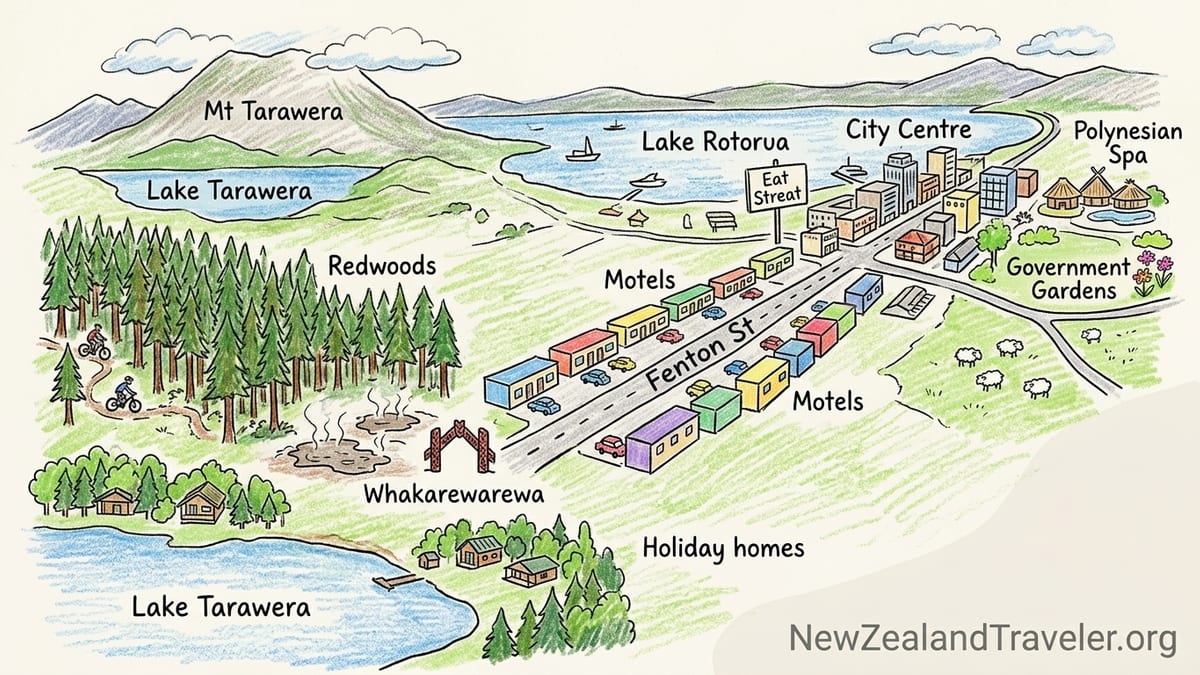
How Rotorua Is Laid Out: The Big Picture
Rotorua’s core is a small walkable centre wrapped around Lake Rotorua’s southern shore, with the main commercial streets running a few blocks back from the lakefront and Government Gardens. From here, Fenton Street runs south in a straight line for around 3.5 kilometres, forming the city’s main motel corridor and connecting the central hotels with Whakarewarewa and the Redwoods area on the outskirts.
Lakeside and nature-focused properties sit just outside that core. On the main lake, you’ll find established hotels like Novotel Rotorua Lakeside and Millennium Hotel Rotorua near the waterfront, plus smaller apartment complexes and motels one or two blocks back. Further out, lakes such as Tarawera and Ōkāreka are within about a 20 to 25 minute drive of the centre, home to upscale lodges and secluded holiday homes that feel a world away from the tour buses.
Rotorua’s official tourism information tends to separate these into three ideas: central city stays near restaurants and the lakefront, lakeside retreats around Rotorua and the outer lakes, and nature lodges tucked into forest or farmland. In reality, visitors usually narrow it down to three decisions: close to Eat Streat and the night-time buzz, somewhere practical and good value on Fenton Street, or a quieter base among the trees or by a lake. Once you know which style suits you, it becomes much easier to compare locations and specific properties.
Driving distances between these areas are short. In light traffic, it is common to drive from a city-centre hotel on the lakefront to the far end of Fenton Street or the Redwoods in under ten minutes, and to Lake Tarawera or Lake Ōkāreka in around twenty. That means you can choose based on atmosphere, parking and noise level rather than worrying too much about being “far” from key attractions.
City Centre & Lakefront: Best for Dining, Walking and Car-Free Trips
If you plan to eat out most nights, enjoy an evening drink and walk back to your room, or arrive without a car, the central city and lakefront is usually the easiest place to stay. Hotels such as Novotel Rotorua Lakeside and Millennium Hotel Rotorua sit close to Government Gardens, the lakefront promenade and Polynesian Spa, while boutique options like Regent of Rotorua and Prince’s Gate Hotel place you within a few minutes’ walk of Eat Streat and the main restaurant cluster.
For car-free travellers, this area works particularly well. Intercity buses and many tour shuttles stop near the central bus interchange, and numerous operators offer pick-up from major hotels in the middle of town. From here you can walk to supermarket shopping, casual cafes, Rotorua Museum’s grounds in Government Gardens, and the paved lakefront boardwalk. A visitor staying at a central hotel can realistically spend a day soaking in Polynesian Spa, strolling to Eat Streat for dinner, and returning late in the evening without getting into a vehicle at all.
Parking in the centre is a mix of hotel car parks and on-street spaces. Many midrange and upscale hotels include guest parking, sometimes free, sometimes with a modest nightly charge that can be significant on a longer stay. Motels and smaller apartment-style properties one or two blocks off the lakefront often offer free on-site parking. If you are driving, it can be worth comparing not only the nightly rate but also the parking fee, as a central hotel with paid parking may work out similar in total cost to a slightly cheaper motel further back with free spaces.
The main trade-off for this convenience is that some central streets experience more geothermal smell, particularly on certain days and after rain, and late-night noise can be higher around the bar and restaurant precinct. If you are sensitive to sulphur odours, consider asking for a lake-facing, higher-floor room, or choosing a boutique hotel a street or two away from the most active vents. Travellers with young children or very light sleep might prefer to check recent guest reviews for comments on nightclub noise, weekend events and nearby road works before committing to a particular central property.
Fenton Street: Motels, Value and Practicality
Fenton Street is Rotorua’s classic motel strip, often referred to locally as the “Motel Mile”. It runs from the lakefront edge of the city down to the Whakarewarewa and Redwoods area, lined for several kilometres with independently run motels, motor inns, budget hotels and a few branded properties. On Booking-style platforms you will see dozens of listings here targeting drivers, families and domestic travellers who value space, kitchenettes and free parking over a lake view.
Nightly rates on Fenton Street are often lower than the equivalent room right in the centre. For example, a standard studio or one-bedroom unit with a small kitchenette and spa tub might price below a compact central hotel room with no cooking facilities and paid parking. Many of these motels include on-site parking at no extra cost, and some have small geothermal hot tubs, indoor pools or family-friendly amenities like playgrounds and barbecue areas. For a family road trip, this can be an appealing combination of value and convenience.
From Fenton Street, driving to attractions is straightforward. The southern end of the strip connects directly to Te Puia and Whakarewarewa thermal village, and the turnoff to the Redwoods forest is only a few minutes further. Heading the other way, you can drive to the lakefront, Eat Streat and the main supermarket hubs in under ten minutes in typical traffic. Many bus tours and shuttle services will pick up from larger motels along this corridor, so car-free travellers who do not mind a less scenic streetscape sometimes base themselves here to reduce accommodation costs.
There are, however, some caveats. In recent years several motels on parts of Fenton Street have been used for emergency or transitional housing. This does not mean the entire strip is problematic, but it does make it essential to check recent reviews for any property you are considering, paying attention to comments about noise, security and overall atmosphere. For nervous travellers or those with young children, choosing a well-reviewed motel in the northern section of Fenton Street closer to the lake, or one of the more established midrange hotels, can provide a more consistently comfortable experience.
Whakarewarewa & Redwoods Side: Nature Access and Active Days
South of the main commercial centre, near the end of Fenton Street, the Whakarewarewa and Redwoods area offers a different style of stay. Here you are close to Te Puia, Whakarewarewa – The Living Māori Village, and the trailheads of the Whakarewarewa Forest, known for its towering redwoods and network of walking, running and mountain biking trails. Hotels like Rydges Rotorua and various apartment-style properties sit within a short drive or even walking distance of the forest car parks.
This side of town suits visitors who plan to spend most of their time outdoors. A typical day might involve driving five minutes from your hotel to the Redwoods Visitor Centre, walking an hour-long loop under the trees, then heading back for a rest before an evening soak in a hot pool. Mountain bikers appreciate accommodation that offers secure bike storage, hoses for cleaning gear and early breakfast options; several properties near the forest market directly to this crowd, sometimes with dedicated bike wash areas and tools.
Parking is generally easy here, with most hotels and motels providing free on-site spaces. You will drive to central restaurants or supermarkets, but the journey is short and largely uncongested outside of peak public holiday periods. If you prefer to avoid driving at night, you might plan on early dinners in town then returning to quieter streets around Whakarewarewa, where traffic noise and late-night bar activity are minimal compared with the central blocks.
Geothermal smells can be more noticeable in parts of Whakarewarewa, given the concentration of hot pools, mud pools and vents in this area. For many visitors, this is part of Rotorua’s charm. However, if you or your children are very sensitive to sulphur odour, you may want to read recent guest feedback and avoid properties immediately adjacent to major geothermal fields. Weather conditions can make a big difference, so two guests staying a month apart can report very different experiences in the same hotel.
Lake Tarawera & Lake Ōkāreka: Quiet Upscale Retreats
For travellers seeking quieter nights, upscale surroundings and a more secluded feel, the lakes around Rotorua offer some of the region’s most memorable stays. Lake Tarawera, about a 20 to 25 minute drive from the city centre, is home to Solitaire Lodge, one of New Zealand’s classic luxury lodges. Perched on a private peninsula overlooking the lake and Mount Tarawera, it offers large suites, inclusive multi-course dining and access to private boat excursions and thermal springs, catering to guests who want a fully hosted, high-end experience.
Along the same lake and neighbouring lakes such as Ōkāreka and Tikitapu, you will also find a mix of architect-designed holiday homes, small lakefront lodges and low-key baches available for short-term rental. Many of these properties focus on tranquility, with features like outdoor hot tubs, decks just above the waterline and private jetties for kayaking or swimming. Early mornings here are typically defined by birdsong and the sound of water rather than traffic, making them popular for honeymoons, special occasions and long weekends away from city life.
The trade-off for this peace is distance from restaurants and shops. While there are a few local cafes and seasonal eateries around the lakes, you should expect to self-cater for at least some meals, and drive back into Rotorua for supermarket shopping or a night at a celebrated restaurant. Parking is usually straightforward at these properties, with private driveways or off-street spaces, but narrow rural roads and limited lighting mean cautious driving at night is advisable.
For families, lake stays can be magical provided you are comfortable supervising children around water and do not mind being further from urban playgrounds and indoor attractions. Many lake houses offer multiple bedrooms, full kitchens, laundry facilities and outdoor space for games, but may not have fenced gardens or lifeguarded swimming. Upscale lodges such as Solitaire often welcome older children but may feel more adult in tone, with formal multi-course dinners and an emphasis on quiet relaxation rather than playground-style facilities.
Parking, Driving Times and Getting Around Without a Car
Rotorua is generally easy to navigate by car, and most accommodation options outside the tightest parts of the centre include on-site parking. City-centre hotels sometimes charge a nightly parking fee, especially those with covered or secure garages, while many motels on Fenton Street and near Whakarewarewa offer free surface parking. When comparing nightly rates, it is worth adding any parking cost to the total, especially on a longer stay where an extra daily charge can add up quickly.
Driving times between key areas are short. From the lakefront hotels to the majority of Fenton Street motels, you are usually looking at five to ten minutes in normal traffic. From Fenton Street to the Redwoods, it is commonly about five minutes more. The road to Lake Tarawera or Lake Ōkāreka typically takes around twenty minutes from the centre, though times can vary with weather and holiday congestion. Many attractions such as Skyline Rotorua, Whakarewarewa, Te Puia and the major geothermal parks south of the city are signposted clearly and designed to be reached by private car or tour bus.
For those planning a car-free trip, basing yourself in the city centre or immediate lakefront gives you the most flexibility. From there, you can walk to Polynesian Spa, Government Gardens, the lakefront promenade and the main dining streets, and join organised tours that include transport to places like Wai-O-Tapu, Waimangu Volcanic Valley or cultural evening experiences. Some midrange central hotels can arrange shuttles or work with local operators who collect guests from reception; confirming this before booking is sensible if you do not intend to rent a vehicle.
Staying further out, such as on Fenton Street’s southern end or at the lakes, is more challenging without your own transport. A few tour companies may pick up from certain motels along Fenton Street, but coverage is not universal and services can change seasonally. Taxi and rideshare options exist but become more expensive once you are beyond the built-up area. If you prefer a quiet lake or forest base and do not drive, consider travelling with companions who do, or planning to spend more time relaxing on-site rather than expecting frequent trips into town.
Families, Geothermal Smell and Choosing the Right Atmosphere
Families visiting Rotorua often face a mix of practical questions: will the kids sleep well, is there enough space, and how strong is the geothermal smell near the hotel. For many, Fenton Street motels with two-bedroom units, kitchenettes and private spa pools offer a good balance of price and comfort, especially if you plan to cook some meals in and spend most days out at attractions. Central apartments and holiday parks on the edge of town can provide similar benefits, sometimes with playgrounds or communal barbecue areas where children can play and parents can socialise.
The sulphur smell is highly localised and can change with wind direction, humidity and recent rainfall. Properties immediately next to active geothermal fields or steaming ground may experience stronger odours, while those a few blocks away on the same street may notice very little. If anyone in your group is particularly sensitive, consider focusing on the lakefront, the northern end of the city or outer lakes such as Tarawera and Ōkāreka, which are typically less affected. When reading reviews, pay attention to comments from guests who visited at similar times of year to your planned trip, as winter fog and rain can make smells more pronounced than on a breezy summer day.
Atmosphere also varies considerably between areas. The city centre near Eat Streat is liveliest in the evenings, with outdoor heaters, music from bars and a steady flow of diners. Fenton Street feels more like a classic highway motel strip: functional, car-oriented and quieter later at night, though some sections are busier due to traffic and the mix of long-term and short-term guests. The Whakarewarewa side and the lakes skew toward early nights and early mornings, with guests rising for dawn walks, fishing trips or forest rides rather than staying out late in town.
Safety expectations are similar to other small cities. As in any destination, it pays to use common sense, lock vehicles and avoid leaving valuables on display. There have been public discussions about social challenges around parts of Fenton Street linked to emergency housing, which is why checking recent, detailed reviews is so important. Many visitors report comfortable, uneventful stays in well-managed motels and hotels, particularly those that maintain clear policies around noise and guest behaviour.
The Takeaway
Rotorua’s compact size means you rarely stay “too far” from the action, but small location choices make a big difference to your daily rhythm. The city centre and lakefront work best if you want to forget about the car in the evenings, walk to dinner and enjoy easy access to Polynesian Spa, Government Gardens and the main promenade. Fenton Street caters to drivers and families looking for good value motels, free parking and simple access to the major roads in and out of town.
On the southern edge, the Whakarewarewa and Redwoods area suits travellers who come for forest walks, mountain biking and proximity to cultural and geothermal attractions, accepting that they will drive into town for most meals. For quiet, upscale stays, especially for couples and special occasions, lake lodges and holiday homes around Lake Tarawera and Lake Ōkāreka offer space, serenity and starry skies in exchange for longer drives and more self-catering.
When choosing where to stay, think practically about your priorities: do you mind driving to dinner, how sensitive are you to sulphur smells, are free parking and kitchen facilities more important than a lake view, and do you prefer lively evenings or a silent shoreline. Rotorua offers credible options for each style of traveller; the art lies in matching your base to the way you actually like to travel, rather than how the brochures imagine you will.
FAQ
Q1. What is the best area to stay in Rotorua for first-time visitors?
For most first-time visitors, staying in the city centre or on the immediate lakefront is the easiest option. You can walk to Eat Streat, Polynesian Spa, Government Gardens and the lakefront promenade, and many tours include pick-up from central hotels, which simplifies logistics if you are still getting your bearings.
Q2. Is Fenton Street a good place to stay in Rotorua?
Fenton Street can be a good choice if you want motels with kitchenettes, free parking and generally lower rates than the lakefront. It is practical for drivers and families, but because some properties have been used for emergency housing, it is important to read recent reviews carefully and focus on well-managed, well-reviewed motels or hotels along the strip.
Q3. Where should I stay in Rotorua if I do not have a car?
If you are travelling without a car, the city centre and lakefront are usually best. You can walk to restaurants, supermarkets and the main spa complexes, and most organised tours either depart from central meeting points or offer pick-up from major downtown hotels. Staying further out, such as by the lakes or near the Redwoods, is more challenging without some form of private transport.
Q4. Are the lake lodges at Tarawera and Ōkāreka worth the extra cost?
Lodges and upscale holiday homes around Lake Tarawera and Lake Ōkāreka are typically more expensive than central hotels, but they offer a quieter, more scenic experience with direct access to the water and surrounding bush. They are especially appealing for honeymoons, special occasions and travellers who value privacy and nature over being close to nightlife.
Q5. Which area has the strongest geothermal smell?
Smell levels change with weather, but generally the areas closest to major geothermal fields, such as parts of Whakarewarewa and some pockets of the central city, notice sulphur odours more often. Lakefront properties and the outer lakes like Tarawera and Ōkāreka tend to be less affected, although conditions can vary day to day.
Q6. Is Rotorua’s city centre noisy at night?
The streets around Eat Streat and nearby bars can be lively, particularly on weekends and during events, with music and foot traffic into the late evening. If you are a light sleeper, consider a room on a higher floor, facing away from the busiest streets, or a boutique hotel or apartment a couple of blocks back from the main dining strip.
Q7. How long does it take to drive from central Rotorua to the Redwoods or Lake Tarawera?
In typical conditions, it is often about five to ten minutes’ drive from central hotels or the lakefront to the Redwoods and Whakarewarewa area, and around twenty to twenty-five minutes to reach Lake Tarawera or Lake Ōkāreka. These times can vary with traffic and weather, but they give a reasonable guide for planning day trips.
Q8. What is the best area for families with young children?
Families with young children often like Fenton Street motels or central apartments that offer separate bedrooms, kitchen facilities and on-site parking. Holiday parks and some lake houses can also work well if you want outdoor space, but it is important to check safety features such as fencing, proximity to water and any child-friendly amenities like playgrounds.
Q9. Is it safe to walk around Rotorua at night from my hotel to restaurants?
Most visitors who stay in central Rotorua report walking to and from restaurants in the early evening without issues, using the same common-sense precautions they would in any small city. If you feel uncomfortable walking late at night or are staying further out on Fenton Street, using a taxi or rideshare for after-dark trips is a simple way to feel more secure.
Q10. Should I split my stay between central Rotorua and a lake lodge?
Splitting your time can work very well if your schedule allows. Many travellers spend one or two nights in a central hotel to visit geothermal parks, cultural attractions and restaurants, then move to a quieter lake lodge or holiday home for a final night or two of relaxation by the water before continuing their journey.