


Rotorua is the place many visitors choose for their first deep encounter with Māori culture. Four experiences in particular are now highlighted in official tourism material as the city’s principal offerings: Te Pā Tū, Mitai Māori Village, Te Puia and Whakarewarewa Living Māori Village. They share common threads of haka, hāngī-inspired food and storytelling, but what you actually do on the day or evening is very different. This guide breaks down those differences so you can match the right experience to your time, budget and travel style.
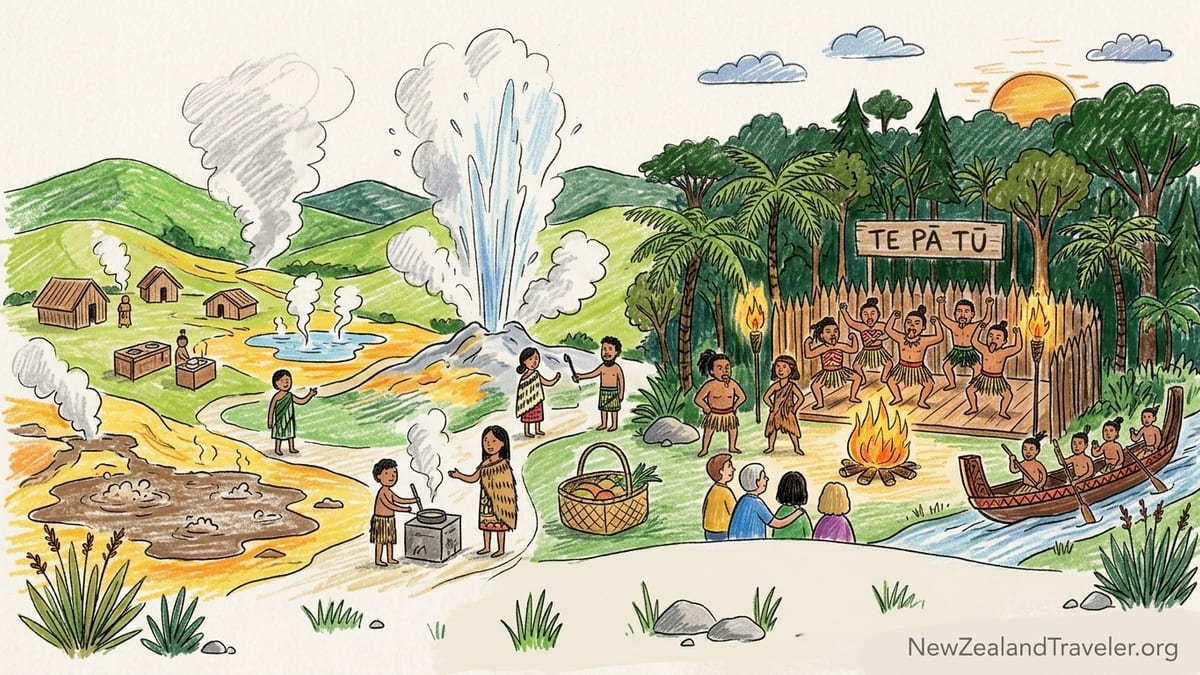
Understanding Rotorua’s Four Main Māori Experiences
Before comparing details like hāngī or hotel transfers, it helps to understand what each experience is trying to do. Te Pā Tū and Mitai Māori Village are primarily evening cultural encounters built around performance and shared food. Both take place outside central Rotorua in forested settings, with transport laid on from town and a strong focus on ceremony, kapa haka and storytelling. In practice, many international visitors choose one of these as their “big night out” for Māori culture.
Te Puia and Whakarewarewa, by contrast, are strongly rooted in place. Both sit within the wider Whakarewarewa geothermal valley, where hot pools, mud and geysers have shaped daily life for generations. Te Puia combines geothermal landscapes, the Pōhutu Geyser, kiwi viewing and the national Māori Arts and Crafts Institute, with optional performances and evening dining. Whakarewarewa is a living village where families still reside among steam vents and boiling pools, and guided tours centre on how people live with that environment.
It is also worth noting that these four experiences emerge from different Māori communities and governance structures. Te Pā Tū and Mitai are operated by whānau and hapū with a strong tourism focus, offering polished, choreographed evenings. Te Puia is closely linked to the New Zealand Māori Arts and Crafts Institute, with a mandate to preserve carving and weaving traditions. Whakarewarewa is the home of Tūhourangi Ngāti Wāhiao, who have welcomed visitors for more than a century while continuing to live in the village. None is automatically “more authentic” than the others; each reflects a distinct relationship between people, land and visitors.
For travellers, the practical question is less which one is “best” and more which format suits your itinerary. If you have children and only daylight hours, a one-hour village tour and geothermal walk might be ideal. If you want a festive evening with performance and a large shared meal, then an evening experience could be the highlight of your Rotorua stay. The rest of this guide breaks down what you actually receive at each place, from waka ceremonies and geyser views to how long you should allow and how easy it is with a stroller or rental car.
Daytime Village Tours and Geothermal Encounters
Whakarewarewa Living Māori Village and Te Puia are the strongest options if you want to explore Māori culture primarily during the day. Whakarewarewa’s Legacy Guided Tour is typically around 60 minutes and focuses on daily life in a village built amid hot pools and steam vents. Guides, many of whom are descendants of families who have lived there for generations, walk you past communal cooking boxes heated by geothermal steam, bath areas once used by ancestors and active features such as bubbling mud. Visitors often comment that this feels less like a theme park and more like being shown around someone’s neighbourhood.
Te Puia’s daytime experience generally takes longer, especially if you add a performance or hāngī-style meal. A typical visit includes a guided walk through the Te Whakarewarewa valley to the Pōhutu Geyser, widely described as the largest active geyser in the Southern Hemisphere, along with mud pools and terraces. Many families allow at least two to three hours to also visit the Kiwi Conservation Centre, where nocturnal kiwi are displayed on a reversed light cycle, and the carving and weaving schools, where tauira demonstrate traditional techniques in real time. Te Puia feels more like a cultural campus, combining geothermal attractions with national-level arts and education.
Mitai and Te Pā Tū are increasingly experimenting with daytime offerings, but their core experiences remain in the evening. Mitai sometimes offers a daytime or lunchtime version of its village and hāngī, which can work well for cruise passengers or families with younger children who tire in the evenings. However, most visitors still encounter Mitai after dark, when flaming torches and forest shadows sharpen the sense of ceremony. Te Pā Tū is almost entirely focused on the evening forest feast, so those with only daytime free will usually look first to Te Puia or Whakarewarewa.
If your priority is geothermal scenery woven tightly with contemporary village life, Whakarewarewa is the most focused daytime choice. If you want the iconic geyser, kiwi viewing and an introduction to Māori arts and crafts in one ticket, Te Puia is usually the better fit. Many travellers with two days in Rotorua pair a daytime visit to Te Puia or Whakarewarewa with a separate evening at Te Pā Tū or Mitai for a fuller picture of both landscape and performance traditions.
Evening Performances, Haka and Storytelling
For many visitors, the quintessential Rotorua memory is an evening of kapa haka under the stars, followed by a shared feast. Te Pā Tū and Mitai Māori Village both deliver this, but with slightly different atmospheres and formats. Mitai begins with a welcome and introductions before guests watch warriors paddle a waka down the Wai-o-Whiro stream by torchlight. This is followed by a cultural performance featuring elements such as pōwhiri (formal welcome), waiata, mōteatea (chant), poi and haka. Seating is in a purpose-built dining and performance space, and the tone is warm and communal, with strong emphasis on explaining each part of the ceremony to first-time visitors.
Te Pā Tū takes a more theatrical, seasonal approach to its evening. Guests are transported from central Rotorua to a forest pā, where a series of hosts guide small groups through stations that explore different elements of Māori culture, often themed around seasonal celebrations. There is typically a formal welcome, haka and waiata, but woven into a broader narrative that may change during the year. Performers and hosts move between te reo Māori and English, and there is a carefully choreographed progression from gathering at the entrance to moving deeper into the forest and finally to the open-air dining space.
Te Puia also offers an evening format that combines geothermal elements and cultural performance. Visitors might walk down into the valley to see the geyser illuminated after dark before heading indoors or to a covered area for a cultural show and dinner. While the haka and songs share common roots with those seen at Te Pā Tū and Mitai, the overall tone at Te Puia is shaped by its role as a cultural institute as well as a visitor attraction. Commentary often highlights the connection between performance, language revitalisation and the preservation of arts taught in the on-site schools.
Whakarewarewa’s core experience remains daytime village tours and geothermal trails, but cultural performances are often scheduled during the day rather than as a stand-alone evening product. For travellers who prefer to be back at their accommodation by sunset, this can be attractive: you can watch haka and waiata performed by village residents, then continue your geothermal walk, all before an early dinner in town. If you specifically want an after-dark performance in the bush, Te Pā Tū and Mitai remain the clearest choices.
Hāngī, Food and Dining Styles
Food is a central part of these experiences, but the style of dining and the degree to which it is strictly “traditional” varies. Mitai Māori Village is widely described as the most hāngī-focused of the four. Guests typically watch the earth oven being lifted, revealing steaming trays of meat and vegetables. Dinner is usually served buffet style with classic hāngī staples such as chicken, lamb and root vegetables, alongside salads and desserts that cater to international tastes. Families often appreciate the relaxed self-service format, which allows picky eaters to choose what they like while still sampling food cooked in the earth.
Te Pā Tū positions its food as a forest feast with strong Māori influences rather than a purely traditional hāngī buffet. The evening often features a multi-course menu that might include dishes cooked using hāngī techniques or incorporating native ingredients such as kawakawa, horopito or mānuka-smoked meats. Plating is more contemporary restaurant style than buffet, and courses are presented as part of the storytelling. Prices are usually higher than Mitai, reflecting both the multi-course format and the emphasis on local and seasonal produce. For food-focused travellers or those marking a special occasion, Te Pā Tū can feel closer to a degustation dinner that happens to be wrapped in cultural performance.
Te Puia offers a range of dining options that shift over time, sometimes including hāngī-style buffets, shared platters or more conventional restaurant menus with Māori twists. Some visitors book a package that combines a guided tour, performance and buffet dinner, while others simply eat at the on-site cafe after exploring the valley and arts schools. This flexibility makes Te Puia appealing for families or independent travellers who do not want to commit an entire evening to a structured dinner but still hope to try food influenced by hāngī or native ingredients.
Whakarewarewa’s emphasis is on showing how geothermal heat has traditionally been used for everyday cooking rather than staging a large evening banquet. On guided tours, you may see food being cooked in steam vents or hot pools, and some packages include the chance to sample corn or eggs cooked this way, or to purchase a simple lunch prepared in the geothermal kitchens. For travellers who are curious about how people actually live with geothermal resources day to day, this practical demonstration can be as memorable as a formal buffet.
Waka, Forest, Geysers and Other Signature Elements
Each experience has signature elements that often tip the balance for travellers choosing between them. At Mitai Māori Village, the highlight for many is the waka segment. As dusk falls, guests gather along the Wai-o-Whiro stream to watch warriors in traditional dress bring their canoe silently through the water by torchlight. The combination of forest, firelight and chanting creates a powerful sense of connection to ancestral river journeys. Mitai also includes a short forest walk where guides point out native plants and, in some cases, brief glimpses of glowworms after dark.
Te Pā Tū’s strongest physical setting is its Tawa forest pā. Instead of water, the focus is on the bush itself: towering trees, boardwalks and open spaces lit by fire and subtle lighting. Guests move between outdoor stages and gathering points where they might learn about weaponry, games or stories of the local iwi. The sense is of being hosted within a fortified village in the forest, with the natural environment as a central character. For travellers who are drawn to native bush as much as to performance, the forest atmosphere can be a major draw.
Te Puia’s non-negotiable signature is the Pōhutu Geyser, which erupts frequently, sometimes up to dozens of times a day, sending plumes of steam and water into the air. The geothermal terraces and mud pools surrounding it create a landscape that many visitors say feels like a natural amphitheatre for the cultural narrative. Add to this the kiwi viewing house and the open workshops of the carving and weaving schools, and Te Puia offers an unusually rich mix of nature and culture in one location. People with limited time often choose Te Puia specifically to “tick off” geothermal wonders and Māori arts in a single visit.
Whakarewarewa’s defining feature is that it is both a geothermal attraction and a lived-in village. Walking past family homes with washing lines strung above steaming vents brings the reality of geothermal life into sharp focus. Trails range from short, accessible loops to longer walks out to lookouts over the valley. Some routes are stroller friendly, while others have steps and uneven surfaces. For photographers, there are opportunities to capture both classic geothermal scenes and everyday village moments such as children walking to school along paths edged with silica terraces.
Practicalities: Transfers, Duration and Family Suitability
Te Pā Tū and Mitai Māori Village both tend to include hotel pickup and drop-off from central Rotorua in their standard evening packages. This is particularly helpful if you are without a car, travelling in a group or simply prefer not to navigate back roads in the dark. Buses usually collect guests from major hotels and motels in the early evening before returning them around 9.30 or 10 pm, depending on the season and exact programme. For families with younger children, it can be worth requesting an early pickup point to secure seats near the front of the coach, where the commentary is easiest to hear.
Te Puia and Whakarewarewa are both a short drive or taxi ride from central Rotorua and are easy to reach in a rental car. They do not typically include hotel transfers in basic daytime admission, although some tour operators bundle visits with transport from cruise ships or other regions. Parking is generally straightforward, and many families appreciate the flexibility to leave gear in the car, take breaks or leave earlier than planned if children get tired. Opening hours for daytime visits usually span mid-morning to mid-afternoon, though it is wise to check current schedules as they can shift with seasons and events.
In terms of duration, Mitai’s evening generally runs around three hours from initial pickup to drop-off, while Te Pā Tū is often slightly longer once multi-course dining and forest activities are included. Te Puia can be experienced in two to three hours if you focus on key highlights, but many visitors stretch this to half a day, especially if they pause for meals and spend time watching artists at work. Whakarewarewa’s guided tour is about one hour, with the option to add self-guided geothermal trails that can turn the visit into a half-day exploration. Planning your day with these approximate durations in mind is important if you are also trying to fit in other Rotorua attractions such as mountain biking or lake cruises.
All four experiences welcome families, but they suit different ages and energy levels. Young children who struggle in the evenings may be happier with a daytime visit to Te Puia or Whakarewarewa, where they can move around freely, watch geothermal activity and meet guides without needing to sit through a long performance and late dinner. Older children and teenagers often love the drama of nighttime haka, flaming torches and storytelling at Te Pā Tū and Mitai. If travelling with a stroller or wheelchair, it is worth checking accessibility information in advance, as geothermal terrain can include slopes, boardwalks and occasional steps.
Matching Each Experience to Different Travellers
When you strip away marketing language and focus on what a visitor actually receives, each of the four Rotorua experiences serves a slightly different traveller profile. Te Pā Tū is often the choice for those who want a high-end, food-focused evening framed by Māori culture and forest immersion. It suits couples, small groups and food lovers who are comfortable with a higher per-person price in exchange for table service, multi-course dining and a carefully choreographed narrative. If you are celebrating a honeymoon, anniversary or a once-in-a-decade trip, Te Pā Tū can feel like the most celebratory of the options.
Mitai Māori Village, with its waka on the river, buffet format and family-owned feel, tends to appeal to a broad mid-range audience. It is popular with families, tour groups and independent travellers who want a classic combination of performance and hāngī at a price that, while not cheap, is more accessible than a fine-dining style forest feast. The waka and forest walk elements also make it an appealing choice for photographers and those who enjoy storytelling linked to waterways and navigation.
Te Puia is best seen as an all-rounder. It works well for travellers who want to “bundle” geothermal activity, kiwi viewing, arts and performances into a single half-day or evening. It is also a logical choice for those interested in how Māori carving and weaving are being taught to new generations, as visitors can watch students at work under the guidance of senior tohunga. For multi-generational groups, Te Puia’s variety usually means that everyone finds something they love, from grandparents fascinated by crafts to younger relatives thrilled by the geyser.
Whakarewarewa Living Māori Village is ideal for travellers whose curiosity leans toward everyday life and history rather than structured performance and banquet dining. Walking through a village where people still live, cook and bathe among steam vents can be both humbling and eye-opening. Budget-conscious travellers also appreciate that the basic guided tour is significantly cheaper than an evening cultural dinner, allowing room in the itinerary for other Rotorua experiences or an additional night in town. Those with more time can combine the village tour with the geothermal trails for a deeper sense of the land.
The Takeaway
Choosing between Te Pā Tū, Mitai Māori Village, Te Puia and Whakarewarewa is less about identifying a single “best” Māori cultural experience and more about understanding the shape of your day and what kind of connection you are seeking. Te Pā Tū is your forest feast and storytelling evening, Mitai your classic hāngī and waka night, Te Puia your geothermal and arts hub, and Whakarewarewa your window into a living village set among steam and hot pools. Each is grounded in its own community, history and landscape.
In practical terms, travellers with limited time often pair one daytime option with one evening experience. For example, you might spend a morning at Whakarewarewa learning how families use geothermal heat, then enjoy an evening at Mitai watching the waka glide along the stream before sharing hāngī. Or you could devote half a day to Te Puia’s geyser, kiwi and arts institute, then return the following night for an immersive forest celebration at Te Pā Tū.
Whatever combination you choose, remember that you are stepping into living cultures rather than static attractions. Arrive a little early, listen as much as you watch, and be willing to ask respectful questions. The most lasting memories from these Rotorua experiences often come not from the biggest geyser eruption or loudest haka, but from quiet conversations with guides and hosts who share their own family stories of this remarkable landscape.
FAQ
Q1. If I can only choose one Māori cultural experience in Rotorua, which should it be?
The best single choice depends on your priorities. If you want an all-in-one mix of geothermal activity, kiwi viewing, arts and performance in one place, Te Puia usually offers the broadest package. If your focus is an evening with haka and hāngī, Mitai or Te Pā Tū may be more satisfying, while those most curious about daily life in a geothermal village often prioritise a guided tour at Whakarewarewa.
Q2. Which experience is best for families with young children?
Daytime visits typically work better for younger children. Te Puia and Whakarewarewa both offer flexible daytime schedules where kids can move around, watch geothermal features and interact with guides without sitting through a late dinner. Older children and teenagers often enjoy the evening drama of Mitai’s waka and haka or Te Pā Tū’s forest storytelling, but parents should be aware that these nights can finish close to 10 pm.
Q3. Do all four experiences include a hāngī meal?
No. Mitai Māori Village and Te Pā Tū are the most clearly hāngī-focused evening experiences, with Mitai emphasising the earth oven and buffet and Te Pā Tū weaving hāngī techniques and native ingredients into a multi-course forest feast. Te Puia often offers hāngī-style or Māori-inspired dining as part of certain packages, but it is not mandatory with basic admission. Whakarewarewa typically demonstrates geothermal cooking on tours and may offer simple tastings or lunches rather than a full hāngī banquet.
Q4. How important is hotel transfer when choosing between them?
Hotel transfer matters most if you do not have a car or prefer not to drive in the dark. Te Pā Tū and Mitai commonly include coach pickup and drop-off from central Rotorua, which simplifies logistics for evening experiences. Te Puia and Whakarewarewa are easy to reach by car, taxi or rideshare from town, and many visitors appreciate the flexibility of arriving and leaving on their own schedule during the day.
Q5. Are these experiences suitable for travellers with mobility challenges?
Accessibility varies by site and by specific route. All four are used to hosting visitors with different mobility needs, but geothermal terrain can include slopes, boardwalks and occasional steps. Te Puia and Whakarewarewa both offer shorter, more accessible routes and viewing points, while Mitai and Te Pā Tū have some outdoor segments on forest or streamside paths. It is wise to contact each operator ahead of time to discuss specific requirements such as wheelchair use or limited walking endurance.
Q6. Can I visit more than one Māori experience in a single day?
It is possible but can feel rushed. A common pattern is to visit Whakarewarewa or Te Puia during the day and then attend Mitai or Te Pā Tū in the evening. Trying to combine both a full daytime programme and a long evening experience on the same day can be tiring, especially for families or after long drives. If you have two or three nights in Rotorua, spreading visits over separate days usually leads to a better experience.
Q7. How far in advance should I book?
Evening experiences such as Te Pā Tū and Mitai can sell out in peak seasons like December to March and during school holidays, so booking several weeks ahead is sensible for those dates. Daytime visits to Te Puia and Whakarewarewa often have more flexibility, but guided tour times and performance slots can still fill, particularly when cruise ships are in port. If you know your travel dates, reserving at least key experiences in advance helps avoid disappointment.
Q8. Is there a big difference in price between the four options?
Yes, prices can vary quite a bit. Daytime guided tours at Whakarewarewa are generally at the lower end, making them a good option for budget-conscious travellers. Te Puia’s combined geothermal, kiwi and arts experiences sit in a mid-range for a half-day attraction. Evening cultural dinners at Mitai cost more than basic daytime admissions, while Te Pā Tū’s multi-course forest feast typically commands the highest per-person price. It is worth checking current rates and what is included, as packages and seasonal pricing can change.
Q9. Which experience offers the best geothermal scenery?
Te Puia and Whakarewarewa both sit within the wider Whakarewarewa geothermal valley and offer striking landscapes of steam vents, mud pools and terraces. Te Puia includes views of the Pōhutu Geyser, which many visitors consider a must-see. Whakarewarewa combines geothermal features with the lived-in village, so the scenery is interwoven with homes, pathways and communal spaces. Evening experiences at Te Pā Tū and Mitai take place in forested settings rather than strongly geothermal ones, so choose accordingly if geysers are a priority.
Q10. How should I dress for these experiences?
Rotorua’s weather can change quickly, and geothermal areas can feel both warm from steam and cool in the wind. For daytime visits to Te Puia and Whakarewarewa, comfortable walking shoes, layered clothing and a light waterproof jacket are sensible. For evening experiences at Te Pā Tū and Mitai, bring a warm layer and, if rain is possible, a compact raincoat, as some segments take place outdoors in forest or beside the stream. Smart casual clothing is perfectly acceptable; there is no need for formal attire.