


Rotorua can feel overwhelming on a first visit. Within a compact area you will find billowing geysers, Māori cultural performances, towering redwoods, hot pools on a lakeshore and more adventure activities than you can fit into a weekend. The trick is not to book everything, but to choose the geothermal, forest, lake, culture, adventure and hot pool experiences that actually match how you like to travel. This guide walks through the main options and shows where they overlap, so you can design a Rotorua itinerary that feels rich without being rushed or expensive.
How to Plan Your Time in Rotorua
Before you start booking, decide what Rotorua means for your trip. Some visitors come for one signature geothermal park and a soak in hot pools before driving on. Others want to combine Māori culture, forest walks, a lake cruise and mountain biking over two or three days. The same core attractions appear in most itineraries, but you do not need to do them all to feel you have “done Rotorua.”
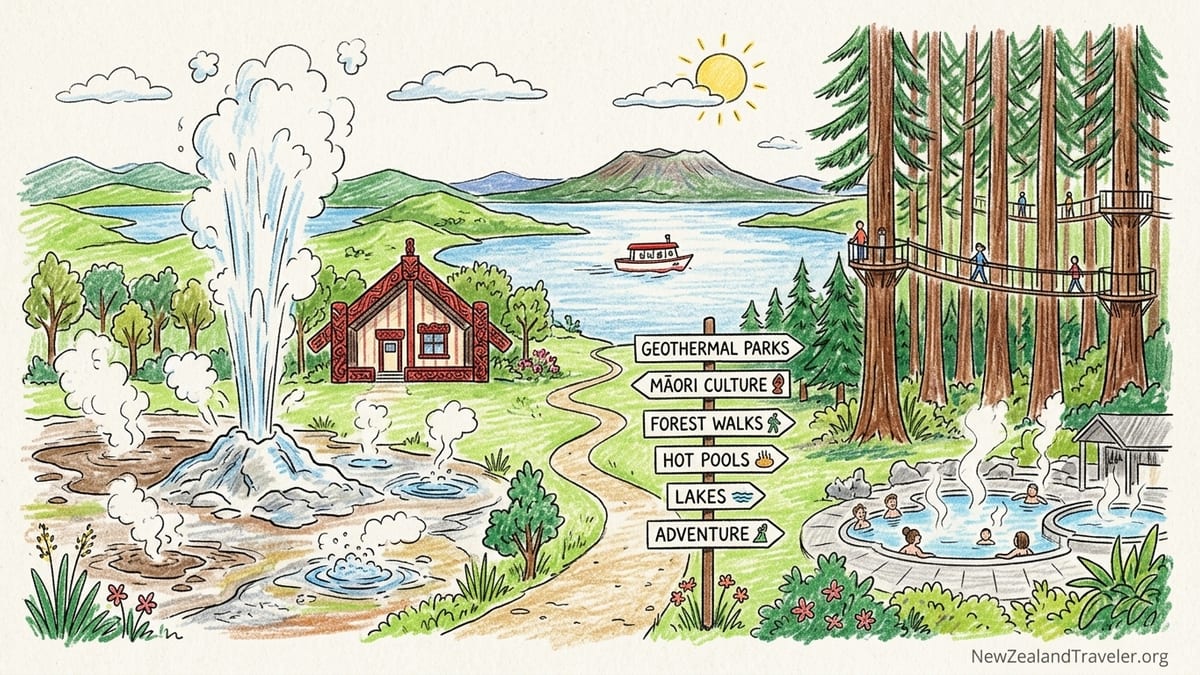
A useful way to plan is to think in six themes: geothermal landscapes, Māori culture, Redwoods and forest, lakes, adventure and hot pools. Rotorua’s official visitor materials use almost the same groupings, and most commercial experiences sit in at least one of these buckets. For example, Te Puia mixes geothermal and culture, while Wai Ariki blends hot pools with Māori wellness. Once you know which themes matter most to you, you can pick one or two flagship experiences in each and leave the rest for another visit.
Costs also vary widely. Some experiences, such as Whakarewarewa Forest and Kuirau Park, are free to enter, which helps balance the budget after ticketed geothermal parks and premium spas. As of late 2026, headline geothermal and hot pool experiences often start from around the cost of a casual restaurant meal per adult and climb into premium “special occasion” territory for multi-hour spa rituals. Treat any prices mentioned here as ballpark figures and always check current rates when you book.
Travel time is another factor. Rotorua’s central lakefront, Kuirau Park, Polynesian Spa and Wai Ariki sit close together, while major geothermal parks like Wai O Tapu and Waimangu Volcanic Valley require a drive south of town. It is very realistic to combine, for instance, a morning geothermal walk with a late afternoon forest visit and an evening hot pool soak, as long as you cluster experiences by direction.
Geothermal Parks: Te Puia, Wai O Tapu, Waimangu and Kuirau Park
If you only do one “big ticket” geothermal experience, decide first what you care most about: dramatic color, wide open volcanic scenery or a combination of geothermal and culture. Wai O Tapu is famous for vividly colored pools and silica terraces. Waimangu offers a long rift valley with crater lakes and more of a remote, natural feel. Te Puia sits on the edge of the city and combines bubbling mud pools and geysers with guided cultural experiences. All three are ticketed attractions with structured opening hours and last-entry rules.
Te Puia works well if you want geothermal activity plus Māori culture and do not have a car, because it is close to central Rotorua and many tours include transport. You will typically see the geyser field, bubbling mud and a kiwi conservation area alongside carved meeting houses and performance spaces. Because Te Puia already gives you a strong taste of geothermal features, many visitors skip a second paid park unless they are particularly interested in landscape or photography.
Wai O Tapu and Waimangu both lie south of Rotorua along State Highway 5. Wai O Tapu is known for its bright mineral colors and boardwalk circuits, while Waimangu Volcanic Rift Valley stretches along a valley formed after the 1886 Mount Tarawera eruption and includes several crater lakes and steaming cliffs. Walking the main Waimangu track can take several hours if you go all the way to Lake Rotomahana and add the optional boat cruise, so it suits travelers who enjoy longer, gently downhill walks with shuttle options back to the entrance.
For many travelers the most effective pairing is one paid geothermal park plus a visit to Kuirau Park, a free public geothermal park on the edge of the city. Kuirau Park has fenced bubbling mud pools, steaming vents and footbaths supplied by natural hot water. It will not replace the scale of Wai O Tapu or Waimangu, but it offers a very good sense of Rotorua’s geothermal character without another ticket. On a two-day stay, a common pattern is Te Puia on one afternoon, then Kuirau Park and a hot pool soak the next day, rather than trying to fund and fit in all three major parks.
Māori Culture: Where to Go and How It Overlaps With Geothermal
Māori culture is deeply woven into Rotorua’s landscapes, and most visitors want at least one experience that is more than a quick photo stop. Te Puia is one of the most convenient entry points, with carving and weaving schools, a cultural performance and guided explanations of the geothermal features on site. Because you are walking across an active geothermal valley that local iwi have used for generations, you get both storytelling and scenery in one place.
Other cultural experiences around Rotorua, such as evening hāngī dinners, village visits and storytelling performances, often include elements you will also encounter at Te Puia: kapa haka (performing arts), explanations of tikanga (customs) and traditional foods cooked using geothermal steam or earth ovens. If your schedule or budget is tight, it rarely makes sense to book multiple full cultural evenings plus Te Puia. Instead, choose one anchor experience that best matches your interests and timing.
For travelers especially interested in indigenous perspectives on wellness, Wai Ariki Hot Springs and Spa on the lakefront offers a different style of cultural experience. Its bathing journeys and spa treatments are explicitly grounded in the worldview of local Ngāti Whakaue, from the way spaces are laid out to the use of local geothermal waters. Where Te Puia is more interpretive and educational, Wai Ariki’s approach is quieter and focused on personal restoration, but both share a clear cultural foundation.
Many visitors find that one strong cultural-geothermal combination, such as Te Puia during the day or an evening cultural village experience, plus time in a Māori-owned spa like Wai Ariki, offers a satisfying and respectful introduction. Doubling up on similar packages can start to feel repetitive. When comparing options, look closely at what is truly unique: is it the performance, the geothermal setting, the food, or the wellness element, and which of those do you want most?
Redwoods and Forest: Whakarewarewa Forest and Redwoods Treewalk
Whakarewarewa Forest, commonly called the Redwoods, is one of Rotorua’s best value experiences. Entry to the forest walking and mountain biking network is free, with only optional extras such as maps, bike hire or guided tours carrying a cost. You can simply drive or take a taxi to the main Redwoods car park, then choose from a series of well signposted walking tracks ranging from short family friendly loops to half-day hikes beneath towering Californian redwoods.
The Redwoods Treewalk is a separate, ticketed experience within the same forest. A series of hanging bridges suspended between the redwood trunks creates an elevated walkway around 9 to 20 metres above the forest floor. The Treewalk typically takes 30 to 40 minutes at a gentle pace and offers a bird’s eye view of ferns and trunks without requiring any special fitness. Because it is a dedicated attraction, prices are comparable to other signature Rotorua experiences, and there are separate tickets for daytime and nighttime visits with lantern-style lighting.
For most travelers, the decision is whether to visit the forest only at ground level for free, or to add the Treewalk as a paid highlight. If you are travelling with young children, older relatives or anyone who loves atmospheric photos, the Treewalk can justify its cost as your main “forest splurge,” while you still enjoy free walks before or after. If you are an experienced hiker or mountain biker already planning several hours on the trails, you might decide your budget is better used on geothermal or hot pool experiences instead.
A practical approach is to plan at least one daylight visit to Whakarewarewa Forest, regardless of whether you book the Treewalk. Even a short 30 to 60 minute loop walk lets you balance the sulfur-scented geothermal areas with cool, earthy forest air. If you do choose the Treewalk and are short on time, you can treat it as your main forest experience and skip longer ground-level walks. If you prefer to linger, combine a free forest wander with a late afternoon or evening Treewalk session for a change in perspective.
Lakes and Adventure: How Much Adrenaline Do You Really Want?
Rotorua sits on the shores of Lake Rotorua, with several other lakes a short drive away, including Lake Tarawera and the smaller lakes of the surrounding district. You will see the main lake from the city centre and from many hotels, but to appreciate the water properly you need at least one on-the-lake or by-the-lake experience. That could be as simple as a lakeside stroll near the central boardwalk, a paddle in a hired kayak from a lakeside operator, or a cruise that includes commentary on local history and geothermal activity along the shore.
Adventure activities in Rotorua cluster in two main categories: gravity based thrills and water based fun. Gravity activities include zipline and canopy tours through native forest, mountain biking in Whakarewarewa Forest, and attractions built around swings, ziplines or luge-style downhill carts in nearby adventure parks. On water, you will find everything from jet boating around geothermal features to rafting trips on rivers outside the city.
If you are already planning a paid Redwoods Treewalk or forest zipline, you may not need additional thrill rides unless you are building an adventure focused trip. The elevated feeling of moving through the forest canopy overlaps strongly between a treetop zipline and the Treewalk, for example, even if the pace and harness use differ. Likewise, a jet boat that passes steaming cliffs may satisfy your need for both geothermal spectacle and adrenaline, reducing the need for a separate high speed activity.
For many visitors with limited time, one adventure-style experience is enough alongside geothermal, culture and hot pools. Choose the option that feels most in tune with your comfort level: a scenic canopy walk or gentle lake kayak for those who prefer soft adventure, or rafting and giant swings for those who want a clear shot of adrenaline. If you are travelling with a group, check minimum ages and weight limits early so you do not end up booking something that only part of your party can join.
Hot Pools and Spas: Polynesian Spa, Wai Ariki and Free Footbaths
Geothermal bathing is one of Rotorua’s signature pleasures, and you will almost certainly want at least one soak. The two flagship central-city options are Polynesian Spa and Wai Ariki Hot Springs and Spa, both overlooking Lake Rotorua but offering quite different atmospheres. Polynesian Spa is Rotorua’s long-established geothermal spa complex, with multiple pool zones drawing on two natural springs. Options range from family friendly public pools to quieter adults-only areas and higher priced lakefront pools with loungers and towel service.
Wai Ariki is a newer, Māori owned hot springs and spa a short walk away along the lakefront. Its design focuses on curated “journeys” through a series of pools, steam rooms and relaxation spaces, some of which are inspired by traditional practices around cleansing and healing. Experience names and details change over time, but you can expect a more structured progression and a strong sense of ceremony compared with the looser come-and-go feel at Polynesian Spa. Many visitors treat Wai Ariki as a special occasion experience, while Polynesian Spa functions as a more casual repeatable soak.
Outside the ticketed spas, you can still find geothermal water for free. Kuirau Park has simple public footbaths where hot mineral water flows through shallow pools. They are basic concrete structures rather than luxury spa facilities, but they are popular with both locals and visitors and are especially pleasant on a cool evening. For travellers on tight budgets, pairing one visit to the Kuirau Park footbaths with a single paid session at Polynesian Spa or Wai Ariki can provide plenty of soaking without over-committing funds.
Because Polynesian Spa and Wai Ariki both use local geothermal water and occupy similar lakefront locations, you probably do not need to book both on a short trip unless hot pools are the central focus of your itinerary. Think of Polynesian Spa as the flexible, classic choice where you can drop in for an hour or two, and Wai Ariki as the immersive cultural wellness option you book in advance and set aside several hours to enjoy. For most visitors, one substantial paid soak plus some time at Kuirau Park’s hot footbaths is more relaxing than trying to sample every bath in town.
Putting It All Together: Sample Decision Paths
Instead of a long list of everything you could do, it is more helpful to see how a few different traveller types might build a Rotorua plan from the same building blocks. A first-time visitor with one full day in the city and a car, for example, might spend the morning at Waimangu Volcanic Rift Valley, return via a lakeside viewpoint, then finish with a free forest walk in Whakarewarewa Forest and a soak at Polynesian Spa in the evening. That single day would cover geothermal, lakes, forest and hot pools without feeling rushed.
A culture focused traveller staying two nights could choose Te Puia as a combined geothermal and cultural anchor, add an evening cultural performance or hāngī if not already included in their ticket, walk in the Redwoods the next morning, then spend the afternoon and evening at Wai Ariki on a restorative bathing journey. Throughout, they might use Kuirau Park’s geothermal paths and footbaths as a relaxed filler between booked experiences, without ever needing to pay for a second big geothermal park.
Families with school age children often benefit from mixing free and paid activities. One sample pattern would be Kuirau Park and lakefront playground time in the morning, followed by an afternoon visit to Wai O Tapu for its dramatic colors and boardwalks, then simple takeaway dinner and an early night. The next day, a visit to Whakarewarewa Forest for short walks and perhaps the Redwoods Treewalk provides a change of texture. A brief session at a family friendly pool area at Polynesian Spa rounds out the experience without requiring multiple premium spa bookings.
If hot pools and wellness are the priority, you might invert the pattern: arrive in the afternoon and head straight to Wai Ariki for an unhurried multi-hour journey, then keep the next day relatively light with a free forest walk and a casual soak at Polynesian Spa or a return visit to Wai Ariki. In every case, the core idea is the same. Pick one flagship geothermal experience, one cultural anchor, one forest moment, one encounter with the lake and one hot pool session, then stop. Anything beyond that is a bonus, not a requirement.
The Takeaway
Rotorua rewards depth more than breadth. With multiple geothermal parks, overlapping cultural experiences, two major lakefront spas and both free and paid forest attractions, it is easy to fill every hour with tickets. Yet most visitors remember a handful of unhurried highlights: watching a geyser erupt against a valley of steam, listening to a guide share their whakapapa, walking quietly under redwoods, or sinking into hot mineral water as evening mist rises off Lake Rotorua.
When you plan, think in themes rather than in names. Decide which geothermal experience speaks to you, choose one strong expression of Māori culture, step into the Redwoods in at least one form, touch the lake in some way and book a single hot pool or spa session that suits your style. Use free options like Whakarewarewa Forest and Kuirau Park to round out the picture, and allow time simply to wander the lakefront streets between scheduled activities.
By being selective, you avoid both decision fatigue and budget shock. Rotorua is not a checklist to complete but a set of interconnected landscapes and stories. A well chosen mix of geothermal, culture, forest, lake, adventure and hot pools will leave you feeling that you have genuinely met the place, rather than just skimmed its brochures.
FAQ
Q1. Do I need to visit more than one paid geothermal park in Rotorua?
Most visitors are satisfied with one major paid geothermal park, such as Te Puia, Wai O Tapu or Waimangu, then a free visit to Kuirau Park for extra bubbling mud and steam.
Q2. Is Whakarewarewa Forest really free to visit?
Access to Whakarewarewa Forest walking trails and general forest areas is free, though you pay for extras such as guided tours, bike hire or the separate Redwoods Treewalk experience.
Q3. Should I choose Polynesian Spa or Wai Ariki for hot pools?
Choose Polynesian Spa if you want a flexible classic soak with several pool areas, and Wai Ariki if you prefer a more structured, culturally grounded wellness journey that feels like a special occasion.
Q4. Can I experience Māori culture and geothermal activity in one place?
Yes. Te Puia combines geysers, mud pools and geothermal landscapes with carving and weaving schools, cultural performances and guided storytelling, so you cover both themes in a single visit.
Q5. Is Kuirau Park worth visiting if I am already paying for a geothermal park?
Kuirau Park is still worthwhile. It offers free access to geothermal pools and steaming ground, plus simple hot footbaths, and gives a different, more local-feeling perspective than the ticketed attractions.
Q6. Do I need to book the Redwoods Treewalk in advance?
Booking ahead is recommended in busy periods, especially for popular evening sessions, but outside peak times many visitors simply walk up, particularly for daytime Treewalk visits.
Q7. How many days should I spend in Rotorua to see the main highlights?
With one full day you can fit a geothermal park, a forest visit and a hot pool soak. Two to three days lets you add a cultural evening, a lake activity and an adventure experience at a comfortable pace.
Q8. Are Rotorua’s hot pools suitable for children?
Many areas of Polynesian Spa are family friendly with varying water temperatures, and Kuirau Park’s hot footbaths are popular with children. Some premium spa zones and treatments, especially at Wai Ariki, are reserved for adults or older teens.
Q9. Is it possible to visit Rotorua without a car?
Yes. Several key experiences, including Te Puia, Whakarewarewa Forest, Polynesian Spa, Wai Ariki and Kuirau Park, can be reached by shuttle, taxi or local tour, although a car offers more flexibility for out-of-town geothermal parks.
Q10. How should I prioritise if I only have one evening in Rotorua?
If you have just one evening, most travellers either book a cultural performance with dinner or choose a memorable soak at Polynesian Spa or Wai Ariki, then add a quick stroll along the lakefront or through Kuirau Park if time allows.