


Rotorua is one of New Zealand’s most convenient bases for self-drive adventures, with Wai-O-Tapu, Waimangu, Hobbiton and Taupō all within a few hours’ reach. But with several rental brands inside Rotorua Airport and more options in the city, plus buses and Uber on tap, it is not always obvious whether you really need a car from the moment you land. This guide walks through the trade-offs between airport and city-centre pickup, compares vehicle types and costs, and highlights when you can comfortably skip a car altogether.
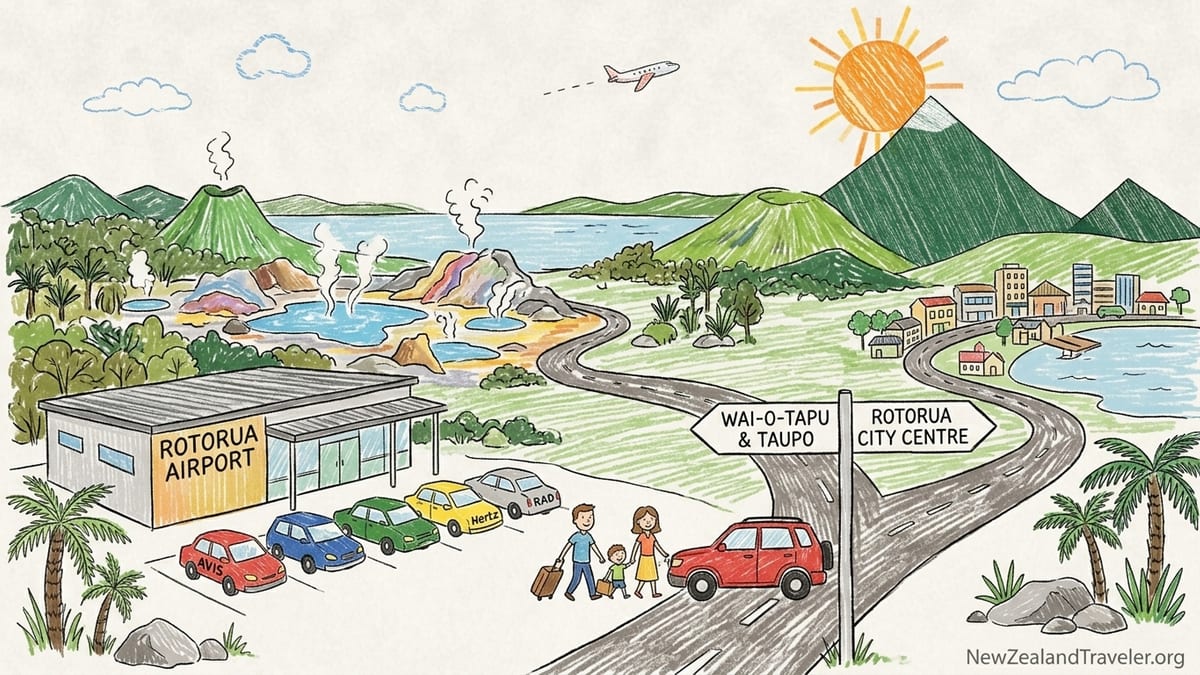
Rotorua Airport at a Glance: Where Your Road Trip Begins
Rotorua Airport is a compact regional airport about 9 kilometres from the city centre, roughly a 10 to 15 minute drive depending on traffic. For a small terminal, it has outsized rental coverage. Inside arrivals you will currently find counters for Avis/Budget, Europcar, Hertz, RAD and Ezi, with vehicles parked in dedicated rental bays just outside. For most travellers this means you can walk off the plane, collect keys and be on State Highway 5 toward Wai-O-Tapu or Taupō in well under an hour.
Opening hours for individual desks vary slightly but typically track the flight schedule from morning into early evening. The terminal itself usually opens before the first departure and closes about 30 minutes after the last scheduled arrival, with after-hours key drop boxes available. In practice this means that if you land on a mid-morning Wellington or Auckland flight and have pre-booked a car, you can expect a straightforward pickup process and daylight driving to your first geothermal stop.
Because all five rental brands operate side by side, walk-up customers sometimes shop rates on arrival, but availability can tighten during school holidays and the December to March high season. If you intend to drive directly to Wai-O-Tapu or Taupō after landing, advanced booking is strongly recommended, especially for SUVs and larger vehicles that families and small groups often prefer.
The airport layout favours quick exits. Once you have the keys, the main car park leads straight out to Te Ngae Road, which connects into State Highway 30 and State Highway 5. From here, the drive south passes lakes and forest before reaching geothermal highlights like Waimangu and Wai-O-Tapu, then continues on to Taupō on the shore of New Zealand’s largest lake.
Do You Really Need a Car? When Buses and Uber Are Enough
Before booking a vehicle, it is worth asking whether you truly need a car for the full duration of your stay. Rotorua’s city centre is compact and walkable, and many central hotels cluster around Fenton Street and the lakefront. From these areas you can stroll to the Government Gardens, Eat Streat, the lakeside promenade and several geothermal attractions such as Kuirau Park without getting behind the wheel.
Public transport from the airport into town is straightforward. Baybus Route 10 typically runs between Rotorua Airport and downtown on an approximately hourly schedule during the day from Monday to Saturday, with services timed around morning to early evening hours. Fares on Rotorua city buses are designed to be affordable, especially if you use a regional Bee Card, which offers discounted tag-on, tag-off pricing compared with paying cash. For solo travellers or couples arriving in daylight with light luggage, this bus can be an easy way to reach a central hotel and delay car hire until you are ready to explore farther afield.
App-based rides are another option. Uber and similar services operate in Rotorua and are permitted to pick up from designated zones at the airport. For a couple or small group, the typical fare from the terminal to central Rotorua is often comparable to, or a little more than, two or three bus tickets but still significantly cheaper than a single extra day of car hire. A practical example: if your compact rental would cost the equivalent of several tens of New Zealand dollars per day, yet you only need a 15 minute transfer to your hotel and plan to spend the first day on foot at Polynesian Spa and the lakefront, an Uber in and out can save you the cost and parking hassle of that entire rental day.
If your itinerary is limited to central attractions, organised tours and perhaps one or two evening experiences like a Māori cultural show with hotel transfers included, you may not need a car at all. Many geothermal valleys and Hobbiton are served by day tours from Rotorua that bundle transportation with entry tickets. The trade-off is flexibility. If you like to set your own pace, linger at viewpoints, or spontaneously stop at smaller lakes such as Okareka or Tarawera, a rental car quickly becomes more attractive.
Airport Pickup vs City-Centre Rental: Which Suits Your Trip?
The key decision is not just whether to rent, but where to pick up your car. Rotorua Airport pickup is ideal if you plan to leave the city almost immediately or if your accommodation is outside the central area. For example, if you land around midday and want to drive straight to Wai-O-Tapu Thermal Wonderland, about 30 kilometres south of Rotorua, collecting your car at the terminal lets you be at the park entrance in roughly 30 minutes without backtracking into town.
Airport pickup also suits itineraries that head onward to other regions. Travellers who plan to drive Rotorua to Taupō, then further south to Tongariro National Park, appreciate being on the highway soon after arrival. A family landing in the morning could collect an SUV at the airport, stop at Waimangu Volcanic Valley on the way, continue to Taupō for an overnight stay and drop the car at another North Island airport a few days later if their rental contract allows one-way returns.
City-centre rental, on the other hand, works best if you have at least one full day in central Rotorua with no need for a car. Many local rental offices have lower base rates than airport desks because they avoid airport concession fees, and some run promotions for multi-day hires that start and finish in the city. A typical pattern is to arrive at your hotel by bus or Uber, spend the first afternoon on foot and in local spas, then collect a car from a downtown branch early the next morning for your geothermal and Hobbiton day trips.
In practice, cost differences between airport and city pickup can be modest for short rentals, but savings increase over longer hires. For example, if a compact car from a city outlet is priced slightly lower per day and you can avoid paying for that first, mostly unused day, your total bill may drop by a noticeable amount. The trade-off is the extra time spent arranging pickup at a separate location and ensuring the rental office hours align with your schedule.
Choosing the Right Vehicle: Compacts vs SUVs for the Volcanic Loop
Most major brands at Rotorua Airport and in the city offer a familiar spread of vehicle categories, from economy hatchbacks to full-size SUVs. For many visitors, especially couples or solo travellers, a compact car is entirely sufficient. The sealed state highways between Rotorua, Wai-O-Tapu, Waimangu, Matamata for Hobbiton and Taupō are well maintained and not especially narrow by New Zealand rural standards. A small hatchback with good fuel efficiency is usually the most economical choice and easier to park in central Rotorua or at busy attractions.
Compact cars are often significantly cheaper than large vehicles. Meta-search sites regularly show small models priced noticeably below the average daily rate at Rotorua Airport, reflecting lower fuel consumption and high fleet availability. For instance, where a mid-size SUV might be quoted at a higher daily rate during the summer school holidays, a compact hatchback from the same brand could come in meaningfully cheaper. Over a five day loop that covers Rotorua, Hobbiton, Taupō and back, the savings on both rental and petrol can easily reach a useful sum.
That said, SUVs make sense for certain travellers and routes. Families juggling multiple suitcases, pushchairs and outdoor gear often appreciate the extra boot space and higher seating position. An SUV is also more comfortable if you plan to drive longer stretches such as Rotorua to Wellington or add side trips on unsealed roads to trailheads and remote lakes. While the main highways to Wai-O-Tapu, Waimangu, Matamata and Taupō are sealed, some secondary access roads and lookouts may involve short gravel sections where higher clearance feels reassuring.
One practical consideration is luggage volume relative to passengers. A group of four adults driving from Auckland to Rotorua, then on to Hobbiton and Taupō, will likely find a compact hatchback cramped once all bags are loaded. In this case, a mid-size sedan or smaller SUV is often the best compromise: more space and comfort than an economy car, yet without the fuel consumption and higher rental price of a full-size four wheel drive.
Route Planning: Wai-O-Tapu, Waimangu, Hobbiton and Taupō by Car
Once you have a vehicle, Rotorua offers one of the most efficient self-drive circuits in the North Island. Heading south on State Highway 5, Waimangu Volcanic Valley lies roughly 20 minutes from Rotorua’s edge, reached via a short side road off the highway. Another 10 minutes or so past this turn-off you reach the Wai-O-Tapu area, with the Thermal Wonderland entrance located just off the highway. Combined, these two geothermal parks make an excellent full day. Many travellers visit Wai-O-Tapu’s colourful pools and boardwalks in the morning, then continue to Waimangu for its crater lakes and optional lake cruise in the afternoon.
The drive from Rotorua to Taupō continues on the same highway past forests, rolling farmland and the Waikato River’s early course. Taupō sits about 80 kilometres south of Rotorua, typically around a one hour drive in normal conditions. Along the way, popular stops include Huka Falls just north of Taupō and the Aratiatia Rapids viewpoint. With a car you can easily turn the journey into a string of short scenic breaks, something that is far harder to achieve on fixed-schedule coaches or tours.
Hobbiton Movie Set near Matamata lies in the opposite direction to Taupō, to the northwest of Rotorua. Driving from central Rotorua to the Hobbiton visitor centre generally takes about an hour to an hour and fifteen minutes under typical conditions, using a combination of state highways through rural Waikato farmland. This makes it feasible to base yourself in Rotorua, depart after breakfast, join a mid-morning Hobbiton tour, and be back in Rotorua for an evening soak in a hot pool or dinner on Eat Streat. With your own vehicle you can also detour to the Blue Spring at Putaruru or nearby small towns for lunch.
For travellers combining all of these sights, a common pattern is a three or four day self-drive loop. One workable example is to spend Day 1 in central Rotorua without a car, collect a compact hatchback the next morning, visit Wai-O-Tapu and Waimangu en route to Taupō for the night, then drive from Taupō back to Rotorua via Hobbiton on Day 3. With flexible rental terms, you could even arrange a one-way drop in another city at the end of your route, though this often adds cost.
Costs, Insurance and One-Way Rentals: What to Watch For
Daily base rates in Rotorua fluctuate with demand and season. As a broad pattern, compact cars are usually the most affordable category, with mid-size sedans in the middle and SUVs at the upper end. Airport locations sometimes incorporate concession fees into their pricing, which can make them slightly pricier than city branches, though promotions and package deals can narrow this gap. Checking both airport and city quotes for your exact dates is worthwhile, especially if you are travelling in peak holiday weeks around Christmas and New Year.
Insurance choices significantly affect your total bill. Most New Zealand rentals include standard cover with a sizeable excess, which is the amount you must pay if the vehicle is damaged or stolen. Agencies at Rotorua Airport and in town typically offer daily add-ons to reduce this excess, which can noticeably inflate the per-day price. Some travellers choose to accept the default excess and rely on separate travel insurance or premium credit card policies that cover rental car damage. If you plan to do substantial driving on North Island highways, it is sensible to factor in your risk tolerance and budget, then decide whether to pay extra to reduce the excess or manage the risk in another way.
One-way drop fees are another consideration for self-drive itineraries that begin or end in Rotorua. If you collect a car at Rotorua Airport and return it in Auckland, Wellington or another city, the rental company may apply a relocation charge, particularly for short hires. These fees vary by brand and can be modest or substantial depending on direction and season. When comparing quotes, look beyond the daily rate and check for any additional one-way charges that appear near the end of the booking process.
Fuel costs add up quickly over long drives, especially with larger vehicles. A compact car on the Rotorua to Taupō return route, plus side trips to Wai-O-Tapu and Hobbiton, will generally use noticeably less petrol than a full-size SUV. Over several days this difference can offset part of the higher rental price of an SUV or, conversely, deliver real savings if you stick with a smaller car. Since petrol prices in New Zealand can be relatively high compared to some visitors’ home countries, it is worth planning fuel costs into your overall budget rather than treating them as an afterthought.
When a Car is Unnecessary: Short Central Stays and Tour-Based Itineraries
Not every Rotorua stay justifies a rental car. If you are in town for only one or two nights and your interests centre on central attractions, a car may be more trouble than it is worth. Guests staying around Fenton Street, Tutanekai Street or the lakefront can typically walk to Polynesian Spa, Government Gardens, the Rotorua Museum precinct and several geothermal spots, as well as cafes and restaurants. Many hotels also offer shuttles or can arrange transfers for evening cultural performances and hangi dinners.
Tour-based itineraries further reduce the need for your own vehicle. A number of operators based in Rotorua run full-day trips to Wai-O-Tapu, Waimangu, Hobbiton or combinations of these, often including hotel pickup and drop-off. For example, a couple visiting from Australia might fly into Rotorua, catch a bus or Uber to their central hotel, join a full-day guided tour that covers both Wai-O-Tapu and Waimangu with commentary and entry included, then spend the second day exploring town on foot before flying onward. In this scenario, a rental car might sit idle in a hotel car park for long stretches, yet still accrue daily charges.
Parking and traffic are more manageable in Rotorua than in larger cities, but they are not trivial considerations. Central accommodation sometimes charges for on-site parking, and popular attractions such as the Redwoods or Skyline Rotorua can be busy at peak times. If your schedule aligns well with available tours and local buses, and you prefer not to drive on the left after a long international flight, combining public transport, taxis or ride-hailing and organised tours can be a low-stress alternative to renting.
That said, even travellers with primarily central plans may benefit from a very short hire. For instance, if you have three nights in Rotorua, you might skip a car on arrival day, rent a compact for just one full day to tackle Wai-O-Tapu or Hobbiton at your own pace, then rely on taxis or Uber again for the airport transfer when you depart. This hybrid approach keeps costs in check while giving you at least one day of full flexibility on the road.
The Takeaway
Rotorua is one of New Zealand’s most driver-friendly hubs, with major rental brands at the airport, straightforward highways to geothermal valleys and lakes, and realistic distances for day trips to Wai-O-Tapu, Waimangu, Hobbiton and Taupō. Yet the best rental strategy depends heavily on how you plan to spend your time. For travellers landing with the intention of heading straight to the thermal parks or onwards to Taupō, airport pickup is often the most efficient choice, placing you on the open road minutes after collecting luggage.
If your first day is centred in town or your stay is short, delaying or entirely skipping a rental can be the smarter move. Buses, Uber and hotel transfers handle airport connections effectively, while organised tours cover the major out-of-town highlights without the need to drive yourself. When you do choose to rent, compact cars are generally the best value for the standard Rotorua loop, with SUVs reserved for larger groups, heavy luggage or extended itineraries.
Ultimately, the most rewarding Rotorua experiences come from matching your transport to your travel style. Self-drivers enjoy the freedom to stop at small lakes, lookout points and roadside cafes that coaches glide past, but they also shoulder the responsibilities of navigation, insurance and fuel costs. By weighing airport versus city pickup, vehicle type, one-way fees and the genuine need for a car day by day, you can tailor a plan that maximises your time among steaming valleys and shimmering lakes rather than at rental counters or in traffic.
FAQ
Q1. Is it better to pick up a rental car at Rotorua Airport or in the city?
For travellers heading straight to Wai-O-Tapu, Waimangu or Taupō after landing, airport pickup is usually more convenient. If you will spend your first day entirely in central Rotorua and can walk or use tours, city pickup the following morning can save a day of rental costs.
Q2. Do I need a car if I am only staying one or two nights in central Rotorua?
If your plans focus on the lakefront, spas, Government Gardens and an evening cultural show, you can manage without a car by using the airport bus, Uber and hotel transfers. A car becomes useful only if you want to add out-of-town sights such as Wai-O-Tapu, Waimangu or Hobbiton.
Q3. How long does it take to drive from Rotorua to Wai-O-Tapu and Waimangu?
Under typical conditions, allow about 20 minutes from Rotorua to Waimangu Volcanic Valley and around 30 minutes from Rotorua to Wai-O-Tapu. The two sites are close together on the same highway, so visiting both in one day is very feasible with a car.
Q4. Is a compact car enough for driving between Rotorua, Hobbiton and Taupō?
For most couples and solo travellers, a compact car is perfectly adequate on the sealed highways linking these destinations. Larger groups or those with bulky luggage may prefer a mid-size sedan or SUV for extra comfort and storage space.
Q5. Are there public buses from Rotorua Airport into the city?
Yes, Baybus Route 10 typically connects Rotorua Airport with central stops on an hourly schedule during the day from Monday to Saturday. Using a regional Bee Card keeps fares low, making this a cost-effective option if you are not carrying heavy luggage.
Q6. Is Uber available at Rotorua Airport?
Uber operates in Rotorua and is allowed to pick up at designated zones at the airport. For small groups, the fare to central hotels is usually competitive with the combined cost of multiple bus tickets and far cheaper than a day’s car hire.
Q7. How expensive are rental cars at Rotorua compared with other New Zealand cities?
Base rates in Rotorua are broadly similar to other regional centres, with compact cars usually the cheapest category and SUVs more expensive. Airport locations can be slightly pricier than city branches due to concession fees, so it is worth comparing both if your schedule is flexible.
Q8. What should I know about rental car insurance in Rotorua?
Most rentals include standard cover with a relatively high excess payable if the car is damaged or stolen. You can often pay a daily fee to reduce this excess, rely on travel insurance, or use a credit card that covers rental car damage. Check the fine print before deciding.
Q9. Are one-way rentals from Rotorua to other cities possible?
Yes, many major brands allow one-way rentals between Rotorua and cities such as Auckland or Wellington, but they may charge a relocation or one-way fee. These charges vary by season and direction, so confirm them when booking and factor them into your total trip cost.
Q10. When is a rental car most worthwhile around Rotorua?
A rental car delivers the most value when you plan multiple out-of-town trips, such as a day at Wai-O-Tapu and Waimangu, a separate day at Hobbiton, and a night or two in Taupō. In these cases the flexibility to choose your departure times, stop at viewpoints and adjust plans for the weather usually outweighs the cost of hire, fuel and parking.