


Rotorua and Taupō sit less than 90 minutes apart on New Zealand’s Central North Island, yet they offer very different versions of the same volcanic landscape. With limited time, most travelers do not need to overnight in both. Instead, the smarter move is to choose a primary base and day trip to the other. This guide looks at what each town does best in 2026, how much you can expect to spend, and which base makes more sense for families, couples and adventure seekers planning a compact itinerary.
Rotorua vs Taupō at a Glance
Rotorua and Taupō are only about 80 to 82 kilometers apart by road, roughly a one hour drive along State Highway 5. Buses such as InterCity typically take just under an hour between the two towns, so it is perfectly realistic to base in one and visit the other as a day trip. Many New Zealanders treating this as a genuine itinerary decision now simply pick whichever better matches their priorities and route rather than splitting already short trips across both.
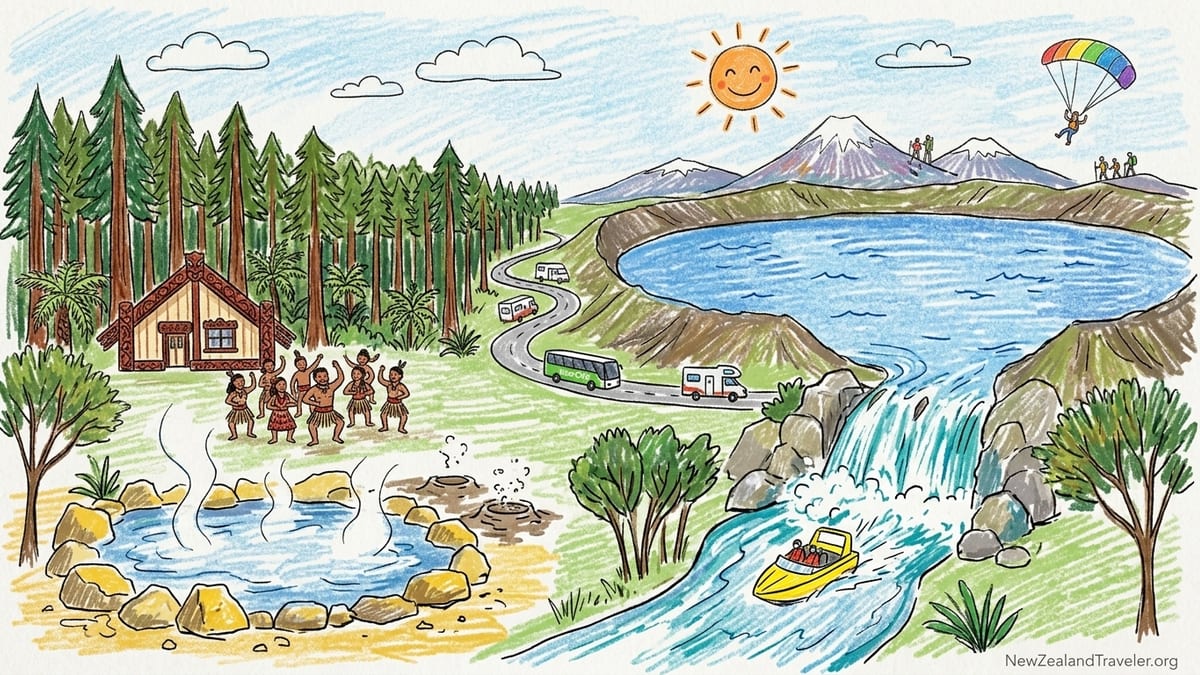
In broad terms, Rotorua is the stronger choice for Māori culture, accessible geothermal parks and spa-style hot pools, plus the famous Whakarewarewa and Redwoods forests. Taupō is better known for its big-lake scenery, Huka Falls, easy access to the Tongariro Alpine Crossing and a slightly sharper focus on adventure sports like skydiving and high-volume white-water rafting.
Price-wise, both towns sit in a similar mid-range bracket. Recent hotel data suggests typical mid-range hotels in Rotorua often run around 150 to 250 New Zealand dollars per night depending on season, with Taupō’s lakefront options usually in a similar or slightly lower range. Budget travelers can still find hostel beds in both towns for a little over 30 to 40 dollars per night if they book in advance outside the Christmas to February peak.
The key for travelers with limited time is to decide what will define this part of their trip. If you imagine soaking in steaming pools after a cultural evening, surrounded by geothermal activity and forest, Rotorua is likely your base. If you picture sunrise over a giant lake, a day out on the Tongariro Crossing, or a tandem skydive landing near the shoreline, Taupō is the better fit.
Why Choose Rotorua as Your Base
Rotorua is still the North Island’s flagship destination for Māori culture and geothermal experiences. Visitors can watch traditional kapa haka performances and hāngī feasts at places such as Te Puia and Whakarewarewa village, where locals have cooked with geothermal steam and hot pools for generations. A full cultural evening with performance and hāngī dinner often costs in the range of 130 to 190 New Zealand dollars per adult, but combines dinner, performance and guided cultural interpretation into one memorable night.
The geothermal parks around Rotorua are compact and easy to access. Wai-O-Tapu Thermal Wonderland, roughly a 25-minute drive south, is known for its vividly colored Champagne Pool and Lady Knox Geyser. Entry for adults typically sits in the mid-30 dollar range. Closer to town, Te Puia offers both geothermal features and cultural experiences, while Kuirau Park at the edge of downtown Rotorua is free and lets you wander past bubbling mud pools and steamy vents right beside residential streets.
Rotorua’s Redwoods, the Whakarewarewa Forest, are a major draw for walkers, runners and mountain bikers. Short loops like the Redwoods Memorial Grove track can take less than an hour and suit families, while dedicated mountain-bike visitors book full days on Rotorua’s trail network. The popular Redwoods Treewalk, featuring elevated hanging bridges between towering trees lit by lanterns at night, usually costs around 40 to 50 dollars for adults, with cheaper children’s tickets.
For travelers who love a hot soak, Rotorua has a denser range of commercial and natural-feeling options than Taupō. Polynesian Spa on the lakefront is the most famous, with lakeside mineral pools and private pools available for a premium. Entry to the public mineral pools is often around 40 dollars for adults, while private pools and spa treatments cost more. Budget-conscious travelers often combine a free foot soak in Kuirau Park’s public hot pools with one paid spa experience during their stay.
Why Choose Taupō as Your Base
Taupō spreads along the northern shore of Lake Taupō, New Zealand’s largest lake, which itself sits in a massive volcanic caldera. The setting is its main selling point. Many mid-range motels and apartments line Lake Terrace facing the water, so it is possible to wake up to wide blue views of the lake and, on a clear day, the peaks of Tongariro National Park beyond. A lake-view motel might start around 160 to 220 New Zealand dollars per night in summer, with cheaper non-view rooms set slightly back from the shore.
Huka Falls, just north of Taupō, is one of the country’s most photographed waterfalls. The Waikato River narrows dramatically and blasts over a short series of falls in a bright turquoise torrent. Visiting the main viewpoint is free, and it is less than a 10-minute drive from the lakefront, making it an easy stop even on a short visit. Many travelers combine a walk along the riverside tracks with a jet-boat ride that powers right up to the base of the falls, with prices per adult commonly around 140 to 160 dollars.
Taupō is also an access hub for the Tongariro Alpine Crossing, widely described as one of the finest one-day hikes in the world. Most travelers base in Taupō and book a shuttle to the trailhead, which typically costs around 50 to 80 dollars per person return depending on provider and season. The drive from Taupō to the start of the Crossing usually takes around 1 hour and 15 minutes, and shuttles depart very early, so staying in Taupō rather than Rotorua can mean a later alarm and less backtracking on the road.
On the adventure front, Taupō leans slightly more toward high-adrenaline activities. Tandem skydives over Lake Taupō at altitudes of 12,000 to 15,000 feet are some of the most popular jumps in the country, often priced somewhere between 350 and 500 dollars per person depending on height and photo packages. Taupō Bungy operates a 47-meter jump over the Waikato River, typically costing around 200 to 260 dollars. For those who prefer to stay closer to the water, there are lake cruises, sailing trips, trout-fishing charters and kayaking excursions to see the mine-bay Māori rock carvings.
Accommodation, Costs and Practicalities
Accommodation in both Rotorua and Taupō covers the full spectrum from holiday parks and hostels to five-star hotels and luxury lodges. In 2026, you can usually find basic motel or hotel rooms in Rotorua from around 130 dollars per night in the shoulder season, with mid-range properties more commonly sitting in the 150 to 250 dollar bracket. Taupō is similar, though simple lake-view motels and apartments can carry a small premium over inland Rotorua motels during busy holiday periods.
For budget-conscious travelers, both towns offer multiple holiday parks with powered sites and cabins. In Rotorua, a powered campsite for two in a well-equipped holiday park might cost 50 to 70 dollars per night, while a simple cabin for a family could run 120 to 160 dollars. Taupō’s lakefront holiday parks are popular with campervan travelers and families, with comparable pricing and shared kitchen facilities that help cut food costs.
Food prices are comparable across the two towns. A casual café brunch in either place typically costs around 20 to 28 dollars per person, while a main course at a mid-range sit-down restaurant starts around 30 to 40 dollars. Rotorua’s hāngī-style buffets and cultural evenings can be a splurge dinner, whereas in Taupō it is common to book a bistro on Tongariro Street or a steak and local wine overlooking the lake. Self-catering is straightforward in both towns, with large supermarkets and smaller grocery stores close to central accommodation.
Parking and driving are uncomplicated in both places by international standards. Rotorua has a more compact central grid with many motels spread along Fenton Street, while Taupō stretches along the lakefront. During peak summer dates, on-street parking near the lake and at Huka Falls can become competitive around mid-morning, so staying somewhere you can walk to the waterfront or booking activities with transfers included is helpful, especially for travelers unused to New Zealand’s narrow highways.
How Many Nights and Sample Itineraries
With limited time, a common dilemma is how to allocate two to four nights in the Central North Island. For many travelers, three nights in one base with a day trip to the other town offers the best balance between variety and avoiding constant packing and unpacking. Because Rotorua and Taupō are only about an hour apart, it is reasonable to explore both without changing hotels.
For example, a three-night Rotorua-based itinerary might look like this in practice. On Day 1, you arrive from Auckland or Hobbiton, check into a mid-range hotel near the lakefront or on Fenton Street, stroll through Kuirau Park’s free geothermal area, then soak at Polynesian Spa in the evening. On Day 2, you spend the morning at Wai-O-Tapu or Te Puia, take a gondola and luge ride at Skyline Rotorua in the afternoon, and enjoy a cultural hāngī experience at night. On Day 3, you drive to Taupō after breakfast, stop at Huka Falls, take a lake cruise or short walk along the Waikato River, then return to Rotorua in time for dinner.
A Taupō-based version might run differently. On Day 1, you arrive from Auckland or Napier, settle into a lakeside motel, walk the waterfront and enjoy an evening drink overlooking the water. On Day 2, you rise early for the Tongariro Alpine Crossing, taking a shuttle from Taupō to the national park and returning by late afternoon for a relaxed dinner. On Day 3, you visit Huka Falls, perhaps combine it with a jet boat ride, and then drive up to Rotorua for the afternoon to browse a geothermal park or relax at one of the hot pools before heading back to Taupō.
With only two nights, it often makes more sense to choose one base and accept that the other will just be a quick taste or a future-trip destination. Many travelers with a strong interest in Māori culture and geothermal activity choose two nights in Rotorua, while those prioritizing Tongariro hiking or a skydive often lean toward two nights in Taupō.
Families vs Couples: Which Town Fits Your Style
Families with school-age children often find Rotorua slightly easier to fill with high-value, family-friendly activities without spending the entire day in the car. The Skyline gondola and luge, the ZORB downhill ball rides, Rainbow Springs-style wildlife experiences or the Agrodome farm show, and the Redwoods Treewalk are all within a short drive of central accommodation. A family might, for instance, spend one day combining the gondola, luge and a visit to the Redwoods, and another day splitting time between a geothermal park and Kuirau Park’s free foot pools.
Taupō still works very well for families, especially in summer when the lake becomes a giant playground. Kids can swim at the main lakefront beach, try paddle boards or pedal boats, or spend half a day at the local hot pools and water slides on the edge of town. Some lakefront holiday parks offer jumping pillows, playgrounds and bike hire, turning them into destinations in their own right. However, if your children are too young for long hikes or high-adrenaline activities like bungy jumps, Rotorua’s variety of shorter experiences in a compact area may offer better value.
For couples, the choice hinges on atmosphere. Rotorua has a slightly more urban feel, but it is easy to craft a wellness-oriented stay with spa visits, quiet forest walks and evening cultural experiences. Boutique lodges and lake-edge hideaways just outside town appeal to honeymooners or couples celebrating a special trip, and some offer private hot tubs fed by mineral springs. A couple might plan a morning walk in the Redwoods followed by a long lunch in town and a sunset soak overlooking Lake Rotorua.
Taupō, by contrast, feels more like a relaxed resort town built around its lake. Couples who enjoy simple pleasures like evenings on a balcony with a glass of wine and a view of the water, or short scenic drives to viewpoints and waterfalls, often prefer it. It also works well for active couples planning a big shared experience such as a skydive or the Tongariro Crossing, followed by a well-earned lakeside dinner. In practice, some couples split their time, spending two nights in Rotorua for culture and hot pools, then two nights in Taupō for lake scenery and hiking before continuing south.
Onward Routes and When One Base Clearly Wins
Your wider North Island route can tip the balance between Rotorua and Taupō. If you are traveling in a loop from Auckland that includes Coromandel, Tauranga or the Bay of Plenty, Rotorua is the more logical base. Many travelers drive from Auckland to Matamata for Hobbiton, continue to Rotorua for several nights, then loop back to the coast or onward to Taupō and Napier. Rotorua also works well as a longer stay for digital nomads or remote workers who want local amenities and easy weekend trips to the lakes, Taupō and even as far as Tongariro.
Taupō becomes the stronger choice if your trip continues south to Tongariro National Park, Tūrangi or Wellington. Basing in Taupō trims driving time to the national park compared with Rotorua and allows more flexible start times for the Tongariro Alpine Crossing or winter skiing at Whakapapa and Tūroa. Travelers routing from Auckland down to Wellington in five or six days often stop at Hobbiton, spend a night or two in Rotorua, then move to Taupō for one or two nights before driving on to the Kapiti Coast or capital.
Weather can also play a role. Rotorua’s geothermal steam and dense forest give it a slightly more atmospheric feel on cool, damp days, and many of its key activities, such as hot pools and cultural evenings, are enjoyable year-round regardless of rain. Taupō’s lakefront, boat trips and outdoor activities shine on clear days with stable forecasts, which is especially important for the Tongariro Crossing where strong winds or low cloud can shut the track or make it unsafe.
There are a few situations where one base clearly wins. If your heart is set on the Tongariro Alpine Crossing or a major skydive and you only have two or three nights, choose Taupō. If your main goal is to experience Māori culture, see vividly colored geothermal terraces, and soak in multiple hot pools, choose Rotorua. In most other scenarios, you cannot go badly wrong with either base as long as you build in at least a half or full day to visit the other.
The Takeaway
Rotorua and Taupō share the same volcanic plateau and similar price brackets, but they frame the Central North Island experience in different ways. Rotorua leans toward culture, geothermal spectacle and spa-style relaxation within a relatively compact urban area. Taupō spreads wide along a vast lake, offering big views, classic waterfalls and access to one of the world’s standout day hikes.
With limited time, the best base is the one that aligns with your non-negotiables. If you want kapa haka, hāngī, colored terraces and hot pools you can walk to from town, overnight in Rotorua and visit Taupō as a side trip. If mountain skylines, lake horizons and the Tongariro Alpine Crossing define your North Island dream, sleep in Taupō and dip into Rotorua for a day of geothermal highlights.
Because they are so close, you do not need to overthink this decision. Pick the base that fits your wider route and travel style, then allow at least three nights in the Central North Island so you can actually slow down and enjoy it. Whether you are soaking in a steaming pool in Rotorua or watching sunset over Lake Taupō, you are still standing on one of the world’s most remarkable volcanic landscapes.
FAQ
Q1. Is Rotorua or Taupō better if I only have two nights?
With just two nights, it is usually better to choose one base. Pick Rotorua if you want Māori culture, geothermal parks and hot pools within a compact area. Choose Taupō if your priority is lake scenery, Huka Falls and possibly doing the Tongariro Alpine Crossing.
Q2. Can I stay in one town and visit the other as a day trip?
Yes. The drive between Rotorua and Taupō is only about one hour each way, so day trips in either direction are common. Many travelers base in Rotorua for three nights and spend one of those days visiting Huka Falls and Lake Taupō, or base in Taupō and spend a day exploring Rotorua’s geothermal attractions.
Q3. Which town is cheaper, Rotorua or Taupō?
Overall costs are similar, with mid-range hotels in both towns often in the 150 to 250 New Zealand dollars per night range. Taupō can be slightly more expensive for lake-view rooms, while Rotorua’s multiple paid geothermal parks and cultural evenings can add to your daily spend. Budget travelers can still find hostels and holiday parks in both places at broadly comparable prices.
Q4. Where should I base myself for the Tongariro Alpine Crossing?
Taupō is the more convenient base for the Tongariro Alpine Crossing. Shuttle buses from Taupō to the trailheads usually take just over an hour and offer early departures, making it easier to complete the hike and return the same day. Basing in Rotorua adds extra driving time and makes for an earlier start and longer day overall.
Q5. Which is better for families with young kids?
Rotorua is often the easier choice for families with younger children because many attractions are close together and can be enjoyed in shorter bursts. Activities like the gondola and luge, Redwoods Treewalk, farm shows, wildlife encounters and kid-friendly geothermal walks can be mixed and matched without long drives. Taupō is great in summer for lake swims and holiday parks but leans more on longer hikes and high-adrenaline activities that suit older kids and teens.
Q6. Which town has the better hot pools?
Rotorua generally offers a wider range of hot pool experiences, from classic lakefront complexes like Polynesian Spa to smaller boutique mineral pools and free public foot pools at Kuirau Park. Taupō does have its own hot pools and spa complexes, some with water slides popular with families, but for variety and atmosphere Rotorua has the edge.
Q7. Is the sulphur smell in Rotorua really that bad?
Rotorua does have a noticeable sulphur smell in parts of town, especially near geothermal areas and on still, damp days. Most visitors find they adapt quickly and stop noticing it after a few hours. The smell is much less apparent in nearby forests and lakeside suburbs, and it is not usually strong enough to be a serious issue unless you are very sensitive to sulphur.
Q8. Which base works better for a wider North Island road trip?
Rotorua fits naturally into itineraries that include Coromandel, Tauranga or the Bay of Plenty, acting as a cultural and geothermal hub. Taupō is a better fit if you are continuing south to Tongariro National Park, Tūrangi or Wellington. Some travelers combine both by spending a couple of nights in Rotorua followed by one or two nights in Taupō on the way south.
Q9. Do I need a car to enjoy Rotorua and Taupō?
A car gives you the most flexibility in both towns, especially for reaching more remote geothermal areas, trailheads and quiet lake bays. However, it is still possible to enjoy each town without one. Rotorua has tour companies that bundle transport with entry to geothermal parks and cultural experiences, while in Taupō many lake cruises, Huka Falls jet boats and Tongariro Crossing shuttles include pickup from central accommodations.
Q10. If I love photography, which should I choose?
Both towns are very photogenic but in different ways. Rotorua offers close-up geothermal colors, cultural performances and misty forest scenes, especially at sunrise and in cool weather. Taupō provides wide lake vistas, Huka Falls’ turquoise water and distant volcanic peaks. If you lean toward landscapes and big horizons, Taupō is ideal. If you prefer textures, steam and cultural detail, Rotorua may be more rewarding.