


Rotorua’s geothermal parks are not interchangeable. Travelers comparing Te Puia, Wai-O-Tapu, Waimangu Volcanic Valley, Hell’s Gate and Whakarewarewa quickly discover that each delivers a distinct mix of geysers, colourful pools, mud, walking, Māori culture and bathing. This guide breaks down exactly what you get at each site, how long to allow, what it roughly costs, and who each park suits best so you can match the experience to your time, budget and travel style.
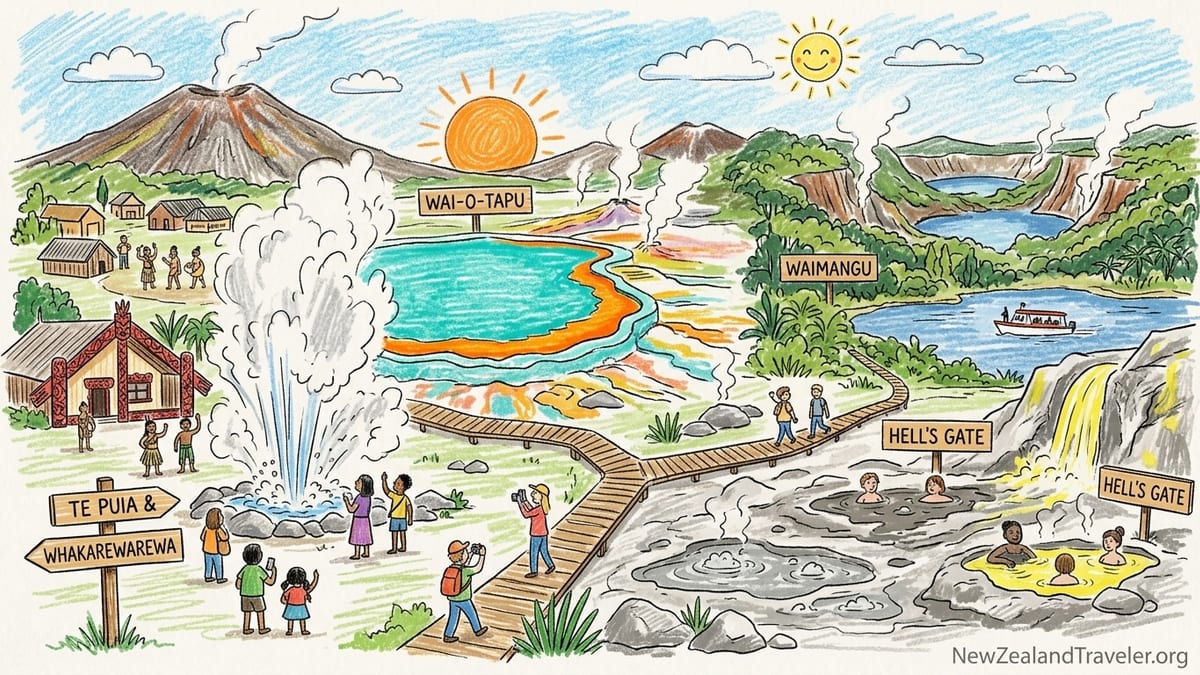
Quick Overview: How These Rotorua Geothermal Parks Differ
If you only remember one thing, remember this: Te Puia is for the mighty Pōhutu Geyser and strong Māori culture; Wai-O-Tapu is for surreal, colourful pools and classic postcard photos; Waimangu Volcanic Valley is for a longer, quieter volcanic-hiking experience; Hell’s Gate is for dramatic geothermal terrain combined with mud and sulphur bathing; and Whakarewarewa is for an intimate, lived-in Māori village wrapped around a geothermal valley.
On a practical level, most visitors spend about 1.5 to 2 hours at Wai-O-Tapu, 2 to 3 hours at Te Puia, 3 to 4 hours at Waimangu (including the optional lake cruise), 2 to 3 hours at Hell’s Gate (walk plus spa), and 1.5 to 2.5 hours at Whakarewarewa. Actual times vary with fitness, photo stops and whether you add cultural performances or dining, but these ballparks help when you are planning a one- or two-day Rotorua itinerary.
Pricing changes regularly, but as of late 2025 and into the 2025–2026 season, adult admission for these parks typically sits in the broad range of about NZD 50 to NZD 90 for core entry, with more for combo products such as night experiences, boat cruises or mud and sulphur spa packages. Expect to pay closer to the upper end for evening cultural dinners at Te Puia, walk-and-cruise options at Waimangu, and mud-and-spa combos at Hell’s Gate.
All five parks are within roughly a 30 to 35 minute drive of central Rotorua in different directions. It is completely feasible to do two parks in one day, for example Wai-O-Tapu in the morning and either Waimangu or Hell’s Gate in the afternoon, or Te Puia plus Whakarewarewa if you want a strong focus on Māori culture.
Te Puia: Pōhutu Geyser, Māori Arts and Big-Ticket Culture
Te Puia, set in the Whakarewarewa geothermal valley, is home to Pōhutu, widely described as the largest active geyser in the Southern Hemisphere. It erupts frequently, often many times a day, sending boiling water and steam up to tens of metres into the air. For many visitors, seeing Pōhutu framed against the sky, with terraces of silica and smaller vents hissing around it, is the defining geothermal moment of a New Zealand trip.
Beyond the main geyser terrace, Te Puia offers bubbling mud pools, smoking fumaroles and native bush tracks on a compact network of paths. Walking is moderate rather than strenuous: most travellers cover the key sights in 60 to 90 minutes of gentle strolling with frequent stops. It is suitable for families and for visitors who prefer not to tackle long or steep trails, though comfortable shoes are still essential due to uneven natural surfaces in places.
What makes Te Puia stand out commercially is its layered cultural offering. The site hosts the New Zealand Māori Arts and Crafts Institute, where you can see tauira (students) learning traditional carving and weaving, and many visitors opt for a guided Te Rā tour that combines geothermal viewing with stories of the valley. In the evening, Te Pō packages pair a cultural performance with a hāngī-inspired buffet dinner, turning Te Puia into a half-day or evening destination rather than a quick stop.
Use Te Puia if you want a single experience that combines a headline geyser, accessible geothermal scenery and structured Māori culture. For example, a couple with only one night in Rotorua might book an afternoon guided tour, stay on for the evening cultural show and dinner, and leave feeling they have seen both geothermal Rotorua and Māori performance at a high standard without hopping between multiple venues.
Wai-O-Tapu: Colourful Pools and Iconic Geothermal Scenery
Wai-O-Tapu Thermal Wonderland, about a 30 minute drive south of Rotorua, is the park most often associated with intense colour. The Champagne Pool, with its vivid turquoise waters and orange sinter rim, and the Artist’s Palette with its streaks of green, yellow and rust, are classic images that appear in guidebooks and on social media feeds. The walking tracks loop past craters, fumaroles, sulphur caves and mineral terraces, giving a compact but visually rich circuit.
The main boardwalk network is divided into several loops of differing lengths. Many visitors take 90 minutes to 2 hours to cover the primary track at a steady walking pace with frequent stops for photos. Elevation changes are modest but there are steps and some uneven ground, so people with limited mobility should plan extra time. Sun exposure can be high on fine days because much of the route is open rather than shaded by forest, so hats and water are useful.
Wai-O-Tapu also features the Lady Knox Geyser, which is induced to erupt at a set mid-morning time. Some travellers love the theatricality and certainty of seeing a geyser jet on schedule, while others find it less natural than Pōhutu’s frequent, spontaneous eruptions in Te Puia. Either way, timing matters: if you want to include Lady Knox, you need to arrive earlier than casual visitors who are just walking the main valley.
Use Wai-O-Tapu if your priority is colourful geothermal landscapes and dramatic photography rather than Māori culture or long hikes. For instance, a self-driving family based in Taupō might stop at Wai-O-Tapu en route to Rotorua, spend a late morning walking the circuits and photographing Champagne Pool, and then continue to other activities like the gondola or Redwoods forest that afternoon.
Waimangu Volcanic Valley: Immersive Geothermal Hiking and Lake Rotomahana
Waimangu Volcanic Valley lies further south of Rotorua and is best treated as a half-day nature excursion. The valley was created by the 1886 eruption of Mount Tarawera, and today you walk through a long volcanic rift with crater lakes, steaming cliffs and dense native bush. The atmosphere is quieter and more expansive than at the more compact, high-traffic parks closer to town.
The main trail descends gently through the valley from the visitor centre toward Lake Rotomahana, with optional side tracks to viewpoints over features such as Inferno Crater. Standard one-way walking distances for visitors are often in the range of 3 to 4 kilometres, though shuttle buses operate within the park to let you shorten or lengthen the walk. Visitors with reasonable fitness commonly spend 2.5 to 3 hours walking, pausing for photographs, and sitting at lookouts.
For those with more time and budget, Waimangu’s signature add-on is the Lake Rotomahana boat cruise, which extends the visit to roughly half a day. The cruise glides past steaming cliffs and lake-edge fumaroles and gives a sense of the broader volcanic landscape beyond the walking tracks. Travellers who enjoy geology or quieter nature experiences often rank this highly, because you are on a relatively large lake with minimal development on its shores.
Use Waimangu if you like the idea of a longer, mostly one-way walk through a living volcanic valley with a strong sense of wilderness. As a real-world example, hikers who enjoy New Zealand’s Great Walks but only have one day in Rotorua often choose Waimangu for the walking-focused, less crowded experience, then stop at a free public spot such as Kuirau Park in town if they still want to see boiling mud pools afterward.
Hell’s Gate: Raw Geothermal Landscapes plus Mud and Sulphur Bathing
Hell’s Gate, east of Rotorua near Tikitere, markets itself heavily on its mud baths and sulphur spas, but the on-site geothermal reserve is a significant attraction in its own right. The walking loop passes steaming grey mud pools, jagged sulphur formations and hot waterfalls in a landscape that feels raw and active. Compared with the bright colours at Wai-O-Tapu, Hell’s Gate feels more elemental, with stronger sulphur smells and bubbling grey and black mud.
The geothermal walk typically takes visitors 60 to 90 minutes at a comfortable pace. Paths are mostly flat but can be exposed to weather and steam, so light rain jackets or spare layers are wise. It is common for travelers to do the walk first, build an appetite and then move into the spa area, where they rotate between warm mud baths, hotter sulphur pools and a cool plunge. Showers and changing facilities are provided and staff manage timings so that mud baths are not overcrowded.
Pricing is tiered. A geothermal walk on its own costs less than the walk-plus-spa or spa-only combos, and children are generally welcomed in the pools with some age or supervision conditions. Many visitors comment that this is one of the few places in Rotorua where you can legally sit in an actual mud bath and cover yourself head to toe, rather than simply soaking in clear mineral hot pools.
Use Hell’s Gate if you want both geothermal sightseeing and a dedicated mud and sulphur bathing session in the same ticketed location. For example, a group of friends on a short North Island road trip might spend the morning ziplining or mountain biking, then book a late afternoon Hell’s Gate package so they can walk the valley and finish their day soaking in warm mud as the air cools.
Whakarewarewa: Living Māori Village with Geothermal Heart
Whakarewarewa, often called The Living Māori Village, is a functioning community as well as a visitor attraction. It sits on the same broad geothermal field as Te Puia but focuses on village life rather than a large, standalone cultural institute. Guided tours walk you through the settlement past carved meeting houses, steam vents used for cooking, bathing areas and viewpoints across to geysers in the valley, including sightlines toward Pōhutu.
Standard guided tours run around an hour, with scheduled departure times through the day. Many tickets now bundle this tour with access to self-guided geothermal trails that extend beyond the main village area. With the trails included, most visitors spend 1.5 to 2.5 hours on site, mixing structured storytelling with independent exploration of boardwalks and lookouts over mud pools and steaming lakes.
Whakarewarewa’s strength is its emphasis on lived experience. Rather than watching culture primarily through staged evening performances, you see how families use hot pools for everyday cooking and bathing, and how houses, churches and burial grounds sit alongside active geothermal features. Some itineraries include time for corn cooked in a geothermal pool or for informal conversations with guides who live locally.
Use Whakarewarewa if you want geothermal activity plus a strong sense of contemporary Māori village life in daylight hours. A practical example: families with school-aged children often choose Whakarewarewa during the day for its combination of easy walking, geyser views and accessible cultural context, then later attend a separate evening cultural dinner elsewhere if they want a more theatrical night out.
Side-by-Side Comparison: Geysers, Pools, Mud, Walking, Culture and Crowds
When travelers compare these parks, they usually focus on a few concrete questions: Where will I see the biggest or most reliable geyser? Where are the best colourful pools? How long will I have to walk? How strong is the Māori cultural component? And how busy will it feel at peak times?
Geysers are strongest at Te Puia, where Pōhutu erupts frequently and at impressive height, and at Whakarewarewa, which shares views over the same general geyser field from a village perspective. Wai-O-Tapu’s Lady Knox Geyser provides a daily scheduled eruption but depends on you timing your visit to that mid-morning show. Waimangu has hydrothermal activity, including crater lakes and steaming cliffs, but not a large, regular, free-standing geyser that dominates the experience. Hell’s Gate focuses more on boiling mud pools and steaming terrain than on single towering geyser jets.
Colourful pools are where Wai-O-Tapu excels. The Champagne Pool and Artist’s Palette are unmatched for intense mineral colours. Te Puia offers more muted, natural tones around sinter terraces and hot pools, while Waimangu’s colours come from crater lakes and bush-fringed water rather than high-contrast mineral rims. Hell’s Gate and Whakarewarewa skew towards grey muds, white silica and steam rather than bright oranges and greens, though there are pockets of colour where minerals concentrate.
For walking distance, Waimangu is the clear choice if you want a longer outing, with one-way trails of several kilometres and optional side tracks, plus the possibility of adding a boat cruise. Wai-O-Tapu’s circuits are shorter and well suited to a 1.5 to 2 hour visit. Te Puia, Hell’s Gate and Whakarewarewa all offer moderate walks that most visitors complete in under 2 hours, though you can linger at lookouts or in cultural spaces to extend your time. Travellers with limited mobility often prefer Te Puia or Whakarewarewa because you can still see key features without committing to long distances.
Crowds vary by season and time of day. Te Puia and Wai-O-Tapu are usually the busiest, especially during school holidays and cruise ship days, and around set events like the Lady Knox Geyser eruption or Te Puia’s main touring windows. Waimangu often feels quieter because visitors spread out over a longer trail. Hell’s Gate’s geothermal walk is less crowded than its spa area, where numbers are managed but peak late afternoon and early evening. Whakarewarewa limits guided tour group sizes, so while it can be popular, the experience often feels more personal than raw visitor numbers suggest.
Prices, Time Required and How to Fit Parks into a Short Itinerary
Exact prices change with seasons and promotions, but as a planning guide most adult entry tickets for the geothermal walk components alone sit somewhere around the NZD 50 to NZD 70 range, with combo products such as Te Puia’s cultural dinners, Waimangu’s walk-plus-cruise, and Hell’s Gate’s mud-and-sulphur spa packages priced higher. Family tickets and child rates often make visiting more than one park realistic for families on a mid-range budget.
If you have only one day in Rotorua and want the strongest single geothermal-plus-culture experience, Te Puia is usually the most efficient all-round choice. You can see Pōhutu, visit the arts and crafts institute, walk through mud pools and vents, and optionally book an evening cultural performance and hāngī-style dinner without leaving the site. Adding a short visit to Kuirau Park in central Rotorua can give you a free look at public mud pools afterward.
With two days, combination strategies work well. One common pattern is to do Wai-O-Tapu in the morning (arriving in time for Lady Knox if that interests you), then continue to Waimangu for a later-morning or early-afternoon valley walk and optional boat cruise, treating that full day as your nature and hiking focus. On the second day, you might book Te Puia or Whakarewarewa for Māori culture and geysers, and finish with Hell’s Gate in the late afternoon so you can wash off the day’s dust in a mud bath and hot sulphur pools.
Travelers driving between Rotorua, Taupō and the Bay of Plenty often fold parks into their transit days rather than dedicating separate nights. For example, driving from Taupō to Rotorua, you might stop first at Wai-O-Tapu mid-morning, then reach Rotorua for an afternoon in town and an evening Te Pō experience at Te Puia. The key is to allow buffer time; rushing geothermal walks to meet set performance or spa times can make visits feel more stressful than they need to be.
The Takeaway
Rotorua’s geothermal parks each occupy their own niche. Te Puia delivers the classic Pōhutu Geyser plus a high-quality cultural and arts institute experience. Wai-O-Tapu offers the most striking colourful pools and a compact but intense geothermal walk. Waimangu Volcanic Valley gives you space, walking and a strong sense of volcanic landscape shaped by the 1886 eruption. Hell’s Gate combines a dramatic geothermal reserve with the rare chance to soak in natural mud and sulphur pools at the same site. Whakarewarewa wraps geothermal features around a living Māori village where cultural traditions are part of daily life.
Choosing the best park for you is less about hunting for a single winner and more about aligning experiences with your interests, mobility, budget and schedule. Start by deciding which matters most to you: a headline geyser, surreal colour, long walks, village life or mud bathing. Then build your Rotorua days around one or two parks that deliver that focus best, using the others as optional add-ons if time and budget allow.
FAQ
Q1. If I only have time for one geothermal park in Rotorua, which should I choose?
If you want a balanced mix of a major geyser, accessible geothermal terrain and structured Māori culture, Te Puia is usually the most versatile single choice.
Q2. Which park is best for colourful hot pools and classic geothermal photos?
Wai-O-Tapu is the standout for vivid colours, especially the Champagne Pool and Artist’s Palette, along with craters and mineral terraces that photograph exceptionally well.
Q3. Where can I experience a proper mud bath in Rotorua?
Hell’s Gate is the leading option for dedicated mud bathing, pairing a geothermal walking loop with managed mud baths, sulphur pools and a cool plunge pool.
Q4. Which park involves the most walking and feels more like a hike?
Waimangu Volcanic Valley offers the longest standard walks, with one-way trails of several kilometres through a volcanic rift and the option to add a lake cruise.
Q5. Where will I see the biggest and most frequent geyser eruptions?
Te Puia, home of Pōhutu Geyser, provides the most consistent and impressive geyser viewing, with frequent natural eruptions reaching significant heights.
Q6. Which Rotorua geothermal park has the strongest everyday Māori village feel?
Whakarewarewa The Living Māori Village focuses on contemporary village life, with guided tours through homes, meeting houses and geothermal cooking and bathing areas.
Q7. Can I visit more than one geothermal park in a single day?
Yes. Many travelers pair Wai-O-Tapu with Waimangu on a nature day, or combine Te Puia or Whakarewarewa with Hell’s Gate for mud bathing in the afternoon or evening.
Q8. How much should I budget for entry to Rotorua’s geothermal parks?
As a broad guide, expect adult geothermal walk tickets to fall roughly between NZD 50 and NZD 70, with higher prices for evening cultural dinners, mud spas or boat cruises.
Q9. Are these geothermal parks suitable for young children?
Yes, but supervision is essential. Te Puia, Whakarewarewa and Wai-O-Tapu have manageable walking distances. Hell’s Gate and Waimangu also welcome families but involve stronger smells or longer walks.
Q10. Do I need to book Rotorua geothermal parks in advance?
Advance booking is recommended in peak seasons or for fixed-time products such as evening cultural dinners, mud-bath sessions, and Waimangu’s Lake Rotomahana boat cruises.