


Base yourself in Taupō and you are within an hour’s drive of some of New Zealand’s most compelling geothermal landscapes. From low-cost steam-filled boardwalks to silica terraces and hot pool spas, the Taupō region offers a quieter, often better-value alternative to Rotorua’s big-name geothermal parks. This guide compares four of the most accessible options for visitors with a rental car: Craters of the Moon, Ōrakei Kōrako, Wairakei Terraces and Tokaanu.
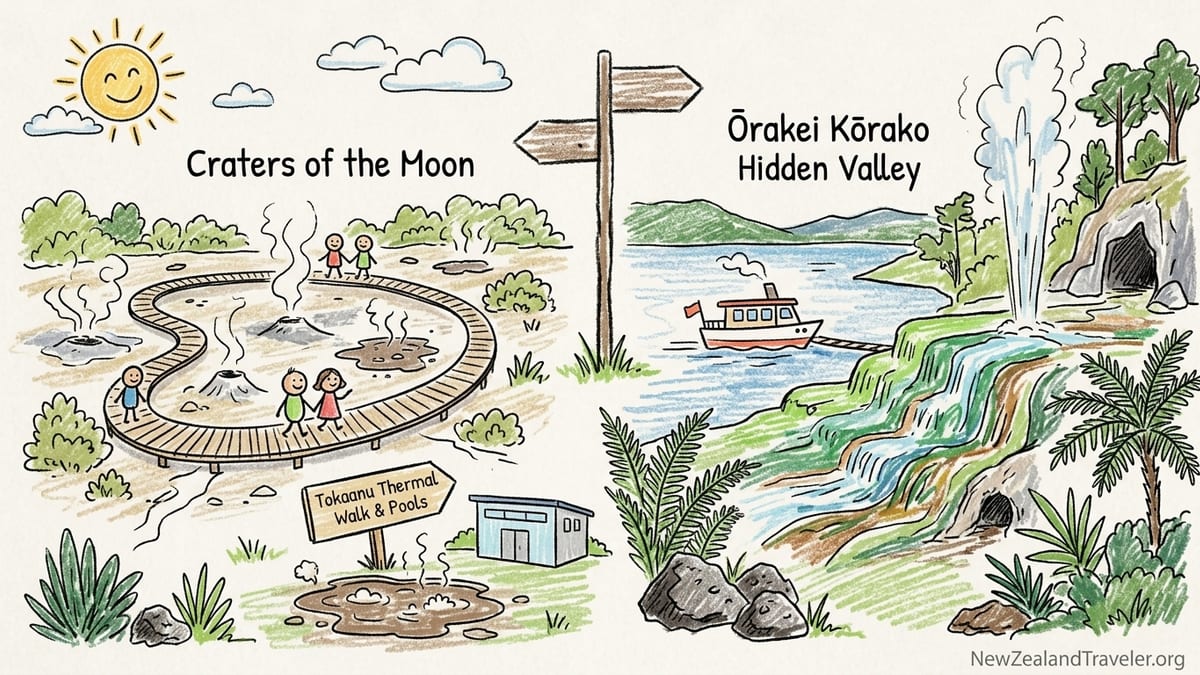
Craters of the Moon: Budget-Friendly Geothermal Sampler
Craters of the Moon is Taupō’s easiest and most affordable introduction to geothermal activity. Located a short drive north of town in the Wairakei geothermal field, it offers a wide boardwalk circuit through a shallow basin filled with steaming vents, bubbling ground and fumaroles. It feels more like a gentle stroll than a major expedition, which makes it ideal for families, older travellers or anyone wanting a quick geothermal fix without committing half a day or a big chunk of their budget.
Adult admission is currently listed at around NZ$10, with discounted rates for children and locals. For a family of four, that typically keeps the total under the price of a single adult ticket at Rotorua’s marquee parks. There are no ferries, shuttles or extras to pay for; you simply drive to the car park, pay at the small visitor kiosk, and step straight onto the loop track.
The main circuit takes about 45 minutes at an easy pace, with an optional short climb to a lookout that adds another 15 minutes. The track surface is mostly boardwalk and compacted gravel, and a substantial section is suitable for wheelchairs and strollers in good weather. Compared with Rotorua’s larger parks, you will not find tall geysers or vividly coloured pools here; the appeal is in its open, slightly otherworldly “steam basin” atmosphere and the ability to wander quietly without crowds.
Driving from central Taupō takes roughly 10 minutes, and Craters of the Moon pairs well with other nearby sights such as Huka Falls or the cafes and attractions in Wairakei Tourist Park. In a single morning you could walk the crater loop, photograph Huka Falls and still be back in town for lunch, which is one reason many visitors choose Craters as their low-effort geothermal stop.
Ōrakei Kōrako: Premium Silica Terraces and Cave Experience
If Craters of the Moon is the low-cost taster, Ōrakei Kōrako is the full degustation menu of Taupō geothermal. Often described as one of New Zealand’s most impressive geothermal parks, it features cascading silica terraces, steaming cliffs, bubbling mud, colourful mineral pools and a rare geothermal cave. This is a place where you could easily spend several hours exploring, pausing for photographs and simply watching geysers pulse and steam drift across the valley.
Adult admission is currently advertised at around NZ$57, with children’s tickets and family passes also available. The ticket price includes a short ferry ride across Lake Ohakuri from the visitor centre to the geothermal valley, plus access to the network of boardwalks and tracks on the far shore. For a couple, that means you are looking at roughly NZ$114 just to enter, which is a similar spend to a visit to Rotorua’s premium parks like Wai-O-Tapu or Te Puia, though in a more remote, less commercialised setting.
Most visitors allow 1.5 to 2.5 hours on site. Once you arrive across the lake, there is a continuous loop of paths and boardwalks that climb gently up the hillside past the Emerald Terrace, geyser fields and the entrance to the cave. The walking involves more stairs and elevation gain than Craters of the Moon or Tokaanu, so it is best for reasonably mobile travellers. It is not fully wheelchair accessible, and families with very small children may find a backpack carrier more practical than a stroller.
Ōrakei Kōrako sits roughly 25 minutes’ drive north of Taupō by car. The approach via Tutukau Road feels distinctly rural, and the park itself is quieter than central Rotorua attractions. Where Rotorua’s big parks emphasise large visitor centres and coach parking, Ōrakei Kōrako feels more like a stand-alone natural site: you park by the lake, buy your ticket, board the ferry and step straight into a hillside of steam and coloured terraces. For travellers who do not mind the higher ticket price and slightly longer walk, it delivers a far more dramatic and varied landscape than any other geothermal experience near Taupō.
Wairakei Terraces: Geothermal Walk Meets Adult-Only Hot Pools
Just north of Taupō, Wairakei Terraces combines two experiences in one stop: a compact geothermal terrace walk and a cluster of soothing, mineral-rich hot pools. The terraces themselves are partly engineered, channelling silica-rich geothermal water into cascading blue pools that echo the long-lost Pink and White Terraces. Steam wafts over the water, and carved posts and interpretive panels link the site to local Ngāti Tūwharetoa stories and the long history of geothermal use in the valley.
The self-guided terrace walk is currently priced at about NZ$15 per adult. It typically takes 45 to 60 minutes to stroll the loop at a relaxed pace, with short side paths to viewpoints over the terraces, sinter formations and a man-made geyser that periodically erupts. The terrain is undulating rather than steep, with compacted paths rather than full boardwalks, so walking shoes or sandals with grip are recommended. While fit, mobile visitors will find it straightforward, it is less suited to wheelchairs than Craters of the Moon.
Most visitors pair the walk with a soak in the adults-only geothermal pools, which are fed by the same mineral-rich water that cascades over the terraces. Pool entry carries a separate fee that is higher than the terrace walk alone, but many travellers treat it as a half-day wellness stop: walk the terraces in the late afternoon, then spend an hour or two soaking as the light softens over the steam. In practice, the combined cost for terrace walk plus pools for two adults is usually lower than buying two adult tickets for Rotorua’s more resort-like spas, making Wairakei a strong value proposition if you enjoy quieter, less flashy hot pools.
Driving time from central Taupō is about 10 to 12 minutes along Wairākei Drive, with ample on-site parking. Compared with Rotorua’s spa complexes, Wairakei Terraces feels smaller and more intimate. You will not find large children’s play areas or slide complexes here; instead, it is marketed squarely at adults seeking a tranquil soak surrounded by bush and steam. For couples or solo travellers looking to combine a geothermal walk with a restorative hot pool session without venturing as far as Ōrakei Kōrako, it is a compelling mid-range choice.
Tokaanu: Authentic Community Pools and Short Thermal Walk
On the southern shore of Lake Taupō, about 45 minutes’ drive from Taupō town, Tokaanu offers a very different style of geothermal visit. Here the focus is on simple, affordable soaking pools and a free thermal walk through an active, steaming landscape just behind the complex. The atmosphere is less polished than at Wairakei Terraces or Rotorua’s spa resorts, but that is also the appeal: Tokaanu feels like a long-running community bathhouse rather than a purpose-built tourist attraction.
The pool complex typically charges a modest fee for access to the large public hot pool, with private mineral pools available at a higher but still accessible price point, usually booked in 20-minute sessions. Exact figures can change, but in practice many travellers find that a family can soak here for less than the cost of a single adult ticket at Ōrakei Kōrako. For those on a tight budget, you can skip the pools entirely and still experience geothermal activity via the free Tokaanu Thermal Walk that loops through native bush behind the buildings.
The thermal walk itself is short and almost flat, usually taking around 15 to 20 minutes. A compacted path and boardwalks weave past steaming vents, sinter-rimmed pools and bubbling mud. It is an easy option for children and older travellers; while the path is narrow in places, it is generally manageable for anyone with moderate mobility. Because the walk is free and unguided, it works well as a spontaneous stop after a day in Tongariro National Park or a drive around the lake.
Tokaanu is about a 5-minute drive from Turangi, and around 45 minutes from central Taupō along the southern lakeshore. Services in the village are limited, so most visitors combine a soak and walk with time in Turangi for food and fuel. Compared with Rotorua’s parks, Tokaanu’s geothermal features are more modest, but the combination of ultra-easy access, low pricing and a strong sense of local character makes it an excellent choice for value-conscious travellers or those keen to experience a more down-to-earth side of the region’s geothermal culture.
How These Sites Compare on Cost, Time and Access
When you line the four experiences up side by side, the commercial trade-offs become clear. At the budget end, Craters of the Moon’s roughly NZ$10 adult ticket is hard to beat for a dedicated geothermal attraction. The free Tokaanu Thermal Walk can be even cheaper if you skip the pools, though most visitors are happy to pay a modest pool fee to enjoy a soak. Wairakei Terraces sits in the middle: around NZ$15 for the terrace walk, with optional extra cost for the geothermal pools. At the premium end, Ōrakei Kōrako’s adult admission around NZ$57 reflects its larger scale, ferry transfer and more dramatic features.
In terms of walking time, Craters of the Moon and the Wairakei terrace walk both sit in the 45- to 60-minute range for a comfortable circuit. Tokaanu is the quickest at 15 to 20 minutes, easily added onto a soaking session. Ōrakei Kōrako invites more lingering; while fit visitors could rush the loop in about an hour, most people spend 1.5 to 2.5 hours exploring and photographing the terraces, geysers and cave. If you only have a single spare hour between other activities, Craters, Wairakei or Tokaanu will be easier to fit in than Ōrakei Kōrako.
Driving logistics also play a big role. From Taupō, Craters of the Moon and Wairakei Terraces are both around 10 to 12 minutes away, making them ideal last-minute outings or evening activities. Ōrakei Kōrako is about 25 minutes’ drive to the north, along quieter rural roads, and Tokaanu is roughly 45 minutes’ drive south along the lake. Travellers without a car will find it easier to reach the closer sites by taxi, though the cost of a return taxi to Ōrakei Kōrako or Tokaanu can quickly exceed admission, so a rental car or tour is usually the most economical option.
Accessibility varies. Craters of the Moon has the most wheelchair-friendly layout, with a broad, mostly level boardwalk and only optional steeper sections. Tokaanu’s short loop is generally flat but narrower and may be trickier for mobility devices. Wairakei Terraces has some inclines and is better for those comfortable on uneven paths. Ōrakei Kōrako includes stairs and hillside traverses and is best suited to visitors with good mobility and sure footing. If you are travelling with a stroller, wheelchair or anyone who prefers short, flat walks, Craters and Tokaanu will be the least demanding.
Taupō’s Geothermal Parks Versus Rotorua’s Heavyweights
Travellers often compare Taupō’s geothermal attractions with Rotorua’s better-known parks such as Wai-O-Tapu, Te Puia and Waimangu Volcanic Valley. Rotorua’s sites usually feature larger visitor centres, more extensive interpretive displays and, in some cases, daily cultural performances or guided tours. They also tend to attract more coach traffic, which can translate into busier boardwalks and more structured visit patterns, especially in peak season.
By contrast, Taupō’s geothermal experiences feel more compact and low-key. Craters of the Moon is essentially a simple loop track through an active field, with a small kiosk and basic facilities. Wairakei Terraces and Tokaanu focus strongly on soaking, with their geothermal walks as an added bonus rather than the main draw. Ōrakei Kōrako is the closest Taupō-region equivalent to Rotorua’s big parks in terms of landscape drama, yet it remains smaller and more intimate than Waimangu or Wai-O-Tapu, with fewer crowds and a more remote setting on the edge of Lake Ohakuri.
Pricing also differs in tone. Rotorua’s flagship geothermal parks commonly charge adult prices in the same range as or higher than Ōrakei Kōrako, particularly when cultural performances or additional experiences are bundled in. If you are travelling on a strict budget and primarily want to see steam, vents and mud pools, Taupō’s cheaper options such as Craters of the Moon or Tokaanu’s free walk can provide plenty of geothermal atmosphere for a fraction of the cost.
Where Rotorua clearly excels is in the depth of cultural interpretation and the density of geothermal attractions within a small area. If you want to pair a dramatic geothermal walk with a formal Māori cultural evening, kapa haka performance or large-scale museum exhibits, Rotorua is the better base. Taupō’s strength lies in variety and flexibility: you can walk a steaming crater in the morning, jet boat to Huka Falls at midday, soak in adult-only pools at Wairakei in the afternoon, and still watch sunset over one of the country’s largest lakes.
Planning Sample Itineraries Around Taupō’s Geothermal Highlights
For a single-day sampler from Taupō, one realistic combination is Craters of the Moon in the morning, followed by lunch in town and an afternoon soak at Wairakei Terraces. This keeps driving to short hops of around 10 minutes each and balances a low-cost walk with a slightly pricier but deeply relaxing pool session. It works particularly well for couples or adults travelling without children, as Wairakei’s pools are adult-only and reward slower, contemplative soaking rather than splashy play.
If you prefer a more dramatic landscape and have half a day to spare, dedicate a morning or afternoon to Ōrakei Kōrako. Leave Taupō with at least a 3- to 4-hour window, which allows time for the 25-minute drive each way, ferry crossings, a full circuit of the geothermal valley and unhurried photography. Many travellers pair this outing with a stop at Huka Falls or a short lakeside walk near Taupō before or after, creating a day that showcases both water in motion and geothermal energy.
Visitors staying on the southern side of the lake, or tackling the Tongariro Alpine Crossing, often gravitate to Tokaanu. A realistic post-hike plan is to finish the crossing, drive back towards Turangi, stop at a supermarket or bakery for food, then head to Tokaanu Thermal Pools for a 20-minute private soak and a gentle stroll on the thermal walk while your legs cool down. The low pricing and lack of formality mean it does not matter if you arrive a little later or stay only an hour; you simply pay on entry and relax.
Over a multi-day stay in Taupō, it is entirely possible to experience all four sites without rushing. One typical pattern is to visit Craters of the Moon and Wairakei Terraces on one day, Ōrakei Kōrako on another, and Tokaanu on a day trip around the lake that also includes viewpoints, short walks near Turangi or a detour into Tongariro National Park. Planning this way allows you to compare the different types of geothermal environments first-hand, from engineered silica pools to wild terraces and bush-fringed vents.
The Takeaway
Choosing the “best” geothermal attraction near Taupō depends less on which park is objectively bigger or hotter, and more on your budget, fitness and travel style. Craters of the Moon is the clear low-cost, low-effort option: close to town, inexpensive at around NZ$10 per adult and gentle enough for almost any visitor. Ōrakei Kōrako sits at the other end of the spectrum, with a much higher ticket price but a far more dramatic mix of silica terraces, geysers, coloured pools and a rare geothermal cave.
Wairakei Terraces occupies an appealing middle ground, combining a reasonably priced terrace walk with adult-only hot pools that feel like a retreat rather than a theme park. Tokaanu, meanwhile, prioritises authenticity and affordability over polish, pairing simple community pools with a short, free thermal walk in a lakeside village. Together, these four sites give Taupō a geothermal offering that can stand alongside Rotorua’s more famous parks, especially for travellers who value flexibility, fewer crowds and better value for money.
For many visitors, the ideal strategy is not to pick just one, but to build a mix: a premium half-day at Ōrakei Kōrako if your budget allows, anchored by low-cost or free walks at Craters of the Moon and Tokaanu, and rounded out with a long, contemplative soak at Wairakei Terraces. Viewed this way, Taupō becomes less a single geothermal “destination” and more a base for exploring a spectrum of volcanic landscapes, each with its own character and price tag.
FAQ
Q1. Which geothermal attraction near Taupō is best if I am on a tight budget?
Craters of the Moon is usually the best dedicated geothermal park for budget travellers, with adult tickets around NZ$10 and a 45-minute loop walk. Tokaanu’s thermal walk is free, and the pools there are also very reasonably priced, so combining those two is often the most economical choice.
Q2. How long should I allow to visit Ōrakei Kōrako?
Plan on at least 2.5 to 3.5 hours door to door from Taupō. That includes roughly 25 minutes’ driving each way, the short ferry crossings and 1.5 to 2 hours walking through the geothermal valley, stopping for photos and time at the major terraces and the geothermal cave.
Q3. Is Craters of the Moon suitable for wheelchairs and strollers?
Much of the main loop at Craters of the Moon is broad boardwalk and gently graded, making it one of the most accessible geothermal walks in the Taupō region. Some steeper side sections and the hilltop lookout may not suit wheelchairs, but many visitors with mobility devices are able to enjoy the central basin section.
Q4. Can I combine a geothermal walk with a hot pool soak at the same site?
Yes. Wairakei Terraces is the most convenient place to do both in one stop: you can complete the 45- to 60-minute terrace walk, then move straight into the adult-only geothermal pools. At Tokaanu, you can stroll the short free thermal walk behind the complex before or after using the public or private pools.
Q5. How do Taupō’s geothermal sites compare with Rotorua’s big parks?
Rotorua’s parks tend to be larger and more commercial, often with cultural performances, big visitor centres and higher ticket prices. Taupō’s options are generally smaller, quieter and often cheaper. Ōrakei Kōrako is the closest in scale and drama to Rotorua’s marquee parks, while Craters of the Moon, Wairakei Terraces and Tokaanu offer more low-key experiences.
Q6. Which site is best after hiking the Tongariro Alpine Crossing?
Tokaanu is a popular choice after the crossing because it is relatively close to the southern end of Lake Taupō, offers both public and private hot pools for tired legs, and has a short, flat thermal walk you can manage even when you are feeling worn out from a full day on the trail.
Q7. Are any of these geothermal walks free to enter?
The Tokaanu Thermal Walk behind the pool complex is free and open during daylight hours. Craters of the Moon, Ōrakei Kōrako and the Wairakei terrace walk all charge admission, reflecting their maintained tracks, facilities and, in Ōrakei Kōrako’s case, the ferry transfer and more extensive infrastructure.
Q8. How far are these attractions from central Taupō by car?
Craters of the Moon and Wairakei Terraces are both roughly 10 to 12 minutes’ drive north of Taupō. Ōrakei Kōrako is about 25 minutes’ drive further north along rural roads. Tokaanu lies around 45 minutes’ drive to the south along the lakeshore, close to Turangi and the access routes into Tongariro National Park.
Q9. Do any of these sites offer guided tours or cultural performances?
Ōrakei Kōrako and Craters of the Moon are primarily self-guided walks with interpretive signage. Wairakei Terraces sometimes offers guided options or cultural storytelling as part of its terrace walk or spa packages, but the core experience is still self-guided. For large-scale cultural performances and full evening experiences, Rotorua is the better-known hub.
Q10. If I only have time for one geothermal experience near Taupō, which should I choose?
If your budget allows and you are comfortable with moderate walking, Ōrakei Kōrako offers the most varied and spectacular geothermal scenery. If you prefer a shorter, cheaper outing close to town, choose Craters of the Moon. Travellers who value soaking over walking often prioritise Wairakei Terraces or Tokaanu for their hot pools and add the walks as a bonus.