


If you are planning a New Zealand trip and cannot give both Auckland and Wellington much time, the choice between them suddenly feels high stakes. Both cities are attractive, both sit on beautiful harbours, and both anchor classic North Island itineraries. Yet they deliver very different styles of stay. This guide compares Auckland and Wellington with a focus on real trip-planning decisions, so you can confidently pick the city that best fits your route, interests and number of days.
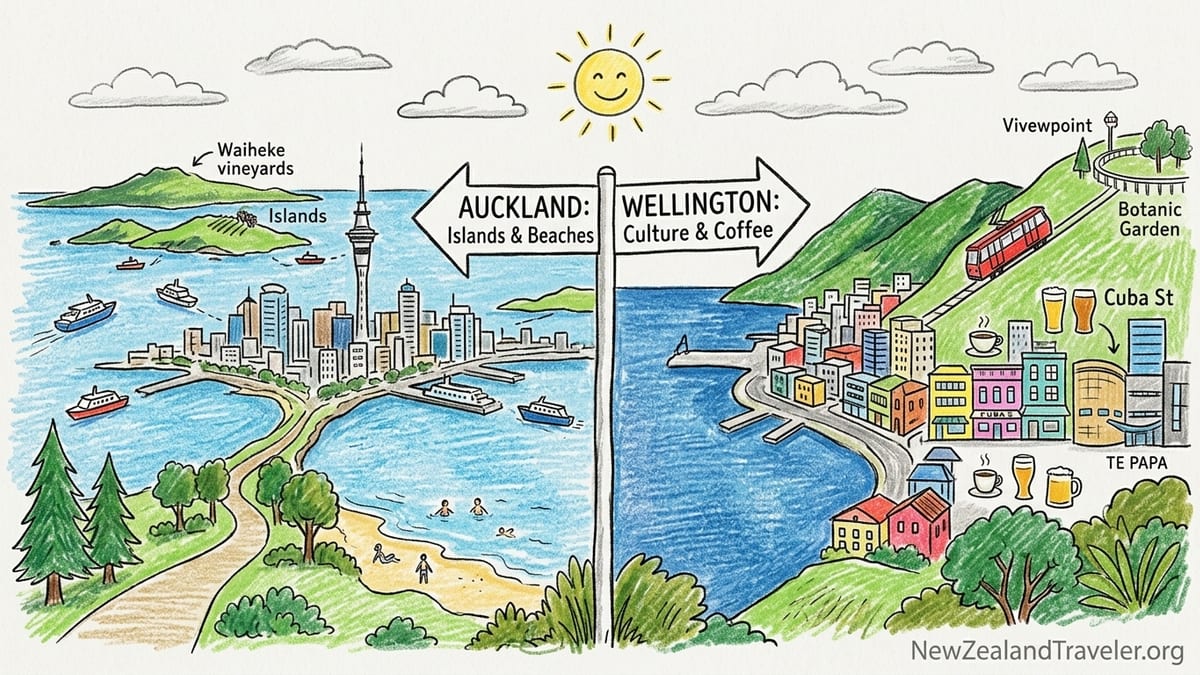
Big Picture: How Auckland and Wellington Feel Different
Auckland is New Zealand’s largest city and its main international gateway. It stretches across isthmuses and harbours, with suburbs spilling out in multiple directions and ferries linking city and islands. For visitors, that scale translates into major-choice energy: more neighbourhoods, more beaches, more viewpoints and more types of day trip, but also more transit time across town unless you base yourself carefully near the harbour or city rail links.
Wellington, the capital, feels almost like the opposite. Wedged between steep hills and a deep harbour at the bottom of the North Island, it is compact, walkable and tightly packed with museums, cafés, bars, small theatres and government buildings. Spend a weekend based near the waterfront and you can realistically walk to Te Papa museum, the cable car, most key restaurants and the craft beer strip in a single day without ever using a car or bus.
When travellers who have lived in both cities compare them, a common pattern emerges. Auckland tends to win for warmer weather, swimming beaches and variety of day trips. Wellington gains fans for its creative, cultural atmosphere and the way so much of interest is concentrated into a small area. If your trip is short and you can only pick one, deciding whether you want a “harbour islands and beaches hub” or a “compact cultural city break” will point you in the right direction very quickly.
Another high-level difference is how each city fits into wider itineraries. Auckland naturally anchors a web of North Island routes north to the Bay of Islands and south through Rotorua and Taupō, while Wellington is the natural jumping-off point for the Cook Strait ferry to the South Island. Where you are flying from and where you are heading next can be as important as each city’s individual appeal.
Airports, Access and Onward Routes
Auckland Airport is by far New Zealand’s busiest and has the widest spread of long-haul connections, especially from North America, Asia and the Middle East. Many travellers arrive here on overnight flights from Los Angeles, San Francisco or Singapore and understandably want a soft landing: one or two nights in the city to sleep off jet lag before tackling a road trip. With the airport about 25 minutes’ drive from central Auckland in light traffic, taxis and ride-shares are straightforward, and an express bus and shuttle services cater to budget arrivals.
Wellington Airport, in contrast, handles a mix of domestic flights and shorter international services, most commonly from Australia. It is physically much closer to the city; on a typical day it is a 15 to 20 minute taxi ride to hotels around the waterfront. For travellers already inside New Zealand, flying into Wellington from Queenstown or Christchurch at the end of a South Island loop and then spending two or three nights before flying out can be extremely efficient, especially if you do not want to backtrack all the way to Auckland.
Your onward route matters. A classic North Island journey runs from Auckland to Wellington by road or rail via Waitomo, Rotorua and Taupō. In that case, you might fly into Auckland, work your way south and depart from Wellington without ever repeating ground. On the other hand, many North Island only holidays are built around a loop that begins and ends in Auckland, with side trips to the Coromandel Peninsula, Northland or the central volcanic plateau. If that is your plan, concentrating your city time in Auckland and skipping Wellington can save both money and transit days.
Price can be another factor. One-way long-haul tickets that arrive in Auckland and depart Wellington are sometimes more expensive than simple returns to Auckland, especially from North America. If your budget is tight and fares are significantly cheaper to fly in and out of Auckland, it can be easier to commit to Auckland as your main city base and treat Wellington as a “next trip” destination, perhaps linked to a future South Island itinerary.
Climate, Weather and Best Time to Visit
Both Auckland and Wellington have temperate maritime climates, but they feel quite different on the ground. Auckland is generally warmer across the year, with average summer highs often a couple of degrees Celsius warmer than Wellington and milder nights in winter. That warmth comes with higher humidity and more frequent showers, especially in late summer and autumn, so you can find yourself in a T-shirt under passing drizzle on days that still feel comfortable for outdoor dining.
Wellington is cooler overall and has a reputation as one of the windiest cities in the world, thanks to its position at the mouth of Cook Strait. On a blustery day the waterfront can feel wild, with whitecaps on the harbour and strong gusts funneling between buildings. Winter fronts can make it feel colder than the thermometer suggests, though recent years have trended slightly milder. The upside is that Wellington often enjoys crisp, clear days between fronts, particularly in late summer and early autumn, which can be perfect for walking and photography.
If swimming, Waiheke Island vineyards and outdoor beach time are priorities, the window from December through March tends to favour Auckland. Temperatures are warm, ferries to Waiheke and the North Shore beaches run frequently, and evenings along Viaduct Harbour or at Mission Bay can feel almost subtropical on still nights. New Zealand school holidays in January are the busiest and priciest weeks, so November, early December or late February can be attractive shoulder options.
For a city-focused break built around museums, cafés and compact urban exploring, Wellington works well nearly year round, provided you pack windproof layers. Many travellers feel that Wellington “handles” a short stay better in marginal weather, because you can duck easily between Te Papa, the waterfront, the cable car museum and Cuba Street’s bars without crossing large distances. Another practical point: in both cities, daylight hours are long in summer, which makes even a two-night stay feel more substantial than the same number of nights in winter.
Harbour Islands, Beaches and Day Trips from Auckland
Auckland’s strongest card for many visitors is its harbour and island network. Within 40 minutes by ferry from downtown you can be tasting wine on Waiheke Island, hiking volcanic cones on Rangitoto or spotting native birds on conservation islands such as Tiritiri Matangi on a guided day trip. These excursions are easy to bolt onto a short city stay; a common pattern is to land in Auckland, have one urban day for the Sky Tower and waterfront, and then spend the next day entirely on Waiheke before heading south.
Beaches are another key advantage. Inner-city bays like Mission Bay and Kohimarama offer calm swimming with views across the Hauraki Gulf, while surfers head to the wild west coast around Piha or Muriwai, which you can reach on organised day tours or with a rental car in about an hour from central hotels when traffic is light. For travellers not renting a car, numerous operators run small-group trips that bundle west coast black-sand beaches with short rainforest walks in the Waitākere Ranges, making it realistic to “escape the city” even on a two-night stopover.
Beyond the immediate harbour, Auckland is a springboard for some of the North Island’s most famous day trips. Hobbiton movie set tours, Waitomo glowworm cave excursions and geothermal visits to Rotorua are all sold as long but doable day trips from central Auckland, typically involving 10 to 13 hours on the road with hotel pickup and drop-off. They are not relaxing days, but for visitors who may never return to New Zealand, the ability to see Rotorua’s geysers and Māori cultural performances while still sleeping in the same Auckland hotel can be compelling.
These options mean that even if you only grant Auckland three nights, you could structure your time as one harbour-and-city day, one Waiheke or west coast nature day, and one “big-ticket” North Island excursion. For travellers who like the idea of a soft urban base with multiple outward spokes, that flexibility is often what tips the scales toward Auckland when time is limited.
Compact Walkability, Culture and Food in Wellington
Wellington’s trump card is how much it compresses into its small downtown and harbourside area. Stay near the waterfront or along Cuba Street and you can walk almost everywhere: to the national Museum of New Zealand Te Papa Tongarewa, to the cable car up to the Botanic Garden, to the historic wooden houses of Thorndon, and to dozens of coffee roasters, cocktail bars and casual eateries. For many short-stay visitors, not needing a car or long taxi rides is a major relief after a long-haul flight.
The cultural concentration is striking. Parliament, the national museum, smaller galleries, live music venues and independent cinemas all cluster within a relatively small radius. On a two-day stay you might spend the morning exploring Te Papa’s Māori collections and interactive exhibits, have lunch at a waterfront food truck or a small bistro on Hannahs Laneway, then ride the cable car and walk downhill through the Botanic Garden, rounding out the evening in a craft beer bar or at a small theatre performance in Courtenay Place.
Wellington’s food and café scene punches above its size, with a reputation for excellent coffee, small-batch roasteries and chef-driven restaurants. Travellers often comment that it feels easy to wander into a good place simply by strolling along Cuba Street or the laneways behind the waterfront. For example, you can move from a serious espresso bar at breakfast to a casual dumpling shop at lunch and then to a contemporary New Zealand restaurant at dinner without ever needing a taxi. For visitors who measure holidays in meals and flat whites rather than beaches, this alone can be decisive.
Nature is still present, just woven into the urban fabric differently than in Auckland. Zealandia, a fenced urban eco-sanctuary where you can see native birdlife and evening kiwi-spotting walks, lies in a valley only a short shuttle ride from central hotels. Coastal walking tracks, such as the route around the Miramar Peninsula or the wild south coast, are within a short bus ride or guided tour, which means you can have a serious hill or coastline hike in the morning and still be back in the city in time for an afternoon gallery visit.
How Many Days to Spend and Who Each City Suits
For a compact visit, Wellington often works very well in two full days. You can arrive mid-morning, check into a central hotel, walk the waterfront, explore Te Papa, ride the cable car and sample the food scene all within the first 24 hours. The second day can be devoted to Zealandia and a coastal walk, or to detours into neighbourhoods like Newtown and Aro Valley. By the time you leave, it feels like you have genuinely “done” the city, even though there is always more beneath the surface.
Auckland’s sprawl means that the same two days barely scratch the surface. If you only have 48 hours, you will need to be ruthless: perhaps one day downtown plus Sky Tower and a harbour cruise, and one day on Waiheke or a guided west coast tour. For Auckland to shine as both a city and a day-trip base, three nights is a more comfortable minimum, with four or five nights ideal if you want to add Rotorua or Hobbiton without rushing.
Different traveller profiles tend to gravitate to one city or the other. First-time visitors flying in from long-haul destinations who want a flexible base with lots of outward excursions often do best with Auckland, especially if they are combining it with a self-drive loop through the North Island. Couples on a shorter city break, or travellers connecting from a South Island road trip and wanting a concentrated hit of museums, dining and urban walks without renting a car, tend to prefer Wellington.
Families with children can weigh practicalities. Auckland offers family-friendly landmarks like the Sky Tower, Auckland Zoo and Kelly Tarlton’s aquarium, plus beaches suited to younger swimmers. Wellington, meanwhile, offers hands-on exhibits at Te Papa, the cable car, a compact zoo and easy waterfront promenades that work well with strollers. In both cases, booking centrally located accommodation near the waterfront or main rail and bus hubs reduces transit time and maximises what you can see in a short stay.
Where to Stay and Neighbourhood Feel
In Auckland, location is crucial because of the city’s spread. For a short stay focused on ferries, harbour islands and downtown sights, many visitors choose hotels around the Viaduct Harbour and Britomart areas. From here you can walk to the ferry terminal for Waiheke and Rangitoto, access a dense cluster of restaurants and bars and reach the lower Queen Street shopping area on foot. Upscale hotels in this zone typically command higher rates but save you money and time on transport.
Another Auckland option is to stay slightly inland around the central business district near Aotea Square or upper Queen Street, where mid-range and budget hotels and serviced apartments are concentrated. You will be a 10 to 15 minute walk from the harbour, but well positioned for city rail links and buses. Travellers with rental cars sometimes opt for accommodation in suburbs like Ponsonby or Parnell, trading immediate ferry access for neighbourhood dining streets and boutique guesthouses, though this works best if you are comfortable driving to the ferry terminal or city attractions.
In Wellington, the decision is simpler because the city centre is compact. Staying anywhere along the golden triangle of the waterfront, Lambton Quay and Cuba Street puts you within walking distance of most attractions. Waterfront hotels give direct access to harbourside promenades and Te Papa, while Cuba Street and Courtenay Place are better if bars and nightlife are priorities. Mid-range chain hotels and character-filled smaller properties sit side by side; the key is to confirm that your chosen hotel is genuinely central, as steep hill suburbs can mean a challenging walk home in the wind.
Price levels across both cities are broadly comparable, with peak summer, major events and school holidays driving rates higher. In Wellington, big events at the stadium or major political sittings can tighten availability, while Auckland prices spike around concerts, international sports fixtures and Christmas and New Year. Booking at least several weeks ahead for high season, and being flexible on exact neighbourhood within the central zones, will usually secure a comfortable base at a reasonable rate.
Onward Itineraries: Building Each City into a Wider Trip
Thinking about what comes before and after your chosen city can clarify the decision. If you are planning a North Island only itinerary of 7 to 10 days, one efficient approach is to land in Auckland, recover from jet lag with an island or city day, then drive or join tours south through Rotorua, Taupō and perhaps Napier, ultimately finishing in Wellington and flying out from there. This uses both cities as bookends and avoids a long backtrack drive or domestic flight back to Auckland.
If you are splitting time between North and South Islands, another popular pattern is to fly into Auckland, spend several nights there plus North Island side trips, then work your way down to Wellington over a week. From Wellington you can take the Interislander or Bluebridge ferry across Cook Strait to Picton and then continue by train or car south to Kaikōura, Christchurch and Queenstown, flying home from there. In that structure, Wellington is less a standalone destination and more a natural pivot between the islands that rewards at least two nights.
Travelers focused mainly on the South Island sometimes invert this. They may fly directly into Christchurch or Queenstown, complete a loop taking in Milford Sound, the West Coast and wine regions, and then fly to Wellington for a concentrated two or three night finale before heading home via Auckland. Because domestic flights between Wellington and both Queenstown and Christchurch are frequent, Wellington can serve as an accessible “urban coda” after a very outdoors-heavy itinerary.
For very short trips, such as a five or six night holiday from Australia or the Pacific, simplicity often wins. In that scenario, picking Auckland alone can make sense: arrive, stay three or four nights using the city as a hub for Waiheke and Rotorua, then add a night or two in another North Island destination accessible by car or coach before looping back to Auckland for your flight home. Splitting such a short stay between both cities risks spending more time in transit than actually enjoying either place.
The Takeaway
If you only have time for one New Zealand city, there is no wrong choice between Auckland and Wellington, but there is likely a better fit. Auckland is the logical pick if you want a warm, harbour-focused base with easy access to beaches, Waiheke Island and a wide range of North Island day trips, particularly if you are flying in on a long-haul service and building a route that circles back to the same airport.
Wellington shines if you value compact walkability, museums, cafés, bars and a strong sense of creative culture, especially as a two or three night stop at the start or end of a longer South Island or North Island journey. Its airport’s proximity to the city, the density of attractions around the waterfront and the ease of exploring on foot add up to a satisfying city stay even when the weather is blustery.
When in doubt, look at your flights and your route first. If a simple return to Auckland keeps costs down and lets you spend more nights on the ground, lean into Auckland and make the most of its harbour islands and day trips. If your itinerary naturally flows from Auckland south to Wellington and then on by ferry or domestic flight, or if you are craving a highly walkable food and culture city, give Wellington the starring role. Either way, you will experience a distinctive slice of New Zealand that rewards a return visit to explore the other city next time.
FAQ
Q1. If I can only visit one city, is Auckland or Wellington better for a first-time trip?
Auckland is usually the better single choice for first-time visitors with limited time, because it combines the main international airport with easy access to Waiheke Island, harbour cruises, beaches and major North Island day trips like Rotorua or Hobbiton. Wellington is excellent, but often fits best as part of a longer itinerary or as a compact city break.
Q2. How many days should I spend in Auckland versus Wellington?
Many travellers find three or four nights in Auckland works well, allowing time for a city day, a harbour island like Waiheke and at least one major day trip. Wellington’s compact size means two full days can cover key highlights such as Te Papa, the cable car, Cuba Street and Zealandia, with a third day useful if you want slower pacing or coastal walks.
Q3. Which city has better weather for outdoor activities and beaches?
Auckland generally has warmer, more humid weather with more swimmable beaches within easy reach, so it suits outdoor harbour activities and summer beach time. Wellington is cooler and windier on average, with dramatic harbour and hill walks that feel best on clear, crisp days rather than purely for swimming.
Q4. Is it realistic to use Auckland as a base for day trips to Rotorua and Hobbiton?
Yes, but be prepared for long days. Many operators sell combined Hobbiton and Rotorua tours or separate full-day excursions, often running 10 to 13 hours door-to-door from central Auckland hotels. These trips are efficient if you do not want to change hotels, but can feel rushed compared to staying overnight in Rotorua.
Q5. Is Wellington easier to get around without a car?
Yes. Wellington’s central city is compact and walkable, with most key sights, restaurants and bars within a short distance of each other and the waterfront. Auckland’s core is improving for pedestrians and public transport, but many attractions and suburbs are further apart, so ferries, trains, buses or taxis are more often necessary.
Q6. Which city is better for food, cafés and nightlife?
Both cities have strong food and drink scenes, but Wellington stands out for the density of quality cafés, small bars and restaurants in its compact centre. Streets like Cuba Street and Courtenay Place offer a high concentration of venues you can easily explore on foot in a single evening, which many travellers find especially appealing on short stays.
Q7. How should I decide flights if I want to include both cities and the South Island?
A common pattern is to fly into Auckland, travel down the North Island through Rotorua and Taupō to Wellington, then cross by ferry to the South Island and eventually fly home from Christchurch or Queenstown. Alternatively, you can start with the South Island, then fly to Wellington for two or three nights and connect to your international flight home via Auckland.
Q8. Are hotels more expensive in Auckland or Wellington?
Average prices are broadly similar, with seasonal peaks and major events pushing rates up in both cities. In Auckland, waterfront and harbour-adjacent hotels around Viaduct Harbour and Britomart tend to be pricier, while in Wellington, waterfront and Cuba Street properties command a premium. Booking early for summer and major event dates helps secure better rates in either city.
Q9. Which city is best for travellers arriving on an overnight long-haul flight?
Most long-haul flights land in Auckland, so it is usually simpler to start there. You can rest, enjoy an easy harbour or Waiheke day and then continue your journey once jet lag eases. Flying straight on to Wellington after a long haul can work, but it adds an extra domestic leg on arrival day, which some travellers prefer to avoid.
Q10. If I am mainly interested in Māori culture, does Auckland or Wellington make more sense?
Both cities offer ways to engage with Māori culture, but the experiences are different. Auckland is a practical jumping-off point for Rotorua, where evening hangi feasts and cultural performances are a major focus, and it also has galleries and urban cultural experiences. Wellington’s national museum Te Papa features significant Māori collections and storytelling within a single, easily visited venue, which works very well on a short city stay.