


Auckland is the main gateway to New Zealand’s North Island, and for most visitors a rental car is the easiest way to reach beaches, geothermal wonders and wine regions beyond the city. Yet the moment you step through arrivals at Auckland Airport, you are faced with a series of practical choices: rent at the airport or in the CBD, choose a compact hatchback or an SUV, accept or reject extra insurance, pay one-way fees or loop back to Auckland. This guide breaks down those decisions with real-world examples so you can start your North Island road trip with clarity instead of confusion.
Understanding Auckland Airport’s Rental Car Setup
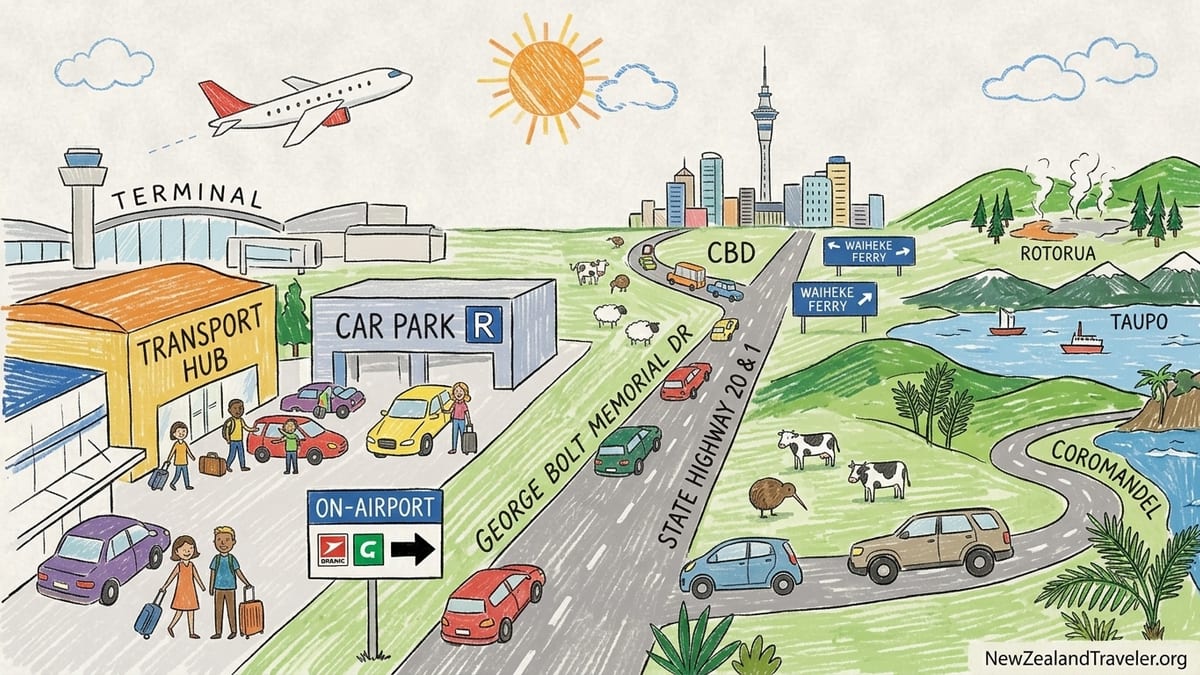
Auckland Airport sits about 20 to 25 kilometres south of the CBD and serves as the main entry point for international visitors to New Zealand’s North Island. The airport has two terminals, international and domestic, connected by a free terminal transfer bus that runs roughly every 15 minutes during the day. On arrival, you will see clear signage directing you toward the Transport Hub near the international terminal and to Car Park R by the domestic terminal, where the on-airport rental brands operate.
The airport currently hosts a cluster of licensed on-site rental car brands, including global companies such as Avis, Budget, Enterprise, Europcar and Hertz at the Transport Hub and domestic parking facilities. In practice, that means you can step off a long-haul flight, walk a short distance through the terminal and collect your keys without needing an off-site shuttle. Less prominent or budget-focused brands often operate from nearby areas such as Airport Oaks and rely on shuttles from a designated off-site transfer zone north of the Transport Hub, which usually adds 10 to 20 minutes to the process.
Because rental counters are concentrated at the airport, it has become a natural starting point for North Island road trips. You can drive straight onto George Bolt Memorial Drive, then connect quickly to State Highway 20 and State Highway 1, whether you are heading north to the Bay of Islands, south to Rotorua and Taupō, or east to the Coromandel. For travellers who value getting on the open road without delay, the convenience of airport pickup is a major advantage.
However, airport convenience can come with extras such as location surcharges and higher base rates compared with some city branches. To decide whether that trade-off is worthwhile, it helps to compare airport pickup with collecting your car after spending time in central Auckland.
Airport Pickup vs CBD Pickup: Which Is Better for You?
Many major brands that operate at Auckland Airport also maintain branches in the CBD or nearby inner suburbs, while local companies like Apex, Omega, GO Rentals, Snap and Ezi typically run both airport and city locations. In broad terms, airport pickup prioritises speed and simplicity, while CBD pickup can shave something off your daily rate and avoid driving in your most jet-lagged state.
For example, a North American couple landing at 6 a.m. from Los Angeles might reserve a compact automatic from a global brand at the airport at around a mid-range daily rate, accepting that they are paying a small premium for the ability to drive straight to Rotorua the same morning. In contrast, a European backpacker arriving at midday might take the SkyBus-style airport bus or a rideshare into the CBD, settle into a hostel near Queen Street, and pick up a cheaper compact or older-model car the next morning from a local operator on Hobson Street or Beach Road.
There are trade-offs beyond price. Driving from the airport into the CBD is mostly motorway, which is relatively straightforward even for tired drivers. Navigating the CBD itself can be slower and more stressful, with bus lanes, one-way streets and dense traffic at peak times. On the other hand, if you are planning to spend two full days exploring central Auckland attractions like the Viaduct Harbour, Auckland Art Gallery and the ferry routes to Waiheke or Rangitoto, having a car parked in the city is more nuisance than benefit.
In practice, travellers starting a North Island road trip often follow two patterns: either they collect at the airport and immediately head out of town, bypassing the CBD entirely, or they delay car pickup until the day they are ready to leave central Auckland. If your itinerary leans more toward museums, harbour walks and ferries for the first 24 to 48 hours, city pickup on departure day usually makes more financial and practical sense.
Should You Collect Your Car Immediately or Explore Auckland Car-free First?
Your arrival time, energy levels and itinerary shape the decision about when to collect the car. After an overnight long-haul flight, many visitors arrive at Auckland Airport in the early morning, facing jet lag and unfamiliar road rules such as driving on the left. In these cases, going car-free in the city for the first day or two can be a safer and more relaxing option.
For example, a family flying in from the United States might land at 7 a.m., take a shuttle or rideshare into a central hotel near Britomart, and spend the first day walking to the waterfront, taking the ferry to Devonport and riding the city’s light rail and buses. On day two, well rested and adjusted to local time, they stroll to a CBD rental office to collect an SUV and drive south toward Hamilton and Waitomo. They have effectively shifted their driving to a day when they are alert, and they have not paid to park an idle car in the city overnight.
By contrast, a couple on a tight schedule who arrive mid-morning and plan to reach Rotorua that evening may be better served by picking up their car at the airport immediately. They can stock up on groceries at a supermarket in a suburb such as Takanini or Pukekohe along the motorway and then continue on to their accommodation. For them, the cost of an extra night’s rental is outweighed by the convenience of waking up already in the heart of their road trip, rather than losing a half-day backtracking out of Auckland.
Parking costs also matter. Many CBD hotels charge overnight parking fees that can rival or exceed the daily cost of a budget rental in low season. If you are paying for secure underground parking in addition to the rental itself, yet using the car only for a short drive to a restaurant, it is usually more efficient to wait and collect your vehicle when you are genuinely ready to leave the city.
Compact vs SUV: What Works Best for North Island Roads?
New Zealand’s North Island roads include everything from wide motorways leaving Auckland to winding rural highways and coastal routes. Most travellers choose between a compact hatchback and a mid-size SUV, both typically available in automatic. Compacts from brands such as Toyota, Hyundai or Kia offer lower rental rates and better fuel economy, which matters when petrol prices are high and you are planning to cover several hundred kilometres.
Take a standard compact automatic from a mainstream brand as an example. It is usually sufficient for two to three adults with moderate luggage planning a loop from Auckland to Rotorua, Taupō, Napier and back via Hamilton. The smaller size makes it easier to manoeuvre in tight parking spaces in places like Ponsonby or small coastal towns such as Tairua on the Coromandel Peninsula. On curving roads through the Kaimai Range or between Rotorua and Tauranga, a smaller car can feel more nimble and less intimidating for drivers not used to New Zealand’s terrain.
An SUV, on the other hand, can be a better fit for families, groups with bulky luggage or travellers planning to use unsealed access roads to trailheads and remote beaches. A mid-size SUV from a brand such as Nissan, Mitsubishi or Toyota gives you a higher driving position, more cargo space and, in some models, all-wheel drive. For a family of four heading north to the Bay of Islands with two large suitcases, two duffel bags and camping gear, the extra space can make journeys far more comfortable.
Price differences between compacts and SUVs vary by season and provider, but it is common to see an SUV costing significantly more per day than a basic compact, especially during the December to March high season. Before automatically choosing an SUV “just in case,” think critically about passenger numbers, luggage and your planned routes. For the classic North Island loop on sealed highways and main tourist roads, a well-maintained compact automatic is usually adequate, leaving you more budget for activities such as Hobbiton tours, geothermal parks and wine tastings.
Automatic Availability, Insurance Excess and How to Manage Risk
Unlike some European markets where manual gearboxes are common, New Zealand rental fleets are heavily weighted toward automatic transmission, particularly among international brands and newer local fleets. At Auckland Airport, it is easy to find automatic compacts, sedans and SUVs with both the large multinationals and local operators. Manuals are more commonly found in older budget vehicles or specialty categories, so if you prefer or require an automatic, you should still select it explicitly when booking.
Insurance excess, sometimes called the deductible, is one of the most important but least understood aspects of New Zealand car rental. Standard rental packages often include basic cover with a high excess that can range into the thousands of New Zealand dollars. If the car is damaged or stolen, you are liable for that amount even if the incident is relatively minor. Rental companies then offer “excess reduction” or “full cover” options that significantly reduce the excess, often close to zero, in exchange for a higher daily rate.
For example, a traveller renting a compact automatic at Auckland Airport might see a base rate that appears attractive online but comes with an excess of several thousand dollars. At pickup, the desk agent may offer to reduce that excess to a few hundred dollars or less by adding a per-day fee. Alternatively, you might use a third-party insurance policy purchased via an online broker, which reimburses you after the fact while the rental company still holds a bond on your credit card. Each option has trade-offs in cost and convenience, and you should budget both time and money to understand them before you arrive at the counter.
New Zealand’s mix of rural roads, gravel access tracks and changeable weather means that minor damage such as windscreen chips and tyre punctures is not uncommon. Travellers planning long North Island itineraries that include lesser-travelled roads, such as sections of the East Cape or inland routes between smaller towns, may find the peace of mind from a generous excess reduction worthwhile. Those sticking mostly to motorways and major highways for shorter trips may be comfortable with a higher excess, particularly if they have a robust travel insurance policy that explicitly covers rental car damage.
One-way Rentals and Fees for North Island Road Trips
One of the main attractions of renting a car in Auckland is the ability to drop it in another North Island city, such as Wellington or Napier, and fly onward from there. Many major rental brands with networks across New Zealand offer one-way hires between Auckland and other centres, although availability tightens in peak season and certain directions may be restricted when fleets are unbalanced.
In practical terms, if you pick up at Auckland Airport and plan to drop in Wellington after a week-long tour via Rotorua and Napier, you may face a one-way fee on top of the base rental cost. For some brands and dates, this fee can be modest or even waived as part of a promotion, while for others it can add a noticeable amount to your overall budget. Local companies such as Apex and Omega have at times promoted low or no one-way fees on specific routes or when cars need repositioning, though these offers change seasonally.
Travellers who wish to include both islands often structure their trip into two separate rentals to avoid higher inter-island one-way charges. For instance, you might rent a car from Auckland Airport and return it in Wellington, cross Cook Strait as a foot passenger on the ferry, then start a separate rental in Picton or Christchurch. Others choose to keep the same car and pay both a one-way fee and the vehicle ferry cost for maximum convenience. The optimal approach depends on your route, timing and tolerance for paperwork.
For a purely North Island road trip that begins in Auckland and ends in Auckland, looping through regions like the Coromandel, Bay of Plenty, Hawke’s Bay and Taranaki, one-way fees are not a concern. In that case, your decision shifts back to whether you drop at the airport or a city branch at the end of the trip, balancing ease of catching your flight against any price differences and downtown traffic.
Example North Island Itineraries and How Pickup Choice Affects Them
To see how these factors come together in real life, consider a classic seven- to ten-day North Island loop. A typical route might start at Auckland Airport, continue to Rotorua for geothermal attractions, then on to Taupō for lake views and adventure sports, across to Napier for art deco architecture and wine tasting, up through the central North Island via Tongariro National Park, and back to Auckland. For this itinerary, a compact automatic picked up at the airport on arrival and dropped there before departure is straightforward and efficient.
Now imagine a slower-paced trip focused on the north. A visitor could spend two nights in central Auckland without a car, exploring the CBD, Ponsonby and the waterfront by foot and public transport, then collect an SUV from a CBD branch to drive to the Bay of Islands via Whangārei. They might then continue west to the Kauri forests, loop back through the surf beaches of the west coast and finally drop the car at the airport before flying south. In this scenario, city pickup and airport drop-off provide the most convenient combination.
For travellers heading all the way to Wellington, the choice becomes more nuanced. One option is to collect a compact at Auckland Airport, drive via the Coromandel, Rotorua and Napier, then return the car at Wellington Airport and fly back to Auckland or onward to the South Island. Another is to return the car in central Wellington if you plan to spend several days car-free in the capital before flying out. Each variant changes where you pay location surcharges and whether a one-way fee applies, underscoring the importance of testing different pickup and drop-off points when you compare quotes.
Whatever your route, it is wise to check not only headline prices but also office hours at your intended pickup and drop-off locations. Some CBD branches close earlier or do not operate on Sundays or public holidays, while airport locations typically align with flight schedules and may open longer hours. If your flight lands late at night or departs very early in the morning, an airport branch may be your only realistic option.
The Takeaway
Designing a North Island road trip from Auckland begins the moment you decide where and when to collect your rental car. Auckland Airport’s cluster of on-site brands in the Transport Hub and domestic parking makes airport pickup extremely convenient, especially if you are keen to leave the city immediately for destinations such as Rotorua, Taupō or the Bay of Islands. Compact automatics from international brands and reputable local operators are widely available, with SUVs commanding a higher daily rate but offering extra comfort and space.
Yet convenience is not the only consideration. Exploring central Auckland car-free before picking up a vehicle in the CBD can save on rental days, avoid downtown parking fees and reduce the risk of driving while jet-lagged. One-way rental options allow flexible itineraries that finish in cities like Wellington or Napier, though you should watch for additional fees and check whether your chosen provider offers favourable terms on your route and dates.
Ultimately, the best strategy is to work backwards from your itinerary. Map out which days you genuinely need a car, whether you will spend significant time in central Auckland, how comfortable you feel driving straight after a long flight, and whether a compact or SUV better matches your group and luggage. Combine those answers with a clear understanding of insurance excess and one-way rules, and you will arrive at a rental choice that supports, rather than constrains, your North Island journey.
FAQ
Q1. Is it cheaper to rent a car at Auckland Airport or in the CBD?
In many cases, city branches offer slightly lower base rates because they avoid airport location surcharges, but the difference can shrink once you factor in the cost of getting into town, any extra hotel nights and parking fees. If you plan to leave Auckland immediately, airport pickup may be worth the premium; if you will stay in the CBD for a day or two, collecting the car later in the city can reduce your overall cost.
Q2. Do I need a car while staying in central Auckland?
Most short-stay visitors do not need a car in the CBD. Many hotels, restaurants and attractions are walkable, and ferries, buses and rideshares cover most journeys. Because hotel parking can be expensive and traffic is dense, it is usually more efficient to delay car pickup until the day you leave the city for the rest of your North Island road trip.
Q3. Are automatic cars easy to find at Auckland Airport?
Yes, automatic transmission is standard in most Auckland Airport rental fleets, especially among international brands and newer local vehicles. Compacts, sedans and SUVs are widely available as automatics. If you specifically want a manual, you may need to choose certain budget or specialty categories and confirm availability in advance.
Q4. Is a compact car big enough for a North Island road trip?
For two to three adults with moderate luggage driving mainly on sealed highways, a compact hatchback is usually sufficient. It is easier to park in cities and small towns and generally uses less fuel. Larger groups, families with bulky gear or travellers planning long distances on rural roads may be more comfortable in a mid-size SUV.
Q5. How do one-way car rentals from Auckland to Wellington work?
Many major brands allow you to pick up in Auckland and drop in Wellington, with availability varying by season. You typically pay the normal daily rate plus any applicable one-way fee. Some companies and dates feature reduced or waived one-way charges, while others add a noticeable premium. It is worth comparing multiple providers and checking both airport and city branches at your intended drop-off point.
Q6. Should I reduce the insurance excess on my rental car?
Reducing the excess lowers the amount you must pay if the car is damaged or stolen, at the cost of a higher daily rental price. On a long North Island itinerary involving rural or gravel roads, many travellers find the peace of mind worthwhile. On shorter, mostly urban or highway trips, some are comfortable with a higher excess, particularly if they have separate travel insurance that clearly covers rental car damage. The right choice depends on your risk tolerance and budget.
Q7. Is it safe to drive out of Auckland straight after a long flight?
New Zealand roads are generally well maintained, but fatigue significantly increases accident risk, especially if you are adjusting to driving on the left. If you arrive early in the morning after an overnight flight and feel very tired, it can be safer to spend a night in Auckland without a car and start driving the next day. If you do drive immediately, consider a short first leg and plan regular breaks.
Q8. Are local New Zealand rental companies reliable compared with international brands?
Reputable local operators such as Apex, Omega, GO Rentals, Snap and Ezi are well established and popular with both domestic and international travellers. They often offer older or higher-mileage vehicles at lower prices than global brands like Hertz, Avis, Budget, Europcar and Enterprise. In exchange for the savings, you may see fewer premium models or slightly more basic facilities, but many travellers report positive experiences when booking directly with well-reviewed local companies.
Q9. Can I take my Auckland rental car to the South Island?
Policies vary by company. Some brands allow you to take vehicles on the Cook Strait ferry between Wellington and Picton, sometimes with specific conditions or fees, while others require you to drop the car on one side and collect another on the other side. If you intend to visit both islands, check inter-island rules and costs carefully when booking and consider whether two separate rentals might work better for your itinerary.
Q10. How far in advance should I book a rental car for peak season?
For travel in the New Zealand summer school holidays and during major events, it is wise to book several months in advance. At busy times, popular categories such as compact automatics and mid-size SUVs can sell out or become significantly more expensive closer to your dates. Early booking also gives you more flexibility in choosing between airport and CBD pickup, different car types and the most favourable one-way conditions.