


I used to think of the Abel Tasman water taxi as a simple add-on: buy a ticket, hop on a boat, start walking. Planning the Abel Tasman Coast Track quickly taught me the opposite. The water taxi is the backbone of your itinerary, the piece that dictates which bays you’ll see, how early you need to pack up, whether you can safely cross Awaroa Inlet, and how much slack you should build into your day. On my most recent trip, I planned the track around the boat rather than treating the boat as a minor ticket purchase, and it made the whole experience calmer, safer, and more enjoyable.
Why the Water Taxi Became the Center of My Abel Tasman Plan
The Abel Tasman Coast Track is famously flexible. You can walk hut-to-hut, camp, day-walk sections, or stitch together a “greatest hits” itinerary by riding a water taxi to one bay and walking back to another. That flexibility can feel like freedom right up until you realize the boat is running to a schedule, the coast is ruled by tide windows, and the easiest “Plan A” often collapses into “Plan B” once you put actual departure times against walking times.
I planned my route with one rule: every walking day needed a clear, believable finish line that matched a real pickup time, with enough buffer to be late and still be safe. That meant choosing bays not just for scenery but for logistics. Some bays are straightforward beach stops. Others, like Awaroa, are tied to a tide crossing that has no alternative track, which changes everything.
To keep decisions grounded, I checked current one-way fares and the latest sailing timetables immediately before publication. On the Abel Tasman Sea Shuttle side, the published one-way fares from Kaiteriteri to Anchorage are NZ$53, rising to NZ$64 for Tōtaranui, with intermediate stops including Medlands, Tonga Quarry (the drop for Onetahuti), and Awaroa. Those numbers matter because they reveal the real trade-off: paying a little more can remove hours of walking at the beginning or end of the track and can put you on the coast when the tide is actually crossable.
On the Abel Tasman Sea Shuttles and associated booking platforms, one-way fares from Mārahau or Kaiteriteri are also commonly quoted starting around NZ$59 to Anchorage and increasing to around NZ$70 for Tōtaranui, with scheduled stops at bays including Bark Bay, Onetahuti, and Awaroa. In practical terms, those price bands are the difference between a short “warm-up” day and a big mileage day that forces you to walk like it’s a race.
Boarding in Kaiteriteri: Faster Check-In, Bigger Boats, Less Guesswork
I personally departed from Kaiteriteri first, and I found it the more predictable place to begin when you’re trying to keep nerves low on day one. The departure area is a proper beach hub with ticketing and a clear flow of people heading out on trips. The vibe is organized: you’re not wondering whether a boat can reach the beach at the time you’ve booked, because Kaiteriteri is the main departure point for larger vessels with all-tide access.
My check-in habit for Kaiteriteri is simple: I arrive early enough that being asked to check in 30 minutes before departure does not feel like a constraint. Many Abel Tasman water taxi operators instruct passengers to check in 30 minutes before departure, and it’s worth following literally. It gives you time to tag your pack, confirm your destination bay out loud, and ask one last timing question that can save your whole day.
Luggage was treated like part of the system, not an afterthought. The booking conditions I used allowed one pack or bag per person, with a stated maximum weight limit for included luggage on some services. In my case, that changed what I carried. I repacked so my walking bag was a single piece I could lift easily while barefoot, because beach boarding is normal in Abel Tasman and you should assume you will step into water at some point.
As for the boat itself: expect a real working water taxi, not a sightseeing cruise with wind-proof glass everywhere. On my departure, I wore a light rain shell even in decent weather, because spray can still find you when the skipper turns into chop between bays. I kept my phone in a dry bag, not a jacket pocket, because “quick photos” are exactly how salt water ends up inside your gear.
Departing from Mārahau: A Different Feel, Smaller-Vessel Energy, More Tide Awareness
On a different day of the same trip, I used Mārahau as my departure point and immediately understood why experienced Abel Tasman walkers have strong opinions about it. Mārahau is a true gateway settlement for walkers and kayakers, and it feels like you’re stepping straight from track culture into boat culture. It is also, by nature, more tide-aware. The park information published by Wilsons notes that Kaiteriteri is the main departure point for larger vessels with all-tide access, while Mārahau’s tidal inlet is better suited to smaller boats.
In practice, that difference shows up in how you start your morning. From Mārahau, I built extra time not just for check-in, but for the human realities of a tidal environment: slower loading, more careful handling of packs, and the possibility that you’ll be wading earlier than expected. It’s not “worse,” but it made me treat the departure like part of the adventure rather than a clean handoff.
Because of the inlet setting, Mārahau felt like the place where last-minute itinerary changes are more common. People were actively discussing where they were getting dropped, what the tide was doing, and whether they’d still make a particular pickup. If you’re the kind of traveler who wants certainty, Kaiteriteri steadied me more. If you’re the kind who likes improvisation, Mārahau felt more in the spirit of the Coast Track.
What didn’t change between them: the need to show up early and be ready to move. Whether you depart from Kaiteriteri or Mārahau, boats leave at scheduled times, and most beach pickups require bookings rather than casual walk-ups. Treat that schedule like a hut booking. It is not the flexible part of your day.
Beach Boarding, Spray, and What I Actually Saw Between Bays
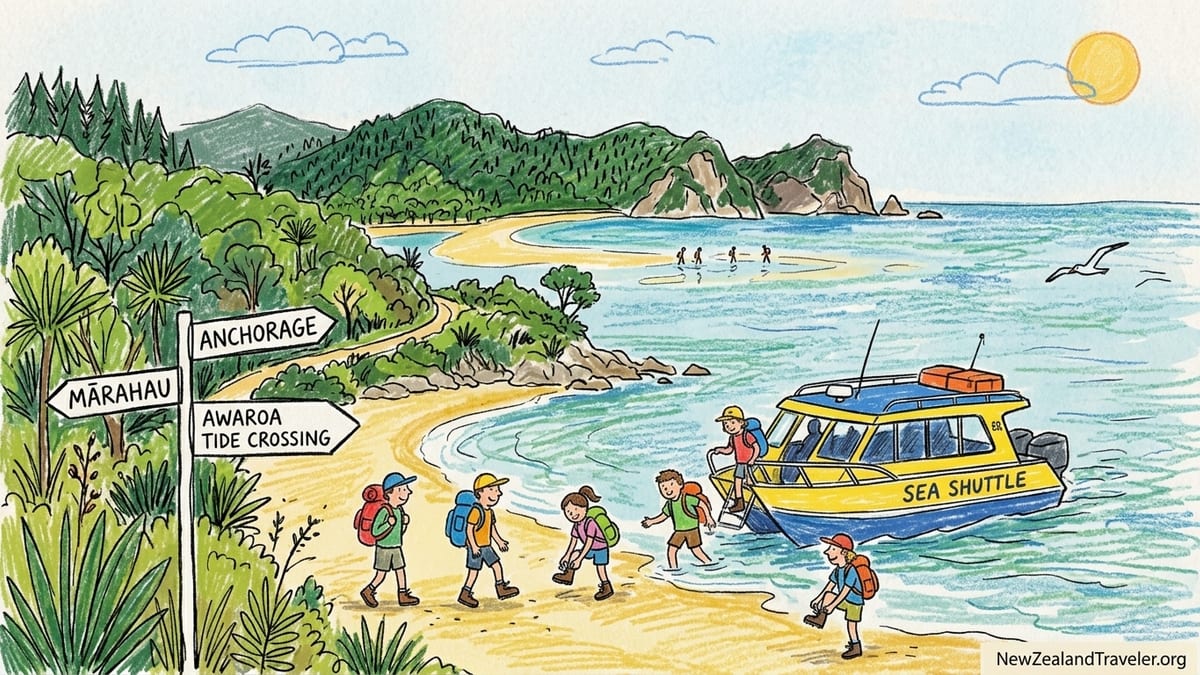
The most “Abel Tasman” moment for me was realizing that boarding can be from the beach, not a wharf. That changes how you dress and what you pack where. I wore trail shoes that I did not mind getting wet and carried a pair of dry socks in an accessible pocket for the first hour of walking after drop-off. If you arrive in sandals and then plan to walk all day, you may regret it by the first muddy patch.
On one pickup, I watched the boat nose in and time a small set of waves, and we walked down the sand in a loose line with packs held high. Nothing dramatic, but enough water movement that you want both hands free and nothing dangling from your pack. If you’re carrying trekking poles, I recommend collapsing them and strapping them down before you step onto the wet sand.
Weather-wise, I had classic Abel Tasman variety: bright sun on the beach, then a cooler breeze once the boat moved out past headlands. Even on a good day, spray is real. I sat where I could lean into it without soaking my day bag, and I still ended up with salty sleeves. The fix was simple: pack a shell you’re happy to wear on the boat even if it’s warm on land.
Wildlife is always a “maybe,” but I did genuinely see seabirds working the surface and a few lazy moments of marine life in the distance that made the boat ride feel like more than transport. I’m careful about claiming specifics because wildlife sightings are never guaranteed, but the experience that felt most real was simply how quickly the coastline changes: coves, headlands, bright sand, then dark-green bush. Even if you’re an avid walker, the water taxi gives you the “whole park” perspective in a way the track cannot.
My Drop-Off Bay, and How the Boat Changed My Walking Route
My most useful drop-off, the one that shaped my walk the most, was Awaroa Beach. This is not just a pretty stop. It is where the water taxi can deliver you into a part of the track that is governed by a tidal crossing with no alternative route around the inlet. The Department of Conservation guidance is clear: you can cross Awaroa Inlet within 1 hour 30 minutes before and 2 hours after low tide, you should cross only in daylight when safe, and you should allow around 25 minutes to cross.
That tide rule turned my “walking day” into a timed sequence. If I arrived at Awaroa too late relative to low tide, it wasn’t a matter of “walking faster.” It was a matter of not crossing at all. So I treated the water taxi as the lever: I chose a sailing that put me on sand with enough time to reach the inlet, assess it, and cross during the window rather than chasing the window.
It also changed which direction I walked. Before using the water taxi, I assumed I would naturally walk south to north, starting at Mārahau and finishing deep in the park. The boat made the opposite strategy smarter: ride north, then walk back south. By pushing myself north by water first, I could meet the Awaroa tide crossing earlier in my trip, when my legs were fresh and my schedule had fewer unknowns.
If you are building a multi-day Coast Track around the boat, this is the big practical lesson: choose one “anchor constraint” and plan outward. For many itineraries, that anchor is Awaroa’s low tide window. Once you accept that, your pickup times, hut nights, and even how long you linger for lunch becomes easier to decide.
When Timings Felt Too Tight: My Buffer Rules and the “Bail-Out” Mindset
I had one day where everything felt tight: a departure time that wasn’t early, a walking section that looked reasonable on paper, and a pickup that required me to arrive on time. The moment I noticed myself doing math every ten minutes, I knew I’d under-budgeted buffer. That is not how Abel Tasman should feel, especially when the whole point of paying for a boat is to remove stress.
My buffer rule became blunt: if missing the pickup would create a safety issue or force me into a tidal crossing at the wrong time, I added more slack or changed bays. In Abel Tasman, there are sections where a “small delay” is normal: stopping to filter water, waiting for a safer tide moment, slowing down on slick roots, or simply pausing because the beach is too beautiful to ignore. If your itinerary can’t survive those delays, it’s too ambitious for a pleasant trip.
The other mental shift was accepting that the boat gives you bail-out options. Knowing you can exit at a bay with scheduled stops changes the psychology of walking. Stops commonly served by water taxi timetables include Anchorage, Bark Bay, Awaroa, and the Tonga Quarry drop used for Onetahuti access. That doesn’t mean you should plan to quit early, but it does mean you can plan with confidence rather than bravado.
One more reality check: not every pickup is created equal. Some locations have restrictions or require pre-arranged beach pickups, and some timetables note that bookings are essential for beach pick-ups. If you’re relying on a mid-afternoon pickup from a smaller beach, I would confirm that pickup clearly when you book, then repeat it at check-in, and then carry the details somewhere offline in case your phone is wet or dead.
The Tide and Track Relationship (Especially for Awaroa) and The Takeaway
In Abel Tasman, tides are not trivia. They are the route. The Department of Conservation highlights specific low-tide crossings on the Coast Track, and Awaroa Inlet is the one that most directly dictates itinerary design because there is no alternative track around it. The safe crossing window is tied to low tide, and DOC notes you can cross within 1 hour 30 minutes before and 2 hours after low tide, with conditions like storm surge and heavy rainfall potentially affecting the real-world window.
This is exactly where water taxis stop being “transport” and become “planning tools.” If you book a water taxi to Awaroa without checking the tide table for your date, you can accidentally create an impossible day: arrive, walk to the inlet, and then realize you’re too early with channels still deep, or too late with water returning. Meanwhile, a different sailing time, or a different drop-off bay like Tonga Quarry (for Onetahuti) can make the whole plan smoother by letting you approach Awaroa when the water is actually low.
I also found it helpful to remember that tide timing is not the only variable. Your actual walking speed changes with sand, boardwalks, mud, and how often you stop for photos. Add in the very human factor of beach time, and “tight” schedules get tighter. I treated the tide window like a flight connection: you don’t plan to arrive at the gate at the exact boarding minute, and you don’t plan to reach Awaroa inlet at the exact minute the window opens.
The Takeaway: the Abel Tasman water taxi is not a mere shuttle. It is your itinerary’s steering wheel. When I planned my Coast Track around the boat, I walked better sections, crossed Awaroa safely, and enjoyed the beaches without constantly checking my watch. If you want Abel Tasman to feel like a coastal holiday rather than an endurance event, pick your drop-off and pickup bays first, confirm fares and sailing times right before you travel, then build your walking days to comfortably fit between those boat moments.
FAQ
Q1. How early should I check in for an Abel Tasman water taxi?
Plan to check in 30 minutes before departure, because boats leave on schedule and you’ll need time to confirm your bay and tag luggage.
Q2. What are the current one-way water taxi fares to Anchorage and Tōtaranui?
Commonly advertised one-way fares from Mārahau or Kaiteriteri start around NZ$59 to Anchorage and rise to around NZ$70 to Tōtaranui, depending on operator and season.
Q3. Are there scheduled stops at Bark Bay, Onetahuti, and Awaroa?
Yes, timetables typically include scheduled services to bays including Bark Bay, the Tonga Quarry drop for Onetahuti access, and Awaroa, but you should confirm for your specific date.
Q4. Is Awaroa Inlet really tide-dependent, and is there an alternative route?
Yes, it is tide-dependent and there is no alternative track around the inlet, so you must plan to cross near low tide.
Q5. What is the safe crossing window for Awaroa Inlet?
Department of Conservation guidance is to cross within 1 hour 30 minutes before and 2 hours after low tide, allowing about 25 minutes to cross, and only in daylight when it’s safe.
Q6. Is Kaiteriteri or Mārahau better for departures?
Kaiteriteri generally offers more all-tide predictability and larger-vessel operations, while Mārahau’s tidal inlet suits smaller boats and feels more tide-driven.
Q7. Will I have to board from the beach and get wet?
Often, yes. Beach boarding is common in Abel Tasman, so plan for wet feet and protect electronics in dry bags.
Q8. How much luggage can I bring on the water taxi?
Policies vary by operator, but many fares include one bag or pack with a stated weight limit, so check your booking conditions and pack as a single manageable item.
Q9. What happens if my walking day runs late and I miss my pickup?
You may face long waits or limited options, and it can create safety issues if a tidal crossing is involved, so build buffer time and confirm pickup requirements at booking.
Q10. What is the most practical way to plan a multi-day Abel Tasman trip using water taxis?
Choose your water taxi drop-off and pickup bays first, then build walking days that comfortably fit between them, using the Awaroa tide window as your main planning constraint if you’ll cross it.