


I stopped trying to crown one “best month” for Nelson Tasman after a few separate research trips that landed in different weather windows and different tide cycles. The region is small enough to feel easy, but it behaves like multiple destinations stitched together: a beach town (Kaiteriteri), a marine park (Abel Tasman), a food and wine region (Waimea and Moutere), and a cycling hub that can be breezy, dusty, muddy, or perfect depending on the week.
What actually decided how good a day felt was not the calendar alone. It was the practical stuff you only notice once you’re there: whether a coastal wind turned a kayak into a workout, whether a sunny spell dried out the track, whether the water was warm enough that a swim felt like a reward instead of a dare, and whether the tide timing let you cross Awaroa Inlet without standing around watching the clock.
To keep this grounded, I’m blending real on-the-ground observations from different seasons with the current “planning layer” you should check before you lock anything in. Regional tourism guidance still describes typical daytime temperature bands of roughly 20–25°C in summer, 17–21°C in autumn, 12–16°C in winter and 16–19°C in spring. But the bigger lesson I came away with is this: dates alone are not enough for Abel Tasman. The Awaroa Inlet crossing is tide-dependent, and the Department of Conservation currently allows crossing only from 1 hour 30 minutes before to 2 hours after low tide, in daylight.
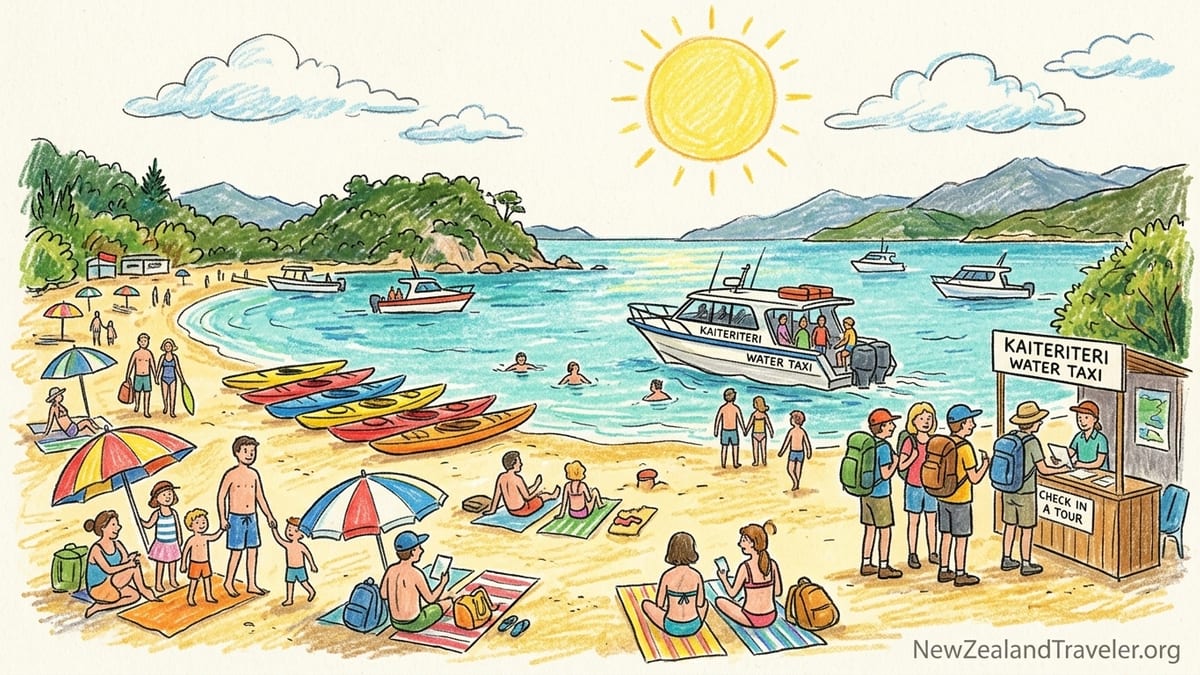
Summer: When Kaiteriteri Turns Into A Beach Resort Town
Summer in Nelson Tasman feels like the region leans into its reputation. On paper, the current regional guidance puts typical daytime temperatures around 20–25°C, and in practice the “how it feels” factor is driven by sun strength and exposure. On clear days, the heat on open sand at Kaiteriteri can feel more intense than the air temperature suggests, especially once you’re carrying a daypack or hauling a kayak bag across the beach.
My strongest summer memory of Kaiteriteri is not a single viewpoint, it’s the vibe shift: the beachfront becomes a full-on holiday strip. The same stretch of sand that can feel sleepy in shoulder season fills with families, tour check-ins, and people timing swims between boat arrivals. If you’re arriving by car mid-morning, parking and last-minute accommodation can feel like part of the “peak season tax,” even if you’re not paying surge pricing directly. It’s also the season when booking early stops being optional for popular departures and stays.
Comfort on the water changes too. In midsummer, local planning resources for Abel Tasman regularly describe peak water temperatures in the high teens Celsius, roughly 16–19°C around early February. In real terms, that’s the difference between “jump in without thinking” and “brace yourself.” I found that a calm, sunny day made paddling in a light base layer comfortable, but a breezy day could cool you fast once you got splashed. The water might be “swimmable,” but after a kayak capsize drill or repeated paddle dips, you still feel it in your hands and forearms.
Trail conditions in summer are usually at their simplest, but that doesn’t mean effortless. Heat management becomes the main issue: exposed sections can feel draining if you start late, and even short walks become noticeably harder when you’re carrying extra water. I started treating summer hiking like a beach day with walking: earlier starts, a slow pace, and a “swim break” mentality at spots like Anchorage, Medlands, or Bark Bay rather than trying to power through the hottest hours.