


I didn’t realize how much Abel Tasman National Park is shaped by logistics until I stayed in two different bases on separate visits and built a third “wish list” plan around sleeping in the park itself. The coastline is the headline, sure, but where you sleep decides whether you’re sprinting for a boat at dawn, strolling to the Coast Track entrance with coffee in hand, or watching the sand go quiet after the last day visitors have been shuttled out. Kaiteriteri, Mārahau, in-park stays, and value-minded Motueka all unlock a different version of Abel Tasman, and the differences are practical, not theoretical.
Why Your Base Near Abel Tasman Matters More Than You Think
Abel Tasman can look deceptively simple on a map: golden beaches, a famed coastal track, and a string of bays reachable by boat. In reality, the park runs on timing. Tides govern key crossings, water-taxi timetables govern your start times, and the distance between where you sleep and where your day begins governs your stress level. When I stayed closer to the action, my days expanded. When I stayed farther away, my days started earlier and ended with more driving than I wanted.
There are no entry fees for Abel Tasman day walks, but overnights in the park are regulated and bookable: the Department of Conservation (DOC) has 4 huts and 18 campsites along the Abel Tasman Coast Track that must be booked in advance year-round, with seasonal pricing that changes by date and resident versus international rates. That framework is a reminder that Abel Tasman is both accessible and managed. Your base is how you interact with that system, whether you’re day-tripping or doing a multi-day Coast Track itinerary.
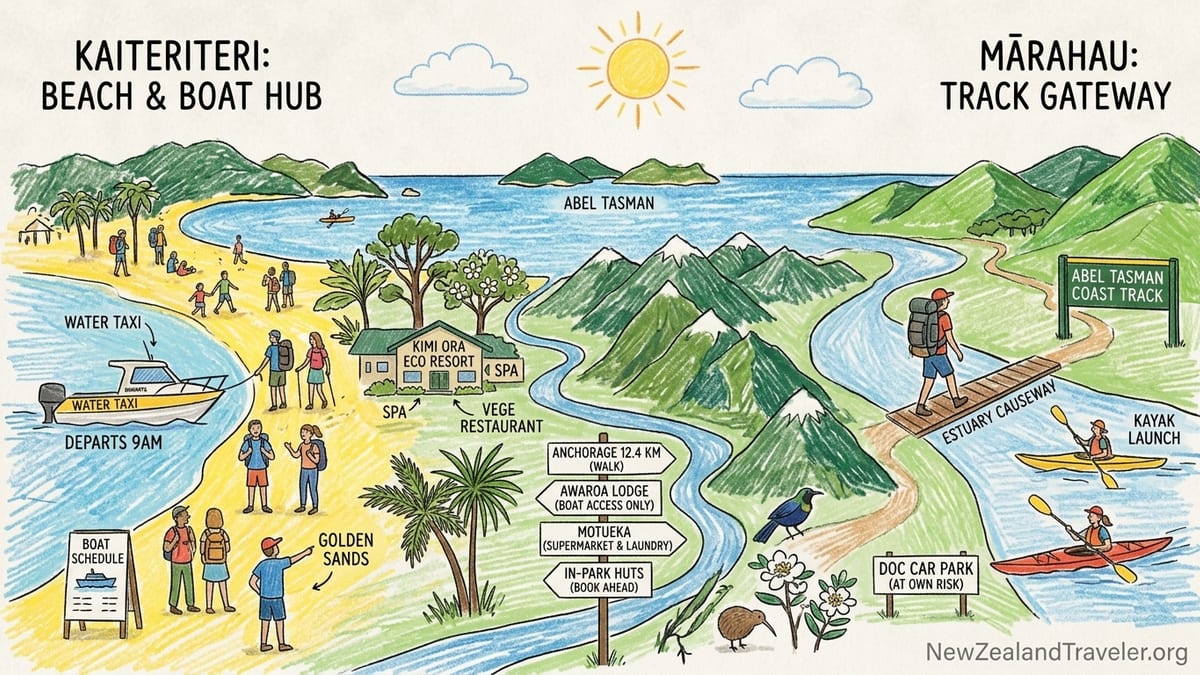
When official operators talk about gateways, they mean it. Kaiteriteri is positioned as the larger beach-and-water-transport hub, with boats leaving directly off the sand and the day-trip energy that comes with it. Mārahau is the southern gateway where you can literally join the Coast Track on foot, starting by crossing the estuary via the Mārahau causeway. If you sleep in-park, you trade convenience stores and restaurant choice for something rarer: the quiet Abel Tasman after the last boats depart.
And then there’s Motueka, the pragmatic alternative. It’s not a “park village” vibe, but it’s where the errands are easy: major supermarket hours, broader dining, and a straightforward drive to the park’s southern end. If your trip includes laundry, stocking up for huts, or simply protecting your budget, Motueka can make Abel Tasman easier to manage.
Kaiteriteri: The Beach-and-Boat Hub That Buys You Time on the Water
Kaiteriteri feels like Abel Tasman’s front door with music on. It’s a well-known beach destination with visitor facilities and a steady stream of people funneling between sand and boat ramps. Official operator information positions Kaiteriteri as the main departure point for cruises and water taxis into the park, and it reads that way on the ground: the beach is where you board, not a separate marina you have to hunt down.
The biggest difference Kaiteriteri made for me was the morning rhythm. If you’re aiming for an early water taxi, the simple act of waking up near the beach is a competitive advantage. With common high-season departures as early as 9:00am from Kaiteriteri on published timetables, staying close can mean a calm breakfast, a short walk with your daypack, and enough buffer to handle last-minute gear checks. On the same timetable, you can see clear, real numbers that help you plan: one-way fares to popular Coast Track stops like Anchorage and Awaroa are listed in the low NZ$50s to low NZ$60s range, which makes “base and boat” days easy to cost out without guesswork.
Accommodation in Kaiteriteri also tends to map neatly onto how people travel. Want to be steps from sand and come back to a hot shower? Beachfront options like Kaiteriteri Recreation Reserve accommodation are designed for that. Want a retreat up in the bush after salty, sun-heavy days? Kimi Ora Eco Resort sits above the beach and sells itself on views, a day spa, and an on-site vegetarian restaurant that (as currently advertised) opens three nights a week, Thursday through Saturday from 5.30pm, which is exactly the kind of detail that matters when you’re choosing whether to cook, drive, or eat where you sleep.
Food and quick supplies in Kaiteriteri are convenient, but it’s not a full-service town. That’s the trade: you get immediate access to boats and a big beach atmosphere, but you’ll still want to think ahead if you’re provisioning for huts or campsites. Kaiteriteri’s strength is that it keeps you close to the transport heartbeat of Abel Tasman, which is why it works so well for day-trippers stacking multiple bays into one itinerary.
Mārahau: The Walking-and-Kayaking Gateway Where the Coast Track Starts at Your Feet
If Kaiteriteri is Abel Tasman’s water-transport hub, Mārahau is the place that makes the Coast Track feel like a local footpath. Official visitor information describes Mārahau as the southern gateway, and the DOC track description is unambiguous about how the classic walk begins: you start by crossing the estuary over the Mārahau causeway and then follow the track through open country and forest on the way to Anchorage. The first time I stayed in Mārahau, that detail became tangible: no driving to a trailhead, no shuttle needed, just a morning walk that started when I decided I was ready.
The practical upside to Mārahau is how it handles “walk in, walk out” days. You can join the Coast Track on foot directly from the northern end of Mārahau near the DOC car park, which is the kind of detail you notice when you’re carrying a pack and you want certainty about where your day begins. Mārahau’s identity as a gateway also shows in the activity mix: it’s a natural base if your plan is a first-day kayak launch, a half-day paddle plus a short Coast Track walk, or a multi-day trek that starts without a boat transfer.
Mārahau is quieter and more rural than Kaiteriteri. That can be a relief at the end of a long, sandy day, but it comes with trade-offs. You’ll likely have fewer dining options within a short stroll, and you’ll want to check what’s open when, especially outside peak summer. The upside is that you’re positioned to begin walking before the day-trippers arrive by boat, and you can also return to a base that feels less like a resort beach and more like a track community.
Parking and vehicles are part of the Mārahau calculus. DOC provides a car park at the Mārahau road end, and it’s explicitly at your own risk. Operators also note that some water taxi and kayak companies provide their own private parking for clients. In practice, Mārahau is one of the easiest places to do a multi-day plan with a car: leave it near the track, walk north, and then arrange a water taxi back to the southern end when your feet have had enough.
Staying In or Immediately Around the Park: When the Beach Goes Quiet After the Boats Leave
Sleeping inside Abel Tasman, or as close as you can get without a road, changes the park from an outing into a place you inhabit. The strongest benefit is the evening. Abel Tasman’s most photographed beaches can feel busy in the middle of the day, especially in summer. After the last water taxis and cruises pull away, the mood shifts. The same shoreline becomes softer, quieter, and more personal, and you start noticing the small sounds: wavelets in the shallows, the wind through coastal vegetation, and the muffled voices of other overnighters settling in.
In-park accommodation spans DOC huts and campsites, plus a small number of private stays that feel like a different category of trip. DOC’s Coast Track system includes 4 huts and 18 campsites that must be booked in advance year-round, with published per-person pricing by season. The rules are not casual: the expectation is you book ahead, stick to your ticketed site, and understand that water is generally untreated at huts and campsites. If your version of “comfort” includes a real bed, a restaurant, and a sense of being hosted, private in-park lodges can make Abel Tasman feel like a remote resort rather than a tramping trip.
A standout example is Awaroa Lodge, which is not accessible by road and sits in the heart of the national park. Its own published details emphasize that it’s surrounded by native forest and waterways, with a restaurant and an outdoor pizzeria that can be open to day visitors. That matters because it hints at the daily cycle: you might share the grounds with walkers passing through at lunch, then have the place calm down as the day visitors move on.
But you pay for the magic in logistics. When you stay in-park, luggage becomes a real consideration. You’ll be coordinating boat drop-offs and pick-ups, carrying what you need, and thinking more carefully about weather buffers. If your plan includes an early departure, you’re no longer just setting an alarm, you’re aligning your entire day around a boat schedule and, in some sections, tidal windows. For travelers who love the feeling of being “in it,” that’s part of the appeal. For others, it’s a reason to sleep outside the park and day-trip in.
Motueka: The Value and Practical Base That Makes Supplies, Meals, and Sleep Easier
Motueka doesn’t sell itself as a beach hub, and that’s precisely why it can work. It’s a real town with real infrastructure. If your Abel Tasman plan involves buying stove fuel, restocking snacks, grabbing sunscreen you forgot, or simply eating somewhere that isn’t timed to a resort schedule, Motueka smooths out the trip. It’s also a practical base if you’re trying to keep accommodation costs down compared with staying directly on the Kaiteriteri sand.
The supermarket point is not glamorous, but it’s decisive. New World Motueka currently lists opening hours of 7.30am to 9.00pm daily at its High Street address. That’s the difference between being able to shop after a long day and being stuck with whatever you can scrounge from a small convenience store. If you’re hiking huts, that’s when you’re buying things like wraps, nut butter, trail mix, and the “second dinner” that always tastes better after a full day of coastal walking.
Motueka also keeps your parking and luggage logistics simple. You can sleep somewhere with reliable parking, load your car once, and then drive to Mārahau for a walking start or to Kaiteriteri for a water taxi day. The drive is short enough that it’s feasible for day trips: published routing estimates put Motueka to Mārahau at around 17 minutes by car for roughly 17 km, which is the kind of scale that keeps Abel Tasman from feeling like an all-day commute.
The trade-off is that you’re not waking up in the beach atmosphere. If your dream is to step out of your room, feel the salt air immediately, and watch the bay change color as boats begin to move, Motueka can’t compete. But if your trip is a mix of Abel Tasman and the wider Nelson Tasman region, Motueka can be the base that makes everything else easier and cheaper without sacrificing the park experience itself.
The Base-by-Base Reality Check: Early Boats, Track Entrances, Food, Parking, and Luggage
Kaiteriteri wins when your priority is water access and convenience for boats. Current published timetables show multiple daily departures in high season, including early morning options such as a 9:00am sailing from Kaiteriteri with stops progressing north. In lived terms, that means you can wake up, pack a day bag, and walk to the sand for boarding rather than timing a drive and a parking hunt first. It’s also the easiest place to stack a cruise, a short walk, and a return sailing without feeling rushed, because you’re starting where the transport network is thickest.
Mārahau wins when you want the Coast Track to start on foot, not by boat. DOC explicitly frames the beginning of the walk as crossing the Mārahau causeway and heading toward Anchorage. That changes your morning from “make the boat” to “start walking.” It also makes kayaking more intuitive if your goal is to paddle from the southern end and then hop onto the track. For multi-day walkers, it’s psychologically satisfying to step onto the Coast Track from the gateway where it’s meant to begin.
In-park stays win on atmosphere and on the feeling of time slowed down. The beach after day visitors leave is not a metaphor, it’s a pattern: Abel Tasman’s day-trip model means many people arrive and depart by water transport. When the boats pull away, you feel the park become less like a destination and more like a shoreline neighborhood. The cost is reduced access to shops and a more complicated luggage plan, because you can’t simply drop your gear in a car and go out for dinner somewhere else.
Motueka wins when you want the most functional trip. You have longer supermarket hours, a wider range of everyday services, and an easy drive to the park gateways. It’s the base I recommend to travelers who are doing Abel Tasman alongside wineries, Tasman Bay beaches, or a broader South Island road trip and want their nights to be restful and simple, not dictated by boat timetables.
The Takeaway
Choosing where to stay near Abel Tasman is not just about comfort levels, it’s about how you want your days to flow. Kaiteriteri is the larger beach-and-water-transport hub, ideal for early water taxis, day cruises, and easy boarding from the beach. Mārahau is the walking and kayaking gateway, the southern start where you can join the Coast Track on foot and treat the park like a trail system rather than a boat excursion. Staying in or immediately around the park is how you get the quiet beach atmosphere after day visitors leave, trading supermarket access and restaurant choice for a deeper sense of place. Motueka is the practical value base: better shopping hours, simpler parking, and a short drive to the gateways.
If you want one simple rule, it’s this: base yourself where your first activity begins. If your mornings start with a boat, sleep in Kaiteriteri. If your mornings start with walking or kayaking from the southern end, sleep in Mārahau. If your best memories come from dusk and dawn on near-empty sand, plan at least one night in the park. If your trip needs a functional backbone for supplies, laundry, and budget control, Motueka is your friend.
Abel Tasman is generous, but it rewards planning. The right base doesn’t just save time, it changes the texture of your day: less rushing, more shoreline, and more of those small, vivid moments that are the real reason you came.
FAQ
Q1. Is Kaiteriteri or Mārahau better for a first Abel Tasman visit?
Kaiteriteri is usually best if your plan centers on water taxis or cruises, while Mārahau is best if you want to start the Coast Track on foot from the southern gateway.
Q2. Where can I join the Abel Tasman Coast Track on foot?
Mārahau is the classic southern start where walkers cross the Mārahau causeway and begin heading toward Anchorage on the Coast Track.
Q3. What is the earliest realistic start for a water taxi day from Kaiteriteri?
In high season, published timetables show morning departures as early as 9:00am from Kaiteriteri, so staying nearby helps you start without a rushed drive and park.
Q4. Do I need to pay an entry fee to visit Abel Tasman National Park?
There is no fee for park entry or for completing a day walk, but DOC charges per-person, per-night fees for huts and campsites that must be booked in advance.
Q5. How many DOC huts and campsites are on the Abel Tasman Coast Track?
DOC currently lists 4 huts and 18 campsites along the Coast Track, with year-round bookings required.
Q6. Is it hard to handle luggage if I stay inside the park?
It can be more complicated because many in-park stays are boat-access only, so you need to coordinate drop-offs and pick-ups and pack with boat and tide timing in mind.
Q7. Where is it easiest to buy groceries and hiking food near Abel Tasman?
Motueka is often the easiest for a full grocery run, with a major supermarket listing daily hours from 7.30am to 9.00pm.
Q8. Can I park at Mārahau if I’m doing a multi-day walk?
Yes. DOC provides a car park at the Mārahau road end, and some operators also offer private parking for clients, but you should still plan for standard precautions as parking is at your own risk.
Q9. What’s the main vibe difference between Kaiteriteri and Mārahau at night?
Kaiteriteri feels more like a lively beach hub, while Mārahau is quieter and more rural, which many walkers prefer before early starts on the track.
Q10. If I only have two days, what base gives me the most flexibility?
Kaiteriteri usually offers the most transport flexibility for quick bay-hopping by water taxi or cruise, while Mārahau offers the simplest flexibility for walking directly onto the Coast Track.