


I landed in Nelson Tasman thinking I had booked myself a neat little triangle: Nelson city, Abel Tasman beaches, Golden Bay’s wild edge, then a quick reset at Nelson Lakes. On a map it looks like a tight cluster. On the road, it is a region that makes you earn every “short drive.” The distances are not huge, but the terrain, the tides, the winding state highway, and the way everything funnels through a handful of pinch points meant I spent more time in motion than I expected. The official 2026 guidance that puts Nelson about 45 minutes from Motueka, roughly an hour from Kaiteriteri or Mārahau, and around two hours from Tākaka turned out to be the difference between a relaxed trip and a constant scramble. I arrived imagining Golden Bay as a Nelson add-on. I left treating it as its own mini journey, with its own weather, pace, and planning rules.
The First Surprise: Nelson Tasman Is Not a “Quick Hop” Region
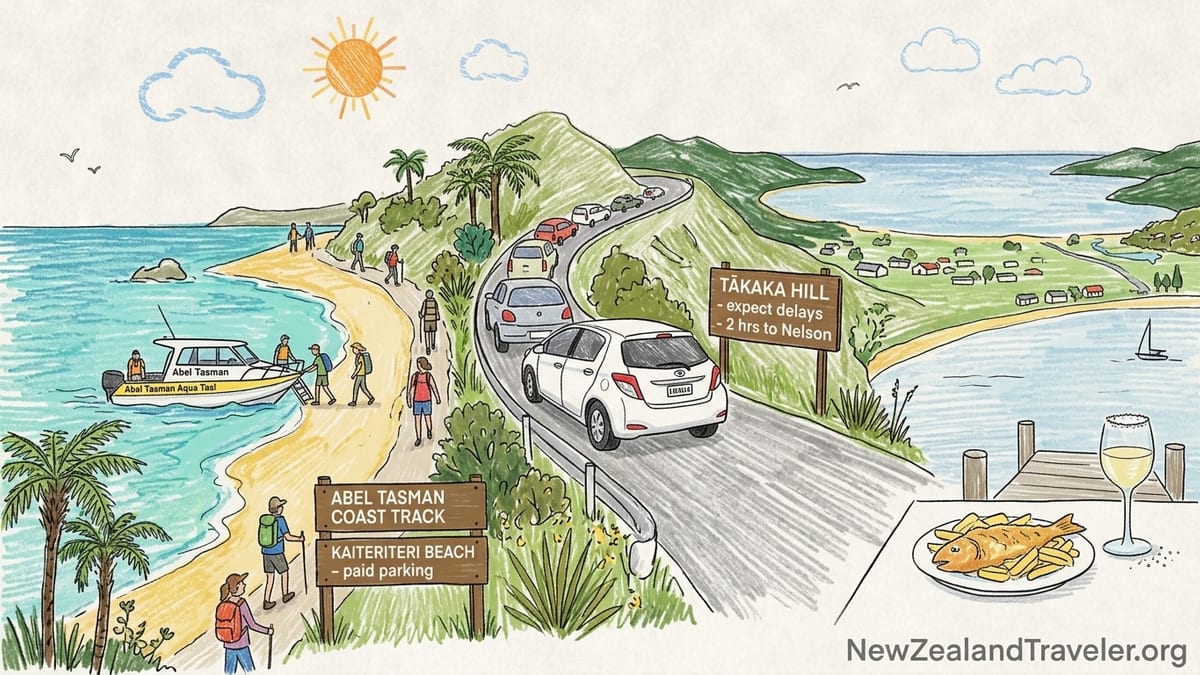
I based myself in Nelson first, telling myself it would keep me flexible. The first morning I tried to stack too much into one day: coffee in Nelson, lunch in Māpua, a quick look at Kaiteriteri, then “surely” I could still make it over Tākaka Hill for sunset in Golden Bay. That plan lasted until I actually sat behind a slow-moving line of cars, watched the minutes tick away, and realized how much the region’s travel time is shaped by two things: curvy roads and bottlenecks where everyone funnels through the same turning points.
I had a compact rental car, a Toyota Corolla hatch, which I chose because I assumed it would make parking painless. In Nelson city it helped, but once I started heading toward Motueka and the Abel Tasman gateways, I realized parking is not just about vehicle size, it is about timing. Arriving at popular beaches in the late morning felt like showing up after the party had already begun. Every “I’ll just pull in quickly” moment turned into circling, waiting, then accepting a longer walk.
Even with the region’s drive-time estimates in mind, I consistently underestimated the add-ons: pulling over for viewpoints, waiting for one-way sections through roadworks, slowing for tight corners, and factoring in stops for fuel, food, and last-minute gear. The distances were reasonable. My expectations were not. Nelson Tasman does not reward optimistic scheduling, especially if you plan around tides and water taxi departures.
Nelson to Māpua: A Wharf Lunch That Reset My Pace
I drove out to Māpua with the kind of casual confidence that makes you think you will be back in Nelson in time for an afternoon swim. The surprise was how quickly the vibe shifted from city streets to waterfront village. Māpua’s wharf area felt like the region exhaling: families drifting between galleries, couples lingering over tasting paddles, and cyclists rolling in with sun-warmed legs.
Lunch was fish and chips eaten outdoors with salt on my hands and that distinct Tasman Bay light reflecting off the water. I paired it with a local white at a nearby wine bar, the kind of glass that tastes like it was made for sunshine and slow conversation. It was the moment I stopped trying to “cover” the region and started letting places take the time they take.
Practical detail that mattered more than I expected: parking near the wharf was easiest earlier in the day. When I arrived closer to midday, it took a couple of loops to find a spot that did not feel like a compromise. If I did it again, I would arrive earlier, treat the wharf as a proper half-day, and leave room for the small detours that make Māpua feel lived-in rather than “ticked off.”
Motueka as My Logistics Hub (And Why Nelson Was Not Enough)
Motueka surprised me by how useful it was as a base, not because it is flashy, but because it is positioned like a hinge. From Nelson, everything felt like an outward push. From Motueka, it felt like I was already on the right side of the region for Abel Tasman days and for the long haul toward Golden Bay.
I tried a mix of transport thinking I could “sample” my way through: one day with the car, one day leaning on buses. The local bus network in Nelson Tasman is now branded as eBus, and the region also has dedicated connections marketed for Abel Tasman access through the Better Bus collaboration between operators. The reality for me was that buses worked best when I was not trying to chain too many locations in a single day. The moment I wanted sunrise flexibility or a late finish, the rental car became my anchor again.
That said, I understood why people happily go car-free for Abel Tasman day walks. Between regional buses and the way water taxis can “skip” large sections of coast, you can build a day that feels like a greatest-hits hike without needing to fight for parking at every beach access point.
Kaiteriteri and Mārahau: Parking, Sand, And the Tides Running the Show
Kaiteriteri was my “gateway beach” and it absolutely looked the part: bright sand, clear water, and boats coming and going with the steady rhythm of a working waterfront. I arrived thinking I would casually wander down and book something on the spot. What I learned fast is that the beach can feel relaxed while the logistics behind it are not. In peak periods, you want your transport plan locked in, not floating in your head.
I also learned a small but meaningful detail: all-day parking at the Kaiteriteri Recreation Reserve has been reported by recent travelers as a paid setup at around NZ$5 for the day. It is not a fortune, but it changes the mental math if you are doing multiple short stops. I found it easier to commit to longer blocks of time rather than bounce in and out.
Mārahau felt different immediately, more like a trailhead village than a beach town. It read as functional: park, gear up, go. This is where I started paying closer attention to tides, because the Abel Tasman coast is not just scenery, it is a coastline that decides how you move. I checked tide information before committing to any walk that might involve tidal crossings or low-tide routes. Even when you are only doing a day section, tides quietly dictate whether you stroll confidently or stand around waiting for water to drop.
Weather was also more changeable than I expected for a place famous for sunshine. I had one day where the air felt warm in Motueka but cooler and windier at the coast, enough that I was grateful for an extra layer while waiting near the water taxi pickup area. The lesson was simple: pack for the coast, not for the forecast you saw in town.
Abel Tasman By Water Taxi and Foot: Trail Surfaces, Beach Time, And Booking Reality
The biggest “I should have known this” moment was how much Abel Tasman is designed around boat logistics. The water taxis are not just transport. They are the park’s pulse. I used Abel Tasman Aqua Taxi for a day that combined a boat ride with a coastal walk, and the timetable structure shaped everything. Their published schedule shows multiple departures from Kaiteriteri or Mārahau through the day, with stops like Anchorage and Bark Bay featuring as key drop-offs. I picked a mid-morning departure so I was not racing from breakfast straight onto a boat.
Once I started walking, the trail surprised me with how comfortable it was underfoot compared with harsher backcountry tracks. Much of what I walked felt like well-formed track, forested sections with a steady tread rather than loose scree. But the surface changed often enough that I stopped assuming my pace would be consistent. Beach sand slowed me, boardwalk and packed track sped me up, and every photo stop added more minutes than I was willing to admit.
Tides were not theoretical here. They were practical. I timed my day so I would not be gambling on a tide-dependent crossing at the wrong moment. I also learned that Abel Tasman tides differ slightly from Nelson, and the regional guidance notes they can vary by about 20 minutes, which sounds minor until you are trying to hit a narrow window. In a place where one delayed pickup or one slow sandy section can cascade into missing your boat, 20 minutes is not trivia.
Booking reality hit when I looked into doing a longer, hut-based section of the Abel Tasman Coast Track. It is a Great Walk, and bookings are structured and competitive in season. DOC has confirmed that bookings are open for the 2026 to 2027 season, and their own guidance for Great Walk booking dates shows Abel Tasman Coast Track bookings opening mid-May for that season. Even if you are only planning a couple of nights, you cannot treat it like a last-minute whim during peak months.
Over Tākaka Hill to Golden Bay: The Drive That Killed My “Day Trip” Fantasy
I had built up Tākaka Hill in my head as a scenic interlude on the way to Golden Bay. It is scenic, absolutely, but it is also a psychological threshold. Once you commit to that climb and descent, Golden Bay stops feeling like it is “just over there.” The road is the only main connection, and it is a real mountain pass experience: bends, elevation, and the sense that you are moving between distinct regions.
I left Motueka after an early start and still felt the day compress as I drove. The hill slowed me down more than a straight-line estimate would suggest, especially once I factored in cautious cornering and the occasional need to sit behind slower vehicles. Even without a full closure, roadworks and scheduled work sites can introduce delays, and I made a habit of checking both the national highway travel table and local council roadworks notices before committing. That habit saved me from at least one “why is everything crawling” surprise.
Golden Bay itself felt like a reward for the effort. The light changed, the horizon opened, and the pace on the roads eased. Tākaka became my obvious service town stop, not just for supplies, but for the simple comfort of stretching my legs and resetting my brain after the hill. This is also where the earlier official drive-time guidance made emotional sense. Nelson to Tākaka is not a quick errand. It is a travel day if you want to enjoy it.
If I could restructure my trip, I would never attempt Golden Bay as a single-day dash from Nelson with Abel Tasman layered on top. I tried to cram that logic into one day and it turned into a rushed sequence of watches and compromises. Golden Bay needs at least an overnight, and ideally two, so you are not treating one of the region’s most distinct corners like a commute.
Nelson Lakes as a Palette Cleanser: Why I Stopped Adding “One More Stop”
After beaches, boats, and the constant mental arithmetic of tides and departures, Nelson Lakes felt like a reset button. The drive to St Arnaud and Lake Rotoiti is not “around the corner” either. The park sits inland, roughly about 100 kilometres from Nelson, and the shift from coastal sparkle to lake and mountain stillness made the region feel even more spread out. It is not just that distances exist. It is that the landscapes are so different that they feel like separate trips stitched together.
I approached Nelson Lakes with more humility than I started the week. Instead of trying to squeeze in a long walk plus a return to the coast the same day, I gave the lakes their own day. That decision made everything better. I stopped chasing the idea of “maximum highlights” and started paying attention to smaller details: the cooler air, the slower pace of other visitors, and the way an inland destination rewards patience more than speed.
I also treated DOC alerts more seriously here. In this region, weather events can change track conditions quickly, and road access and track work can shift. I did not assume that what was true last season would be true the week I arrived. Even when nothing is closed, knowing you checked makes the day feel calmer, because you are not wondering if you missed a key notice.
The Takeaway
Nelson Tasman surprised me because it is not one trip. It is several, loosely connected by a few key roads, a tide timetable, and whatever the weather decides that day. Nelson to Motueka felt like a legitimate drive. Motueka to Kaiteriteri or Mārahau felt like an outing that needed a plan. And Motueka over Tākaka Hill to Golden Bay felt like crossing into another chapter entirely.
The mistake I made early was treating the region like it had city-style proximity. I tried to fit Māpua, Kaiteriteri, and Golden Bay into one day and learned, the hard way, that drive times are only the starting point. Add parking, add tides, add the very real human tendency to stop every time the water turns a different shade of blue, and your schedule will stretch.
If I could give you one piece of practical guidance from my own trip, it would be this: pick fewer bases, commit to fewer big moves per day, and let the transport systems dictate your rhythm instead of fighting them. Book the Abel Tasman pieces that need booking, watch the tide windows when your walk depends on them, and treat Golden Bay as the destination it is, not a Nelson suburb. The moment I stopped trying to do Nelson Tasman in fast-forward, the region started giving me what I came for: long beaches, slow lunches, and travel days that felt like part of the story instead of an obstacle to it.
FAQ
Q1. How far apart are Nelson, Motueka, Kaiteriteri, and Tākaka in real travel time?
Using current regional guidance, I planned around Nelson being about 45 minutes from Motueka, roughly an hour from Kaiteriteri or Mārahau, and around two hours from Tākaka, then added extra buffer for parking and stops.
Q2. Do I need to book Abel Tasman water taxis in advance?
In busier seasons I would, because the water taxi timetable shapes your whole day. I treated my departure time like a reservation I did not want to gamble on, especially if I needed a specific pickup later.
Q3. Which water taxi operator did you use, and what route did you do?
I used Abel Tasman Aqua Taxi for a boat-and-walk day, building my plan around their published departures from Kaiteriteri or Mārahau and using major bays like Anchorage and Bark Bay as realistic drop-off and pickup points.
Q4. Are there DOC bookings required for the Abel Tasman Coast Track?
Yes, if you are staying in huts or campsites on the Great Walk. DOC has confirmed bookings are open for the 2026 to 2027 season, and the booking opening period for Great Walks is typically mid-May for that season.
Q5. What surprised you about tides in Abel Tasman?
How quickly they stop being background information and become the main constraint. I also learned that Abel Tasman tide timing differs slightly from Nelson, which matters when you are trying to hit a narrow window.
Q6. Is Golden Bay doable as a day trip from Nelson?
I would not plan it that way. Even with an early start, the drive over Tākaka Hill and the two-hour Nelson to Tākaka guidance made it feel like a travel day, not a quick out-and-back.
Q7. What is the deal with Tākaka Hill?
It is the main road link into Golden Bay and it drives like a mountain pass: winding, slower than you expect, and sensitive to conditions and any roadworks. It changed how I structured my whole itinerary.
Q8. Did you find parking difficult at Kaiteriteri and Mārahau?
Yes, mainly due to timing. Kaiteriteri can be congested, and recent travelers have reported all-day parking fees around NZ$5 at the reserve. I found arriving earlier reduced the stress.
Q9. Can I get around without a rental car in Nelson Tasman?
Partly. The region has the eBus network, and there are dedicated Abel Tasman connections like Better Bus, which can work well if your days are built around fixed departure times and you are not trying to do too many locations in one day.
Q10. How did you avoid overpacking your days after the first mistake?
I stopped chaining multiple “headline” areas together. I gave Abel Tasman its own day built around a single water taxi plan, and I treated Golden Bay as an overnight destination rather than an afternoon add-on.