


Nelson Tasman is one of those regions where the “right” place to stay is less about the fanciest room and more about how many times you want to repeat the same drive. When your days revolve around tide-timed beaches, water-taxi departures, winery lunches, and mountain passes, your base becomes the quiet engine of the trip. After nights split across the region, I ended up thinking about each stop the way you’d think about a great trailhead: how quickly can you get fed, fueled, parked, and pointed in the right direction the next morning?
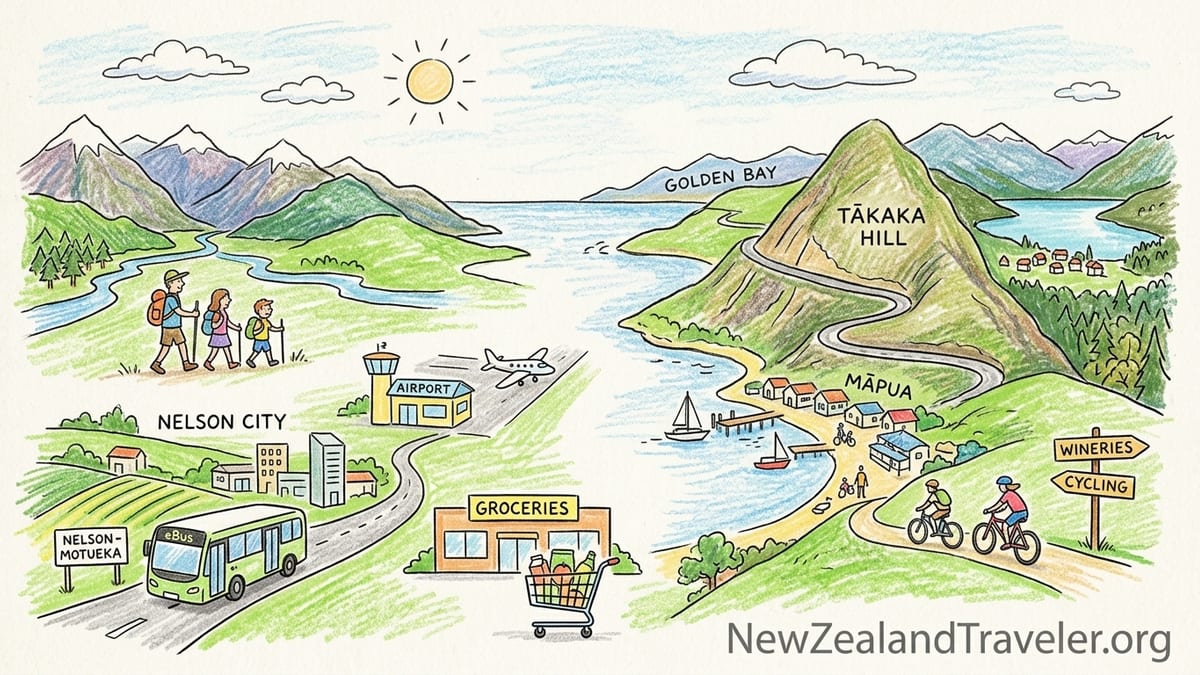
Nelson City: The practical first and last night that saves your trip
For most travelers flying in, Nelson City is the cleanest first and last-night base because it keeps arrival day simple. Nelson Airport sits about 6 km southwest of central Nelson, which means you can land, grab a rental car, and be checking in quickly rather than committing to an hour-plus drive on day one. That short transfer also matters on departure day, when you do not want a long road or a hill pass between you and a flight.
Nelson also “solves” the boring logistics better than anywhere else in the region: supermarket choice, late-afternoon errands, and restaurant variety you can actually walk to. In practical terms, it is the easiest base for a quick grocery reset before heading toward Abel Tasman or Golden Bay, and the easiest place to handle those unglamorous tasks like buying a new rain layer after a forecast turns. If you are the kind of traveler who likes a morning coffee and an evening meal without driving, central Nelson is the most forgiving option.
Parking is the trade-off. Nelson’s inner core feels like a real city, not a resort village, so you will encounter time limits and paid areas depending on exactly where you stay and where you dine. The way it works best is to choose accommodation with an included off-street space, then treat the car like a day-trip tool rather than something you move for every dinner reservation.
As a geographic base for day trips, Nelson is excellent for short hops: Richmond shopping runs, Tahunanui beach time, and winery afternoons close to town. But it is not the smoothest base for multiple Abel Tasman days. If you are doing back-to-back water-taxi mornings, Nelson adds repeated driving before you even reach the coast.
Māpua: A slower waterfront base for wineries and cycling, not the park
Māpua works best when you want your accommodation to feel like part of the holiday rather than merely a launchpad. The village is the kind of place where the evening plan can be: park once, wander the waterfront, and choose dinner based on mood. Compared with Nelson, it leans more “small seaside settlement” than “city,” which makes it an appealing mid-trip decompression stop.
Geographically, Māpua is strongest for the Moutere Hills and winery orbit, plus cycling. If your ideal day is a ride that ends at a cellar door lunch, or a gentle roll between seaside settlements, staying here reduces the friction. It is also well-positioned for the gentle coast-and-estuary scenery that makes the Tasman side of the region feel bright and open.
The limitation is that Māpua does not magically shorten Abel Tasman logistics the way Motueka does. You are still committing to a drive to reach Kaiteriteri or Mārahau for water taxis and track access. If Abel Tasman is the center of your trip, Māpua can feel like an indulgent detour base: lovely, but not the fastest.
Practicalities are generally easy but scaled-down. You will find basics, but if you want a bigger supermarket run or you are cooking for a group, you may find yourself timing a drive toward Richmond or Nelson for a full restock. Māpua is at its best when you plan to eat out or keep meals simple, and use the village as a walkable evening hub.
Motueka: The “sweet spot” base that cuts daily driving into Abel Tasman
If your priority is exploring Abel Tasman National Park without staying inside the small resort nodes, Motueka is the practical sweet spot. It is a real service town with proper groceries, casual eateries, and enough accommodation choice to suit different budgets, but it sits close enough to the Abel Tasman gateways that you stop burning time on repeated commutes.
In day-to-day terms, Motueka is where routines get easy. It is the place you can finish a beach-and-track day, swing by a supermarket, and still have energy left to find dinner without having to drive another half hour just to eat. That matters more than it sounds once you’ve done a long coastal walk, timed a water taxi, and returned salty and tired.
Motueka also works well for travelers without a car, because bus services connect it with Nelson on a regular timetable. Operators like eBus list a Nelson to Motueka route with multiple stops through Richmond and the coastal settlements, which can be a realistic option if you are building a mostly car-free itinerary and only renting a vehicle for select days.
The main trade-off is that Motueka is not a beach-front town in the way Kaiteriteri is. You are still driving to swim, and you are still driving to depart on water taxis. But compared with Nelson, the reduced distance becomes the whole point: you are closer to the action while still sleeping somewhere with supermarkets, parking, and choice.
Kaiteriteri and Mārahau: When being next to the water taxi is worth it
Staying directly in Kaiteriteri or Mārahau is the move when Abel Tasman is not just a day trip, but the focus of your itinerary. These are the places where you can wake up close to the beach, walk to check-in, and be on a boat before the region is properly awake. The payoff is not theoretical: it is the real feeling of removing an extra driving leg from the beginning and end of a day that is already shaped by timetables and daylight.
Water-taxi logistics are the biggest reason to base here. DOC notes that commercial water taxis operate between Marahau or Kaiteriteri and Tōtaranui, and that there is dedicated parking at key road ends, with some operators also offering private parking for clients. If you have ever tried to coordinate parking, check-in, and a departure time from farther away, you will understand why being local helps.
On current published pricing, Abel Tasman AquaTaxi lists Marahau or Kaiteriteri to Anchorage at $59 and around 45 minutes, which is the kind of straightforward, bookable segment many travelers use to turn a long day walk into an out-and-back without having to reverse the entire track on foot. That simple one-way fare becomes the backbone of a relaxed itinerary: taxi north, walk south, finish with dinner near your accommodation instead of a long drive back to Nelson.
The trade-off is food choice and evening energy. Kaiteriteri and Mārahau have options, but you are not in a large town. In peak summer, parking can also become a real factor: Wilsons Abel Tasman’s visitor information advises allowing at least 30 minutes to find a convenient spot in the Kaiteriteri public car park during the busiest period, and notes free overnight parking is available at the trailer park on Martin Farm Road, about a 15-minute walk (around 1 km) from check-in. In other words, staying close cuts driving, but you still have to think about where the car sleeps.
Golden Bay: Why crossing Tākaka Hill is a multi-night decision
Golden Bay is the part of the region that punishes a rushed plan. The road over Tākaka Hill is beautiful, but it is also mentally demanding and time-consuming enough that it rarely feels satisfying as a “quick day trip.” If your itinerary includes Golden Bay highlights, the simplest way to make the geography work is to commit to multiple nights on the far side of the hill.
What you gain is a completely different rhythm: quieter mornings, beaches that feel less scheduled, and access to places that are hard to justify if you have to get back over the hill for dinner. In practical terms, staying in or around Tākaka (or nearby) is what turns Golden Bay from a long drive into an actual chapter of the trip.
Golden Bay also works as a second base for travelers who want to see Abel Tasman from the northern side, because water taxis run to the northern reaches around Tōtaranui. DOC’s Coast Track information points out that water taxis operate into Tōtaranui, and that DOC provides car parks at road ends including Tōtaranui and Wainui. That means you can structure your Abel Tasman time so it is not all funneled through Kaiteriteri and Mārahau.
The trade-off is that Golden Bay is not the place to leave “errands” for last. If you want big-supermarket flexibility, a broad restaurant scene, or quick airport access, you handle those things before you cross the hill. Golden Bay is for being there, not for optimizing connections.
St Arnaud (Nelson Lakes): The alpine base that only makes sense if you use it
St Arnaud is the outlier base in a Nelson Tasman article, but it earns its place if your trip includes Nelson Lakes National Park. It is an alpine village by Lake Rotoiti where the day revolves around lake-edge walks, short hikes, and longer tramping routes. The big advantage is proximity: you are not commuting from Nelson to do a “quick” lake morning.
Facilities are limited but functional. St Arnaud is small, with a village store, petrol, and a cafe-restaurant style offering rather than full supermarket variety. Nelson Lakes Accommodation, based in the village, emphasizes that cafes, a restaurant, and the village general store are within about a five-minute walk, which matches the way the settlement feels: compact, quiet, and walkable once you arrive.
For a traveler, that means you plan differently. You arrive with groceries if you want to self-cater seriously, and you expect a smaller menu universe at night. In return, your mornings become effortless. You can be on the lakeside track quickly, and you can be back at your room without a long drive at the end of a cold-weather day.
St Arnaud is not a substitute for a Nelson or Motueka base. It is a purposeful add-on: a one- or two-night alpine interlude that makes the region feel larger than beaches and bays. If you are already driving between coasts and parks, it can be the most “different” overnight of the itinerary.
The Takeaway
If you want the easiest bookends and the most walkable evenings, Nelson City is the region’s best first and last night. The airport is close, the dining choice is broad, and the errands are painless.
If Abel Tasman is the point of the trip, Motueka usually gives you the best balance: close enough to reduce repeated driving, big enough for supermarkets and casual dinners. Then, if you plan more than one early water-taxi day or you want dawn-to-dusk beach time, it is worth moving again and sleeping in Kaiteriteri or Mārahau to put departures and finishes on foot.
If Golden Bay is on your list, treat Tākaka Hill like a boundary between two trips and book multiple nights over the top. And if you want an alpine counterpoint, St Arnaud is the specialist base that rewards you only if you actually hike and lake-walk from the doorstep.
FAQ
Q1. Which base is best for a first night after flying into Nelson?
Nelson City is usually best because the airport is close to the CBD, so you can check in quickly and handle dinner and groceries without an extra long drive.
Q2. Is Nelson a good base for multiple Abel Tasman days?
It can work, but it adds repeated driving to reach Kaiteriteri or Mārahau. If you have more than one park day, Motueka or staying at Kaiteriteri or Mārahau is usually easier.
Q3. What is the most practical town base for Abel Tasman if I still want supermarkets and lots of dining?
Motueka is the most practical compromise: close to the park gateways while still feeling like a service town with proper grocery options and casual places to eat.
Q4. When is it worth staying in Kaiteriteri instead of Motueka?
It is worth it when you want to walk to water-taxi check-in and spend maximum time on the beach and track, especially for early departures or back-to-back park days.
Q5. When is it worth staying in Mārahau instead of Kaiteriteri?
Choose Mārahau when your plans are centered on the Coast Track southern trailhead, or when you want to minimize morning logistics for walking and water-taxi connections out of Mārahau.
Q6. What is a real-world example of a common Abel Tasman water-taxi segment?
Abel Tasman AquaTaxi lists Marahau or Kaiteriteri to Anchorage at $59 and about 45 minutes, a popular option for turning a long walk into a manageable one-way day.
Q7. Do I need to plan for parking hassles at Kaiteriteri in summer?
Yes. Wilsons Abel Tasman advises allowing at least 30 minutes to find a convenient parking spot in Kaiteriteri during the busiest summer period, so staying nearby can reduce stress.
Q8. Should Golden Bay be a day trip from Nelson or Motueka?
It can be done, but it often feels rushed because the Tākaka Hill crossing consumes time and attention. Golden Bay usually makes more sense as a multi-night base once you cross the hill.
Q9. Can I explore parts of Abel Tasman from the Golden Bay side?
Yes. Water taxis operate into Tōtaranui, and DOC provides car parks at road ends including Tōtaranui and Wainui, so you can plan access from the northern side as well.
Q10. Is St Arnaud a good base if I want beaches and wineries?
No. St Arnaud is best for Nelson Lakes National Park and Lake Rotoiti time. It is an alpine add-on base, not a substitute for Nelson, Motueka, or the coastal villages.