


Nelson Tasman is small enough to taste in a weekend, but varied enough to keep surprising you. Tourism New Zealand frames the region around two main wine-growing areas, the clay-rich Moutere Hills and the alluvial Waimea Plains, with key styles including Pinot Noir, Chardonnay, Sauvignon Blanc, Pinot Gris, Riesling and Gewürztraminer. I planned my route exactly that way: one day in the Moutere Hills for texture and depth, one day on the Waimea Plains for lift and brightness. What follows is a cellar-door-by-cellar-door account of what I ordered, what I tasted, how I got there, and the specific wines and moments that stuck with me long after the last sip.
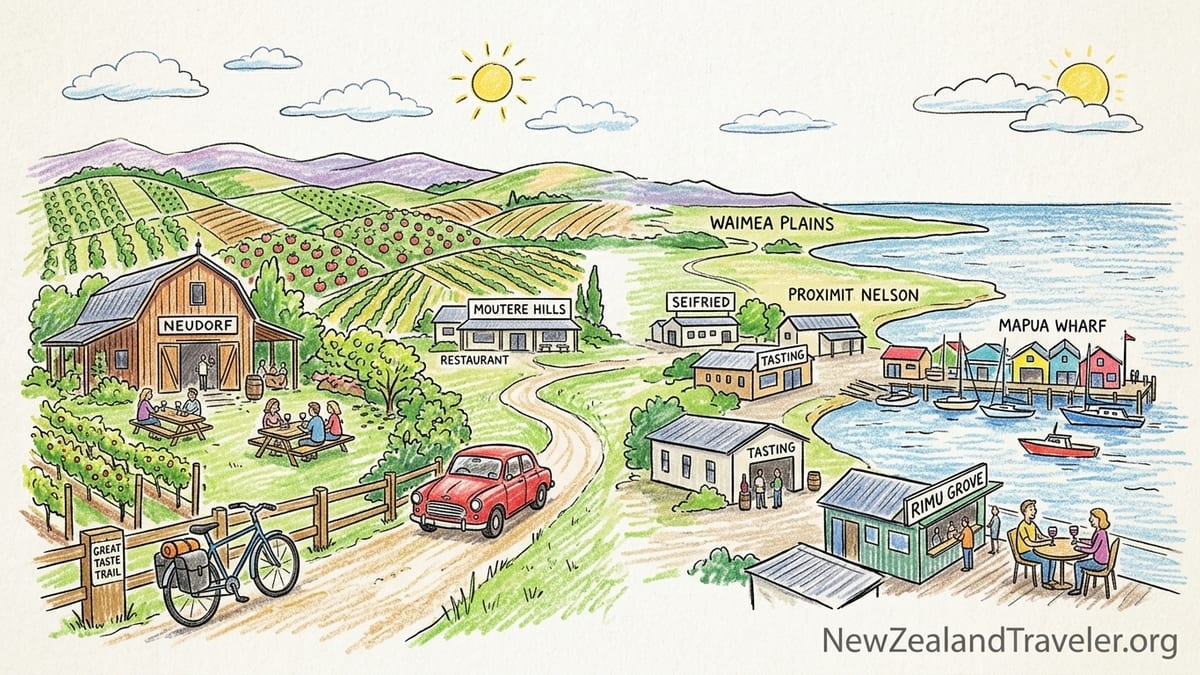
Before You Taste: Two Subregions, Two Moods (And How To Get Around)
I based myself in Nelson and treated the region like two separate day trips. The Moutere Hills feel rural and hushed, a patchwork of hop gardens, apple orchards and vines in rolling valleys. The Waimea Plains sit closer to town on flatter ground, with more “pop in for a flight” ease. Even before you taste, the geography cues you: the Hills are where you slow down and settle in; the Plains are where you can stitch together a few short, practical stops.
For the Moutere Hills day, I drove a rental car from central Nelson, took the main road out toward Upper Moutere, and committed to longer stays at fewer places. For the Waimea Plains day, I kept distances short and paired tastings with a waterfront stop. If you are planning to taste more than a couple of pours, build in food and water, and decide early whether you are driving or booking a tour service. Nelson Tasman also suits cyclists, with Tasman’s Great Taste Trail beginning near Nelson Airport and running past plenty of food-and-drink detours, but I chose a car for timing control and because I wanted to linger without watching a return-ride clock.
The biggest practical surprise was how early wine experiences can quiet down in New Zealand. Many cellar doors keep daytime hours and close mid-afternoon. I booked the experiences that required a set time, and I kept one flexible option each day as a “if we have energy” final stop.
Moutere Hills: Neudorf Vineyards (Upper Moutere) And The Chardonnay That Reset My Benchmarks
I arrived at Neudorf by car from Nelson, pulling into Upper Moutere after an easy, pastoral drive through hop rows and orchards. Neudorf’s “Wine Bar” set-up feels more like a garden hangout than a formal tasting room, and that matters. This is a place that encourages you to taste slowly, let the wind move through the vines, and notice the gap between smelling a wine and understanding it.
I booked the seated “Neudorf Moutere Tasting,” which is priced at NZ$35 per person and is designed around their single-vineyard, organic Moutere wines. The pace was unhurried and structured, the kind of tasting where you are given enough context to recognize what you are tasting instead of just naming it. I stayed a little over two hours total, because I followed the tasting with time in the garden rather than rushing off.
Wines tasted (from the tasting experience and a follow-up glass): I focused on Chardonnay and Pinot Noir first, then moved into aromatic whites. The difference I personally noticed in Neudorf’s Chardonnay versus the region’s brighter, more linear styles was shape and quiet power: the wine felt like it had an extra layer of density through the mid-palate, and the finish lasted long enough that I found myself pausing before taking the next sip. Their Pinot Noir read as red-fruited and composed rather than heavily extracted, with a savory edge that showed up more clearly as the glass warmed. In the aromatic set, the whites felt less about overt perfume and more about clarity and precision, with acidity that made local food taste sharper and fresher.
What I ordered: I added one of Neudorf’s picnic baskets to share in the garden after tasting, because I wanted something explicitly local and non-fussy. The food is meant to be eaten outdoors with a glass in hand, and it did exactly what good wine-country food should do: it didn’t compete, it underlined. The wine that genuinely stood out for me was Chardonnay. It was the bottle I kept mentally comparing everything else to for the rest of the trip, not because it was loud, but because it felt complete.
Moutere Hills: Moutere Hills Vineyard (Sunrise Valley) For A Full Lunch And A Broader Flight
I drove from Neudorf to Moutere Hills Vineyard for lunch, treating it as the “sit down, reset, and taste broadly” stop of my Moutere day. The setting changes immediately: you are in a vineyard-and-restaurant environment with views over vines and neighboring hops, and the experience becomes as much about the table as it is about the tasting bench.
I timed it so I could eat first and taste with food in my system, then do a short tasting. I stayed about two and a half hours. The cellar door operates alongside the restaurant, and the wine list is wide, including varieties you do not always see poured casually, such as Chenin Blanc and Viognier alongside the staples like Chardonnay, Pinot Noir, Sauvignon Blanc, Riesling and Gewürztraminer.
What I ordered: I ordered a platter-style lunch because I wanted something that could stretch while I tasted. The menu changes, but the style is consistent: local ingredients, vineyard pacing, and enough salt and texture to keep you honest about acidity in the glass. I treated the meal like an extended tasting tool rather than a separate event.
Wines tasted: I chose four wines to taste and made sure the set included Chardonnay, Pinot Noir, Sauvignon Blanc and one aromatic. The personal differences were clear in a side-by-side context. The Sauvignon Blanc on the Moutere Hills day came across less like a punch of green and more like a ripe, rounded expression, with a softer feel on the palate than the very brisk, citrus-driven versions I associate with gravelly, free-draining sites. Chardonnay again read as the region’s natural strength here, showing breadth and a creamy texture without feeling heavy. Pinot Noir leaned darker and more structured than the version I had just tasted at Neudorf, with a firmer frame that made me want protein rather than just cheese. For the aromatic white, I leaned toward Riesling or Gewürztraminer depending on what was available for tasting; either way, the point was to notice how the wine behaved next to food. Aromatics here felt like they carried scent first, then snapped back with acidity, making them surprisingly useful with salty bites and pickles.
Moutere Hills: How The Hills Changed My Palate (Chardonnay, Pinot Noir, Sauvignon Blanc, Aromatics)
By late afternoon in the Moutere Hills, I had a distinct sensory pattern. The day tasted more textural than zippy. Chardonnay kept presenting itself as layered rather than simply fruity, with a mid-palate that felt like it had been gently padded out. Pinot Noir consistently showed a savory streak, a reminder that Nelson Tasman can be quiet and serious, not just sunny and fruity.
Sauvignon Blanc in the Hills was the biggest surprise. I arrived expecting only the classic New Zealand punch, but my glasses leaned riper and softer, with less aggressive bite and more of a mouth-filling shape. If you are used to Sauvignon Blanc that tastes like cold lime and cut grass, tasting it after a Moutere Chardonnay can make you realize how much structure can vary even inside a familiar grape.
Aromatic varieties were the day’s “slow burn.” Pinot Gris, Riesling and Gewürztraminer were less about a single obvious note and more about how the aroma met the palate. I noticed that aromatics here could smell generous but still finish clean, a useful trick when you want a wine that feels expressive but doesn’t wear you out over a long lunch. If you have limited tasting slots, I would still prioritize Chardonnay and Pinot Noir in the Hills, then add one aromatic to see how the region handles perfume and acidity.
Waimea Plains: Rimu Grove On Mapua Wharf For Seaside Sips And A Different Kind Of Cellar Door
The next day, I aimed for the Waimea Plains and a lighter, more coastal-feeling itinerary. I drove from Nelson toward Mapua and parked near the wharf. Rimu Grove’s cellar door is located right on Mapua Wharf with views over the Waimea Inlet out to Tasman Bay, which makes it a very different sensory experience from a vineyard driveway. You can smell the water, you can hear the wharf activity, and the tasting feels social rather than secluded.
I arrived around early afternoon and stayed about 70 minutes. This was intentionally a shorter stop: a flight, a quick decision on a favorite pour, and then a walk to shake it out. Rimu Grove’s hours are generous, opening daily from noon until 6 p.m., which also makes it a practical choice if you start late or want a last tasting without sprinting.
Wines tasted: Because I had already saturated my palate with Moutere Hills Chardonnay, I pushed myself toward the styles that suit the Plains mood: Sauvignon Blanc, Pinot Gris and a Riesling if available. Here, Sauvignon Blanc tasted brighter and more brisk to me, with a cleaner cut that matched the sea air and the “in motion” feeling of the wharf. Pinot Gris came across as an easy bridge wine, more about pear-like softness and gentle spice than sharp angles, and it felt like the kind of bottle you could happily open with fish and chips without overthinking it.
The wine that genuinely stood out at this stop was the one that best matched the setting: a fresh, aromatic white that made me immediately want something salty and hot to eat. It was the kind of moment that reminds you travel wine tasting is not just about ranking wines, it is about noticing which ones click with a place.
Waimea Plains: Seifried Estate (Researched, Not Visited) And What I’d Do Differently Next Time
Not every winery I researched fit the exact trip timing, and I want to be clear about what I did not personally visit. Seifried Estate was high on my list because it is one of the best-known cellar-door stops in Nelson Tasman, and the estate positions its cellar door experience around guided tastings that can include current releases and cellar selections. I ultimately didn’t visit on this itinerary because I prioritized fewer stops with longer stays, and I anchored my Plains day around Mapua’s wharf setting.
If I were to rebuild the Waimea Plains day for a future trip, I would start earlier and include Seifried as the first structured tasting, then use Mapua Wharf as the late-afternoon, casual decompression stop. That order makes practical sense: you do the more focused, talk-through tasting while your palate is fresh, and you finish somewhere scenic where you can choose one glass and watch the light change.
What I would be looking to taste at Seifried, based on their range and the region’s strengths, would be a Plains-leaning Sauvignon Blanc for brightness, then Chardonnay to compare directly with the Hills’ richer expressions, then one aromatic like Riesling or Gewürztraminer to see how perfume and acidity show in a flatter, free-draining setting. Without a personal visit, I won’t pretend a particular bottle “stood out,” but it remains one of the first places I would add back in for readers who want a classic Nelson Tasman cellar-door lineup.
The Takeaway
If you only remember one planning idea, make it this: treat Nelson Tasman as two different wine days. In the Moutere Hills, book a seated tasting and give yourself time for Chardonnay and Pinot Noir to unfold. Neudorf is the stop that lingered for me because it made Chardonnay feel like a destination rather than a default, and because the garden pacing let the wines settle into memory instead of disappearing in a rush.
On the Waimea Plains, lean into freshness and aromatics, and don’t underestimate how much setting influences what you crave. Rimu Grove on Mapua Wharf was memorable because it was the opposite of a hushed tasting room: it was open-air, sea-edged, and built for a simple, satisfying flight followed by a walk. Balance those two moods and you will understand the region more quickly than by trying to tick off every cellar door in a single day.
Finally, be honest about what you like. Sauvignon Blanc can be bright and bracing or softer and rounder depending on site and style. Chardonnay in this region can carry real depth without turning heavy. Pinot Noir can be savory and structured even in a sunny place. Aromatic varieties can smell generous but finish clean, making them some of the most food-friendly pours you will taste all weekend. Give yourself the time, the food, and the quiet to notice those differences.
FAQ
Q1. What are the two main wine-growing areas in Nelson Tasman?
They are the Moutere Hills and the Waimea Plains, which offer different landscapes and soil profiles and help explain the region’s range of wine styles.
Q2. Which grape varieties should I prioritize in Nelson Tasman?
Pinot Noir, Chardonnay and Sauvignon Blanc are key, and the aromatic whites are important too, especially Pinot Gris, Riesling and Gewürztraminer.
Q3. How long should I allow for Neudorf Vineyards if I book a tasting?
If you do a seated tasting and then spend time in the garden, plan for roughly two hours so you are not rushing through the experience.
Q4. What does Neudorf’s seated tasting cost?
The Neudorf Moutere Tasting is listed at NZ$35 per person, and it is positioned as a seated tasting focused on their single-vineyard, organic Moutere wines.
Q5. Is Neudorf dog-friendly?
Yes. Neudorf welcomes dogs, provided they are comfortable around other dogs, kids and adults.
Q6. What are Rimu Grove’s cellar door hours at Mapua Wharf?
Rimu Grove lists its cellar door as open daily from noon until 6 p.m., which makes it a useful stop if your day starts late.
Q7. What is the simplest way to get between cellar doors in Nelson Tasman?
Driving is the simplest for most visitors, especially if you want to split the region into a Moutere Hills day and a Waimea Plains day and control your timing.
Q8. Can I cycle between wineries in Nelson Tasman?
Yes. Tasman’s Great Taste Trail starts near Nelson Airport and is designed for scenic riding with stops for food and drink, but you will still want to plan carefully around tasting limits and closing times.
Q9. Why do Chardonnay and Pinot Noir often feel stronger in the Moutere Hills?
The Hills are known for clay-rich soils and a slightly different microclimate feel than the Plains, and many tasters notice more richness and texture in wines from those sites.
Q10. Which wineries in this article were researched but not personally visited?
Seifried Estate is included as researched but not visited. The other cellar doors described in first-person detail are presented as visited stops.