


I came to Tasman’s Great Taste Trail for a coastal ride and a few winery tastings, and left convinced it’s one of New Zealand’s most satisfying ways to move through a landscape. It’s not just that the trail is mostly gentle, mostly off-road, and stitched together by beaches, estuaries, orchards, and tidy villages. It’s how easy it is to turn a ride into a day of small, very real pleasures: a ferry crossing that feels like a cheat code, a wharf lunch that lands exactly when your legs are ready to stop, and a late-afternoon final push where an e-bike becomes the difference between arriving fresh and arriving fried.
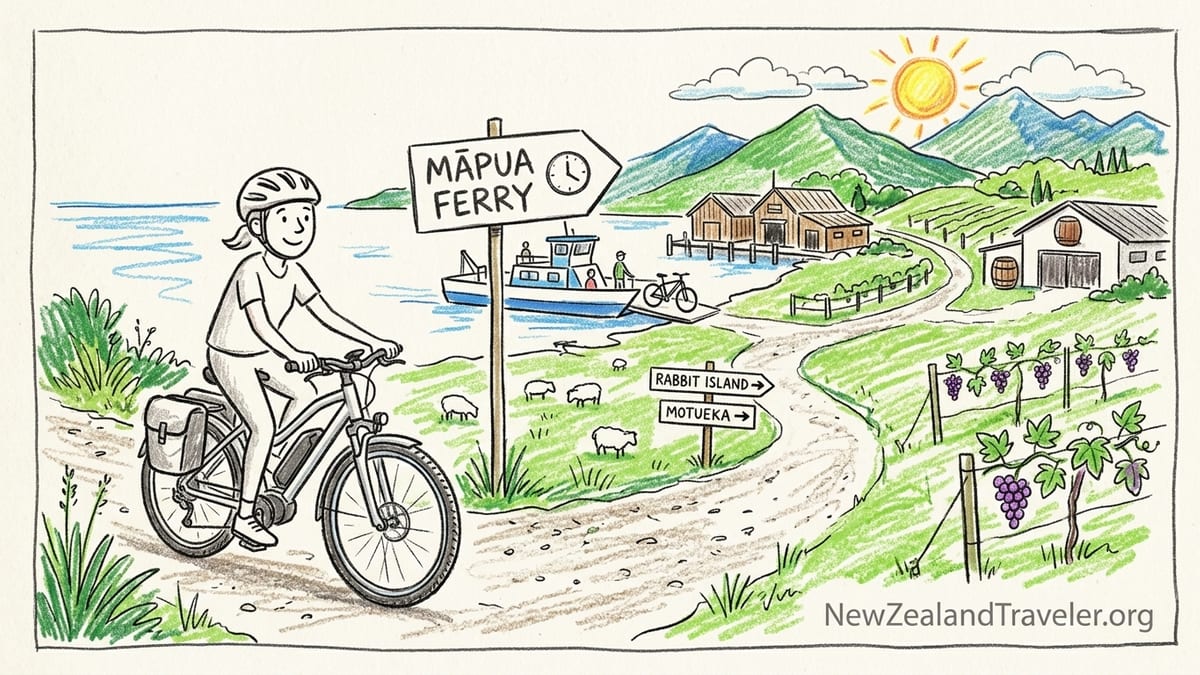
Planning Reality Check: What’s Open, What’s Seasonal, What’s Not Guaranteed
The Great Taste Trail is marketed as a 1–4 day ride of around 200 km, Grade 1–3, mostly off-road, connecting Nelson, Richmond, Māpua, Motueka, Riwaka, and Kaiteriteri. That description is broadly right, but the day-to-day truth is that your experience hinges on three things: what sections are open, whether you need to bridge a gap with transport, and whether the Māpua Ferry is operating when you arrive.
Before I even booked a bike, I checked the official Heart of Biking trail update because parts of this trail do periodically close. As of an update dated 18 September 2026, Heart of Biking reported that about 90% of the trail is open, with Quail Valley Road closed from September 15. That single note matters if you’re trying to stitch together longer inland segments, or if you planned a particular loop day and suddenly need a detour or a shuttle.
The other non-negotiable check is the Māpua Ferry season. It’s not a year-round assumption. The operator’s published timetable page shows daily operation for a summer season and limited operation in winter on weekends, school, and public holidays, with a seasonal changeover around late September. That aligns with how the region usually works: shoulder-season spring rides can be brilliant, but you have to match your day to the ferry’s hours, not your own.
Bike Hire That Felt Like Travel Logistics, Not a Guessing Game
I rented through Kiwi Journeys because they are closely integrated with Great Taste Trail logistics and they operate around Nelson, Māpua Wharf, and Kaiteriteri. I wanted a setup that was explicitly trail-ready and included the basics that matter on a food-and-wine ride: helmet, panniers, and something that could handle mixed surfaces without feeling twitchy.
The bike I hired was a hardtail trail e-bike, step-through frame. On Kiwi Journeys’ published hire list, their hardtail trail e-bikes are Bosch-powered and priced at $135 for a full day, with a multi-day rate listed at $125. I chose the step-through because I was planning frequent dismounts for tastings, photos, and ferry loading, and because a relaxed upright posture helps you keep the day enjoyable rather than athletic.
On pickup, the details I cared about were simple: helmet fit that didn’t pinch, brakes that bit cleanly, and panniers that could swallow a jacket and a water bottle without forcing me into a backpack. Kiwi Journeys’ multi-day tours list their standard equipment bundle as including helmet, panniers, repair kit, odometer, and trail documentation. That’s the kind of package thinking that makes a multi-day ride feel doable for travelers rather than only for cyclists.
If you want an even more casual setup and you’re starting closer to Richmond, Trail Bikes Richmond advertises hire with helmets and locks included and lists e-bike models like the Avanti Discovery-E Low. I didn’t use them for this ride, but it’s useful context: there are multiple hire options, and you can choose based on where you want to start and finish.
Day 1: Nelson Toward The Coast, Settling Into The Trail Rhythm
I started in Nelson aiming for a coastal-first ride that would let me ease into the trail before stacking in the longer distances. The first hour was about rhythm: finding a comfortable assist level, getting used to the e-bike’s weight when stopping, and learning the difference between “flat” on a map and “flat” on a windy coastline. Coastal sections on this trail are generally Grade 1–2 and largely flat, which means your legs aren’t the limiter. The wind and the number of tempting stops are.
Surface-wise, this portion felt like what you’d hope for from a Great Ride: predominantly smooth and confidence-building, with short sections where you pay attention for grit, damp patches, or tighter corners near shared-use areas. I kept the pedal assist low early on and saved battery for later, because the real value of an e-bike on this trail is not brute speed. It’s smoothing out the moments that would otherwise spike your effort and your sweat, especially if you’re mixing exercise with tasting rooms.
One practical note that surprised me: the day doesn’t feel “long” until you actually commit to doing it properly. Every stop adds time. That’s not a complaint, it’s the point. It’s also why I treated this as a true ride day rather than a “quick spin.” Heart of Biking’s own approximate times are a good gut-check: their Sparkling Coastline segment (Richmond to Kaiteriteri Beach) is listed at 64 km and 4–6 hours excluding stops. If you stop for lunch, a ferry, a tasting, and a swim, you can turn “a ride” into a full-day experience without trying.
The Māpua Ferry: Timings, Prices, And Why It Changes Your Whole Day
The Māpua Ferry is the trail’s most charming piece of infrastructure, and also the one you should plan around most carefully. The operator’s published timetable lists departures on the hour from Māpua and ten past the hour from Rabbit Island. In the summer timetable shown on the operator page, departures run from 10:00 am through 5:00 pm. In the winter timetable shown there, it operates weekends, school, and public holidays only, with departures from 10:00 am through 4:00 pm. The key takeaway is simple: the ferry is not “whenever you arrive.” It’s a schedule you match.
I treated the ferry as a hard appointment. I aimed to roll in with a buffer, because arriving two minutes late isn’t a small inconvenience. It’s an hour of waiting while your legs cool down and your appetite ramps up. The actual crossing is short, but the psychological effect is huge: one minute you’re in quiet Rabbit Island mode, the next you’re at Māpua Wharf surrounded by cafés, galleries, and the kind of waterfront energy that makes you want to sit down immediately.
On cost, the ferry operator’s published prices list $15 adult one-way and $18 adult return, with EFTPOS available on board. That’s refreshingly straightforward for a link that feels essential to the trail experience. I paid on the spot and wheeled the bike on without drama, but I kept my speed low and my hands ready because loading an e-bike is different than a light commuter bike. The motor weight is real, and the panniers make the bike feel wider in tight spaces.
If you’re riding early or late in the shoulder season, the ferry is also the first thing I would verify the day before. The operator’s timetable page shows date ranges for seasons, and those dates change year to year. It’s exactly the kind of detail that can turn a coastal ride into an awkward reroute if you assume it’s always on.
Māpua To Motueka: The “Tasty” Middle Miles Where Stops Multiply
After Māpua Wharf, the ride becomes a choose-your-own-adventure of coastal scenery and food stops. This is where the Great Taste Trail earns its name, but it’s also where discipline disappears. Every time you think you’re back “just riding,” you pass something that looks like a worthwhile detour or a well-timed espresso. I leaned into it, because this is not a ride that rewards austerity.
In Māpua itself, the ferry operator highlights how the crossing links Rabbit Island with the wharf’s cluster of eateries and attractions, including Golden Bear Brewing and Rimu Wine Bar. I used Māpua as my first major meal stop, the kind of lunch that’s motivated by both hunger and strategy. Eating properly here meant I could ride onward without the late-afternoon crash that turns a pleasant trail into a slog.
On the bike, this section is where the e-bike helped in a quieter way. The trail may be gentle, but you still get little ramps, short pinches, and moments where you’re accelerating out of corners or restarting after a stop. On a standard bike, those repeated starts add up, especially if you’re carrying water, a jacket, and whatever you picked up along the way. With pedal assist, I could keep my effort steady and arrive at stops feeling like I wanted to explore rather than collapse.
Fatigue here wasn’t a single big wall. It was a gradual heaviness that arrived in layers: first in my neck from looking around, then in my hands from braking and steering, then in my legs from the cumulative time in the saddle. I adjusted assist level to keep my breathing calm, because on a day that includes tastings, the goal is to stay sharp and steady, not to ride on the edge.
Motueka To Kaiteriteri: Where The E-Bike Pays For Itself
The closer you get to Kaiteriteri, the more the day starts to feel like a proper journey rather than a scenic outing. It’s not just distance. It’s the fact you’ve already been stopping, tasting, and restarting all day, and you begin to notice how your body responds differently to each small rise. This is the portion where I was happiest not to be on a fully loaded acoustic bike.
There’s a reason the official trail description calls out a Grade 3 feel in some places, with a few steeper pinches and tighter corners. Even when the climbs are short, a headwind and a heavy bike can make them feel longer than they look on paper. This is where I bumped the pedal assist up and stopped worrying about being “tough.” The e-bike materially helped not by making the ride effortless, but by making the ride consistent, which matters when you’ve got a late-day arrival in mind.
If you’re coordinating with transport connections, this is also where real-world travel times matter. Abel Tasman operator information notes that Nelson to Kaiteriteri can take about 1 hour 15 minutes by road in clear conditions, and Motueka to Kaiteriteri about 25 minutes. Those figures are car or shuttle context, not cycling time, but they’re useful for understanding spacing: Motueka is genuinely close to the beach gateway, and you can plan your lodging with that in mind.
By the time I rolled into Kaiteriteri, my fatigue was the satisfying kind: a full-body sense that I’d actually traveled. My legs felt heavy when I dismounted, and I could tell I’d be happy not to climb anything else that day. But I wasn’t wrecked. That’s the e-bike dividend. You finish with enough left to enjoy the place you’ve arrived in, rather than treating it as a finish line and nothing more.
Shuttles And Backup Plans: What I’d Do Differently If Weather Or Closures Shift
Even if you intend to ride every kilometer, the Great Taste Trail is a place where having a backup plan is smart, not defeatist. Closures happen, detours appear, and wind can change the character of a “flat” day. In late September 2026, Heart of Biking’s trail update explicitly flagged Quail Valley Road as closed from September 15, and that sort of notice is exactly why I check official updates before committing to a specific inland segment.
For shuttle options, one of the most useful current realities is that Better Bus, a shared-operator transfer service connecting Nelson, Motueka, Kaiteriteri, and Mārahau, is seasonal. Their booking page states the scheduled Better Bus is finished for the season and operates again from October 1, 2026, while private transfers remain available. Their rates page lists 2026/27 season one-way fares including Nelson to Kaiteriteri or Mārahau at $42.50, Nelson to Motueka at $22.50, and Motueka to Kaiteriteri or Mārahau at $22.50.
There’s also a genuinely budget-friendly local option for weekend riding: Tasman District Council’s eBus page notes the Motueka Coastal Bus runs Saturdays and Sundays and can carry bikes for free with fare-paying passengers, with fares listed at $6 each way. The same page includes a concrete Saturday departure from Motueka i-SITE at 9:30 am returning at 3:00 pm, and Sunday departure at 1:00 pm returning at 6:00 pm. Those are real times you can build a day around if you’re doing a shorter out-and-back or a one-way ride with a bus return.
The key is not to overcomplicate it. I planned my ride so that if weather turned ugly, or if a closure forced me to skip a section, I could switch to a transport-assisted plan without losing the whole day. That meant carrying a little extra battery margin, keeping my arrival times conservative, and paying attention to the dates when services switch from winter to summer operations.
The Takeaway
Tasman’s Great Taste Trail is not a ride that rewards rushing. It rewards being concrete. When you plan around the ferry timetable, acknowledge seasonal transport realities, and hire a bike that matches how you want to feel at the end of the day, the trail becomes a string of small wins: a smooth gravel stretch along an estuary, a wharf lunch that tastes better because you earned it, and the simple pleasure of arriving at Kaiteriteri with enough energy left to enjoy the coast.
If I had to summarize what makes this trail special, it’s that it doesn’t ask you to choose between “exercise trip” and “food trip.” You can do both, honestly, in the same day. And if you pick an e-bike, you can do it with a steadier effort level, less sweat, and more time feeling present rather than depleted.
The single best piece of advice I can give is to treat schedules as part of the landscape. Check trail notices. Check the seasonal start dates for buses. Check the Māpua Ferry hours. Once you do that, the Great Taste Trail becomes exactly what it promises: a coastal ride where the logistics are manageable and the rewards keep showing up right on cue.
FAQ
Q1. Is the Māpua Ferry operating year-round?
Not as a year-round daily service. The published timetable shows a summer season with daily sailings and a winter period with weekend, school-holiday, and public-holiday operation, with the seasonal changeover around late September.
Q2. What does the Māpua Ferry cost for adults?
The published prices list $15 adult one-way and $18 adult return, with EFTPOS available on the ferry.
Q3. How often does the Māpua Ferry run during the day?
The published timetable shows departures on the hour from Māpua and at ten past the hour from Rabbit Island during operating hours.
Q4. Are there current trail closures I should check before riding?
Yes. Official updates can flag partial closures. For example, a Heart of Biking update dated 18 September 2026 noted that about 90% of the trail was open and flagged Quail Valley Road as closed from September 15.
Q5. When does the seasonal Better Bus service resume in 2026?
The Better Bus booking page states the scheduled service operates again from October 1, 2026, and notes private transfers are still available outside the scheduled season.
Q6. What are Better Bus one-way fares for the 2026/27 season?
The rates page lists Nelson to Kaiteriteri or Mārahau at $42.50 one-way per person, Nelson to Motueka at $22.50, and Motueka to Kaiteriteri or Mārahau at $22.50.
Q7. Is there a low-cost weekend bus option that carries bikes?
Yes. Tasman District Council’s eBus information says the Motueka Coastal Bus runs on Saturdays and Sundays, costs $6 each way, and can carry bikes for free with fare-paying passengers.
Q8. What are the Motueka Coastal Bus weekend departure times?
The eBus page lists a Saturday departure from Motueka i-SITE at 9:30 am returning at 3:00 pm, and a Sunday departure at 1:00 pm returning at 6:00 pm.
Q9. What’s a realistic ride-time expectation for the coastal section?
Heart of Biking lists the Sparkling Coastline segment (Richmond to Kaiteriteri Beach) as 64 km with an approximate riding time of 4–6 hours excluding stops, which can expand significantly with meals and tastings.
Q10. What’s a concrete e-bike hire price example in Nelson for Great Taste Trail riding?
Kiwi Journeys’ published hire list shows hardtail trail e-bikes at $135 for a full day, with a multi-day rate listed at $125, which is a useful benchmark when comparing operators.