


Sea kayaking Abel Tasman is one of those rare travel experiences that feels exactly like the brochure, and also nothing like it. The photos get the color right: water that flips between jade and clear bottle-glass, pale sand so bright it looks dusted with flour, and bush that leans right down to the tide line. What the photos miss is the physicality: the salt crust that forms at the corners of your mouth, the steady heat that builds under a spray jacket even on a cool morning, the way your shoulders start to argue with you after an hour of paddling, and the awkward little ballet of landing a kayak without filling your shoes with seawater.
Before You Paddle: Check-in, the Safety Briefing, and Why It Matters Here
Most guided kayak days at the southern gateway start with a morning meet-up in Mārahau, the small settlement that functions as Abel Tasman National Park’s most common launch point for kayaks and Coast Track day-walkers. In practice, “meeting up” is part logistics, part reality check. Guides use the first 15 to 30 minutes to confirm who can swim, who has sea kayaking experience, who has back or shoulder issues, and who is quietly nervous. In Abel Tasman, conditions are often sheltered, but it is still open coast, and the tone of the briefing is clear: you are responsible for listening, staying with the group, and not freelancing around headlands.
A proper briefing here is not just a formality. It is the place where you learn the things that change your whole day: how to carry the kayak without torquing your back, how to sit so your hips are centered and your legs are comfortably braced, how to use a simple forward stroke that saves your shoulders, and what to do if wind funnels through the Astrolabe area and turns a calm paddle into a “work” paddle. Operators also cover what to do if a water taxi wake rolls through, how to raft up if the group regathers, and the non-negotiables around staying in the guide’s line of sight.
DOC’s own visitor information is blunt about the experience gap: for people who have not kayaked before, a guided trip is recommended, and independent kayak rentals require at least two people and previous sea-kayaking experience. DOC also notes that if the weather is too rough to safely kayak to your intended destination, you should stop and wait for sea conditions to improve, and it specifically flags that kayaking is not recommended north of Onetahuti Bay due to the remote and exposed coastline. That combination is why the best briefing feels practical, not preachy: you leave knowing how quickly a day can change, even in a national park famous for “easy” paddling.
Gear That Actually Gets Used: Double Kayaks, Spray Skirts, Dry Bags, and What You Feel All Day
On most guided trips in Abel Tasman, the default boat is the stable double (tandem) sea kayak. Wilsons Abel Tasman explicitly describes using stable double kayaks for its guided sea kayaking day trips and provides all the main gear, including buoyancy vests, spray jackets, and dry bags. That “stable double” detail is not marketing fluff. In real paddling terms, it means a wide, forgiving hull that tracks calmly even when a boat wake hits you side-on, and enough volume that first-timers can settle their balance without the twitchiness of narrower performance boats.
If you are paddling solo, it varies by operator and day. Some operators will place solo paddlers into a double with another guest, while others may have single kayaks available depending on the trip and conditions. Either way, your body notices the difference immediately. A tandem spreads the workload, but it also requires rhythm. If the front paddler is splashing or the back paddler is overreaching, the kayak yaws side to side and you spend energy correcting rather than cruising. When a tandem team clicks, it feels like the kayak is on rails and your paddle blades are only dipping in as deep as needed, with a quiet “ka-thunk” as water releases off the blade.
Spray skirts and spray jackets are the two items people misunderstand before they arrive. Many Abel Tasman guided day trips emphasize comfort and stability, so you may not always be fully skirted-in like a cold-water expedition, but you will almost always have some kind of spray protection. The sensory reality is that even in mild conditions, your lower half stays damp. You feel it first at your shins and the backs of your knees, then as a cool patch at the base of your spine. Add sun, and the dampness becomes a temperature regulator. Without it, you are roasting inside a jacket; with it, you are comfortable until the wind picks up and evaporative cooling makes you suddenly grateful for an extra layer.
Dry bags matter here in a very unglamorous way: sandy landings and surprise splashes are the norm, not the exception. A good guide will tell you to pack as if you will flip the kayak, even if the day looks flat. Phone, car key, and an insulating layer belong in a properly rolled dry bag. Even on a calm day, you end up with salt spray on your sunglasses and tiny grains of sand on your knuckles from grabbing the kayak at the waterline. Keeping your essentials dry is what makes the beach stops relaxing instead of anxious.
What a September 2026 Kayak-and-Walk Day Really Looks Like (And How Much You Paddle)
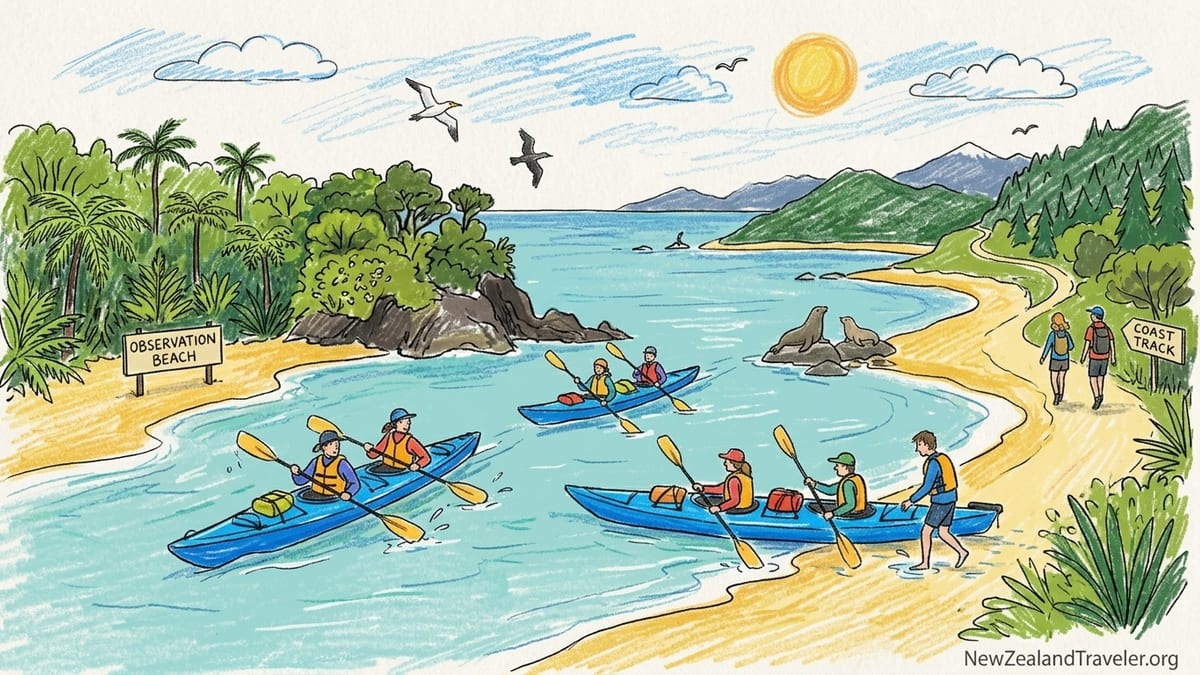
If you want one current, concrete example that matches how people actually day-trip Abel Tasman, Abel Tasman Kayaks is advertising a one-day “Kayak & Walk” with a September 2026 special price of NZ$230 per person. The tour description is specific about the flow: a guided kayak journey from Mārahau to Observation Beach, then lunch at Observation Beach, with the note that the trip may run in reverse and that the kayak section is guided while the walk is unguided.
In practice, a kayak-and-walk day lives or dies on pacing. The paddling portion feels longer than you expect if you have not paddled on saltwater before. Even when the water is relatively flat, you are doing thousands of repetitions. The first 20 minutes are all setup: finding your seat position, learning the cadence, reminding yourself to relax your grip so you do not death-clench the paddle. Then you settle into the “middle hour” where the coast slides by: golden sand pockets between headlands, darker rock shelves, and that signature Abel Tasman contrast where the bush canopy looks almost black-green against bright water.
By about the 60 to 90 minute mark, you start feeling it in specific places: the back of your shoulders (rear deltoids) when you pull too hard, the front of your shoulders if you are reaching high and wide, and the small stabilizers around your shoulder blades if you are keeping your torso rotation clean. The easiest way to describe the fatigue is that your arms do not fail dramatically. They just gradually feel “full,” like you have been carrying groceries for too long. Guides who are attentive will notice sloppy strokes, then call for a short raft-up to reset technique and hydrate.
Time on water versus time on beaches is where expectations often need correcting. A “day trip” sounds like long beach lounging, but the active part is real. With a kayak-and-walk format, you might spend a solid half of the daylight hours moving, then the rest split between a proper lunch break and the return leg on foot (or vice versa). The beach time is not a single endless sit; it is a series of short, sensory stops: a quick stretch on warm sand that squeaks underfoot, a drink of water that tastes faintly plastic-warm from a bottle, then back into the cockpit with wet ankles and a little sand stuck to your heel strap.
Sea Conditions, Weather, and the Small Things That Change Your Day
Abel Tasman’s reputation for friendly conditions is earned, but it is not a guarantee. DOC’s official trip planning guidance includes an explicit warning that you should never risk your life by kayaking in dangerous seas, and that if it becomes too rough to safely reach your intended destination, you should stop and wait. That advice reads dramatic until you are on the water and a breeze turns into a steady headwind. What was a quiet glide becomes a slow grind, and suddenly you are aware of how much “surface area” your body and kayak present to the wind.
September is shoulder season. DOC’s published climate information for Tōtaranui lists September averages around 15°C maximum and 7°C minimum, with roughly a dozen rainy days in the month. That means you can have a day that starts cool enough for a beanie at check-in, then turns into bright sun where you are sweating inside a spray jacket, then flips again when cloud moves in and the wind makes your wet sleeves feel cold. The “sensory truth” is constant micro-adjustments: unzip, rezip, swap hat for sunglasses, apply sunscreen again because salt water and towel-drying erase it.
Sea state in the southern park often shows up as short wind chop and boat wake rather than big swell. The wake from water taxis can lift the kayak gently or slap it with a sharper side wave depending on angle. The first time you feel that lift, you tense. The second time, you realize the kayak is built for it, and you focus on keeping the paddle low and your hips loose. A good guide will time group crossings so you do not get strung out when wakes pass, and will coach bracing in plain language: “Loose knees, paddle flat, keep your shoulders down.”
Landings, Beach Time, and the Moment You Realize Paddling Is Not the Hard Part
Landing a sea kayak in Abel Tasman is usually straightforward, but it is not always elegant. The “easy landing” is a gentle, sandy beach where you can glide in on a small wave, step out ankle-deep, and lift the bow before the next ripple swings the kayak sideways. The “awkward landing” is when a small shore break keeps pushing the kayak back at you, or when there are shallow rocks that force you to hop out earlier and drag the boat in while trying not to scratch it or twist your knee. Even in calm weather, that last 10 meters is where most people get soaked.
Observation Beach is specifically named in the current Abel Tasman Kayaks kayak-and-walk day, and it is the kind of stop that resets your entire body. You feel the difference immediately: the solid ground under your feet, the warmth of sand through thin soles, the way your hips uncoil after sitting in one position. Lunch tastes better than it has any right to, partly because of effort, partly because you are eating with salt still drying on your lips. This is also where guides quietly evaluate the group. Who looks comfortable? Who looks drained? Who is drinking enough?
The beach time is also where people discover that the “hard part” is not always paddling. It is transitions. Getting in and out repeatedly can be more tiring than steady paddling because you are lifting, bracing, squatting, and balancing on uneven sand with tired legs. If you are doing a kayak-and-walk combination where the walking is unguided (as Abel Tasman Kayaks notes for its format), you want enough energy left to walk with stable ankles and good footing, not the wobbly-legged gait that comes from sitting and paddling hard without stretching.
Wildlife Encounters: Seals, Birds, and What You Should and Shouldn’t Expect
Most operators sell Abel Tasman kayaking with some version of the same promise: scenic coast, clear water, and a decent chance of wildlife. Abel Tasman Kayaks’ current “Kayak & Walk” description explicitly mentions opportunities to spot “a seal or two,” and it specifically references NZ fur seals (kekeno). That is realistic, but the experience is not scripted. You might see seals hauled out on rocks, or you might only notice a quick head popping up, a dark, wet profile that disappears before you can point it out.
When seals do show, the sensory details are small and specific: the oily sheen on wet fur, the sudden splash when one torpedoes off a rock into the water, and the way they sometimes surface closer than you expect, curious rather than afraid. The guide’s job here is to keep the group calm and respectful, and to avoid the common mistake of paddlers speeding up to “get closer,” which can separate the group and create collisions. If you are lucky, you see the classic Abel Tasman moment: a seal head surfacing, whiskers visible, eyes tracking you for a beat, then a smooth dive that leaves only expanding rings in glassy water.
Birdlife is often the more reliable backdrop. Even on days when the marine mammals are elusive, you are typically paddling with seabirds moving along the same edges of the coast. Some of the most satisfying moments are quiet: drifting for 30 seconds with your paddle across your lap, listening to water tap the hull, and hearing birds from the bush behind the beach. It is not a zoo experience. It is a coastal day where you are a visitor passing through.
What to Book in 2026: Half-Day vs Full-Day vs Overnight (After Doing It, Here’s What Makes Sense)
After you have actually spent time in a sea kayak here, the biggest surprise is how quickly a half-day disappears. By the time you’ve done the briefing, adjusted gear, launched, found a rhythm, and had even one proper stop, it can feel like you are turning around just as your body starts to understand the motion. Half-day guided options can be perfect for families, travelers arriving the same day, or anyone unsure about shoulder endurance, but if you want the coastline to feel like a journey rather than a sample, a full day makes more sense.
That is why the kayak-and-walk format is such a strong middle ground. The September 2026 NZ$230 guided kayak-and-walk day from Abel Tasman Kayaks is a clear example of a product designed for people who want both viewpoints without committing to an overnight logistics puzzle. You get the water perspective, then you shift into walking when your paddling muscles are tiring, which helps balance effort across your whole body. If you are traveling with mixed abilities, it is also psychologically easier: someone who loves paddling can enjoy the kayak leg, while someone who prefers walking gets a highlight section of the Coast Track.
Overnight trips are the most immersive, but they are not automatically the “best” choice for everyone. They cost substantially more than day trips, and the value only lands if you want what overnights give you: early and late light, beaches when the day crowd is gone, and the sense of moving through the park rather than visiting it. DOC’s booking system for huts and campsites is year-round and strict, and it’s easy to accidentally design an itinerary that looks reasonable on paper but fights tide windows and wind patterns. If you are not confident with tides, loading a kayak, and handling changing weather, a guided multi-day is the safer and more comfortable way to do an overnight. If you are confident, a self-guided multi-day can be incredible, but it demands respect for planning and conditions.
My practical recommendation after paddling the coast is simple: for a first Abel Tasman kayak experience, book a full-day, guided kayak-and-walk. You get the real paddling fatigue, the real beach landing practice, and the satisfaction of covering ground, without the complication of carrying overnight kit or aligning your entire trip to a tide timetable. Then, if you fall in love with the rhythm, come back for a multi-day when you actually want the park’s quieter hours and are willing to pay for them.
The Takeaway
Abel Tasman’s magic is not just that it is beautiful. It is that the beauty is reachable with ordinary fitness, ordinary courage, and a guide who keeps the day flowing. The coastline rewards steady effort: paddling that is smooth rather than heroic, beach landings that are careful rather than rushed, and pauses that let you notice details like the temperature shift when a cloud passes or the way salt dries on your wrists.
In September 2026, the most compelling “value-to-real-experience” option is a guided kayak-and-walk day like the NZ$230 special currently advertised by Abel Tasman Kayaks. It is long enough to feel genuinely earned, structured enough to be safe for first-timers, and varied enough that your day is not just paddling or just walking. If you want more, multi-day guided products exist, DOC confirms multiple licensed commercial kayak operators work within the park, and DOC’s own planning advice makes the logic clear: conditions can change, so experience and support matter. Book for the experience you want, not the one you think you are supposed to want, and you will leave Abel Tasman pleasantly tired, salt-sticky, and already plotting your return.
FAQ
Q1. What is the current price for a guided Abel Tasman kayak-and-walk day in September 2026?
Abel Tasman Kayaks is advertising a September 2026 special of NZ$230 per person for its one-day “Kayak & Walk.”
Q2. Is the kayak-and-walk format fully guided?
On the Abel Tasman Kayaks “Kayak & Walk,” the kayaking section is guided and the walking section is unguided, and the direction can run either way depending on conditions.
Q3. What minimum age should I expect for guided sea kayaking?
Minimum ages vary by operator and trip, but Abel Tasman Kayaks states guided customers generally need to be 12+ (with an 8+ minimum on its Split Apple Classic guided option).
Q4. Can beginners do Abel Tasman sea kayaking?
Yes, many trips are designed for first-timers, especially in the more sheltered southern bays, but DOC specifically recommends a guided trip for people who haven’t kayaked before.
Q5. Are double kayaks or single kayaks more common on guided tours?
Stable double kayaks are commonly used on guided trips; Wilsons Abel Tasman describes using stable double kayaks and matching solo paddlers with a suitable partner when needed.
Q6. What rules apply to self-guided kayak rentals in Abel Tasman National Park?
DOC advises that independent kayak rentals require at least two people and previous sea-kayaking experience, and emphasizes waiting out unsafe conditions rather than pushing on.
Q7. What wildlife is realistic to see while kayaking?
Fur seals are a common highlight in operator descriptions, including Abel Tasman Kayaks’ mention of seeing “a seal or two,” but sightings depend on the day and conditions.
Q8. Where is kayaking not recommended in Abel Tasman?
DOC notes that kayaking is not recommended north of Onetahuti Bay because the coastline becomes more remote and exposed.
Q9. How do tides affect an Abel Tasman trip?
DOC notes the Coast Track has tidal crossings that must be timed, including Awaroa Inlet and Torrent Bay Estuary, and publishes low-tide timetables to plan safe crossings.
Q10. Should I choose a half-day, full-day, or overnight kayaking trip?
For most first-timers, a full-day guided kayak-and-walk offers the best mix of paddling and Coast Track scenery without the added complexity and higher cost of a multi-day.