


I’ve stayed in Hawke’s Bay four different ways: a compact Napier city break where I could walk to dinner and the waterfront at dusk, a Havelock North village weekend built around cellar doors and Te Mata Peak, a practical Hastings stop when I wanted central positioning and easy parking, and a couple of nights out in the vines and on the coast when I wanted the scenery to be the accommodation. The region is small enough that nothing is truly far, but your base changes everything: how often you move the car, whether a wine tour feels effortless or fiddly, whether you finish dinner with a short stroll or a sober drive, and how early starts to Cape Kidnappers or a cycle day actually feel.
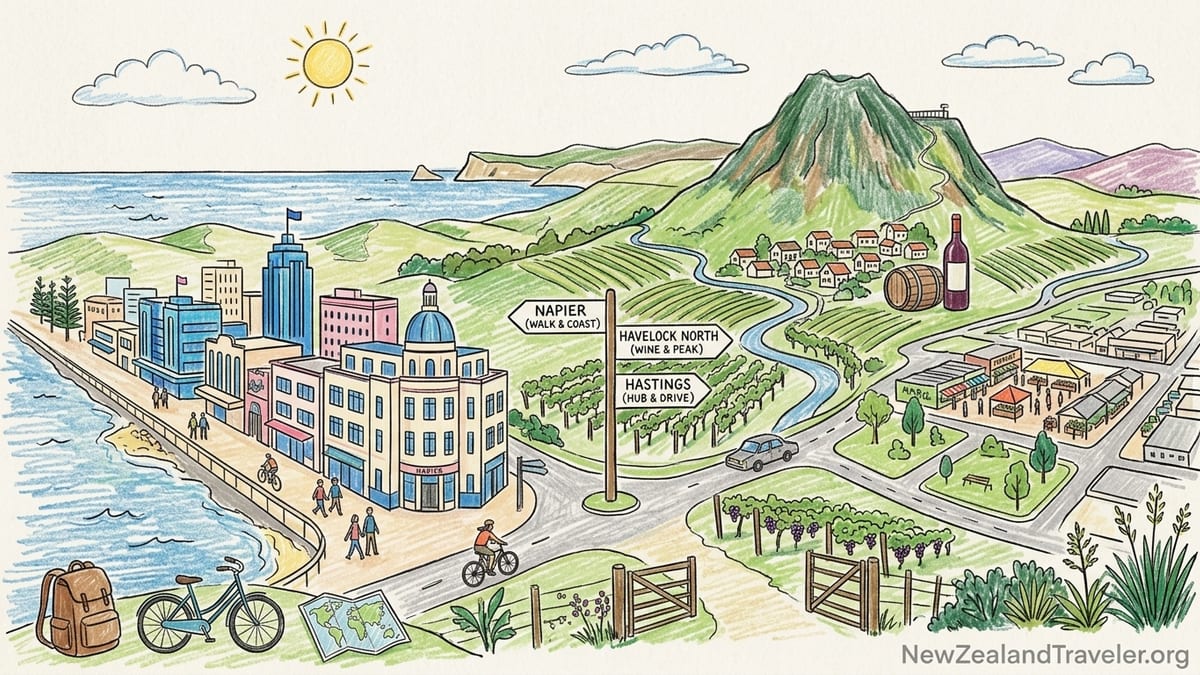
How To Choose A Base In Hawke’s Bay (Before You Choose A Hotel)
Hawke’s Bay is a twin-city, many-neighborhood region: Napier on the coast and Hastings inland, with Havelock North tucked close to Hastings at the foot of Te Mata Peak. Add the vineyard corridors around the Tukituki Valley and the coastal stretches toward Cape Kidnappers and Waimārama, and you’ve got a destination where “where you sleep” quietly determines your whole itinerary.
The mistake I made on my first visit was choosing a property I loved on photos, then realizing I’d added small frictions all day long: driving into dinner, circling for a park, and thinking twice about a second glass of syrah because I had to get back. On later trips, I flipped the order: I picked the base first, then the hotel. That one change made exploring easier.
Three questions helped me decide each time. One: will you be walking to dinner and drinks most nights, or is the car part of the plan? Two: are you here primarily for Art Deco and waterfront time, or wine country and long lunches? Three: do you want the region to come to you via tours (with pick-ups), or do you want to self-drive and keep a flexible schedule?
It also helps to think about “trip rhythm.” Hawke’s Bay is ideal for early starts: sunrise runs on Marine Parade, first tastings at cellar doors, and morning departures for coastal experiences. Your base affects how painful those early alarms feel, and how much driving you stack on top of them.
Napier: The Stronger Compact, Walkable Art Deco And Waterfront Base
For a first-timer who wants Hawke’s Bay to feel instantly like a holiday, Napier is the easiest base to understand. Official tourism leans into what you notice on foot: it’s compact, straightforward to explore, and walk- and cycle-friendly, with the waterfront right there and a high concentration of restaurants, wine bars, and Art Deco experiences in and around the CBD and Marine Parade.
In practice, that meant my evenings were genuinely car-free. One night I walked from my room to a waterfront drink at Ahuriri, then continued on foot to dinner without planning anything beyond “follow the lights and the sound.” Another night, I kept it simple: a sunset stroll along Marine Parade, then back into town for a late bite. The big win with Napier as a base is not just that you can walk, but that you actually will, because the city is set up for it.
Napier is also a very workable base for cyclists. The local i-Way and broader Hawke’s Bay Trails network is promoted as an easy-riding system spanning 200+ kilometers of mostly flat, shared paths connecting Napier, Hastings, and Havelock North, including waterfront and estuary loops and longer rides that reach toward the Tukituki Valley and Cape Kidnappers. When I stayed in Napier, I found it easier to commit to “a proper ride day” because I could start with a gentle waterfront spin, get my legs going, and then decide whether I felt like pushing inland.
If your trip includes guided wine touring, Napier’s convenience is underrated: several Hawke’s Bay wine tour operators advertise accommodation pick-ups across Napier, Hastings, and Havelock North. The day feels smoother when the van collects you and you’re not first wrestling with traffic or a cross-region meet-up point. The trade-off is that you’ll do a little more driving if you plan multiple visits deep into wine country on your own, especially if you like to pop back for a rest between tastings.
Havelock North: Wine Country, Boutique Atmosphere, Food, And Te Mata Peak Access
Havelock North feels like a village with city-level taste. It’s the base I choose when the trip is about wine country days and good meals rather than “see the sights.” Official destination descriptions position it exactly where it sits: at the foot of Te Mata Peak, and as a strong launch point for the Tukituki River valley and the vineyards beyond. Once you’ve driven the back roads with Te Mata Peak filling the windscreen, you understand why that positioning matters.
What I loved about staying in the village itself was the low-effort evenings. After a day of cellar doors, I could park once and walk to dinner. That’s the key difference from staying out among the vines: in Havelock North, you still get a boutique feel, but you regain the ability to stroll. On my last stay, that turned into a pattern: late afternoon rest, then an easy walk to a table, then an unhurried wander back past shopfronts going dark for the night.
Te Mata Peak access is a real, tangible advantage. Te Mata Park’s main gates are on Te Mata Peak Road in Havelock North, and visitors can drive to the summit carpark. I used that proximity in two ways: a quick pre-dinner lookout run when I had energy, and a sunrise revisit when I wanted the view without turning it into a half-day mission. The park also has mountain-biking trails across multiple difficulty grades, which makes Havelock North a smart base if your trip includes trail riding as well as wine tasting.
For wine logistics, Havelock North sits in the sweet spot. You’re close to the Tukituki Valley decision point where one turn takes you toward names travelers recognize. It’s also close to cycle-trail segments that thread past vineyards and connect back toward Clive and on toward Napier. When you base in Havelock North, you can do the classic Hawke’s Bay thing: a long lunch with vineyard views, then still be back in the village in time for a second, smaller night out.
Hastings: The Practical Central Base (Parking, Routes, And A Different Night Feel)
Hastings is the base I pick when I want to reduce cross-region backtracking. It’s not as instantly “holiday-pretty” as Napier’s waterfront, and it doesn’t have Havelock North’s boutique village sheen, but it functions extremely well as a hub. Official visitor information highlights that Hastings city has a strong range of things to do, including arts venues, galleries, dining and drinking, and retail. That matters because it means you’re not condemned to “drive elsewhere for everything” if you stay here.
From a practical traveler perspective, Hastings made my days feel more efficient when I was mixing activities: a morning inland, an afternoon winery appointment, a quick stop for supplies, then an evening event. Parking was generally simpler than my Napier CBD nights, and because my accommodation was set up with easy in-and-out access, I didn’t dread moving the car. If you’re doing a self-drive trip with multiple bookings each day, Hastings can quietly be the least stressful base.
The dinner equation is different. In Napier and Havelock North, “walking to dinner” is part of the charm. In Hastings, I walked sometimes, but I also drove more often, especially if I was hopping between a restaurant and somewhere for a late drink. If you’re traveling with family or prioritizing space, this is where Hastings can shine: mid-range accommodation styles, easy access to supermarkets and services, and less of the “pay extra to be in the postcard” effect you sometimes feel on the waterfront.
I also liked Hastings as a base for cycle days that weren’t purely scenic. The wider Hawke’s Bay Trails network spans Napier and Hastings districts and links communities with mostly easy riding. When I stayed in Hastings, it was easy to map a point-to-point plan: ride a section, stop somewhere for lunch, and still be close enough to your base that you’re not finishing the day with a long drive home while tired and sunburned.
Vineyard And Coastal Stays: When The Accommodation Is The Destination
Staying among the vines or out toward the coast is the most romantic way to do Hawke’s Bay, but it’s also the option that changes your logistics the most. The upside is obvious: you wake up in the landscape you came for. The downside is that everything becomes a decision, especially dinner. Unless your property is attached to a restaurant, you’ll likely drive to eat, and that means committing to a sober return or arranging transport.
One of my favorite “why we stayed here” examples came from a Tukituki Valley-leaning trip. I wanted the classic Hawke’s Bay day: tastings with views, a long lunch, then a slow return to a quiet room. Official wine touring notes point out how quickly you can reach major cellar door clusters from Havelock North, and that reality extends into the valley itself. If you’re staying close to those corridors, you can do short, low-stress drives between tastings, which feels safer and calmer than doing big cross-region hops.
Cycle access can be surprisingly good depending on exactly where you stay. The Hawke’s Bay Trails “Landscapes Ride” is described as a smooth, wide cycling trail with views across the ocean, the Tukituki River, and vineyard country, with stops that can be directly off the trail including at least one winery mentioned as accessible from the path. That’s the dream scenario for a vineyard base: you pedal to a tasting or lunch, then roll back without needing to touch the car until tomorrow.
Coastal stays shift the center of gravity again. They’re perfect if you want beach time, starry nights, and morning walks that feel far from town. But if your plan includes multiple dinners out, nightlife, or early pickups for tours, ask yourself how often you want to drive in and out. For me, coastal bases worked best as a “two nights of exhale” after I’d already done the urban walks, wine bars, and museums from a more central base.
What I’d Choose For Different Trips (First Visit, Wine Weekend, Romance, Car-Light)
For a first trip where you want the most variety with the least friction, I’d start in Napier. The city is easy to navigate, the waterfront gives you that immediate holiday feeling, and it’s the simplest place to build evenings around walking. It also keeps Art Deco experiences and casual dining within a small radius, which means less planning and more spontaneous exploring.
For a wine-focused weekend, I’d base in Havelock North village if you want a blend of vineyard access and walkable nights. It’s close to Te Mata Peak for a morning lookout or a leg-stretch between tastings, and it positions you well for the Tukituki Valley winery corridors. If you’re booking a guided tour, it’s also worth noting that several tour operators in Hawke’s Bay advertise pick-up from accommodation across Napier, Hastings, and Havelock North, so you can keep the car parked regardless of which of the three you choose.
For a romantic stay, I’d lean vineyard or coastal, but only if you accept the trade-offs. If your ideal evening is a long dinner on-site or close by, the romance factor is unbeatable. If your ideal evening is a progressive crawl of wine bars and a nightcap somewhere lively, romance might actually be easier in Napier or Havelock North, where you can walk home.
For a car-light visit, I’d choose Napier first, then Havelock North second depending on your priorities. Napier’s cycle-and-walk culture is a real advantage, especially if you plan to use the i-Way and Hawke’s Bay Trails network for daytime exploring and keep nights local. Havelock North can also work car-light if your plan is village dining plus pre-booked wine tour days with pick-ups, but you’ll feel the lack of a coastal promenade if waterfront time is important to you.
The Takeaway
There isn’t one universal “best” base in Hawke’s Bay, because the region rewards different travel styles. Napier is the strongest compact, walkable base with Art Deco character and waterfront energy, and it makes evenings easy without a car. Havelock North is the best base when your trip is anchored in wine country, boutique village dining, and quick access to Te Mata Peak and the Tukituki Valley. Hastings is the practical hub: central, functional, and often the easiest place to keep your days efficient, especially if you’re driving yourself. Vineyard and coastal stays deliver the most atmosphere, but they also create the most driving decisions.
If you match your base to your trip style, Hawke’s Bay feels effortless. You finish dinner with a stroll instead of a drive, you start your morning ride already on a trail, and you stop thinking about logistics. The hotels matter, but the base is what makes exploring easier.
FAQ
Q1. Is Napier or Havelock North better for a first visit to Hawke’s Bay?
Napier is usually easier for a first visit because it’s compact and walkable, with the waterfront and plenty of dining close together. Havelock North suits first-timers who are primarily focused on wineries and Te Mata Peak.
Q2. Can I do Hawke’s Bay without a car?
You can do a car-light trip by basing in Napier and using walking and the regional cycle-trail network for local exploring, then booking guided wine tours that pick up from your accommodation. You’ll still have more flexibility with a car.
Q3. Which base is best for walking to dinner and drinks?
Napier is the easiest for consistently walking to dinner, especially around the CBD, Marine Parade, and Ahuriri. Havelock North village can also be walkable for evenings once you park.
Q4. Which base is best for wineries in the Tukituki Valley?
Havelock North is the most convenient base for quick access to the Tukituki Valley and Te Mata Peak area, especially if you want to do tastings and long lunches with minimal driving.
Q5. Is Hastings a good place to stay for tourists?
Yes, especially if you want a practical hub with straightforward parking and a central position for mixing inland activities, wineries, and day trips to Napier. It’s less of a waterfront holiday feel than Napier.
Q6. Are Hawke’s Bay wine tours available from all bases?
Many operators advertise pick-up from accommodation in Napier, Hastings, and Havelock North, which makes it easy to choose your base based on evenings and atmosphere rather than tour logistics.
Q7. Which base is best for cycling the Hawke’s Bay Trails?
Napier is a strong choice if you want easy access to waterfront riding and the i-Way network, while Havelock North and Hastings work well for connecting into inland sections and rides toward the Tukituki River and vineyard corridors.
Q8. What’s the biggest downside of vineyard or coastal stays?
The main downside is logistics: you’ll likely drive more for dinner, wine bars, and some activities, and you’ll want to plan tastings responsibly because returning to your accommodation usually requires a car trip.
Q9. Where should couples stay for a romantic weekend?
For pure atmosphere, a vineyard or coastal stay can feel special. For romance with easy evenings out, Napier or Havelock North often works better because you can walk to dinner and enjoy a relaxed nightcap.
Q10. If I only have two nights, where should I base?
For a balanced two-night trip, choose Napier if you want Art Deco, waterfront walks, and dining. Choose Havelock North if your priority is wine country and Te Mata Peak, with village-style evenings.