


I went to Hawke’s Bay thinking a guided wine tour would be the “easy” option: someone else drives, you taste a few wines, you’re back at your hotel before dinner. What I didn’t expect was how much a good guide can turn a string of tastings into an actual story about place, people, and why Hawke’s Bay tastes like Hawke’s Bay. This is a detailed first-person review of a genuine guided tasting day I took, down to the pickup, the exact number of stops, the pace, what I drank, and whether the day ever felt rushed. I also researched current Hawke’s Bay operators, pickup zones, pricing, cancellations, and typical winery inclusions separately so you can compare your options realistically before you book.
Booking the Tour, and Why I Chose Guided This Time
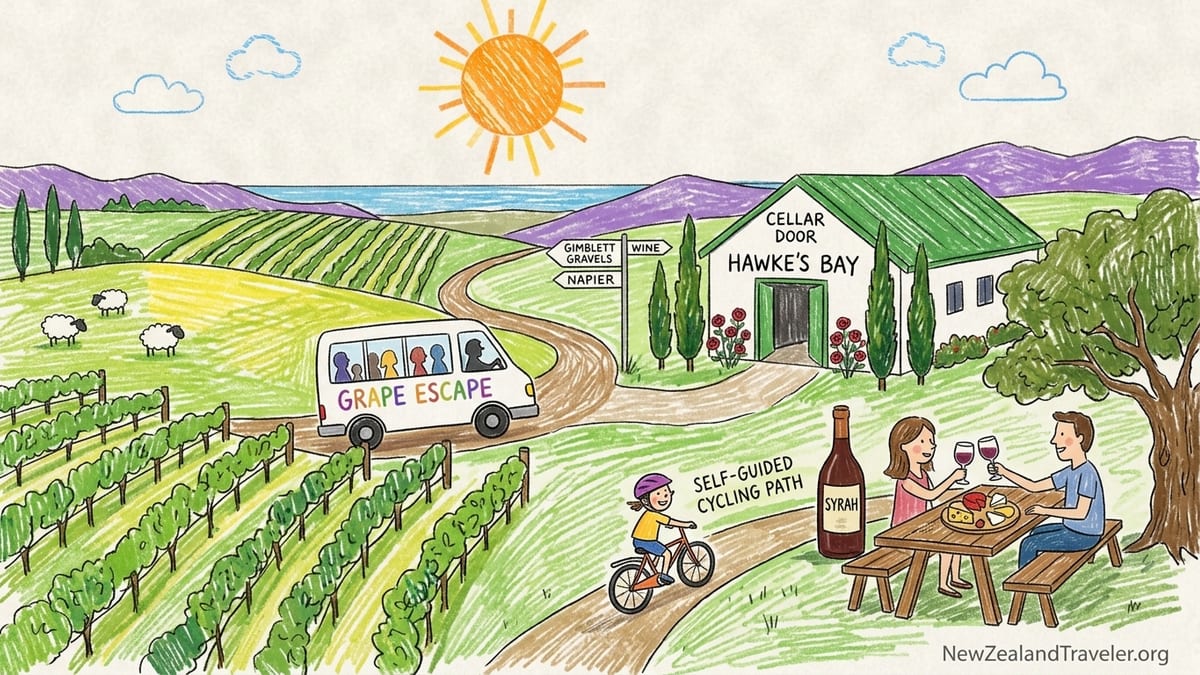
I booked a small-group afternoon tour with Grape Escape, a long-running Hawke’s Bay operator that runs scheduled shared tours with accommodation pickup across Napier, Hastings, and Havelock North. At the time I booked, the scheduled tour price was advertised at NZD $195 per person, including four wineries, standard tastings, and a cheese platter, with a maximum group size of 12.
I chose guided for one simple reason: I wanted to taste without doing mental math on blood alcohol limits, distances, and who would be the designated driver. I have self-driven wine regions before, and I’ve also done self-guided winery cycling days. Both can be brilliant. Both also come with friction: logistics, navigation, and the subtle pressure to keep moving because you’re the one managing the clock.
Hawke’s Bay’s official tourism material strongly promotes guided tours alongside self-guided and cycling options, and after a day on the ground I understood why that mix exists. The region is set up for DIY exploration with extensive trails and clustered cellar doors, but it’s also a place where a hosted day can help you connect the dots between subregions, soils, and styles in a way that’s hard to replicate when you’re staring at a map app between stops.
Pickup, the Vehicle, and the Group Vibe
Pickup for my tour was from my accommodation in Napier. The pickup window was communicated in advance, and the actual pickup felt like a real “door-to-door” service rather than a vague meet-you-somewhere arrangement. That matters in a wine region because the day starts more relaxed when you’re not hunting for a bus stop in an unfamiliar neighborhood.
The vehicle was a clean, air-conditioned tour van rather than a big coach. It felt intentionally set up for conversation: you could actually hear other guests without shouting, and you weren’t isolated in separate rows like a commuter shuttle. The group size on my day was small enough that we learned names quickly and compared notes on what we liked, but big enough that the guide could keep the energy up without it becoming an overly intimate, couple-only vibe.
Our guide had the kind of personality you hope for on a tasting day: friendly, lightly humorous, and capable of reading the group. When someone wanted geekier detail, they got it. When someone just wanted “the one that tastes like peaches,” that was treated as a perfectly valid tasting note too. The result was a day that felt social rather than scripted.
The Exact Route: Four Wineries, Real Time Between Stops, and a Pace That Made Sense
We visited exactly four wineries, matching the operator’s advertised format. What I appreciated most was that the day wasn’t built on rushing to squeeze in “as many cellar doors as possible.” Instead, each stop felt long enough to settle in, taste properly, ask questions, and actually remember what I was drinking.
The pacing was consistent: arrive, get a quick orientation from the guide about what the winery is known for, then a hosted tasting led by cellar door staff. Between stops, the drive time was short enough that the day kept momentum, but long enough to reset your palate and your attention. In practice, that meant you were rarely in the van long enough to get sleepy, but you also didn’t feel like you were bouncing around a theme park.
Water was available in the vehicle, and we were encouraged to use it. That sounds minor until you’ve done a DIY tasting day and realized that unless you carry your own water and remember to drink it, you can end up tasting on hard mode by the third stop. Having water and a guide who actively reminds people to hydrate changed how I felt at the end of the day.
Most importantly: I did not feel rushed by the final tasting. The last stop still had enough breathing room that I could re-taste a favorite pour, ask about vintages, and decide what I wanted to buy without the guide hovering by the door doing the “two minutes, folks” shuffle. The day ended when it should have ended, not when the schedule panicked.
What I Actually Tasted: The Wines That Stuck With Me
Hawke’s Bay has a reputation for reds and structured whites, and my day reflected that. The most memorable pours were the ones that made me think about why Hawke’s Bay is so often discussed in terms of Syrah and Bordeaux-style blends, and why Chardonnay is such a quiet star here when you get it poured in context.
Across the day, I tasted a mix of aromatic whites, Chardonnay, and reds that leaned into the region’s strengths. The guide did something subtle but helpful: they framed each tasting as part of an arc rather than a random lineup. Instead of “here are six wines,” it was “here’s what this producer does, here’s how this subregion tends to show up in the glass, and here’s what to look for.” Even for casual drinkers, that kind of simple framing makes the day feel more coherent.
I also appreciated that the guide didn’t try to force a hierarchy of taste. If you loved the bright, crisp white and didn’t care about the flagship red, you weren’t made to feel like you “missed the point.” You were simply helped to identify what you like, and where you could find more of it in Hawke’s Bay.
By the end, my palate fatigue was real, but manageable. That’s the difference between a tour that tries to stack tastings like a checklist and a tour that treats tasting like the main activity rather than something you rush through between photo ops.
Lunch, Snacks, and the Practicalities People Forget to Ask About
On my tour, the built-in food element was a cheese platter served during the day, which matched the operator’s advertised inclusion for the scheduled tour. It wasn’t a full sit-down winery lunch, but it was enough to slow down the alcohol absorption and keep the mood steady. It also created a natural break in the tasting rhythm, which is where you realize whether you’re enjoying the day or just enduring it.
If you want a full lunch as a centerpiece, some Hawke’s Bay experiences are explicitly designed around that, including higher-end or private tours that include a winery lunch. For example, Grape Escape also sells private Signature-style touring in a Mercedes V-Class format for smaller groups, and other premium providers in Hawke’s Bay build suggested routes around major names such as Craggy Range and Te Mata Estate, with lunch woven into the plan. The key is to check whether lunch is included in the ticket price or listed as “own cost,” because both models exist in the region.
In terms of basics, the day was thoughtfully managed: we had water access, bathroom timing was naturally covered by each stop, and the guide made sure no one was left guessing about what came next. I didn’t once have that DIY feeling of, “Wait, are we supposed to be driving now, or is there another tasting room?”
One more small detail that mattered: the guide normalized spitting. Not in a preachy way, just in a “this is how you survive four stops and still taste accurately” way. That gave the whole group permission to pace themselves without feeling self-conscious.
What the Guide Added Beyond Transport (This Is the Real Value)
The biggest difference between a guided tour and self-driving is not the van. It’s the narrative and the access. Throughout the day, our guide explained the logic behind where we were going and what we were tasting: how Hawke’s Bay’s wine landscape breaks into different pockets, why some areas specialize in certain styles, and how producers position themselves within the region.
That context made the wines easier to understand. You can read tasting notes online all day, but it’s different when someone points out that one stop is designed to show you a classic expression, while another is chosen because it highlights a different pocket or a different winemaking approach. The guide also handled the quiet operational work: coordinating with cellar doors, keeping the group moving without stress, and smoothing over any timing issues so the day stayed relaxed.
There’s also a huge practical benefit that doesn’t sound romantic but absolutely matters: you avoid the problem of driving after wine. Some tour operators in Hawke’s Bay are very explicit about this, even noting that if you do tastings you can easily be over New Zealand’s legal limit to drive. That frankness is not marketing fluff. It’s the simplest reason guided tours continue to sell so well, even in regions where the wineries are relatively close together.
I’ve done self-driving wine days in other places, and I always end up doing one of two things: either I taste lightly and feel like I’m not really participating, or I taste normally and feel vaguely uneasy every time I get behind the wheel. The guided day removed that tension completely, and that alone changed my enjoyment of the wines.
How This Compared With My Self-Drive and Self-Guided Cycling Wine Days
Self-driving has one undeniable advantage: total control. You can chase a specific producer, linger for as long as you want, and pivot instantly if you fall in love with a cellar door. In Hawke’s Bay, self-driving is also straightforward geographically, but the tradeoff is responsibility. You become the schedule keeper, navigator, and safety officer, which can subtly drain the fun out of the day.
Self-guided cycling is the most joyful way I’ve ever experienced a wine region when the conditions are right. Hawke’s Bay is particularly set up for it, with a well-known trails network and winery routes that can be done at an easy pace. One prominent local cycling operator, On Yer Bike Winery Tours, advertises self-guided rides through districts like Bridge Pa Triangle and Gimblett Gravels, with cellar doors spaced a short ride apart and a practical service where they collect wine purchases so you’re not hauling bottles in a bike basket all afternoon.
The tradeoff with cycling is that you need decent weather, some confidence on a bike, and an honest sense of how much tasting plus pedaling you can handle. It’s a different kind of day: more physical, more independent, and less likely to include the kind of in-depth context a guide can provide in transit. If you want to be told why one pocket matters and how it differs from another, you’ll either need to read up in advance or accept that your education is mostly what you overhear at the bar.
The guided tour sat in the sweet spot for me: low effort, high learning, and genuinely relaxing. I still love cycling days, but for a first or second visit to Hawke’s Bay, guided gave me a clearer mental map of the region, and it helped me identify which subregions and producers I’d want to return to on a DIY day.
The Takeaway
A guided Hawke’s Bay wine day gave me something more valuable than convenience: it gave me a structured, unrushed way to understand the region while tasting confidently and safely. The best part wasn’t being driven around. It was having a guide who stitched the wineries into a story about Hawke’s Bay and kept the day running smoothly enough that I could stay present for every pour.
My tour delivered exactly what it promised on paper: accommodation pickup in the main Hawke’s Bay centers, a small-group format, four winery visits, standard tastings, and a cheese platter. In real life, it felt better than the itinerary suggests because the pace was human, water was available, and the day ended without the stressed sprint that can ruin a final tasting.
If you’re deciding between guided and DIY, I’d frame it like this. If you’re already deeply familiar with Hawke’s Bay producers and you have a reliable non-drinking driver, self-driving can be great. If you want to combine wine with a scenic ride and a little adventure, self-guided cycling is one of the most naturally fun ways to do the region. But if you want to learn quickly, taste comfortably, and avoid the safety and scheduling hassles entirely, a guided tasting day is the most relaxing way to turn “wineries on a map” into a real experience.
FAQ
Q1. What areas do Hawke’s Bay wine tour operators usually pick up from?
Most scheduled tours focus on accommodation pickup in Napier, Hastings, and Havelock North, which covers the main visitor bases for winery touring.
Q2. How many wineries should I expect on a half-day guided tour?
A common format is four wineries on a half-day scheduled tour, though some operators run three-winery formats, and private tours can vary.
Q3. Are tastings typically included in the tour price?
Many scheduled small-group tours include standard tasting fees, but you should confirm for your specific tour because some experiences add premium tastings as an upgrade.
Q4. What does a typical Hawke’s Bay small-group wine tour cost right now?
Published prices vary by operator and inclusions, but examples in the market include around NZD $195 per person for a scheduled four-winery tour, and around NZD $295 per person for a private small-group signature-style option.
Q5. Do tours include lunch, or do I pay separately?
Some tours include a cheese platter or light food during the day, while full winery lunches are often either included only on premium tours or listed as “own cost.” Always check the inclusions.
Q6. Will I feel rushed on a guided tour with four winery stops?
It depends on the operator and group size, but the better tours build in enough time at the final stop that you can re-taste, ask questions, and buy wine without pressure.
Q7. Is a guided tour safer than self-driving if I plan to do tastings?
Yes. A guided tour removes the risk of driving after drinking, which is a major practical advantage even when wineries are close together.
Q8. Is cycling between Hawke’s Bay wineries realistic for most travelers?
It can be, especially on the region’s flatter winery trail areas, but it’s weather-dependent and best for travelers comfortable riding while managing tasting pace and hydration.
Q9. What should I bring on a guided wine tour day?
Bring a light layer for cellar doors, sunglasses, and a small bottle of water if you like having your own. Eat beforehand and consider using the spit bucket to manage pace.
Q10. How far in advance should I book a Hawke’s Bay wine tour?
For weekends and peak travel periods, booking ahead is smart, especially for small-group tours with capped numbers and for any premium experiences tied to popular winery restaurants.