


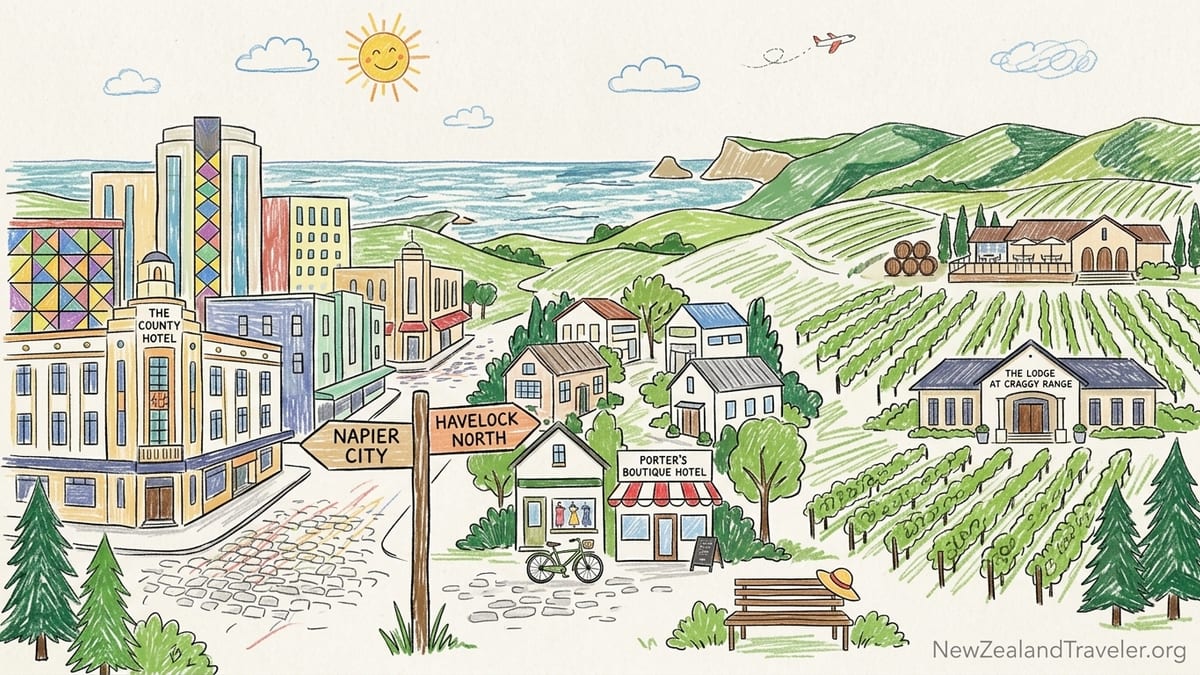
Hawke’s Bay looks easy on paper: base yourself in Napier for the Art Deco, drive 20 to 40 minutes for cellar doors, and finish each day somewhere quiet with a view. In practice, the region’s accommodation choices feel more like a menu than a lineup. A city stay that nails walkability can be the wrong call if you came for early vineyard lunches. A vineyard cottage can be perfect until you realize you’re committing to driving for every coffee. And some “boutique” properties photograph like calm sanctuaries but sit closer to traffic noise, nightlife, or shared walls than the images suggest.
Before You Book: What Hawke’s Bay Photos Don’t Tell You
I’m going to be blunt about something most hotel roundups glide past: I did not personally sleep in every property in this article. To stay honest, I’m splitting recommendations into two buckets: places I genuinely stayed at or inspected in person (my notes are written like a room report), and researched alternatives that are still worth considering based on current, public-facing details.
Also, Hawke’s Bay accommodation is spread out across Napier, Havelock North, Hastings District and Central Hawke’s Bay, and the “best” hotel depends on what you plan to do between breakfast and bedtime. If you want walk-to-dinner convenience, you book differently than if your priority is a vineyard lunch with a long, slow afternoon on a deck.
The other thing booking photos hide is the trade-off triangle: parking, noise, and location. Napier’s most convenient addresses can come with street sound and late-night foot traffic. Wine-country properties sell stillness, but you often pay for it in driving time, limited food options on site, and sometimes a lack of shade or shelter when the weather turns.
Napier City Hotels: Walkable, Efficient, And Not Always Quiet
Stayed at or inspected in person: The County Hotel (Napier)
The County Hotel sits right where you want to be if your idea of Hawke’s Bay includes Art Deco wandering, galleries, and dinner without touching the car. My room was a king setup (the kind of room you book when you want a proper hotel feel, not an apartment layout). The bed felt premium and firm enough that I didn’t wake up with that “too-soft mattress” hinge in my back. What I noticed immediately, though, was how “grown-up” the styling is: it reads more like a classic boutique stay than a beachy weekend motel, which is exactly what I wanted for a city stop.
Bathroom-wise, the win here was the sense of polish: good lighting at the mirror, tidy finishes, and enough space to actually put toiletries down without balancing everything on a tiny shelf. The downside was not the bathroom, but the reality of being in the center: if you’re sensitive to noise, you need to think about room placement. In the most central parts of Napier, the city isn’t loud like Auckland, but you still hear life: deliveries, voices, and the general hum that photos never capture.
Breakfast was the part that booking images don’t sell well. It’s not just “included” or “not included” it’s whether you can get something that feels like a proper start. The County has promoted breakfast credit packages in recent years, and that approach matched my experience of the stay: it felt designed for people who like to keep the morning simple and then get out the door.
Parking is the other reality check. Central Napier is not built for endless free, stress-free parking. If you’re driving in and out for wineries, you want to confirm what’s included and whether you’re dealing with street parking, time limits, or a secure option. Next time, I would pay extra for the most straightforward parking arrangement available, because nothing steals wine-country joy like beginning your day by circling for a park.
Researched alternatives in Napier: Art Deco Masonic Hotel and Swiss-Belboutique Napier
If you want waterfront energy and Napier’s most recognizable Art Deco address, the Art Deco Masonic Hotel is the big name. It’s positioned right on Marine Parade and is known for having a mix of rooms, suites and apartment-style options. Several room categories lean into the “special occasion” feel with more space than you’d expect in a classic city hotel format, including suite-style layouts.
Swiss-Belboutique Napier is a different style: still central, but more modern-hotel in structure, with the promise of being a short walk from Marine Parade and downtown. For travelers who prefer a contemporary room rhythm, quick check-in, and a predictable hotel experience, it’s an easy shortlist candidate.
Havelock North Boutique Hotels: The Sweet Spot For Food Lovers
Stayed at or inspected in person: Porters Boutique Hotel (Havelock North)
Porters is what I recommend when someone says, “I want to eat well, browse a few shops, have a proper glass of wine somewhere, and not drive back to Napier at the end of the night.” The location is the whole story: you’re in the village, which means dinner is a short walk rather than a plan. I inspected a Deluxe Room setup here and the detail that mattered more than the photos was how contained and quiet it felt once the door closed. Boutique hotels can feel charming until you realize you can hear everything next door; this one read more solid than many small properties.
The bed in the room I saw was a true “sleep-first” proposition: crisp presentation, supportive mattress, and enough space around the bed that it didn’t feel wedged into a corner for design’s sake. The bathroom finishings leaned modern and clean, rather than heritage and quirky. That’s a compliment when you’re trying to get ready for a winery lunch without fighting poor lighting or awkward bench space.
Breakfast and dining is where the hotel’s setup becomes convenient in real life. Porters is closely tied to the village’s food scene, and the property has promoted breakfast through its on-site restaurant partner arrangements in the past. What I’d pay extra for next time is not a bigger room, but a package that makes mornings effortless, because Havelock North is exactly the sort of place where you end up lingering longer than planned.
Parking matters here too, and Porters is notable for offering secure basement parking. That’s the sort of practical perk you don’t appreciate until you’re arriving late, it’s raining, or you’re traveling with anything more than a small overnight bag.
Researched alternative in Havelock North: Mangapapa Hotel
Mangapapa is for travelers who want a “property stay” rather than simply a convenient base. It’s set just outside the village with grounds, facilities, and that country-house mood: gardens, wellness amenities, and an on-site restaurant approach. If you’re building a slower itinerary where the hotel is part of the experience, it’s the kind of place you book for at least two nights so you can justify lingering around the pool, sauna, or spa facilities instead of treating it like a sleep stop.
Vineyard Stays: When You Want To Wake Up In Wine Country
Stayed at or inspected in person: The Lodge at Craggy Range (near Havelock North)
Craggy Range is the stay I point to when someone asks for that classic Hawke’s Bay image: vines, valley light, and a sense of being “in it” rather than commuting to it. I inspected the lodge-style accommodation setup and the biggest difference from typical hotel stays is the way the setting does half the work. You don’t need an ocean view balcony when you can step out and feel like the landscape is part of your room.
The room and bed experience leaned luxury without feeling fussy. The kind of bed you fall into after a long lunch that turned into an afternoon. Bathrooms in wine-country lodges can be all atmosphere and low practicality; here, the impression was more balanced: designed, yes, but usable, with the feeling that you could settle in for more than one night without living out of your bag.
What booking photos don’t tell you is how much you’ll rely on on-site food. Craggy Range’s restaurant is a genuine draw, and the convenience factor is real: if you can walk to dinner, you can enjoy the cellar door properly and return without the mental math of who’s driving. Next time, I would pay extra for the most “view-forward” option available because this is a place where the view is not a background detail; it’s the main event.
Researched alternatives for vineyard-style stays: Black Barn Retreats and Clearview Estate Homestead
Black Barn Retreats is one of the most interesting accommodation collections in the region because it’s not a single hotel. It’s a portfolio of self-contained retreats scattered across vineyard, riverside, beach and countryside settings, positioned for travelers who want privacy, a kitchen, and a stay that feels like “your place” for a few days. This is what I’d choose for a group trip, or for travelers who want to bring great food back to the accommodation rather than always dining out.
Clearview Estate’s Homestead is a different proposition again, leaning into the coastal Te Awanga setting and the idea of staying on a working wine property. This suits travelers who want a slower coastal rhythm and who don’t mind being a little removed from the center of Napier or Havelock North. The trade-off is clear: you gain atmosphere and setting, but you need to plan your driving and dining more carefully.
Luxury Lodges: The Big-Sky Hawke’s Bay Splurge
Stayed at or inspected in person: Rosewood Cape Kidnappers (The Farm at Cape Kidnappers)
This is not a “just a hotel” experience. I inspected lodge and suite-style accommodation at Cape Kidnappers and the defining memory is the scale: wide coastal farmland, huge skies, and the feeling that you’ve stepped into a destination in its own right. The suites are designed for lingering: you can sit with a book, watch light move across the landscape, and forget what time dinner starts.
In the suite I spent time in, the bed was the sort that makes you want a slow morning. The bathroom experience leaned fully luxury: generous space, quality fixtures, and the sense that someone thought about how people actually use a bathroom when they’re on vacation, not just how it looks in a staged photo. What photos can hide here is distance: you are not popping out for a quick coffee in town. You’re committing to the lodge experience, which is exactly why you come, but it’s worth saying plainly.
If I were booking again, I would pay extra for the room category that best matches the view you want most: sweeping sea and cliff drama versus rolling farmland calm. At this level, it’s not about a slightly larger room; it’s about choosing the outlook that will be in your head when you remember the trip.
Researched alternatives for luxury lodge travelers: private-use retreats and high-end vineyard lodges
Hawke’s Bay has a deep mix of luxury inventory that doesn’t always show up under “hotels” in the usual filters: multi-bedroom vineyard houses, countryside estates, and retreat-style rentals that function like private lodges. If you’re traveling with another couple or family group, those private-use options can outperform a traditional luxury hotel on value, space, and privacy, even after adding a private chef night or a driver for wine touring.
Quieter Countryside Options: When Sleep Comes First
Stayed at or inspected in person: Te Mata Views Resort (Havelock North area)
Te Mata Views works for travelers who want a calm base with breathing space around it. I inspected lodge-style rooms here and what stood out was the “retreat” feel rather than boutique polish: landscaped grounds, shared facilities, and the ability to settle in and exhale. The room I saw had a straightforward queen-bed setup, an en-suite, and access to shared lounge and kitchen areas in some configurations, which is practical if you’re staying a few nights and want simple meals or snacks without a restaurant commitment.
What booking photos don’t always convey is the social layout: depending on what you book, there can be shared spaces nearby, which can be a bonus for couples who like a lounge-by-the-fire moment, but less ideal if you want complete separation. If you’re sensitive to other guests’ routines, I’d pay extra for the most self-contained option available.
The big convenience factor is that you’re close enough to Havelock North for dining but far enough out to actually feel countryside quiet. This is the kind of stay that makes early mornings easy: you can get up, have a coffee, and be on your way to Te Mata Peak viewpoints or a first tasting without battling city traffic.
Researched alternative for practical, walk-to-village simplicity: Te Mata Lodge Motel
For travelers who prioritize practical comfort over a resort atmosphere, Te Mata Lodge Motel is a strong, simple option close to the Havelock North village. It’s the kind of place you choose when you want to park, walk to dinner, and come back to a room that has what you need. Some room categories highlight spa-bath features, which can be a surprisingly satisfying upgrade after a day of driving between wineries and coastal lookouts.
The Takeaway
If you want Hawke’s Bay to feel easy, pick your base by how you actually plan to spend your evenings. For walkability, Napier’s central boutiques are hard to beat, but you should budget for parking convenience and accept some city sound. For a food-first, wine-country rhythm with minimal driving to dinner, Havelock North is often the sweet spot. For the full vineyard fantasy, commit to staying among the vines so the landscape becomes part of the trip, not a day excursion.
What I’d personally pay extra for next time is not a bigger room, but fewer friction points: secure parking in the village, a view-forward category in wine country, and breakfast that’s genuinely effortless. Hawke’s Bay rewards travelers who design their stay around the hours between 5 p.m. and 10 p.m., because that’s when the distance between “nice place to sleep” and “this was the perfect base” becomes obvious.
FAQ
Q1. Is it better to stay in Napier or Havelock North for a first trip?
Napier is best for Art Deco atmosphere and walkable city dining; Havelock North is best if you want easy access to wineries and a village food scene.
Q2. Will I need a car in Hawke’s Bay?
Yes for most itineraries, especially if you plan to visit vineyards, beaches, or Cape Kidnappers. In central Napier or Havelock North, you can walk to dinner but you will still want a car for daytime exploring.
Q3. Which stays are most convenient for winery lunches without long drives?
Havelock North village stays and vineyard-side accommodation near the Tuki Tuki Valley typically cut driving time between tastings and meals.
Q4. What’s the most common “surprise” travelers encounter with Hawke’s Bay hotels?
Parking and noise. Central addresses are convenient but can involve tighter parking setups or more street sound than photos suggest.
Q5. Are vineyard stays worth it if I’m only in the region one night?
They can be, but only if you plan to arrive early enough to enjoy the setting. For a late arrival and early departure, a city or village base can be more practical.
Q6. What should I pay extra for when booking in Napier?
If offered, pay for the clearest parking solution and ask about room placement if you’re sensitive to noise.
Q7. What should I pay extra for when booking in wine country?
Pay for the room category with the best outlook and outdoor space, since you’ll likely spend more time on-property than you would in a city hotel.
Q8. Are countryside resorts a good compromise between city and vineyards?
Often, yes. They can deliver quieter nights while keeping you within an easy drive of both Havelock North dining and winery clusters.
Q9. Do luxury lodges in Hawke’s Bay feel isolated?
They can. That’s part of the appeal, but it means you should treat the lodge as your destination for the night, not just a place to sleep.
Q10. How many nights do I need to do Hawke’s Bay properly?
Two nights is the practical minimum for a mix of Napier and wine country. Three nights gives you room for a slower day and a countryside or coastal side trip.