


Waitomo is one of New Zealand’s most iconic bucket list stops, but the maze of cave tours and black water rafting options can be confusing when you are trying to choose and budget. From the classic boat ride under thousands of glowworms to five-hour underground adventures with abseils and waterfall jumps, each product caters to a very different type of traveler. This guide breaks down Waitomo Glowworm Caves tickets, Ruakuri Cave, cave combinations, Black Labyrinth and Black Abyss so you can pick the right experience for your time, fitness level, age group and appetite for adventure.
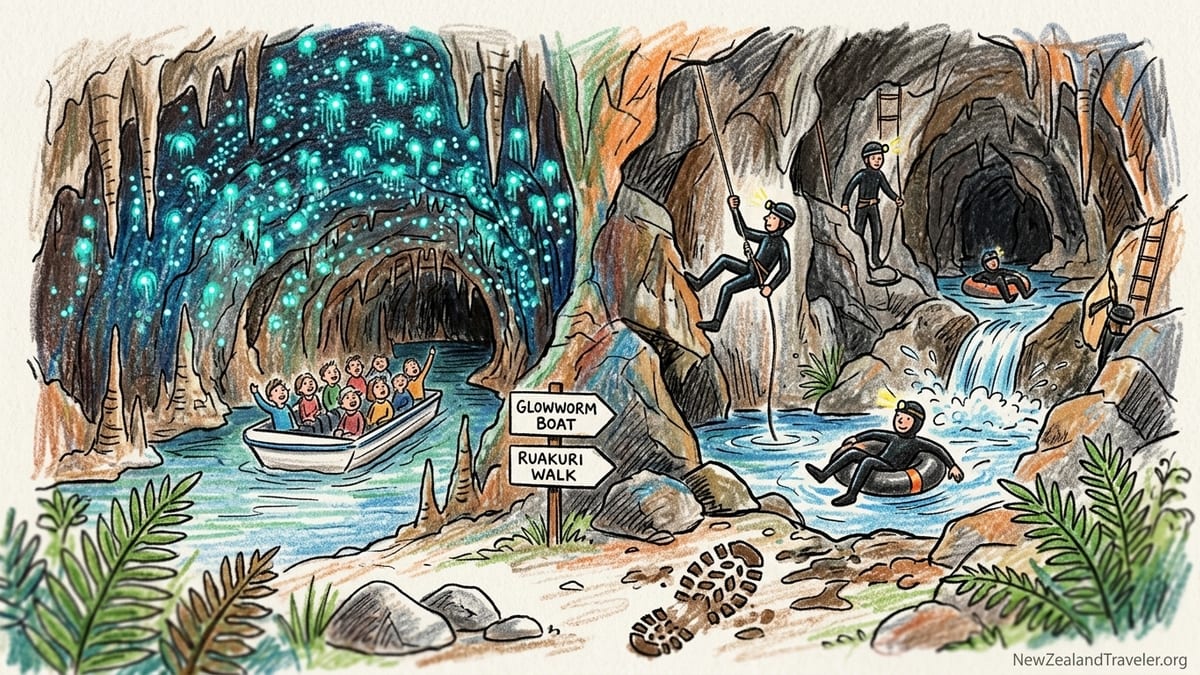
Understanding the Main Waitomo Cave Experiences
Most travelers encounter Waitomo when looking up the world-famous glowworm boat ride through the Waitomo Glowworm Cave. That 45-minute guided tour, currently priced around NZ$61 per adult for standard admission, gives you a gentle walk through large limestone chambers followed by a silent boat drift in the Glowworm Grotto beneath thousands of tiny blue-green lights. It is short, mostly flat, and designed to be accessible to a wide range of visitors, including older travelers and children who can handle a group tour environment.
Ruakuri Cave is the second major product, usually sold as a 1.5 to 2-hour guided walking tour through a longer cave system. Accessed by a dramatic spiral ramp rather than stairs, it is known for being wheelchair accessible on the main route and for allowing photography during the tour, making it attractive for travelers who want to linger over cave formations and take their own images. Prices are typically a little higher than the basic Glowworm Cave ticket, reflecting the longer duration and smaller tour groups.
For visitors who want more than one cave, Discover Waitomo and independent operators sell combination tickets that bundle the Glowworm Cave with Ruakuri, or with the smaller but highly decorated Aranui Cave. These combos are structured to cost less than buying the two caves separately, and they are a smart option if you are driving through the region only once and want a fuller sense of the Waitomo landscape in a single day.
Then there are the black water rafting products. Black Labyrinth and Black Abyss, both operated by The Legendary Black Water Rafting Co, are wet cave adventures using inner tubes and ropes in the Ruakuri cave system. Black Labyrinth is a roughly three-hour tour starting around NZ$193 per person, while the more intense Black Abyss is about five hours underground and starts around NZ$322 per person. These trips serve a completely different audience from the standard cave tours: confident swimmers, physically fit travelers and adventure seekers comfortable with cold water and confined spaces.
Duration, Time Planning and Seasonality
Time is one of the biggest constraints in Waitomo trip planning. The classic Waitomo Glowworm Caves tour runs for about 45 minutes once you are checked in and with your guide, but you should allow at least 90 minutes total including arrival, ticketing and browsing the visitor center afterward. Many Auckland and Rotorua day trips build a single Glowworm Cave visit into a long day that also includes stops in Otorohanga or at Hobbiton, so the short duration fits well for coach groups on tight schedules.
Ruakuri Cave tours are more substantial, so plan on at least 1.5 to 2 hours from start to finish. That includes the slow descent via the spiral ramp, interpretive stops at formations and glowworms, and the return walk. If you are self-driving and mixing Ruakuri with the Glowworm Cave in one day, two cave tours plus check-in time, a café break and some photo stops can easily fill four to five hours. Travelers with evening accommodation in Waitomo village or Te Kuiti generally find it comfortable to book two cave tours on the same day, especially in summer when there is more daylight for the drive.
Black Labyrinth, the introductory black water rafting trip, is structured as a three-hour product, including suiting up in wetsuits and boots, safety briefing, underground tubing and walk-back. Only about an hour is actually spent deep underground, but the entire three-hour window must be protected in your schedule. Black Abyss, which includes abseiling, flying fox, rope climbs and waterfall jumps, is a much bigger commitment. You should allow five hours door to door, which makes it the main anchor of your Waitomo day. Many travelers planning a Black Abyss tour choose to stay overnight nearby rather than rushing on to Rotorua or Taupo the same day.
Seasonality matters mostly for comfort. Tours operate year round, but water in the caves is cold even in summer, and winter temperatures in the region can make the wait between wetsuit and hot shower feel longer. In July and August, a three-hour Black Labyrinth can feel like plenty of time in the water, while the five-hour Black Abyss may be better suited to hardy travelers used to cold-weather activities. The walking cave tours are less season-dependent, although heavy rain can sometimes affect operations or access, so it is wise to check confirmation emails and operator notices on the morning of your visit.
Fitness Levels, Age Limits and Safety Considerations
The gentle Glowworm Cave boat tour is the most accessible of the Waitomo products. The route includes some steps and uneven surfaces but is manageable for most visitors with general mobility. Children are welcome, and families regularly visit with kids as young as four. Babies in arms are typically allowed at the operator’s discretion, but many parents choose to avoid the tour with infants because of the dark environment, the need for quiet in the glowworm section and the potential for crying to disturb other guests.
Ruakuri Cave’s walking tour requires a moderate level of mobility but not technical fitness. The spiral ramp design, rather than a long stairway, means that it is much more accessible than traditional cave tours. It does involve extended periods of standing, walking on damp paths and occasional low ceilings, so people with significant balance issues or severe claustrophobia may find it challenging. There is no specific minimum age in typical marketing materials, and multigenerational groups often book Ruakuri together, from grandparents to school-aged children.
The black water rafting experiences have clearly defined safety criteria. Black Labyrinth requires participants to be at least 12 years old, with a minimum weight of around 45 kilograms. Guides expect guests to be comfortable in water, capable of jumping backwards off small underground waterfalls while holding an inner tube, and able to scramble over rocks and uneven ground in low light. You do not need elite athleticism, but a reasonable baseline of fitness and coordination is important. Operators reserve the right to refuse anyone who appears physically unsuited to the tour for their own safety.
Black Abyss is a serious adventure product and should be treated as such in your planning. Participants must also be at least 12, with similar weight and fitness minimums, but the experience adds technical elements such as a vertical abseil down into the cave, a flying fox in the dark, rope climbs up a waterfall and extended time moving through tight, slippery passages. It is not recommended for anyone uncomfortable with heights, darkness or confined spaces, and is better suited to travelers who have previously tried activities like canyoning, rock climbing or zip-lining and want to step up the intensity in an underground environment.
Photography Rules, Glowworm Etiquette and What You Can Capture
One of the biggest surprises to first-time visitors is that photography is completely banned inside the Waitomo Glowworm Cave, including phones and action cameras. This policy is driven partly by conservation concerns, as repeated light bursts can disturb glowworms, but it is also about managing large group tours safely in darkness and respecting the cultural significance of sections of the cave. You cannot even take photos during the boat ride, so any images you see on postcards or in brochures are usually from professional shoots rather than standard visitors.
Ruakuri Cave is much more camera-friendly. Photography is normally allowed throughout the tour, which means you can linger to photograph stalactites, spiral ramps and small constellations of glowworms. Tripods are usually discouraged for safety reasons, as paths can be narrow, but modern smartphones and compact cameras with good low-light performance can capture atmospheric images. For many travelers, this is the decisive factor in choosing Ruakuri over, or in addition to, the classic Glowworm Cave.
The black water rafting trips sit somewhere in the middle. On Black Labyrinth you typically cannot bring your own camera underground, because you need both hands for safety and because the equipment is not designed for guests to manage personal electronics. However, guides often take photos during the experience using rugged waterproof cameras, and these images may be available for purchase afterward in printed or digital form. It is worth asking at check-in exactly what is offered that day so you can decide whether to budget for souvenir photos.
On Black Abyss, photography and videography are generally prohibited for participants, again for safety and cultural reasons and because of the technical nature of the activities. If capturing glowworms is a high priority for you, consider booking a Ruakuri Cave walk either before or after your Black Abyss adventure. In practice, many photographers pair a calm, camera-friendly Ruakuri tour in the morning with a camera-free Black Labyrinth or Black Abyss trip in the afternoon, accepting that the adventure product is about immersion and memory rather than images.
Pricing, Value and Common Ticket Combinations
At first glance, the spread between Waitomo products can look dramatic: approximately NZ$61 per adult for standard Glowworm Cave admission versus around NZ$193 for Black Labyrinth and roughly NZ$322 for Black Abyss. It helps to think of them as different categories entirely. The Glowworm Cave price is roughly in line with other short, iconic natural attractions worldwide, such as guided walks to New Zealand’s geothermal pools or short glacier viewpoints, while the black water rafting tours are closer in price and structure to half-day canyoning or via ferrata trips.
If you are mainly interested in glowworms and cave formations, the best value is often in combo products. A common combination sold by Waitomo-based operators pairs the Glowworm Cave and Ruakuri on the same ticket, with a total price that undercuts buying both separately. Some Auckland day tours package a Glowworm Cave visit with a visit to Hobbiton Movie Set, effectively spreading the transportation cost across two major attractions. It is worth comparing the price of a direct cave combo with that of a coach or minivan day trip, especially if you are traveling as a family where small differences per person add up.
Black Labyrinth and Black Abyss rarely feature major discounts, though occasional seasonal promotions appear. The most meaningful way to evaluate value here is by asking whether you will realistically use and enjoy the full adventure. Travelers who dislike cold water or who are anxious in the dark often come away feeling they have paid too much for personal discomfort. In contrast, guests who enjoy white-water rafting, canyoning or adventure park ziplines often describe Black Labyrinth as a highlight of their trip and Black Abyss as expensive but unforgettable.
One practical example: a couple traveling on a moderate budget might spend roughly NZ$122 on two standard Glowworm Cave tickets. For not much more than double that, they could book Black Labyrinth for both of them at around NZ$386 total and see glowworms as part of a much longer adventure. Their decision should turn not on the raw price difference but on whether they want a calm, accessible showcase of glowworms or a three-hour immersion in cold, moving water with a significant physical component.
Which Experience Suits Families, First-Timers and Adventure Travelers
For families with younger children, the standard Glowworm Cave tour is usually the easiest fit. It is short enough to match limited attention spans, the walking is gentle, and there is no need to change into special gear. Many families pair this with a stop at the nearby Waitomo Caves Museum or Ruakuri Bush Walk, creating a full day of age-appropriate activity without committing to a second paid cave. When children are old enough to enjoy a slightly longer and more educational tour, Ruakuri becomes an excellent second step, especially for kids curious about geology or ecosystems.
Multi-generational groups and first-time visitors to New Zealand often choose a Glowworm plus Ruakuri combo. The shorter Glowworm tour delivers the iconic boat ride, while Ruakuri offers a slower, more detailed exploration with the ability to take photographs. This combination works well if you are unsure how older relatives will handle stairs, as the ramped access at Ruakuri is generally more forgiving than a long descent in the dark. It also spreads out your time underground, avoiding the fatigue that can come from trying to do too much in one cave.
Adventure travelers and confident swimmers who are at least 12 years old will usually get more from the black water rafting side of Waitomo. Black Labyrinth is the natural entry point: it includes tubing, small waterfall jumps and a mix of floating and walking, but does not demand specialist skills. Many backpackers, van lifers and road-tripping couples build this tour into their North Island itinerary as their main Waitomo experience and skip the classic boat tour entirely.
Black Abyss is best reserved for visitors who are both physically capable and genuinely enthusiastic about technical adventure sports. If you have abseiled in a canyon in the Blue Mountains, tried a multi-pitch via ferrata in Europe, or enjoyed ice climbing or serious scrambling elsewhere, you are in the right demographic. If your main goal in Waitomo is simply to see glowworms and you have not done much adventure tourism before, Black Abyss is likely to feel like overkill in both intensity and price. In that situation, pairing the Glowworm Cave with Ruakuri, or the Glowworm Cave with Black Labyrinth, provides a more balanced introduction.
Real-World Itineraries: How Travelers Actually Combine Tours
To make all of this more concrete, consider a couple driving from Auckland to Rotorua with just one full day for Waitomo. If they are traveling with a 9-year-old and a 13-year-old, a realistic plan is to book the 10:00 a.m. Glowworm Cave tour for the whole family, have lunch in Waitomo village and then let the 13-year-old and one parent tackle Black Labyrinth in the afternoon while the other parent takes the younger child to the Ruakuri Bush Walk or the local museum. This way, the younger child avoids age restrictions and cold water while still experiencing glowworms and caves.
A second, very different example: two friends in their early thirties, both reasonably fit and keen on adrenaline activities, are driving a campervan through the North Island in late November. They choose to stay at a Waitomo holiday park for two nights. On day one, they book a mid-morning Ruakuri Cave tour for photography and context, then relax at their campsite. On day two, they schedule the five-hour Black Abyss trip at midday, giving themselves a calm, warm morning and the evening to recover after hot showers and a meal. In their case, the classic Glowworm boat tour is optional, because glowworms are already included as part of both Ruakuri and Black Abyss.
A third scenario involves travelers on a tight budget doing New Zealand by bus. They take a day trip from Auckland that includes transport, a Waitomo Glowworm Cave tour and a brief stop in a nearby town, returning the same evening. Here, the coach itinerary makes it difficult to add Ruakuri or black water rafting, and the right call is simply to lean into the short, iconic experience and treat it as a highlight of the journey between cities. If those same travelers later rent a car for a North Island road trip, they might return to Waitomo and choose Ruakuri or Black Labyrinth as a deeper, second experience.
These examples illustrate that there is no single “best” cave in Waitomo. The right choice depends on your group composition, interests and energy. The key is to start with your non-negotiables: minimum ages, fitness comfort zone, photography goals and how much you want to spend. Once those constraints are clear, the decision between Glowworm, Ruakuri, combos, Black Labyrinth and Black Abyss usually becomes straightforward.
The Takeaway
If your goal is a gentle, iconic experience suitable for almost any traveler, the classic Waitomo Glowworm Cave tour delivers exactly that in under an hour at around NZ$61 per adult. It is the most accessible entry point into the region and integrates seamlessly into bus and self-drive itineraries. Just remember that you will not bring home your own photos from inside the cave, and that the experience is over quickly compared with the longer products on offer.
Travelers who want more time underground, more context and the ability to shoot their own images should give Ruakuri serious consideration, either alone or in a combo with the Glowworm Cave. For many people, a one-two punch of Glowworm plus Ruakuri strikes the best balance of price, variety and accessibility, especially in mixed-age groups or for first-time visitors to New Zealand.
Those drawn to adventure tourism will find that Waitomo’s true adrenaline heart lies in Black Labyrinth and Black Abyss. Black Labyrinth provides a three-hour sample of black water rafting at a starting price around NZ$193, while Black Abyss scales up the commitment to about five hours and roughly NZ$322 with abseils, ziplines and waterfall climbs. These trips are unquestionably more expensive, but they pack in far more activity and time underground and are often remembered as signature experiences of a North Island road trip.
Ultimately, the best Waitomo choice is the one that respects your group’s limits while matching your curiosity. Decide how wet, how physical and how long you want to be underground, factor in the ages and fitness of everyone involved, then pick the product that aligns. Whether you quietly drift under a galaxy of glowworms or leap backwards into an underground river, Waitomo rewards those who choose with clear eyes and realistic expectations.
FAQ
Q1. Is the Waitomo Glowworm Cave suitable for young children and older travelers?
The standard Glowworm Cave tour is designed to be accessible, with a short duration, gentle walking and no special gear, so it usually suits families and older visitors who can manage a few stairs and low light.
Q2. Can I take photos inside the Waitomo Glowworm Cave?
No. Photography and video, including phones and action cameras, are not allowed inside the Glowworm Cave, especially during the boat ride, to protect the glowworms and manage safety in the dark.
Q3. What is the main advantage of choosing Ruakuri Cave over the classic Glowworm Cave?
Ruakuri offers a longer, more detailed walking tour with the ability to take your own photos of formations and glowworms, and its spiral ramp access is generally more accessible than steep cave stairways.
Q4. How long does the Black Labyrinth black water rafting tour take?
Black Labyrinth is structured as a three-hour experience including check-in, gearing up, safety briefing and time underground, with about an hour actually spent deep in the cave system.
Q5. Who should consider the Black Abyss tour instead of Black Labyrinth?
Black Abyss is aimed at physically fit adventure travelers comfortable with heights, darkness and confined spaces who want a longer, more technical experience with abseils, ziplines and waterfall climbs.
Q6. What are the minimum age and fitness requirements for black water rafting in Waitomo?
Both Black Labyrinth and Black Abyss generally require participants to be at least 12 years old, meet a minimum weight threshold and be physically capable of swimming, jumping and scrambling over rocks in cold water.
Q7. Is it worth buying a combo ticket for the Glowworm and Ruakuri caves?
For many visitors, a combo is good value because it costs less than booking the two caves separately and delivers both the iconic boat ride and a longer, more in-depth walking tour.
Q8. Can I see glowworms if I only book a black water rafting tour?
Yes. Both Black Labyrinth and Black Abyss run through sections of cave with glowworms, so you will see them as part of the adventure even if you skip the classic Glowworm boat tour.
Q9. How should I plan my day if I want to do both Ruakuri and a black water rafting tour?
Most travelers schedule a Ruakuri walking tour in the morning, take a break for lunch, then book a Black Labyrinth or Black Abyss departure in the afternoon so there is time to recover with hot showers afterward.
Q10. What should I wear and bring for a black water rafting trip in Waitomo?
Operators provide wetsuits, boots and helmets, so you mainly need swimwear, a towel, warm clothes to change into afterward, and a realistic understanding of your comfort with cold water and dark confined spaces.