


The Waikato is often described as the beating rural heart of New Zealand’s North Island, a green belt of dairy farms, limestone hills and river valleys that sits between Auckland and Rotorua. For many first-time visitors it is a place you drive through on the way to somewhere else, yet it contains some of the country’s most memorable experiences: the Hobbiton Movie Set near Matamata, glowworm caves at Waitomo, surf breaks and black-sand beaches at Raglan, and a surprisingly lively city scene in Hamilton. This guide connects the key hubs of Hamilton, Cambridge, Matamata and Hobbiton, Waitomo, Raglan, Lake Karāpiro and Sanctuary Mountain Maungatautari, and shows how Waikato fits neatly into a wider North Island itinerary.
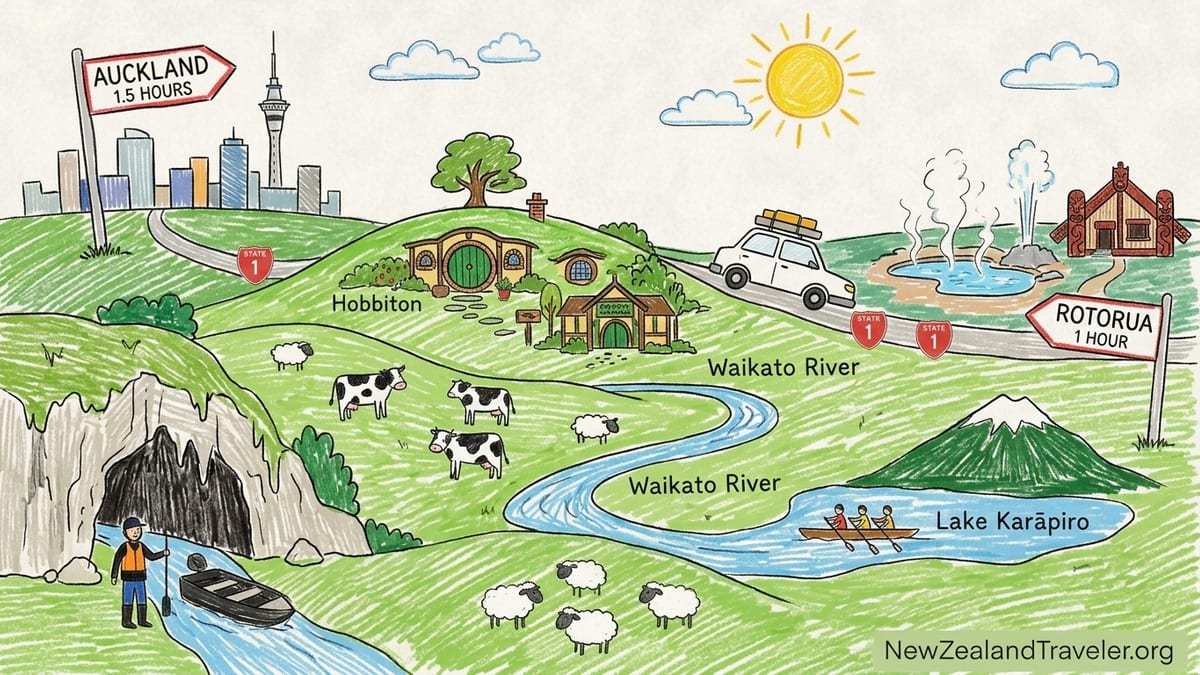
How Waikato Fits Between Auckland, Rotorua and the North Island
On a map, Waikato forms a broad band across the upper central North Island, immediately south of Auckland and west of Rotorua. For first-time visitors this geography makes it a natural connector: you can drive from central Auckland to Hamilton in about 1.5 hours, continue 45 minutes to Cambridge or Matamata, then reach Rotorua in another hour or so. That means you can land in Auckland, collect a rental car and be among rolling pastures and limestone hills before lunch.
Waikato’s main routes are straightforward. State Highway 1 runs south from Auckland past the Bombay Hills towards Hamilton and Cambridge, while State Highway 3 cuts southwest from Hamilton to Waitomo and on towards Taranaki. Raglan branches off to the west on a sealed road from Hamilton in about 45 minutes, and Hobbiton is roughly 45 minutes east of Hamilton, close to Matamata. For planning, almost everything in this guide is within 45 to 90 minutes of Hamilton, so you can build day trips rather than packing and unpacking every night.
In a classic North Island loop, many travellers start in Auckland, drive via Waikato to Rotorua and Taupō, then continue to Tongariro National Park or return via the west coast. Some add a night in Raglan for surfing and coastal scenery, or a farm stay near Cambridge for rural life. Because driving distances are moderate, you can comfortably fit Hobbiton, Waitomo and Raglan into a three or four day window between Auckland and Rotorua without feeling rushed, provided you book the major attractions in advance.
Public transport exists but is limited compared with driving. Intercity-style buses run between Auckland, Hamilton, Rotorua and some Waikato towns, and there are shuttle services to Hobbiton and Waitomo, but you will have the most flexibility with your own car or a rental campervan. Distances are short but roads can be narrow and winding in places, especially towards Raglan and Waitomo, so allow a little margin in your timing.
Hamilton and Cambridge: Urban Hub and Rural Charm
Hamilton is the practical hub of Waikato and the place where many itineraries intersect. The city spreads along the Waikato River and offers more than most visitors expect, with riverside walking paths, a growing food scene and the highly regarded Hamilton Gardens. These themed gardens are free to enter and might easily fill a morning: you can wander from a formal Italian Renaissance garden into a Japanese contemplative space, then step into a whimsical Surrealist garden that feels like walking through an artwork.
For accommodation, Hamilton covers the full spectrum. Around the central city you will find familiar mid-range chains, motels and serviced apartments that suit road trips and families, along with smaller boutique hotels. Typical nightly rates range from budget motels to comfortable mid-range hotels that sit between backpacker and high-end luxury. The city is a good base if you prefer to return to the same hotel each night and drive out on day trips to Raglan, Waitomo or Hobbiton.
Cambridge, about 25 minutes southeast of Hamilton, has a very different feel. Marketed as a “town of trees and champions” for its leafy streets and equestrian culture, it is smaller, calmer and closer to Lake Karāpiro and Sanctuary Mountain Maungatautari. The town centre has historic buildings, independent cafes and antique shops, and many visitors stay in characterful bed and breakfasts or farm stays on the outskirts. Properties on lifestyle blocks often offer guest rooms overlooking paddocks, where you might wake to the sound of cattle being moved or horses grazing.
Between Hamilton and Cambridge you will also find practical services that can anchor a trip, such as major supermarkets, rental car depots and fuel stations. For first-time visitors who want a mix of city convenience and rural atmosphere, a common pattern is two nights in Hamilton followed by two nights in or near Cambridge. From these two bases you can cover Raglan, Waitomo, Hobbiton, Lake Karāpiro and Sanctuary Mountain on manageable day trips.
Matamata & Hobbiton: Middle Earth and Pastoral Waikato
Matamata is a small rural service town about 45 minutes from Hamilton and 50 to 60 minutes from Rotorua by car. On its own it is a classic Waikato farming centre, with a main street of cafes, bakeries and agricultural suppliers, fringed by lush paddocks and low hills. Since Peter Jackson chose a nearby sheep and beef farm as the filming location for the Shire in The Lord of the Rings and The Hobbit films, Matamata has become a global tourism magnet and one of Tourism New Zealand’s headline Waikato experiences.
The Hobbiton Movie Set lies a short drive from town on that working farm, accessible only by guided tour. Standard tours last around two to two and a half hours on site, reached by a short coach ride from the visitor base, and take you on foot past dozens of hobbit-hole facades, the Party Tree and the Mill pond area before finishing at the Green Dragon Inn for an included drink. Adult tickets for the core “Signature” tour typically sit a little above the hundred New Zealand dollar mark, with child prices roughly half that, and must be booked in advance during busy periods.
For first-time visitors, the decision is usually whether to visit Hobbiton as a day trip or to stay overnight nearby. Many travellers visit on coach tours from Auckland or Rotorua, sometimes combined with Waitomo in a long day, but self-drivers often find it more relaxed to stay a night in Matamata or Cambridge and book a morning or late afternoon tour. In Matamata you will find motels, a holiday park and a small selection of bed and breakfast options. In Cambridge, the accommodation tends more towards boutique guesthouses and rural stays, which pair well with a Hobbiton excursion followed by dinner in town.
Visiting Hobbiton also gives you a glimpse into everyday Waikato farming life. As you drive out to the set you pass grazing sheep and tidy hedgerows, and guides often talk about seasonal farm rhythms alongside film trivia. Combined with a stop at a local cafe in Matamata or a detour to Te Aroha’s heritage main street, a Hobbiton day feels like a crossover of fantasy cinema and real-world rural New Zealand.
Waitomo: Glowworms, Caves and Underground Adventure
Southwest of Hamilton, around a 1 hour 15 minute drive away, the village of Waitomo sits on a limestone plateau riddled with caves and underground rivers. The area’s most famous draw is the Waitomo Glowworm Cave, where you walk through caverns and finish with a silent boat ride under a ceiling of tiny bioluminescent insects. The effect is often compared to drifting under a galaxy of stars and remains one of the North Island’s signature experiences.
Beyond the classic glowworm boat tour, Waitomo has a cluster of other caves and adventure options. Ruakuri Cave is known for its dramatic spiral entrance and longer walking tour, while Aranui Cave offers formations and speleothems in a quieter setting. For thrill-seekers, operators such as the Legendary Black Water Rafting Co. run trips that combine caving, tubing or abseiling into underground streams, often branded as Black Labyrinth or Black Abyss tours. These require a reasonable level of fitness and comfort with water and enclosed spaces, and cost more than the standard cave walks, but deliver a very different style of encounter.
Accommodation in Waitomo ranges from backpacker hostels and campgrounds through to lodges and motels dotted around the surrounding countryside. Many travellers opt to stay one night in or near the village, do two cave experiences across an afternoon and the following morning, then drive on to their next stop. Others base themselves in Hamilton and make Waitomo a long day trip, driving down for a morning glowworm tour and returning via the back roads in time for dinner in the city.
From a wider itinerary perspective, Waitomo slots neatly between Auckland or Hamilton and the Taranaki region, or between Hamilton and the “Forgotten World” highway. If you are linking Waikato with Rotorua and Taupō, you can drive a triangle: Hamilton to Waitomo, then cut east through rural backroads towards Te Awamutu and on to Rotorua. Distances look small on the map but the roads are winding, so allowing at least two to two and a half hours between Waitomo and Rotorua is sensible.
Raglan: Black-Sand Beaches, Surf and Laid-Back Coastal Life
Raglan, about 45 minutes west of Hamilton by car, offers a complete contrast to the inland farms and caves. This small harbour town on the Tasman Sea is famous in surf circles for the long left-hand point breaks at Manu Bay and Whale Bay, made legendary by the 1960s surf film “The Endless Summer”. More broadly, it is known for dramatic volcanic black-sand beaches, rolling dunes and a relaxed, creative community that draws artists, surfers and weekenders from across the North Island.
Ngarunui Beach, a few kilometres from town, is the main swimming and beginner-surfing beach, a wide sweep of dark sand backed by dunes and coastal forest. On summer days you will see surf schools running group lessons, families picnicking on the sand and experienced surfers using the beach as a warm-up before heading to the point breaks further around the coast. The iron-rich black sand absorbs heat, so many visitors wear sandals or jandals for comfort when walking at the height of the day.
The town itself has a compact centre of cafes, galleries, surf shops and fish and chip counters around the harbour. You can rent surfboards or wetsuits from local outfits, book a beginner lesson or simply watch the sunset from the wharf with a takeaway coffee. Nearby attractions include Bridal Veil Falls, a 55-metre waterfall reached by a short bush walk, and Mount Karioi, an extinct volcano that offers demanding full-day hikes with wide views over the coast when the weather is clear.
Raglan’s accommodation scene leans towards casual and creative. Expect hostels with ocean views, campground and holiday parks, self-contained baches and holiday homes, and a handful of boutique lodges or eco-stays that emphasise local materials and low-impact design. Nightly rates are often higher in peak summer and over long weekends, and many places require two-night minimums, so advance booking is wise. For first-time visitors with a car, a common pattern is to spend two nights in Raglan between Hamilton and New Plymouth, or to day trip from Hamilton if time is tight.
Lake Karāpiro & Sanctuary Mountain: Nature, Cycling and Wildlife
Lake Karāpiro, a hydro lake on the Waikato River about 15 minutes from Cambridge, is the region’s centre for rowing and flatwater paddling. On many mornings you will see training sculls gliding across the still water or school teams preparing for regattas. For visitors it offers a mix of lakefront holiday parks, walking tracks and water activities such as stand-up paddleboarding or kayaking. Several operators rent gear on the lakefront or run guided tours on sheltered sections of water, particularly in the summer months.
The lake edges also form part of longer cycling routes. Sections of the Waikato River Trails run nearby, offering off-road riding through rural scenery with river views. Around Cambridge itself, a network of shared paths and quiet country roads give beginners and families options for shorter rides, perhaps linking the town centre with Lake Karāpiro and back via backroads. Bike hire is available in Cambridge, and many accommodation providers can point you towards routes suited to your fitness and experience.
Sanctuary Mountain Maungatautari, about 35 to 40 minutes drive from Cambridge, is one of New Zealand’s most significant mainland ecological restoration projects. The mountain is ringed by a predator-proof fence, creating a safe haven for native birds and forest life. Visitors can walk well-maintained tracks through mature bush, listen for birdsong from species such as kākā or saddleback, and climb towers or viewing platforms that rise above the canopy. Guided walks are available and provide insight into conservation work and Māori cultural connections to the maunga.
Both Lake Karāpiro and Sanctuary Mountain suit travellers who want to balance headline attractions such as Hobbiton and Waitomo with quieter, nature-focused experiences. You might stay in a lakeside cabin or a rural bed and breakfast outside Cambridge, spend one day cycling and paddling on Lake Karāpiro, and the next walking in the sanctuary before heading on to Rotorua. These stops also work well for families, giving children space to move and interact with nature between more structured activities.
Where to Base Yourself, Driving Times and Accommodation Styles
The key to a relaxed Waikato itinerary is choosing one or two bases and understanding realistic driving times. Hamilton is the most central hub: from the city centre it is roughly 45 minutes to Raglan, just over an hour to Waitomo, about 45 minutes to Matamata and Hobbiton, and around 25 minutes to Cambridge. From Cambridge it is about 15 minutes to Lake Karāpiro, 35 to 40 minutes to Sanctuary Mountain Maungatautari and around an hour to Rotorua.
For many first-time visitors with three or four nights to spend in Waikato, a simple pattern works well. Spend two nights in Hamilton to cover Raglan and Waitomo as day trips, then two nights in or near Cambridge or Matamata to visit Hobbiton, Lake Karāpiro and Sanctuary Mountain before continuing to Rotorua or Taupō. If you have less time, you might choose three nights in Hamilton alone and accept a slightly longer drive to Hobbiton on one of the days.
Accommodation across the region broadly falls into several categories. In Hamilton you will find city hotels, serviced apartments and motels, suitable for travellers who prefer on-site restaurants, easy parking and short walks to evening dining. Around Cambridge, Matamata and the countryside you are more likely to encounter bed and breakfasts, farm stays and holiday homes, where you might share breakfast with hosts or wake to views over paddocks and hills. In Raglan and at Lake Karāpiro, holiday parks, simple cabins and beachfront baches are common, reflecting the coastal and outdoor focus.
Pricing varies by season, but as a general guide, basic motel rooms often sit in the lower to mid hundreds of New Zealand dollars per night in high season, while boutique lodges and full-house rentals can climb higher, especially for properties with standout views or amenities such as hot tubs. Camping and holiday park sites are more budget-friendly and appeal to campervan travellers. Because major events in Hamilton or regattas at Lake Karāpiro can book out entire towns, checking local calendars and reserving key nights early is prudent.
Beyond the Icons: Rural Life, Gardens and Everyday Waikato
While Hobbiton, Waitomo and Raglan are the headline experiences marketed by Tourism New Zealand, part of Waikato’s appeal lies in its quieter layers. Driving the backroads between Cambridge, Te Awamutu, Matamata and Tirau, you see the day-to-day patterns of dairy farming and rural life: early-morning milking sheds lit in the half-light, tanker trucks on their rounds, and lines of Friesian and Jersey cows heading to new pasture. Many small towns have cafes that double as community hubs, where you might sit alongside local shearers or vet nurses on their morning tea break.
Hamilton Gardens represents another side of the region’s identity, blending horticulture, art and storytelling. Each enclosed garden tells a distinct narrative, from a productive kitchen garden echoing the city’s food-growing heritage to the new concept gardens that play with design and symbolism. Visiting in late afternoon can be particularly pleasant, when the light softens and local families stroll after work. The gardens also host events and festivals at various times of year, so you may find outdoor performances or food stalls during your visit.
Markets and local produce are strong themes, especially around Cambridge and Matamata. Weekend farmers markets often feature artisan cheeses, honey, seasonal fruit and small-batch baking, much of it produced within a short drive. Some visitors structure their days around these markets, picking up picnic supplies before heading to Lake Karāpiro, Raglan or a roadside lookout. Farm tours and hands-on rural experiences are available in parts of the region, though usually need to be booked ahead and are more common on smaller, visitor-focused properties than large commercial dairy farms.
Cycling is an increasingly visible part of Waikato life. In addition to the Waikato River Trails and paths around Lake Karāpiro, many towns have invested in shared pathways and rideable links between suburbs, parks and riverbanks. For visitors this means you can hire a bike in Hamilton or Cambridge and spend a half day riding flat, scenic routes without needing technical mountain biking skills. It is an easy way to experience the gentle contours of the landscape and to connect pockets of urban and rural scenery.
The Takeaway
For first-time visitors to New Zealand, the Waikato often begins with a single image: Hobbit holes in the Shire, glowworms over an underground river, or a surfer cruising across a Raglan point break. In reality the region is a network of experiences that link the rural heartland, a growing regional city, dramatic west coast beaches and restored native forest, all within a couple of hours of Auckland and Rotorua.
By choosing practical bases in Hamilton, Cambridge, Matamata or Raglan and understanding drive times, you can weave Hobbiton, Waitomo, Raglan surf, Lake Karāpiro and Sanctuary Mountain Maungatautari into a relaxed itinerary that still leaves room for gardens, markets and quiet backroads. Rather than treating Waikato as a corridor to be rushed through, slowing down for three or four days reveals how these elements fit together: a region where global film pilgrims and underground adventurers share space with rowers on the river and farmers in the fields.
Whether you are road tripping in a rental car, joining coach tours from Auckland or Rotorua, or exploring by campervan, Waikato rewards a little extra time and curiosity. Stop for coffee in a farm town, walk an extra trail in the sanctuary, stay long enough in Raglan to watch the tide and light change. The big North Island icons will still be there when you arrive, and your memories of this green heartland in between may be just as strong.
FAQ
Q1. How many days should I spend in Waikato on a first visit?
Most first-time visitors find that three to four days is enough to see Hobbiton, Waitomo, Raglan and a mix of Hamilton, Cambridge or Lake Karāpiro without rushing.
Q2. Is it better to base myself in Hamilton or Cambridge?
Hamilton is more central for day trips to Raglan and Waitomo and has more hotels and dining, while Cambridge is quieter, closer to Lake Karāpiro and Sanctuary Mountain and offers more rural-style stays.
Q3. Do I need to book Hobbiton tours in advance?
Yes, advance booking is strongly recommended, especially in summer and around public holidays, because popular tour times and special experiences often sell out.
Q4. Can I visit Hobbiton and Waitomo in one day from Auckland?
It is possible on a long guided coach tour or a full day of self-driving, but you will spend many hours on the road. Staying in Waikato and splitting them across two days is more relaxed.
Q5. Is Raglan suitable for beginner surfers?
Yes, Ngarunui Beach near Raglan has sand-bottom waves and surf schools that cater to beginners, while the famous Manu Bay point break suits more experienced surfers.
Q6. Do I need my own car to explore Waikato?
You can reach some highlights with buses and organised tours, but having your own car or campervan gives you far more flexibility for small towns, lakes and trailheads.
Q7. What kind of clothing should I pack for Waikato?
Pack layers, including a light waterproof jacket, comfortable walking shoes and a warm layer for cool evenings or cave tours, plus swimwear and sun protection for lakes and beaches.
Q8. Are the Waitomo caves suitable for children?
The standard glowworm boat tour and some walking cave tours are generally family-friendly, while black water rafting and abseiling trips are restricted to older children and adults who meet age and fitness requirements.
Q9. Can I visit Sanctuary Mountain Maungatautari without a guide?
Yes, there are self-guided walking tracks within the fenced area, and you can also book guided walks if you want more context on wildlife and conservation work.
Q10. How does Waikato fit into a wider North Island road trip?
Waikato naturally links Auckland with Rotorua, Taupō and Taranaki, so many travellers pass through as part of a loop, using Hamilton or Cambridge as bases before heading further south or east.