


Waikato is one of those regions where everything looks temptingly close on the map, yet each town offers a very different experience. Rather than racing between photo stops, it pays to decide where you actually want to sleep, linger over coffee and unpack your bag. This guide compares Waikato’s key destinations Hamilton, Matamata for Hobbiton, Waitomo, Cambridge, Raglan and Maungatautari not as a list of attractions, but as distinct bases for different kinds of trips, with clear advice on when to stay overnight and when a simple stop on a road trip is enough.
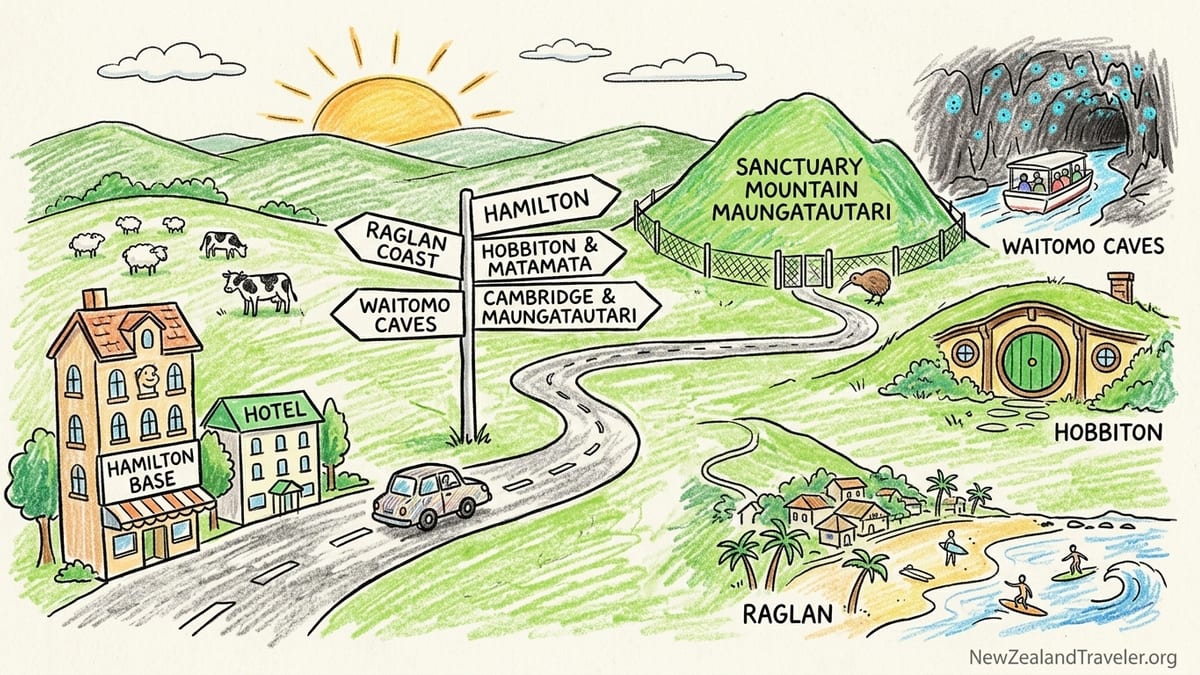
How to Structure a Waikato Trip
Most visitors see Waikato on a loop between Auckland, Rotorua and the central North Island, often trying to squeeze Hobbiton, glowworm caves and the coast into one frantic day. On paper you can drive from Hamilton to Hobbiton in around an hour, then another hour to Waitomo, and another 90 minutes or so to Raglan if traffic cooperates. In practice, tours, weather and rural roads mean you will enjoy Waikato more if you pick one or two hubs and accept some things will be day trips.
A realistic three or four day plan might use Hamilton or Cambridge as a central base, adding single nights in Raglan or Waitomo if you want sunset, stargazing or early-morning activities. If your time is tighter, you might keep your luggage in one place and treat Hobbiton, Maungatautari and Waitomo as spoke trips from Cambridge or Hamilton, both of which sit within roughly an hour’s drive of most of the region’s highlights.
When choosing a base, think about your style rather than only distance on a map. Do you want café culture and a wide range of restaurants, or are you happiest rinsing sand off your feet beside a beachside holiday park sink? Are you travelling with children who nap in the middle of the day, or keen to book a late-night kiwi-spotting walk? The sections below break down each destination in those real-world terms, including when an overnight stay genuinely adds value.
Hamilton: Urban Hub for Gardens, Food and Convenience
Hamilton is the region’s largest city and the practical transport hub, with intercity buses, a small airport and the most accommodation variety from central business hotels to budget motels and family apartments. Travelers often underestimate it, but for many itineraries Hamilton is the easiest place to base yourself if you want convenience and choice rather than a picture-perfect village feeling.
The city’s headline draw is Hamilton Gardens on the southern edge of town, a sprawling collection of themed gardens that has grown into one of New Zealand’s most visited attractions, drawing well over a million visitors a year. You can wander from an Italian Renaissance courtyard to a Japanese garden of contemplation and on to Te Parapara, the country’s only traditional Māori productive garden, in the space of a morning. The gardens are free to enter for general exploring, so you can drop in for an hour between other plans or return on multiple days without watching the clock.
Hamilton’s compact centre along Victoria Street and the river is where the convenience shows. You can check into a mid-range hotel near the river, drop your car in an undercover car park and spend the evening walking to dinner, riverside bars and late-opening supermarkets. Dining ranges from relaxed burger spots and Korean barbecue joints to busy bistros doing seasonal New Zealand produce and good wine. For many visitors, that means you can spend the day in Hobbiton or at Maungatautari, then drive back to a familiar, well-lit base with plenty of food options still open after 8 pm.
Hamilton works well as a base if you have two to four nights in Waikato and want to minimise hotel changes. It is particularly practical for families who like playgrounds and easy supermarket access, and for travellers using public transport. If you are motivated mostly by scenery and small-town charm, you might prefer Cambridge as your base instead, but Hamilton deserves at least one full day and is often worth an overnight stay purely for its gardens and food scene.
Matamata & Hobbiton: A Cinematic Detour or Themed Overnight
Matamata itself is a modest rural service town, set in rolling dairy country about 45 minutes’ drive from both Hamilton and Cambridge. The reason most people come is Hobbiton, the film set built on a nearby sheep farm and now one of New Zealand’s busiest privately run attractions. Tours depart from the Hobbiton Movie Set site on Buckland Road and from Matamata’s i-SITE, and usually last around two to three hours including a guided walk past hobbit holes and a drink at the Green Dragon Inn.
For many travellers, Hobbiton functions best as a half-day trip from another base. If you are staying in Cambridge, for example, you can easily book a late-morning Hobbiton tour, leave after breakfast, stop for coffee at one of Matamata’s cafes, join your tour, then be back in Cambridge or on to Rotorua by late afternoon. That suits itineraries where Hobbiton is a must-see but you do not particularly need to wander Matamata’s streets in the evening.
An overnight in Matamata makes sense if you are a devoted fan who has booked one of the evening banquet experiences or early-morning tours, which often come with lower crowd levels and softer light for photos. In those cases, staying in town or at a nearby rural lodge keeps your driving in the daylight. It can also be appealing if you want the feel of a small Waikato town, with farm-supply stores, takeaway outlets and one or two sit-down restaurants rather than a long strip of bars.
In decision terms, treat Matamata and Hobbiton as a specialty stop rather than a base for exploring the wider region. One night is plenty unless you are combining it with horse trekking or other local rural experiences. If you are short on time, keep your overnight in Cambridge or Hamilton and let Hobbiton be a memorable detour.
Waitomo: Glowworms, Caves and When to Stay the Night
Waitomo is a tiny settlement built around a world-famous cave system. The classic experience is the Waitomo Glowworm Cave boat tour, where guides lead you through limestone chambers and then pole a small boat under a canopy of blueish glowworms in almost complete silence. Nearby Ruakuri and Aranui caves add spiral entrances, stalactites and more spacious caverns, and several operators run black water rafting trips involving wetsuits, inner tubes and underground rivers.
From Hamilton or Cambridge, Waitomo is usually around 90 minutes’ drive each way. That makes it perfectly manageable as a day trip, especially if you pre-book a mid-morning or early-afternoon cave tour. Many visitors drive down, do one or two caves plus a café lunch in the village or at a roadside diner in nearby Otorohanga, then return to their base before dark. This is the most efficient approach if you prefer not to change accommodation and do not plan to do adventure caving.
Staying overnight in or near Waitomo comes into its own if you want either a very relaxed schedule or a full day of activities. For instance, you might arrive by late afternoon, check into a farmhouse stay or motel, enjoy dinner at the local tavern, and then be up early for a first cave tour before the big coaches arrive. If you are booked on a longer four to five hour black water rafting or abseiling trip, having a comfortable room a five-minute drive away is much less tiring than facing a long drive back after being cold and wet underground.
Used as a base, Waitomo is quite limited. Once you have done the caves and perhaps a short bush walk to a viewpoint or waterfall, there is not a lot of evening buzz. For most travellers, the sweet spot is one night if you have a packed cave itinerary, or a simple day trip from Hamilton or Cambridge if you only plan a standard glowworm tour and a second cave.
Cambridge: Attractive Rural Base for Slow Travel
Cambridge has become one of Waikato’s most appealing overnight bases, especially for travellers who like a small-town feel without sacrificing good coffee and restaurants. About 25 minutes’ drive from Hamilton, the town is known for its mature tree-lined streets, heritage buildings and relaxed, slightly genteel atmosphere that has earned it the nickname town of trees and champions. It also sits close to Lake Karāpiro, a major rowing venue, and the Grassroots Trust Velodrome, which anchors its reputation as a cycling hub.
The compact centre is very walkable. You can base yourself in a character lodge or modern motel a few blocks from Victoria Street, then spend mornings strolling to the farmers’ market on weekend days, browsing antique shops and boutiques, and circling the hidden lake of Te Koo Utu in the middle of town. Cafes do serious espresso and cabinet food, while bistros and wine bars serve modern New Zealand dishes that would not feel out of place in a larger city, often using produce from the surrounding farms.
Practically, Cambridge makes an excellent hub for a three or four night stay if your focus is the wider Waikato rather than one single marquee attraction. You are within comfortable driving distance of Hobbiton near Matamata, Sanctuary Mountain Maungatautari, Lake Karāpiro walks and water activities, and the inland routes to Rotorua and Taupō. The Te Awa River Ride, a sealed cycle and walking trail along the Waikato River, runs past town, so you can hire bikes locally and ride traffic-free sections without needing a support vehicle.
If you enjoy evenings that are lively enough for a drink and good dinner but quiet by midnight, Cambridge is a strong choice. It suits couples, families and anyone building a slower-paced itinerary around rural scenery, cycling and easy access to both Hamilton’s city services and the more remote nature experiences. For many visitors, Cambridge and one night elsewhere, such as Raglan or Waitomo, make a very satisfying four to five day Waikato trip.
Raglan: Surf Town and Black Sand Coast
Raglan sits on the wild west coast, about 45 minutes’ drive from Hamilton on a winding road that makes it feel further away in spirit than it is on the odometer. The town is best known for its surf, with the long left-hand point break at Manu Bay and nearby Whale Bay acting as magnets for surfers from around the world. Just down the coast, Ngarunui Beach offers a wide expanse of black volcanic sand and a more forgiving beach break, which is where most surf schools take beginners for lessons.
The township itself has an easygoing, somewhat bohemian feel, with compact streets lined by surf shops, galleries, cafes and fish and chip counters. You will find everything from vegan-friendly brunch spots to food trucks doing tacos and burgers, along with casual bars that fill on weekend evenings. Accommodation runs from backpacker hostels and surfer lodges to holiday homes and a few boutique stays perched on the hills. Many have outdoor decks where you can watch the light fade over the harbour after a day in the water.
Whether Raglan deserves an overnight stay depends on how much the coast matters to you. If you just want to see black sand, watch a few sets roll through at Manu Bay and grab lunch with a view, you could theoretically do it as a day trip from Hamilton, especially in summer when the days are long. In real terms, though, the combination of curvy roads, surf traffic and the temptation to stay for sunset makes rushing back feel wasteful.
If you care about surfing, beach walks or coastal photography, Raglan repays at least one, preferably two nights. That gives you the flexibility to catch a lesson at Ngarunui Beach, walk the length of the sand at low tide, explore both the harbour and oceanfront sides of town, and still have downtime for slow coffees. It is not a convenient base for the rest of Waikato, as you have to backtrack inland for almost everything, so think of Raglan as a side chapter in your itinerary rather than your main hub.
Maungatautari: Immersive Native Wildlife Without the Crowds
Sanctuary Mountain Maungatautari, south of Cambridge, is one of New Zealand’s most ambitious conservation projects, enclosing roughly 3,400 hectares of regenerating forest within a predator-proof fence. Inside, native birdlife is gradually returning, including species such as kākā, takahē and kiwi, alongside dense understorey plants and towering trees that give a sense of what pre-clearing Waikato forest might have felt like. For visitors, it offers a network of walking tracks and guided experiences that feel much wilder than the short bush loops you often find next to highways.
The main southern enclosure is reached by rural roads from Cambridge or Te Awamutu, with parking, a small visitor centre and a choice of trails from gentle 30 minute loops to longer half-day options that climb higher on the mountain. Boardwalks and well-formed paths in the shorter loops make them accessible for most reasonably fit travellers, while more serious hikers can tackle longer traverses across the sanctuary if they arrange shuttles and come well prepared. The atmosphere is peaceful and often surprisingly quiet away from the main lookouts, aside from birdsong.
From a trip-planning perspective, Maungatautari works extremely well as a day trip from Cambridge or Hamilton. You can leave after breakfast, arrive mid-morning, spend three to five hours walking and picnicking in the forest, then return to town for dinner and a proper bed. If you book a guided night walk to search for nocturnal wildlife and the soft glow of native insects, staying nearby on a rural property or back in Cambridge becomes appealing so you are not driving long rural stretches late at night.
There is limited accommodation immediately adjacent to the sanctuary, mostly small lodges and farmstays, so Maungatautari rarely functions as an independent base. Think of it instead as a nature anchor for a wider Waikato itinerary: a place where you trade sealed garden paths and city cafes for damp leaf litter, birds overhead and the occasional rustle in the undergrowth. A full day is ideal, though even a half day will give you a meaningful taste of New Zealand native bush.
Choosing Overnight Bases vs Day Stops
Seen together, these destinations divide naturally into likely bases and likely stops. Hamilton and Cambridge are the obvious candidates for multi-night stays if you value a range of accommodation, food options and access to supermarkets, petrol stations and transport links. They are only about half an hour apart, so the choice between them is mostly about feel: Hamilton for a busier, more urban environment and major gardens, Cambridge for smaller-town charm and an easy connection to cycling and lakeside walks.
Raglan, Waitomo and Matamata with Hobbiton are best viewed as focused experiences that may justify an overnight stay depending on your interests. Surfers, photographers and anyone who loves coastal towns should strongly consider sleeping in Raglan, so they can see the black sand and headlands under both morning and evening light and avoid long drives on the twisting road each day. Adventure cavers or those undertaking multiple cave tours in one day will appreciate waking up in or near Waitomo, while Hobbiton superfans with evening banquets or dawn tours booked will find it easiest to stay in Matamata.
Sanctuary Mountain Maungatautari sits somewhere in the middle. You can absolutely treat it as a day walk from Cambridge or Hamilton, but if you add a night walk or are travelling with young children who benefit from midday breaks, staying on a nearby farmstay for one night can keep the day less rushed. Still, it rarely functions as a long-stay base in the way Cambridge or Hamilton can.
If you have three nights in Waikato, a simple pattern would be two nights in Cambridge or Hamilton and one in Raglan or Waitomo. With five nights, you might split between Hamilton, Cambridge and Raglan, adding day trips to Hobbiton and Maungatautari. Using this hub-and-spoke mindset avoids constant packing and unpacking, helps with booking tours in advance, and allows you to build in slow mornings and spontaneous stops at roadside viewpoints, which are often the most memorable parts of a Waikato journey.
The Takeaway
Planning Waikato is less about ticking boxes and more about deciding where you want to slow down. Hamilton offers city convenience and world-class gardens, making it a solid all-round base. Cambridge supplies the rural charm, boutique feel and easy access to lakes, cycling and Maungatautari. Raglan brings wild coast and surf culture, best enjoyed with at least one night to soak up the atmosphere. Waitomo delivers caves and glowworms in a tight package that can be either a full but satisfying day trip or a one-night adventure base. Matamata and Hobbiton are a cinematic highlight suited to a focused detour, while Maungatautari provides deep immersion in native forest and wildlife without the crowds.
If you choose one city or town as your anchor and treat the others as deliberate side trips, you will spend more time walking gardens, coasts and forest tracks and far less time stressed behind the wheel. That, more than any specific attraction, is what turns a run through Waikato into a trip you remember.
FAQ
Q1. Is Hamilton or Cambridge a better base for exploring Waikato?
Hamilton suits travellers who prioritise food choices, nightlife, big supermarkets and easy public transport links, while Cambridge is better if you prefer a quieter, small-town atmosphere with tree-lined streets, boutique shops and close access to Lake Karāpiro, cycling trails and Maungatautari. Both work well as hubs within an hour or so of Hobbiton, Waitomo and other key sights.
Q2. Do I need to stay overnight in Matamata for Hobbiton?
You do not need to stay overnight if you book a daytime tour, as Hobbiton is within comfortable driving distance of Hamilton, Cambridge, Rotorua and Tauranga. An overnight stay in Matamata becomes worthwhile if you are booked on an evening banquet, early-morning first tour or simply prefer not to drive rural roads in the dark after your visit.
Q3. Is Waitomo better as a day trip or overnight stop?
For many visitors, Waitomo works well as a day trip from Hamilton or Cambridge, especially if you are only doing the classic glowworm cave tour and perhaps one additional cave. If you plan a long black water rafting or abseiling experience, or want a slower pace with early or late cave tours, staying one night in or near Waitomo will make the day less tiring.
Q4. How many nights should I spend in Raglan?
If you care about surfing, coastal walks or sunsets, aim for at least one, preferably two nights in Raglan so you can enjoy different tides, book a surf lesson at Ngarunui Beach and still have downtime in town. A rushed day trip from Hamilton is possible but gives you less flexibility if the weather or swell is not ideal when you first arrive.
Q5. Can I visit Maungatautari and Hobbiton from the same base?
Yes. Cambridge in particular works very well for this, sitting roughly between Sanctuary Mountain Maungatautari and Matamata. You can spend one day hiking and wildlife spotting inside the sanctuary and another on a guided Hobbiton tour, returning to the same accommodation each night without long drives.
Q6. Is Hamilton worth visiting if I am more interested in nature than cities?
Hamilton is still worth including because of Hamilton Gardens and its position on the Waikato River, even if you are not a typical city traveller. You can treat it as a practical overnight stop that gives you easy access to gardens, river walks, restaurants and supermarkets, then spend most of your days on nature excursions to places like Raglan, Maungatautari or Waitomo.
Q7. Do I need a car to get around Waikato?
A car makes Waikato much easier to explore, especially for reaching Raglan, Maungatautari and Waitomo, which have limited public transport. You can reach Hamilton and sometimes Cambridge by intercity bus, and join some day tours to Hobbiton and Waitomo, but having your own vehicle gives far more flexibility to choose sunrise or sunset visits and combine multiple stops in a single day.
Q8. How many days do I need in Waikato to see the main highlights?
With three full days you can comfortably visit Hobbiton, one day of caves in Waitomo and either a coastal day in Raglan or a nature day at Maungatautari, using Hamilton or Cambridge as your main base. With five days, you can add extra nights in Raglan or Waitomo, include both Maungatautari and the coast, and build in rest time between drives.
Q9. Is Raglan a good base for visiting Hobbiton and Waitomo?
Raglan is wonderful for surf and beach time but sits off to the side of most other Waikato sights, requiring you to backtrack to Hamilton before heading anywhere else. It is better used as a dedicated coastal chapter in your trip for one or two nights, while Hamilton or Cambridge serve as more efficient bases for Hobbiton, Waitomo and Maungatautari.
Q10. What is the best order to visit these places on a road trip from Auckland?
A common loop from Auckland is to drive first to Hamilton or Cambridge as your base, add day trips to Hobbiton and Maungatautari, then continue to Waitomo for caves and on to the central plateau or Taranaki, or detour to Raglan for coast time before returning north. Choosing one main hub for two or three nights reduces packing and driving, while one-night stops in Raglan or Waitomo let you catch sunsets, early tours and starry skies without long evening drives.