


Ringed by volcanoes, fed by hot springs and cut through by the turquoise Waikato River, Taupō is one of the North Island’s most compelling destinations. For first-time visitors it works both as a relaxed lakeside holiday town and as a central base for exploring the volcanic heart of Aotearoa New Zealand, from Huka Falls and the Waikato River trails to Tongariro National Park and hidden geothermal parks.
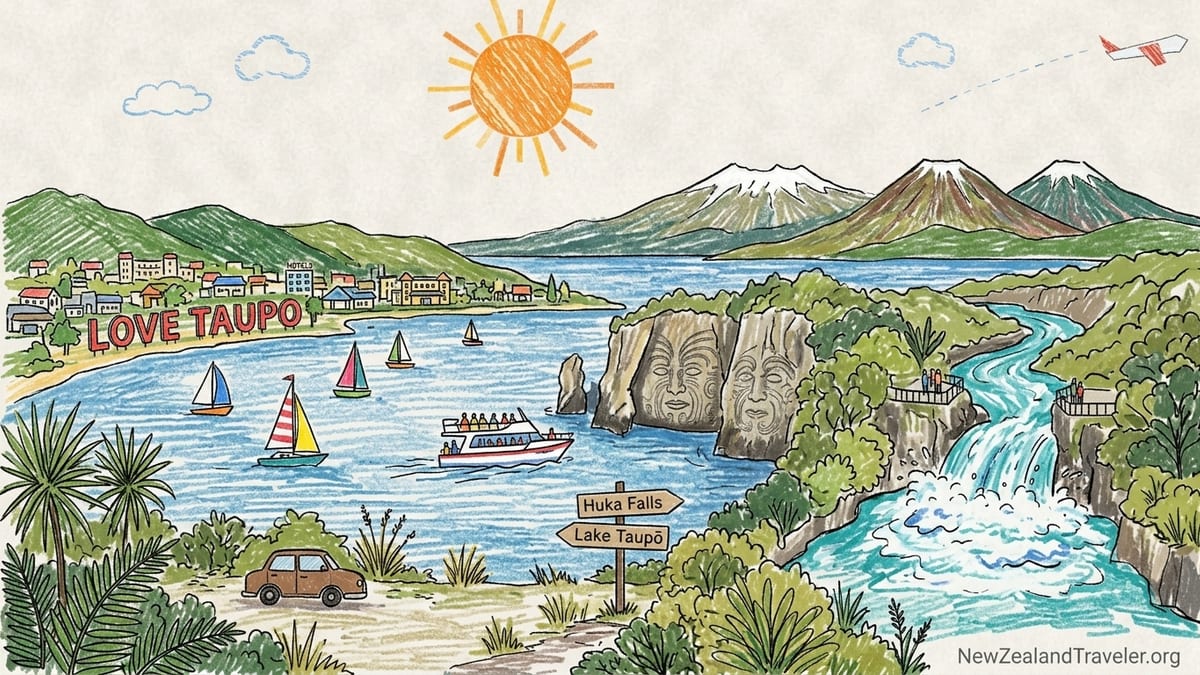
Why Taupō Belongs on Your First North Island Itinerary
Set on the shore of Lake Taupō, New Zealand’s largest lake, the town of Taupō feels surprisingly small and easygoing for such a major destination. The lake itself sits in the caldera of the Taupō volcano, and the wider region is alive with geothermal activity, from steaming cliffs and mud pools at Ōrakei Kōrako to the hissing vents at Craters of the Moon. For a first visit, that mix of gentle lakeside holiday vibe and dramatic volcanic landscape is what makes Taupō stand out.
Road access is straightforward, which is why Tourism New Zealand often positions Taupō as a natural stop on a North Island road trip. By car it is about 3 hours 10 minutes from Auckland on State Highway 1 and roughly 1 hour from Rotorua, depending on traffic and weather. Many visitors drive south from Auckland via Hamilton or Matamata, stop to see Hobbiton or Waitomo, then continue on to Taupō as a scenic overnight base before heading on to Tongariro National Park or Wellington.
Beyond its scenery, Taupō is well set up for first-time travellers. The compact town centre lines the lakeshore, with supermarkets, a range of cafes and restaurants, and most lake cruise operators based at the boat harbour just a short walk away. You can land at Taupō Airport, collect a rental car and be checked into a lakefront motel or wandering the promenade within 20 minutes in normal conditions.
For many people Taupō is also the most accessible way to experience the volcanic Central North Island. From one base you can cruise to the Mine Bay Māori Rock Carvings, soak in geothermal hot pools, walk river trails to Huka Falls, drive to geothermal parks like Craters of the Moon and Ōrakei Kōrako, or spend a full day hiking in Tongariro National Park.
Getting There, Getting Around and How Long to Stay
If you are arriving internationally, the most common approach is to fly into Auckland or Wellington, then rent a car and drive. From Auckland, expect around 3 hours 10 minutes of driving time in good conditions, longer if you stop in Hamilton, Cambridge or at attractions like Hobbiton or the Waitomo Caves. From Wellington, the drive north via the Desert Road takes about 4 and a half to 5 hours, with expansive views of the central volcanoes on a clear day.
Taupō Airport sits just south of town and handles domestic flights. At the time of writing, regular services run to and from Auckland, typically operated by turboprop aircraft. That makes it realistic to fly Auckland to Taupō in under an hour and be on a lake cruise the same afternoon. Taxi and shuttle services connect the airport with central accommodation, and several rental car brands operate desks or off-airport pickups, which is useful if you plan day trips to Tongariro National Park or Ōrakei Kōrako.
Within Taupō, a car offers the most flexibility, especially if you want to reach outlying walks and geothermal parks. That said, first-timers can manage without one if they stay near the town centre. From most lakefront motels it is a short walk to cafes, supermarkets, the boat harbour and lakeside mini golf. A local bus network, the Taupō Connector, links the town with some suburbs and key stops. Many tour operators, including lake cruise companies and shuttle services for Tongariro, offer central pick-up points or hotel pick-ups for a fee.
For a first visit, two nights in Taupō is an absolute minimum; three to four nights is more realistic if you want to combine lake time, hot pools and at least one full day in Tongariro National Park. For example, a three-night stay might include a lake cruise and town exploring on day one, Huka Falls and geothermal attractions on day two, and a full or half day hiking in Tongariro on day three before moving on. If you are building a longer Central North Island itinerary with Rotorua, Tongariro and perhaps Napier, four or five nights in Taupō lets you use it as a comfortable hub while minimising constant packing and unpacking.
Where to Stay: Lakefront Motels, Lodges and Family-Friendly Options
Most first-time visitors choose to stay along the Lake Terrace strip that runs beside the northern shore of Lake Taupō. Here you will find a dense run of motels, hotels and apartments, many with lake views and easy foot access to the promenade and the “Love Taupō” sign. For mid-range travellers, classic New Zealand motels such as The Reef Resort or Chelmswood Motel typically offer self-contained studios and one-bedroom units with kitchenettes, on-site parking and often a small thermal plunge pool or hot tub.
If you are looking for something more upmarket, boutique properties and lodges are dotted around the region. Near the mouth of the Waikato River you will find exclusive lodges that appeal to anglers and luxury travellers, while lakeside retreats closer to town offer suites with wide glass windows facing the mountains of Tongariro National Park. Expect significantly higher nightly rates at this end of the market, particularly in summer and over long weekends, but you gain privacy, landscaped grounds and often concierge-style help with booking lake charters or helicopter excursions.
Families tend to gravitate towards holiday parks and cabin-style accommodation, where children can use playgrounds and heated pools. Holiday parks on the edge of town often combine powered campervan sites with basic cabins and motel-style units, which suits mixed groups. Having an on-site communal kitchen and barbecues can make it easy to self-cater after a day at Huka Falls or the lakefront playgrounds.
For budget-conscious travellers, backpacker hostels and simple guesthouses are scattered in and around the town centre. These typically offer dorm beds and a small selection of private rooms, along with shared kitchens and lounges. Staying in town rather than out on the highway makes it easier to walk to supermarket supplies, the i-SITE visitor centre and pick-up points for activities like skydive shuttles or river rafting.
Experiencing Lake Taupō: Cruises, Rock Carvings and Lakeside Life
Lake Taupō is the backdrop to almost everything in town, and you do not need to be an adventure seeker to enjoy it. The most popular introduction for first-time visitors is a scenic lake cruise to the Mine Bay Māori Rock Carvings, often combined with commentary on the lake’s volcanic history and local stories. Several companies run multiple departures daily on comfortable launches or catamarans, with typical cruises lasting 90 minutes to 2 hours. Adult tickets are commonly in the moderate price range for New Zealand boat tours, and some operators include tea, coffee and a snack such as a muffin on board.
The Mine Bay carvings themselves are relatively recent artworks, created in the late 20th century by Māori artist Matahi Whakataka-Brightwell and collaborators. The main 14-metre high face of Ngātoroirangi towers over the lake cliffs and is accessible only by water. Seeing it from a boat or kayak gives you a close-up sense of scale and a chance to appreciate the surrounding smaller figures and patterns cut into the rock. On clear days the cruise also delivers distant views of the peaks of Ruapehu, Tongariro and Ngāuruhoe at the southern end of the lake.
For a more active experience, guided kayak tours paddle along the sheltered bays to reach the carvings, typically taking around 4 hours return including stops. These tours usually provide all gear, basic instruction and dry bags for cameras, so confident beginners can participate. If you would prefer something shorter, stand-up paddleboard hire, lakefront bike rentals and casual fishing charters depart from or near the boat harbour.
Back on shore, the town’s lakefront is easy to enjoy with little planning. You can stroll the paved path past the Love Taupō sign, watch brave souls attempt the lakefront hole-in-one golf challenge, or sit on the pumice sand beaches at spots like Two Mile Bay, where floating pontoons and lakeside eateries create a holiday atmosphere in summer. In cooler months the lake takes on a moodier beauty, and early morning fog can hang low over the water before lifting to reveal snow-dusted peaks in the distance.
Waterfalls, Rivers and Geothermal Wonders Around Taupō
Just north of town, the Waikato River surges through a narrow volcanic gorge to form Huka Falls, one of the most visited natural attractions in New Zealand. A short, flat walk from the main car park brings you to viewing platforms right over the churning turquoise water, where you can feel the vibration of the river as it drops over the final six-metre fall. Allow 30 to 60 minutes for a visit, longer if you plan to walk part of the riverside trail that links Huka Falls with Taupō town or with the geothermal Spa Thermal Park.
For a different perspective, jet boat operators run high-speed trips that blast up the river to the base of Huka Falls, performing spins and fast turns along the way. These tours cost more than a self-guided visit but deliver a thrill ride combined with commentary on the river and dam system. Families with younger children may prefer a gentler river cruise option that approaches the falls at a calmer pace and allows for photography without the adrenaline rush.
Just beyond Huka Falls lies the Craters of the Moon geothermal area, where an easy loop track and boardwalk pass steaming vents, bubbling mud and craterlike hollows. It is a relatively compact site, so many visitors combine it with Huka Falls on the same morning or afternoon, paying a modest entry fee that supports track maintenance. You should expect raised wooden walkways, some steps and light sulphur smells, but it is generally suitable for most fitness levels in fine weather.
Further north, roughly 30 to 45 minutes’ drive from Taupō depending on traffic, Ōrakei Kōrako offers one of the region’s most dramatic geothermal landscapes. Reached by a short boat ride across the Waikato River from its visitor centre, it features colourful silica terraces, geysers and steam vents set against native bush. Paths and boardwalks traverse the hillside, and visitors typically spend 1.5 to 2 hours on site. Because it is slightly off the main highway, Ōrakei Kōrako feels less crowded than some better-known geothermal parks and works very well as a half-day excursion from Taupō.
Soaking and Swimming: Hot Pools and Thermal Experiences
Taupō’s geothermal setting means you are never far from hot water, whether you want a family swim complex or a quieter adult retreat. On the edge of town, Taupō DeBretts Spa Resort combines accommodation with a public hot pool complex that includes large outdoor thermal pools, water slides and private pools bookable by the hour. As of recent seasons, adult day entry prices have typically been in the moderate range for New Zealand thermal facilities, with separate charges for private pools or hydroslides. This makes DeBretts a popular choice for families and road trippers wanting a soak after driving in from Auckland or Wellington.
Closer to Huka Falls, Wairakei Terraces offers a quieter adults-only thermal pool experience, with terraced outdoor pools overlooking a steaming silica terrace. Recent visitor information suggests adult entry to the pools alone sits around the upper end of standard thermal pool pricing in the region, reflecting the boutique setting and age restrictions. Many travellers choose Wairakei Terraces for an evening soak after a day visiting Huka Falls and Craters of the Moon, when cooler air and low light add to the atmosphere.
If you would prefer a straightforward lap and leisure pool complex, AC Baths in town operates heated indoor and outdoor pools, a toddler area and basic slides. Entry prices are generally lower than the more resort-style facilities, making it a practical option for families on a budget or anyone wanting a quick swim rather than a spa experience. The water here is geothermally heated but the atmosphere feels more like a community aquatic centre than a luxury spa.
For a more natural-feeling soak, Spa Thermal Park on the banks of the Waikato River includes a free hot stream that flows into the river, creating spots where bathers can sit in warm water while watching the current. Temperatures can vary, and you should take care with footing and avoid submerging your head, but on a cool evening it is one of Taupō’s most memorable simple pleasures. Bring a towel, avoid leaving valuables on the riverbank and be prepared to share the space with locals and fellow travellers.
Adventure Activities and Day Trips: From Skydive to Tongariro
Taupō has long marketed itself as an adventure town, and first-time visitors will find no shortage of options, from jet boating at Huka Falls to bungy jumping over the Waikato River. The Taupō bungy site offers a jump platform perched on a cliff above the river, with classic head-dipping options for those who want to touch the water. Prices are in line with other New Zealand bungy operations and usually include return transport from town for those not driving.
Skydiving is another Taupō hallmark, thanks to wide views over Lake Taupō and the volcanoes. Tandem skydive operators based at Taupō Airport run multiple daily flights in suitable weather, with jump altitudes commonly ranging from around 12 000 to 15 000 feet. Packages are priced by height and photo or video options, and free shuttle pick-ups from town are often available. If you want this on your itinerary, allow half a day to account for weather delays or queues.
Beyond the adrenaline, Taupō makes an ideal base for Tongariro National Park, around 1.5 hours’ drive south. The Tongariro Alpine Crossing, frequently described as one of New Zealand’s best one-day hikes, traverses a high volcanic saddle between Mount Tongariro and Mount Ngāuruhoe. Several shuttle companies run return transfers from Taupō to the trailheads in season, typically departing very early in the morning and returning in the late afternoon. First-time visitors should check the weather forecast carefully, carry appropriate layers and allow a contingency day in case high winds or poor visibility make the crossing unsafe.
If you prefer shorter or less exposed walks, Tongariro National Park still merits a day trip from Taupō. Popular options include the Taranaki Falls loop near Whakapapa Village, the short trail to Tawhai Falls, and nature walks through alpine tussock and beech forest with views back to the volcanoes. In winter, the park also functions as a snow-play and ski hub, although ski field operations can vary season by season. Even a simple scenic drive to the national park with lunch at a historic hotel can give first-timers a sense of the volcanic plateau beyond Lake Taupō.
Using Taupō as a Base for the Volcanic Central North Island
One of Taupō’s biggest advantages for first-time visitors is how centrally it sits among the North Island’s major natural attractions. An hour’s drive north brings you to Rotorua’s well-known geothermal parks and cultural experiences, while 90 minutes east leads to Hawke’s Bay wine country and the Art Deco city of Napier. South, as noted, is Tongariro National Park, and to the west lie the Waitomo glowworm caves and rolling King Country farmland.
That geography makes Taupō a practical base for travellers who prefer to unpack once and explore in a series of day trips rather than executing a tight one-night-per-stop loop. A four-night stay, for instance, might include one day devoted to lake activities and Huka Falls, one focused on geothermal experiences at Craters of the Moon and Ōrakei Kōrako, one full day in Tongariro National Park, and one flexible day for Rotorua, Napier or simply relaxing by the lake.
In practice, it is wise not to overload every day. Driving times on New Zealand’s state highways can creep longer than expected due to roadworks, weather or scenic stops. For example, while Taupō to Rotorua is frequently described as about an hour, you may take 90 minutes if you pull into viewpoints or stop for coffee on the way. Similarly, a Tongariro day can be tiring if combined with additional stops, so consider alternating longer days with gentler ones spent around the lakefront, hot pools and short walks.
For road trippers linking major cities, Taupō also slots neatly into multi-day itineraries. Many visitors drive Auckland to Rotorua or Waitomo on day one, then continue to Taupō on day two, spend one or two nights, and then head south over the Desert Road towards Wellington, overnighting in Tongariro or Taihape. Others loop east through Napier before eventually returning to Auckland. In all cases, Taupō’s mix of reliable services, lake scenery and central location help break long drives into manageable, enjoyable stages.
The Takeaway
For first-time visitors, Taupō is more than just a convenient pin on the map between Auckland and Wellington. It is a genuine destination in its own right, with Lake Taupō’s vast caldera waters at its heart and an accessible ring of waterfalls, geothermal wonders and river trails close at hand. You can cruise to the Mine Bay Māori Rock Carvings in the morning, stand above the roar of Huka Falls after lunch, soak in a thermal pool at sunset and still be back at your lakefront motel without a long drive.
At the same time, Taupō works exceptionally well as a base for the wider volcanic Central North Island, putting Tongariro National Park, Rotorua’s geothermal attractions and even Hawke’s Bay wine country within realistic day-trip range. With two nights you can sample the highlights. With three or four, you can slow down, weave in adventure activities like skydiving or bungy, and spend unhurried hours simply enjoying the lake and town.
Whether you arrive by road from Auckland, by domestic flight into Taupō Airport, or as part of a longer New Zealand holiday, this compact lakeside town offers an approachable introduction to some of the country’s most dramatic landscapes. Plan a stay long enough to balance exploration with downtime, and Taupō will reward you with geothermal warmth, volcanic horizons and the easy rhythm of lake life.
FAQ
Q1. How many nights should first-time visitors spend in Taupō?
For a first visit, aim for at least two nights, which allows one full day for lake activities and nearby geothermal sites. Three to four nights is ideal if you want to add a full day in Tongariro National Park or a day trip to Rotorua or Napier without feeling rushed.
Q2. Is Taupō or Rotorua better as a base for the Central North Island?
Both work well, but Taupō tends to feel more relaxed and central for day trips to Tongariro National Park, Ōrakei Kōrako and Napier. Rotorua has more structured cultural experiences and geothermal parks. Many itineraries include both, using Taupō for lake and volcano scenery and Rotorua for Māori cultural shows and urban conveniences.
Q3. Do I need a car to enjoy Taupō’s main sights?
A car offers the most flexibility, especially for Tongariro National Park and Ōrakei Kōrako, but you can still enjoy Taupō without one. Lake cruises to the Mine Bay Māori Rock Carvings, walks along the lakefront, some river trails and hot pools are accessible from town, and many tour operators provide shuttles for activities such as skydiving or the Tongariro Alpine Crossing.
Q4. How do I get to Huka Falls and how long should I allow?
Huka Falls is a short drive or cycle north of Taupō and has car parks close to viewing platforms. Most visitors spend 30 to 60 minutes there, longer if walking sections of the riverside tracks. It combines easily with a visit to Craters of the Moon or Wairakei Terraces on the same half day.
Q5. What is the best way to see the Mine Bay Māori Rock Carvings?
The most straightforward way is by scheduled lake cruise, typically 90 minutes to 2 hours return from Taupō Boat Harbour, with commentary included. If you prefer something more active and the weather is calm, guided kayak trips also visit the carvings and offer closer, slower views of the cliffs and artwork.
Q6. Are Taupō’s hot pools suitable for children?
Yes, several complexes are family-friendly. Facilities like Taupō DeBretts and AC Baths offer shallow pools, slides and family changing areas. Wairakei Terraces is a quieter, adults-only option and not suitable for children, so check age policies and pool depths when choosing where to go.
Q7. When is the best time of year to visit Taupō?
Summer brings warm lake days, long evenings and busier crowds, while autumn and spring offer milder temperatures and fewer visitors. Winter can be crisp and cold, but snow on the distant volcanoes and steaming hot pools make it atmospheric. If hiking the Tongariro Alpine Crossing, shoulder seasons with stable weather forecasts often provide good conditions.
Q8. Can I visit Tongariro National Park as a day trip from Taupō?
Yes, Tongariro National Park is around 1.5 hours’ drive from Taupō in good conditions. Many operators run transfer shuttles for the Tongariro Alpine Crossing in season, and shorter walks such as Taranaki Falls or Tawhai Falls are realistic on a day trip. Start early and check weather and track conditions before you go.
Q9. How expensive are activities in Taupō compared with the rest of New Zealand?
Activity prices are broadly in line with other New Zealand destinations. Scenic lake cruises, geothermal park entries and hot pool visits sit in the mid-range, while adventure activities like skydiving and bungy jumping are premium experiences. You can balance costs by mixing paid attractions with free walks, lakefront time and self-guided visits to places like Spa Thermal Park.
Q10. Is Taupō a good stop on a drive between Auckland and Wellington?
Yes, Taupō is a natural midway stop on the Auckland to Wellington route. From Auckland it is roughly 3 hours 10 minutes by road in good conditions, making it a comfortable first or second night on a north–south itinerary. You can break the journey with an overnight in Taupō to see Lake Taupō and Huka Falls before continuing south through Tongariro National Park or east via Napier.