


I spent two separate two‑week stretches in New Zealand’s Southern Lakes region: first based in Queenstown, then shifting my base to Wānaka. I booked apartments, ate my way through mid‑range restaurants and takeaway spots, skied at Cardrona and Treble Cone, and tested how each town worked in practice as a base for a South Island trip. What follows is not a tourism brochure, but how the two destinations actually felt when paying real bills, driving real roads and trying to enjoy the mountains without losing my sanity in peak‑season traffic.
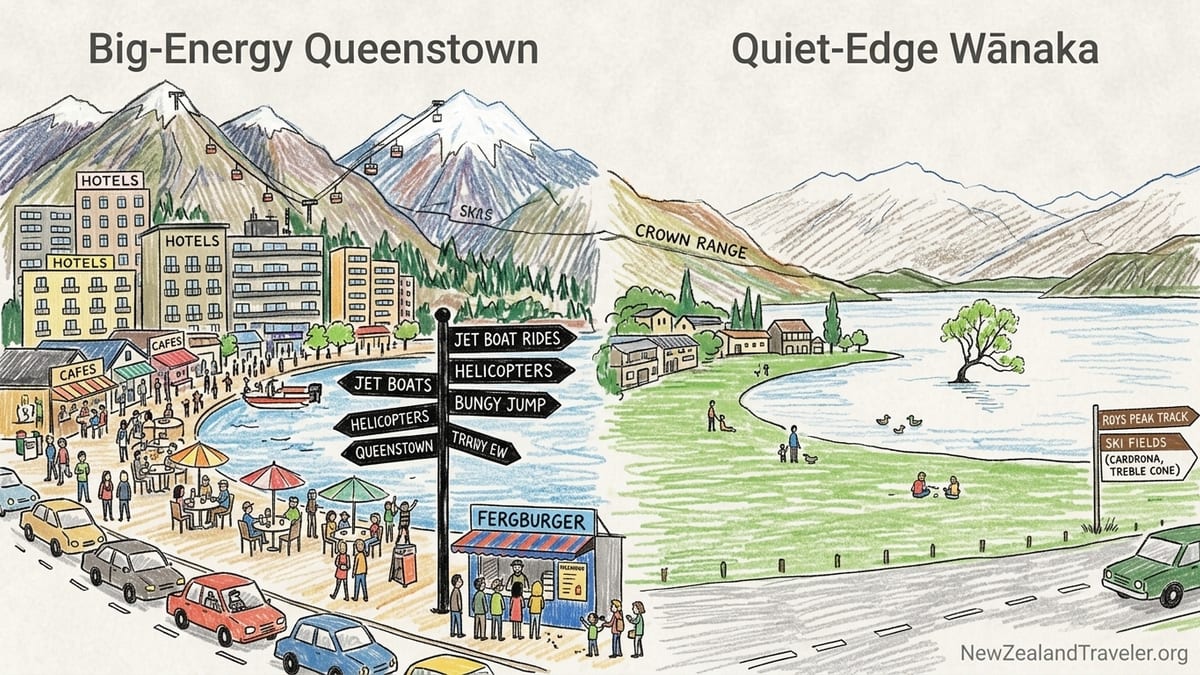
First Impressions: Big‑Energy Queenstown vs Quiet‑Edge Wānaka
Landing at Queenstown Airport and stepping into town felt like arriving at a compact resort city. The skyline is a wall of hotels and apartment blocks, the lakefront is busy from morning coffee to late‑night burgers, and every second shop seems to sell jet‑boat rides or helicopter landings on glaciers. I could walk from my apartment near Shotover Street to dozens of restaurants and bars within ten minutes, and it was easy to book activities on the same day. That convenience came wrapped in noise: delivery trucks at 6 a.m., bar crowds at midnight and a constant low roar of traffic orbiting the compact centre.
Driving over the Crown Range and settling in Wānaka felt like exhaling. The town has grown, but the centre still reads as a lake village rather than a vertical resort. Buildings stay mostly low, the lakefront green is wide open and there are long stretches where you hear wind and water instead of engines. From my rental a few blocks back from the lake, I could see the Southern Alps but hardly heard traffic at night, aside from the odd ute heading out early for a ski day.
Those first impressions held up for the rest of my stays. Queenstown gave me energy on demand: if I wanted a 10 p.m. cocktail after a day on Coronet Peak, it was a short walk away. Wānaka gave me space: an evening walk along the lake often meant more ducks than people. Neither is inherently better, but they created very different headspaces for the same kind of holiday.
Crucially, Queenstown’s scale supports a deeper infrastructure for tourism. There are more tour operators, more shuttles up to the ski fields and more options if bad weather cancels your original plan. Wānaka, by contrast, trades in a slower, more local rhythm. Cafes close earlier, restaurant options are fewer and nightlife mostly ends by around 10 or 11 p.m. That contrast coloured almost every practical decision of my trip.
Accommodation Costs and What You Get for Your Money
In Queenstown, my first stay was in a one‑bedroom apartment hotel a ten‑minute walk from the lakefront. In late August, the nightly rate came out to around NZ$320 including taxes for a flexible booking. That aligned with hotel market snapshots putting Queenstown’s average daily hotel rates in the low‑NZ$200s outside peak and significantly higher in winter and over New Year. I was paying a premium for proximity and a kitchen, but not getting luxury: comfortable bed, compact living area, standard bathroom, and a partial lake view over a busy road.
In Wānaka a week later, I booked a one‑bedroom unit in a low‑rise motel five minutes’ walk from the lake. The winter rate there was NZ$250 per night for a similar flexible deal. The interior was slightly older than the Queenstown apartment, but the trade‑off was space and quiet. I had a small private deck, room to leave skis and boots by the door, and parking right in front of the unit without extra cost. For almost NZ$70 less per night, I sacrificed no real comfort but gained a calmer setting.
Looking again in shoulder season for a return trip, I found central Queenstown hotel rooms in the NZ$260 to NZ$380 range on typical dates, with lakeview suites and luxury lodges climbing higher. In Wānaka on the same dates, comparable studios and one‑bedrooms were often NZ$200 to NZ$260. In other words, Wānaka routinely undercut Queenstown by around NZ$50 to NZ$100 per night for similar comfort, especially if you were willing to stay a few minutes’ walk back from the water.
The one caveat is that Queenstown’s larger inventory gives you more rungs on the ladder. If you want a hostel bed under NZ$70 or a dorm for less, you will simply find more choices there. At the top end, Queenstown’s luxury lodges and apartments outnumber Wānaka’s, and some travellers will value concierge services, valet parking and on‑site spas that Wānaka properties seldom offer. For my mid‑range budget, though, Wānaka felt like better value for a self‑catering stay, while Queenstown felt like I was paying extra for buzz and convenience.
Food, Drink and Nightlife: Where I Spent More and Stayed Out Later
Eating out in Queenstown cost more, but it was also where I had the widest range of options. On most evenings I could walk out and be holding a burger from a famous takeaway spot for around NZ$18 to NZ$22, or sit down at a mid‑range lakefront steak and ribs place with mains in the NZ$30 to NZ$45 range. A standard three‑course meal for two with a shared starter, mains and a glass of wine each easily nudged NZ$160 or more. Broader New Zealand dining guides place a mid‑range dinner with drinks in tourism hot spots like Queenstown at roughly NZ$50 to NZ$90 per person, and my bills landed firmly in that bracket.
The extra sting came from repetition. After five nights in Queenstown, I realised my “casual” dinners still averaged about NZ$45 per person when I added a beer or glass of wine. Multiply that by a week and food alone started to rival my accommodation bill. There are hacks that locals talk about, such as early‑sitting discounts or happy hour food specials, but you need to plan around them, which undercuts the spontaneity Queenstown otherwise encourages.
Nightlife in Queenstown, however, is undeniably easier. On a Friday, I could finish skiing, shower and walk into a bar with live music, a good local pinot noir by the glass and people still drifting in at 10.30 p.m. Bars and burger joints stay open late, queues at takeaway windows can stretch past midnight, and backpacker pubs pack out on most winter nights. I am not a nightclub person, but I appreciated having the option to be out late without worrying how to get home.
Wānaka felt like a reset for both my budget and my evenings. Cafe breakfasts were often a few dollars cheaper than in Queenstown, and while dinner mains in central Wānaka still hovered around NZ$30 to NZ$40, the overall bill tended to land slightly lower. A pizza and shared salad with two drinks came in closer to NZ$90 for two than NZ$140. There are fewer big‑name restaurants chasing global attention, and that seemed to keep things more grounded. The catch is that kitchens close earlier: twice we were turned away from otherwise half‑full restaurants because we showed up after 8.30 p.m., something that would almost never happen in Queenstown.
Traffic, Parking and Getting Around Day to Day
Traffic was where Queenstown frustrated me most. My apartment came with no on‑site parking, so I relied on street parking or public lots. On a mid‑winter Saturday, it took several laps of the one‑way system before I found an available space, and even then it had a short time limit. Paid parking in the central streets quickly added NZ$10 to NZ$20 per day to my costs. When I needed to leave for a ski day at Cardrona or The Remarkables around 7.30 a.m., I first had to walk ten minutes to collect the car from an overnight car park, then join ground‑to‑a‑halt traffic in and out of town.
Queenstown’s road layout concentrates everything into a narrow envelope between the lake and steep hillsides. Morning peaks around school and ski departure times can turn a simple five‑kilometre errand into a 30‑minute crawl. Coming back from the Remarkables access road one bluebird afternoon, I hit a solid line of cars well before Frankton and spent another 25 minutes inching the last few kilometres into the centre. None of it ruined my trip, but after two weeks I found myself planning outings at odd hours just to avoid sitting in traffic.
In Wānaka the experience inverted. My motel had free off‑street parking, and I rarely struggled to find a space on the main streets, even at lunchtime. There is traffic on winter weekends, particularly when everyone is heading towards Cardrona or Treble Cone, but the delays felt modest. Leaving town for Cardrona around 8 a.m., I would be past the last roundabout and onto open road in a few minutes. Coming home, the last kilometres into Wānaka were usually free‑flowing even on busy days, and I could be showered and on the lakefront within twenty minutes of taking off my ski boots.
On foot, Queenstown is more compact. Once I had accepted the parking situation and left the car in one place, I could walk almost everywhere in ten to fifteen minutes, from the botanic gardens to the gondola base. Wānaka is more spread along the lake edge; I walked further there, but the sidewalks were wide, crossings were easy and traffic noise never felt oppressive. The only time I truly missed Queenstown’s density was on wet evenings when walking between a slightly out‑of‑centre rental and the restaurants in marginal weather.
Lakefront Atmosphere and Hiking Access
Queenstown’s lakefront is dynamic bordering on chaotic. The paved promenade along Lake Wakatipu is lined with bars, restaurants, souvenir shops and ice‑cream counters. On sunny afternoons, people spill onto the grass, buskers draw crowds and backpacker groups gather around piles of rented e‑scooters. Views of the Remarkables are spectacular, especially at sunset, but the soundtrack is clinking glassware, jet‑boat engines and amplified music. It is fun, but rarely peaceful.
Wānaka’s lakefront, by contrast, felt like it belonged as much to locals as to visitors. There are cafes and bars along the main road facing the water, but behind them stretch long lawns, walking paths and beaches that are easy to access without weaving through commercial strips. In the late afternoon, dog walkers, children on scooters and after‑work swimmers shared the same space with visitors taking photos of the famous willow tree. Even at the height of school holidays, I found corners where I could sit with a takeaway coffee and hear waves lapping rather than speaker systems.
For hiking, Queenstown wins for sheer variety of trailheads within ten minutes of town. The Queenstown Hill walk starts a short drive or steep walk from the CBD and rewards in two to three hours with some of the best aerial views of Lake Wakatipu. The Ben Lomond Track, accessible from near the gondola, offers a full‑day challenge with significant elevation and a summit panorama that justifies its popularity. A network of shorter lakeside and forest tracks means you can improvise a leg‑stretch between activities without much planning.
Wānaka does not lack for hiking, but the rhythm is different. Iconic tracks like Roys Peak require a short drive and now operate with managed parking and often early starts to beat the crowds at the famous summit photo spot. Closer to town, the Mount Iron loop and lakeside paths gave me easy, low‑effort outings that still delivered big sky and mountain views. What Wānaka offered that Queenstown struggled with was a sense of space on those walks. Once I stepped beyond the main lakefront, I often had entire stretches of track to myself, particularly at sunrise or late afternoon, and that changed the emotional tone of every hike.
Skiing and Adventure Activities: Infrastructure vs Proximity
From Queenstown, I had easy access to The Remarkables and Coronet Peak, both around a 30 to 45‑minute drive depending on traffic and road conditions. Shuttle services left from central town and from Frankton, meaning I could leave the rental car parked and still reach the snow. On non‑ski days I could stack a half‑day jet‑boat ride on the Shotover River, a gondola trip to the Skyline complex and a luge session into one long, varied day without ever driving out of the basin. The density of operators meant that if weather scrubbed a scenic flight, I could quickly rebook a wine tour or canyoning trip instead.
Wānaka shifted the centre of gravity towards Cardrona and Treble Cone. From my motel, the drive to Cardrona village took about 25 minutes, and from there the access road climbed to the ski field car parks. Treble Cone, widely regarded for its steeper terrain and advanced skiing, sat about 35 minutes’ drive away in the other direction. Combined passes for Cardrona and Treble Cone have been marketed in recent seasons at around NZ$1,400 to NZ$1,500 for an adult season, and day passes, while not cheap, offer access to both mountains on the same product. Being based in Wānaka, I could day‑trip either field without wrestling Queenstown’s town‑centre traffic first.
Adventure activities are where Queenstown’s scale really showed. On a single morning I booked a jet‑boat ride for the next day and a small‑group winery trip for later in the week, both from offices within a few metres of each other. Operators run multiple departures per day for everything from bungy jumps and zip‑lines to Milford Sound flights and back‑country off‑road trips. Prices were not modest, often in the NZ$150 to NZ$300 range per person for headline experiences, but the convenience of choice and availability was undeniable.
Wānaka offered adventure at a slower pace. Local operators run lake cruises, kayaking trips and scenic flights over Mount Aspiring, but departures are less frequent and many activities must be booked in advance, especially in winter and peak summer. On the flip side, my Wānaka lake kayak hire felt more relaxed: fewer boats on the water, no constant background thump from waterfront bars and an easier time finding a quiet bay to drift in partial silence. If you want to tick off a long list of iconic thrills in a short stay, Queenstown is hard to beat. If you want one or two big experiences framed by empty trails and gentle evenings, Wānaka supports that rhythm better.
What Frustrated Me in Queenstown and What I Missed After Moving to Wānaka
By the end of my Queenstown stay, three frustrations stood out. The first was crowd pressure. On a bluebird Saturday in July, the lakefront felt more like a festival than a small town: lines outside popular burger shops stretched down the block, every bench was occupied and foot traffic moved at a slow shuffle. That intensity can be fun for a night or two, but it eroded the sense of being in the mountains rather than an outdoor mall.
The second frustration was how rapidly small costs piled up. Parking, coffee, a quick lunch and a spontaneous activity booking could burn through over NZ$150 before dinner. A single day where I paid for parking, two cafe visits, a mid‑range restaurant dinner and a round of drinks came close to NZ$260 for two people without any “big ticket” thrill ride. None of the individual prices felt outrageous given the context, but the cumulative effect was hard to ignore.
The third was the feeling of being funnelled. The town’s geography and infrastructure push most visitors through the same narrow corridors of streets, shops and viewpoints. At peak times it was almost impossible to find a quiet corner by the water within the central area, and I often felt like I was following a pre‑set tourist script, even when I strayed into side streets or sought out less obvious cafes.
After shifting to Wānaka, however, I realised what Queenstown had given me that Wānaka could not fully replace. I missed the ease of late‑night options. In Queenstown, finishing a long drive or delayed flight at 9.30 p.m. still meant choices for a proper meal. In Wānaka, one late arrival turned into a scrounged dinner of supermarket snacks because every kitchen within walking distance had already closed. I also missed Queenstown’s one‑stop‑shop feel for activities: in Wānaka I spent more time online and on the phone arranging bookings, whereas in Queenstown I could sort my entire week by walking into three different storefronts in half an hour.
In short, Queenstown occasionally made me feel over‑managed as a visitor, while Wānaka occasionally made me work harder for basic conveniences. My personal preference by the end of the trip leaned towards Wānaka’s breathing room, but I understood why so many first‑time visitors fall hard for Queenstown’s buzz and never feel the need to look over the Crown Range.
Who Each Place Suits: Matching Towns to Traveller Types
For families, Queenstown’s infrastructure is a major draw. Easy access from the international airport, plentiful apartment‑style accommodation, several ski fields reachable by shuttle and kid‑friendly attractions like the Skyline luge and lake cruises all reduce logistical friction. The trade‑off is price: feeding a family of four in Queenstown restaurants can quickly outrun the accommodation budget, so self‑catering or staying slightly outside the centre becomes almost essential. Wānaka works beautifully for families who value space and slower days, with parks, mellow lake walks and shorter queues, but it demands more planning around supermarket runs, early restaurant closing times and slightly longer drives to some attractions.
Nightlife‑oriented travellers should strongly favour Queenstown. If bars, live music, late‑night food and a social hostel scene matter to you, Queenstown is the Southern Lakes capital. You can step out any night of the week in winter and realistically find a crowd. Wānaka’s bar scene is more modest and seasonal, and on shoulder‑season weeknights some venues feel very quiet. Couples who enjoy a few drinks with dinner but do not need clubbing until 3 a.m. may find Wānaka entirely sufficient, but if nightlife is a core part of your trip, Queenstown is the safer bet.
Serious hikers and trail runners might find themselves split. Queenstown offers close access to iconic day hikes like Ben Lomond and connections to multi‑day tracks such as the Routeburn via transport services. Wānaka, on the other hand, opens the door towards Mount Aspiring National Park and a slightly wilder feeling backcountry. If your ideal day is a big climb followed by a quiet beer watching the sun set without a crowd, Wānaka has the edge. If you want a challenging day on the hill followed by multiple late‑night options and a buzzy bar to dissect the route, Queenstown will feel more natural.
Skiers choosing primarily between Cardrona and Treble Cone on one side of the ranges and Coronet Peak and The Remarkables on the other have a practical calculation to make. Wānaka offers shorter drives to Cardrona and Treble Cone, which many advanced skiers favour for terrain. Queenstown places you closer to Coronet Peak and The Remarkables and still within reach of Cardrona, but at the cost of more town traffic at each end of the day. For mixed‑ability groups that include non‑skiers who want shopping and activities, Queenstown may be worth the congestion. For ski‑focused travellers who plan to spend every day on the Cardrona and Treble Cone pass, Wānaka’s proximity is hard to beat.
First‑time South Island visitors often default to Queenstown for good reasons. The airport connections are excellent, the scenery is spectacular from the moment you land, and many of the region’s iconic experiences are either based there or depart from there. For a short trip of three to five days, staying entirely in Queenstown and joining day tours out to Milford Sound, Glenorchy or nearby ski fields can make perfect sense. However, if your trip extends beyond a week, splitting your time with at least three nights in Wānaka can soften the pace and reveal a gentler side of the Southern Lakes that many visitors miss.
People who dislike crowded resort towns or feel drained by constant noise should give Wānaka serious consideration as a primary base. It is busier and more developed than its marketing sometimes suggests, but it remains significantly quieter and less commercial in feel than Queenstown. You still get excellent cafes, good restaurants and access to world‑class mountains, just without the same density of tour desks and nightlife. If you know that queues, loud bar streets and congested parking will grate on you after two days, Wānaka will likely feel more like the New Zealand you came to find.
The Takeaway
After living with both towns for several weeks, my personal preference tilted towards Wānaka. The quieter streets, easier parking, slightly gentler prices and direct access to Cardrona and Treble Cone made daily life smoother. Evenings by the lake felt restorative in a way Queenstown rarely managed, and I appreciated waking up to birds and light traffic instead of delivery trucks and bar noise.
Yet I left Queenstown with a real appreciation for what it does exceptionally well. For first‑time visitors and anyone who wants concentrated adventure, walkable nightlife and seamless logistics built around an international airport, Queenstown is a powerful base. It excels at taking you from plane door to mountain ridge, wine barrel or river canyon with minimal friction, provided you are willing to pay the premium and tolerate the crowds.
If your trip allows, the most satisfying compromise is not to crown a winner at all, but to divide your time. Fly into Queenstown, lean into its energy for three or four nights, then drive over the Crown Range and exhale into a Wānaka stay focused on skiing, hiking or simply watching the light change across Lake Wānaka. Treat them not as rivals but as two complementary halves of a single Southern Lakes experience, and you will leave with a more rounded picture of what this part of New Zealand can offer.
FAQ
Q1. Is Queenstown really that much more expensive than Wānaka?
In my stays, Queenstown cost noticeably more for centrally located accommodation and restaurant meals, often by NZ$50 to NZ$100 per night on similar rooms and around NZ$10 to NZ$20 more per dinner for two. Groceries and petrol were broadly comparable between the two towns.
Q2. Which town is better if I will be skiing mostly at Cardrona and Treble Cone?
If your ski days will focus on Cardrona and Treble Cone, Wānaka is generally the more convenient base. Drive times are shorter, you avoid Queenstown’s town‑centre congestion at each end of the day and many local accommodations are set up with gear storage and early breakfasts tailored to skiers.
Q3. How bad is Queenstown traffic in winter?
In peak winter and school holidays, traffic into and out of central Queenstown can be slow, especially around morning and late‑afternoon peaks. A drive that takes ten minutes in shoulder season can easily stretch to 25 or 30 minutes, and finding parking in the town centre often adds extra time and cost.
Q4. Does Wānaka have enough restaurants for a week‑long stay?
Yes, Wānaka has a solid mix of cafes, pubs and restaurants that can easily cover a week of varied meals, especially if you mix in self‑catering. You will not have Queenstown’s depth of choice, but you are unlikely to feel stuck eating the same thing every night.
Q5. Which place has better nightlife?
Queenstown has far more bars, later closing times and a busier, more international nightlife scene. Wānaka offers a handful of relaxed bars and pubs that can be lively on weekends and in peak season, but most venues are quieter and close earlier.
Q6. How far is the drive between Queenstown and Wānaka?
The drive over the Crown Range between Queenstown and Wānaka typically takes around 1 hour 15 minutes in good conditions, a little longer in winter or poor weather. There is also a longer but gentler route via Cromwell that adds roughly 20 to 30 minutes.
Q7. Is it realistic to base in one town and just day‑trip to the other?
Yes, many travellers do exactly that, especially outside winter. From Queenstown you can day‑trip to Wānaka for hiking or a lakefront lunch, and from Wānaka you can visit Queenstown for a busier day of activities and dining. In winter, road and weather conditions should always be checked before committing to same‑day returns.
Q8. Which town feels less commercial and more “local”?
Wānaka generally feels less commercial, with fewer tour desks, less dense advertising and more visible everyday local life along the lakefront and in supermarkets and cafes. Queenstown has a strong local community too, but the town centre is dominated by tourism businesses and signage.
Q9. Is it easier to visit without a car in Queenstown or Wānaka?
Queenstown is easier to manage without a car. You can take shuttles from the airport, walk to most central hotels, restaurants and activity departure points, and use tour operators’ transport to ski fields and nearby attractions. In Wānaka, a car makes life more convenient, especially for reaching trailheads and ski areas.
Q10. If I have only four days on the South Island, should I stay in Queenstown or Wānaka?
With only four days, most visitors will get more out of staying in Queenstown. Its airport access, range of tours and density of restaurants mean you can fit more variety into a short stay without spending time on extra driving. If you already know you prefer quieter towns and plan to focus mainly on Cardrona or Treble Cone, Wānaka can still be a great choice, but Queenstown is usually the more efficient base for a first short visit.