


In Queenstown, bungy jumping is not just another line on a bucket list. It is part of the town’s origin story as the self-proclaimed adventure capital of the world. Commercial bungy as we know it began here in 1988, when AJ Hackett opened the world’s first permanent public bungy site on the old Kawarau Gorge Suspension Bridge. Today three AJ Hackett bungy sites define the Queenstown bungy experience: Kawarau Bridge Bungy, Nevis Bungy and the Ledge Bungy. They share the same operator and safety culture, but they deliver very different days out, levels of fear and styles of jump.
Kawarau, Nevis and Ledge in a Nutshell
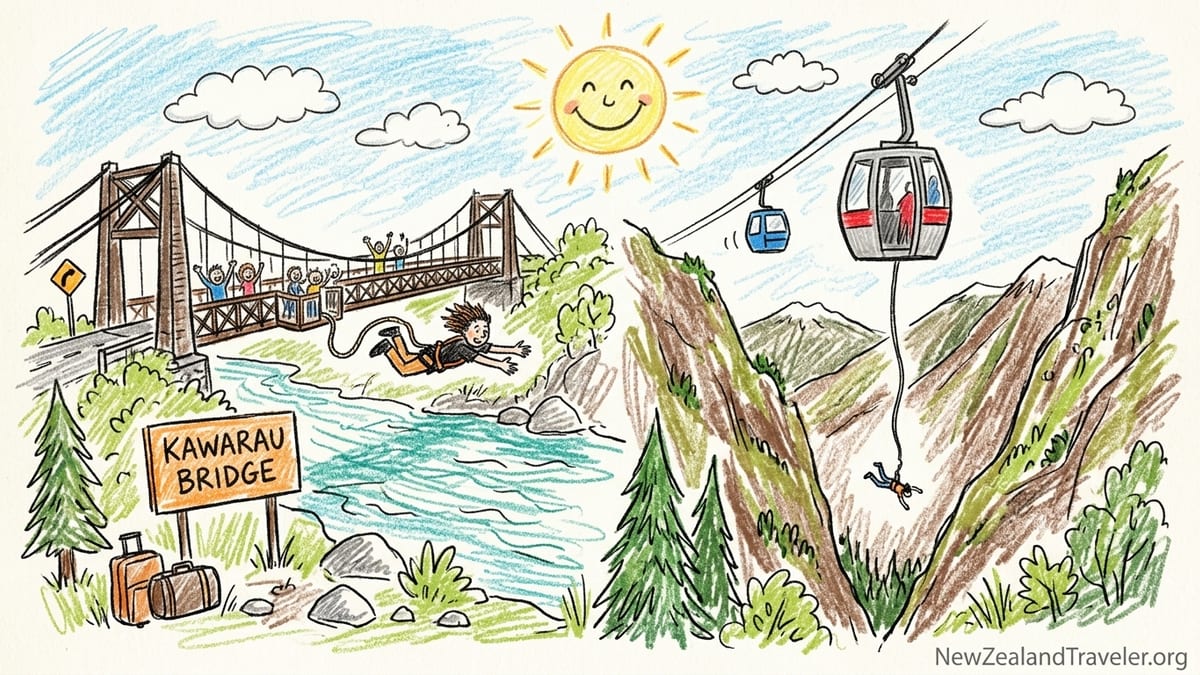
All three Queenstown bungy jumps sit under the AJ Hackett Bungy New Zealand banner, but they feel like three different personalities. Kawarau Bridge Bungy is the original. The jump is 43 metres over the teal Kawarau River, and part of the appeal is its heritage. You jump from a historic suspension bridge and can request a water touch or full dunk if river levels and conditions allow. It is positioned by both the operator and many repeat jumpers as the strongest choice for a first-ever bungy, because the height is intimidating without being overwhelming and spectators crowd the viewing decks just metres away.
Nevis Bungy is the big one, both physically and psychologically. The cable car–style pod is slung high across a remote canyon in the Nevis Valley, and the jump measures 134 metres from platform to river bed, making it the highest bungy in New Zealand. You get around 8 to 8.5 seconds of freefall, which feels qualitatively different from any bridge jump. Getting there is part of the experience: you ride a 4WD shuttle from central Queenstown to a private high-country station, then transfer by small cable car out to the bungy pod itself.
The Ledge Bungy sits above town at the Skyline Queenstown complex on Bob’s Peak. The jump height is around 47 metres, but the real point of difference is the harness system and the view. Instead of a traditional ankle harness, you clip into a full-body harness more like a climbing system. That allows freestyle departures: running starts, flips or swan dives if you have the nerve. The platform looks out over Lake Wakatipu and the township lights and is especially popular for late-afternoon and evening jumps when it is operating.
As of late 2026, Kawarau Bridge and Nevis are running daily schedules, while Ledge is listed by AJ Hackett as closed with a “coming summer 26/27” note for its return. For anyone planning a trip in late 2026, that means you can jump Kawarau and Nevis now and keep an eye on Ledge reopening announcements if your visit falls into the southern summer of 2026/27.
Fear Factor: How Each Jump Feels on the Edge
If you ask people coming off the bus or the viewing deck which jump is the scariest, almost everyone points to Nevis. The objective factors are plain. At 134 metres, the platform hangs high over a rocky river bed, and you cannot see any road, town or comfortable human structure in the immediate surroundings. The freefall lasts roughly twice as long as a typical 40 to 50 metre jump, so several travellers describe having time to think “I am still falling” before the cord begins to stretch. The glass floor strips in the pod and the small cable car across the abyss add a layer of apprehension even before the jump itself.
Kawarau Bridge delivers a different type of fear. The height is intense enough for your stomach to drop, but you can see spectators on the opposite viewing platform and rafts or jet boats drifting down the river. It is easy to imagine yourself stepping off because you are on a familiar structure, a bridge with railings and stone abutments, not a sci-fi hanging pod in a remote valley. That combination of visible safety and very real drop is exactly why so many nervous first-timers choose it. There is also the social pressure. Friends can stand almost beside the jump platform and shout encouragement or film you as staff count you down.
The Ledge sits between the two in raw height but has its own psychological twist. You are not directly above a river or canyon floor. Instead, when you look out from the platform you see Queenstown far below, with Lake Wakatipu and the Remarkables in the distance. Jumpers report a “flying over town” sensation rather than “plummeting into a canyon.” The freestyle harness can either lessen or amplify fear. Some people feel more secure clipped in from the waist and shoulders, while others find that having the option to run and leap or spin introduces new ways to psych themselves out.
For someone who is genuinely unsure whether they can step off, Kawarau generally offers the lowest barrier to entry, Ledge offers more playful distraction from the fear, and Nevis is an all-in commitment. Staff at all three sites are used to coaching people through panic at the platform, but at Nevis there is more time for fears to build during the 4WD drive and cable car ride, so it is worth being honest about your tolerance before you book.
Price, Time Commitment and What You Actually Get
AJ Hackett’s current pricing for the Queenstown sites reflects the different levels of infrastructure and experience. As of October 2026, published adult rates start from about NZ$320 for Kawarau Bridge, NZ$395 for Nevis and around NZ$240 for the Ledge Bungy once it returns in the 2026/27 summer season. These are full retail prices when booking directly through the operator and already include photos and video packages under AJ Hackett’s current “all pricing includes photo & video” model, which replaced earlier pay-on-the-day media bundles. Prices may change with seasonal adjustments or promotions, but they give a realistic planning figure.
Time commitment is one of the biggest practical differences. Nevis requires the longest block of your Queenstown schedule. The operator states that you should allow about 4 hours door to door from check-in at the Queenstown Bungy Centre. That includes the 40 to 45 minute 4WD each way and time for harnessing, safety briefings, jumps and watching other people in your transport group. Morning departures are often recommended, particularly in winter and shoulder seasons, when shorter daylight hours can compress the Nevis timetable.
Kawarau Bridge is far more flexible. The site sits on State Highway 6 between Queenstown and Cromwell and is about a 25 minute drive from central Queenstown in normal traffic. If you book direct and select the “Bungy Bus,” a return shuttle from central Queenstown is included at no extra charge, and you usually need to allow around 2.5 to 3 hours in total including transfer time. Self-drivers who are already heading towards Cromwell, Wanaka or the wineries often combine Kawarau with a daytime road trip, stopping for the jump then continuing onwards.
The Ledge, once back in operation, typically asks guests to allow around 1.5 hours including the Skyline Gondola ride, harnessing and the jump itself. The important thing is that the gondola fare is not included in the bungy price. You either buy a return gondola ticket or use a package that combines gondola and luge. That makes Ledge a smart add-on if you were already budgeting for Skyline for the views or the luge but a slightly more expensive choice if you only want to jump and leave.
Logistics: Transport, Access and Spectator Experience
Transport logistics can change how easy it is to fit a bungy into a tight itinerary. Nevis is the least flexible but most self-contained. You cannot drive yourself to the Nevis site. Access is via AJ Hackett’s 4WD Bungy Bus from the Queenstown Bungy Centre in town, and the transport is included in the Nevis price. From a planning point of view, that means you simply show up at the check-in time and surrender half a day to the experience. It is an advantage if you do not have a rental car, but it does mean Nevis is harder to squeeze in between other time-sensitive bookings such as Milford Sound flights or lake cruises.
Kawarau sits in the middle. You can reach the site by free Bungy Bus if you book directly and select that option, which is helpful for those staying in town without a car. Self-driving is straightforward for anyone heading along State Highway 6, though you need to allow extra time in peak summer or ski-season traffic. Spectators are well catered for at Kawarau. Viewing platforms line the side of the gorge, and there is a café bar, small cinema with a short history video and a gift shop. Friends and family can watch free of charge from the main viewing decks and often become quite involved in psyching up or gently pressuring would-be jumpers.
The Ledge is the most town-adjacent bungy but with the most complicated spectator calculation. Once the site reopens, jumpers and spectators will still need to buy Skyline gondola tickets to get to Bob’s Peak. There is no road access for private vehicles. For families where only one person wants to jump, that extra cost can tip the scales toward choosing Kawarau or Nevis instead, unless the group was already planning a gondola visit. The upside is that spectators at the Ledge can watch from a platform that shares the same sweeping view over Queenstown and can easily move between the bungy, Skyline restaurant, luge tracks and walking trails.
In terms of atmosphere, Kawarau usually feels the busiest and most social. Tour buses and self-drive travellers filter in and out, with a constant stream of onlookers leaning over rails. Nevis is more contained and intense. Everyone on the 4WD is either about to jump or has chosen to ride along as a paid spectator, so there is a shared nervous energy within a smaller group. The Ledge, perched above a tourist complex, tends to feel casual and playful, with a mix of serious jumpers and gondola visitors who wander over just to watch the action for a few minutes.
Rules, Age Limits, Weight Ranges and Safety Culture
AJ Hackett’s brand is built around pushing fear boundaries inside a very structured safety framework. Across the Queenstown sites, there are age and weight rules driven by physics and equipment design rather than marketing. For Nevis, the published minimum age is 13, and there is no separate “child” price category. For Kawarau and Ledge, the minimum age is 10, with under-15s requiring an accompanying adult or signed parental consent. These baselines are occasionally adjusted, so parents should check the latest details at the time of booking.
Weight ranges are equally important. Kawarau and Nevis use ankle harness systems with back-up attachments, and the operator publishes a minimum and maximum weight for each. For example, documentation from AJ Hackett and travel partners notes that solo jumpers must fall within a specific weight band, and that tandem jumps at Kawarau have a combined maximum weight of around 235 kilograms. Ledge lists a 35 to 127 kilogram range with a full-body harness. Staff weigh every jumper discreetly at check-in, and if you fall outside the safe range for a particular site they will redirect you or decline the jump altogether.
On the day, safety begins with the briefing. At Nevis, jumpers are fitted with body harnesses in a small base building before boarding the cable car out to the highwire pod. At the pod, staff perform multiple attachment checks and talk you through the exact sequence. Kawarau operates similarly on the bridge, with staff checking weights, harnesses and cord selection for each jumper. The Ledge briefing includes extra guidance on safe ways to use the freestyle harness, including what you can and cannot attempt in terms of spins or flips.
From a traveller’s perspective, it is worth being upfront about any medical conditions during booking. AJ Hackett publishes a detailed medical requirements list that covers common concerns such as heart conditions, epilepsy, pregnancy and recent surgeries. Staff may ask for a doctor’s note or decline to jump people whose conditions do not fit within their risk guidelines. This can feel disappointing in the moment, but it is part of why New Zealand’s adventure tourism sector maintains a strong safety record despite operating at the edge of perceived risk.
Photos, Video and Combo Pricing
Part of the modern bungy experience is taking home proof. In earlier years, AJ Hackett sites sold photos and video as an optional extra, but current pricing sheets for the 2025/26 and 2026 seasons state that photo and video are included in the advertised bungy prices. Practically, that means staff on site will capture multi-angle stills and video of your jump and you will receive a digital download link or similar package without needing to make a separate decision in the post-jump adrenaline haze. For travellers weighing the cost of a jump, it helps to know that you will not be upsold heavily for media afterwards.
Combo pricing is where Queenstown bungy can become better value for people who want more than one big hit. AJ Hackett promotes a number of Queenstown combos such as Kawarau Bungy plus Kawarau Swing or Nevis Bungy paired with the Nevis Swing or Nevis Catapult. Retail rate sheets for the region list typical savings compared with booking each activity separately. For example, a Kawarau Bungy and Zipride combo is listed from around NZ$355 in 2026 pricing, which is less than booking a full-price Kawarau jump plus a separate zipline ticket. Multisite combos can also spread your experiences between days or even different regions like Auckland and Taupō, with up to 12 months to complete.
From a planning perspective, combos work best for travellers who already know they want to jump more than once. A common pattern is to book Kawarau as a confidence-building first jump, then add Nevis on a separate day. There are occasional promotions that offer percentage discounts for repeat customers across AJ Hackett sites, which can soften the price of that second hit. Independent booking platforms and activity passes rarely offer deep discounts on flagship bungy products, so the most reliable savings come from the operator’s own combo structures rather than chasing coupon codes.
For photos and video, conditions at each site shape the final look. Kawarau images tend to highlight the historic bridge and green river, with jumpers often drenched if they have opted for a water touch. Nevis media emphasizes the canyon walls and the aerial perspective from the pod, while Ledge footage frames the town and lake backdrop, especially at sunset or after dark when the township lights glow beneath jumpers in mid-air.
Decision Matrix: Which Bungy Is Right For You
When you strip away brand and hype, choosing between Kawarau, Nevis and Ledge comes down to matching the experience to your personality, schedule and budget. For a genuine first-time jumper, especially someone who is excited but anxious, Kawarau stands out. The 43 metre drop is big enough to feel life-changing, but the heritage setting, visible river and presence of non-jumping spectators reduce the sense of isolation. You can request a gentle water touch or stay dry, and the fact that many other visitors are doing the same jump throughout the day creates a sense of normality around what is, objectively, a wild act.
If your main goal is sheer adrenaline and bragging rights, Nevis is the obvious leader. At 134 metres and roughly 8.5 seconds of freefall, it is New Zealand’s highest commercially operated bungy and one of the most memorable jumps in the world. The mandatory 4WD trip and cable car ride out to the pod extend the tension and the payoff. It demands half a day and a higher price than Kawarau or Ledge, but in exchange you can truthfully say you have gone as big as it gets in Queenstown.
For travellers who value scenery and playfulness as much as height, the Ledge is compelling once it reopens. The 47 metre drop is slightly taller than Kawarau, and the full-body harness allows more creative ways to leave the platform. The view, both for jumpers and spectators, is the postcard Queenstown panorama: lake, town and surrounding mountains. The trade-off is that you pay separately for the Skyline gondola if you were not already planning a trip up the hill, and in stormy weather operations can be affected more easily than at Kawarau.
For those unsure if they will actually step off, the decision matrix leans toward Kawarau or possibly Ledge. Both allow you to see other people jumping in quick succession, normalising the act. Staff on the Kawarau bridge excel at helping hesitant jumpers through the final countdown, and if you truly cannot go through with it after check-in, you are closer to town and other activities than you would be at Nevis. In contrast, once you commit to the Nevis shuttle, you have invested time, money and the emotional build-up of the drive and cable car. That can be motivating for some, but overwhelming for others.
Fitting Bungy Into a Short Queenstown Stay
Many travellers only have two or three nights in Queenstown and are juggling jet boats, Milford Sound, wine tours and hikes. In that context, time and logistics matter as much as height and fear factor. Kawarau is the easiest to weave into a day with other stops. You can drive or take the Bungy Bus mid-morning, jump, enjoy a coffee overlooking the gorge and still be back in town by early afternoon for a Shotover Jet booking or a relaxed lakeside walk. It also pairs naturally with a side trip to Arrowtown or the Gibbston Valley wineries.
Nevis, with its 4-hour time block and fixed shuttle departure times, works best when you dedicate a morning or afternoon exclusively to bungy. It is rarely sensible to schedule something time-critical within an hour of your planned return, because traffic, weather holds or extended group processing can push the schedule slightly. If your Queenstown window is only one full day sandwiched between travel days, Kawarau or Ledge is usually the safer bet.
The Ledge is uniquely suited to late afternoon or evening slots once it resumes operation. Historic opening hours have run into the evening, allowing visitors to ride the Skyline gondola for sunset, run a few luge laps, then step across to the Ledge platform for a jump as the town lights flicker on below. For business travellers or conference delegates with daytime commitments, that pattern can be the only realistic way to fit a bungy into an otherwise packed itinerary.
Weather and season also influence the fit. In winter, Nevis operations are more limited because the access road and daylight window are vulnerable to snow, ice and early darkness. Kawarau, on a main highway and at lower elevation, tends to operate more consistently year-round, with only occasional wind or storm holds. Ledge, exposed on a mountaintop, can be affected by strong winds that might not be obvious at lake level, so booking flexibility is useful.
The Takeaway
Queenstown’s three AJ Hackett bungy sites are not interchangeable versions of the same thrill. Kawarau Bridge offers history, a 43 metre river jump and the psychological support of a busy, social viewing area. Nevis pushes height and isolation to deliver New Zealand’s biggest bungy at 134 metres and about 8.5 seconds of freefall, wrapped in a half-day adventure into a remote canyon. The Ledge Bungy, poised to return in the 2026/27 summer season, adds freestyle harnesses and skyline views that feel more like flying above town than diving toward a river.
For most first-timers, Kawarau is the strongest all-round starting point, especially if you are unsure how you will respond when you actually look over the edge. For dedicated adrenaline hunters or travellers who may only visit Queenstown once, Nevis justifies its higher price and longer time commitment by delivering a singular story to take home. The Ledge fills a niche for scenic, flexible, after-hours jumping and for those who want a more playful relationship with gravity.
Whichever site you choose, the nuts and bolts matter. Check current prices, age and weight limits, and shuttle times before you lock in other bookings. Think honestly about your own fear threshold, and whether you will feel more comfortable stepping off a historic bridge, out of a hanging pod in a remote valley, or off a platform high above town. Then commit. The moment your feet leave the platform will be over in seconds, but the memory and the way it reframes your sense of what you can do tend to last for years.
FAQ
Q1. Which Queenstown bungy is best for a first-time jumper?
Kawarau Bridge is generally the best first-time choice. The 43 metre height is intense but manageable, there is an option for a water touch, and the busy viewing areas with friends and strangers cheering you on make it easier to take that first step.
Q2. Which bungy has the biggest freefall and adrenaline hit?
Nevis Bungy has the biggest freefall at 134 metres, with around 8 to 8.5 seconds of falling before the cord rebounds. The remote canyon setting, cable car access and hanging pod amplify the sense of exposure and make it the top option for adrenaline seekers.
Q3. How much do Kawarau, Nevis and Ledge Bungy cost?
As of October 2026, typical full retail prices with AJ Hackett are around NZ$320 for Kawarau Bridge, NZ$395 for Nevis and NZ$240 for the Ledge once it reopens in the 2026/27 summer. Prices can change, so always confirm the latest rates when you book.
Q4. How long does each bungy experience take door to door?
Nevis requires about 4 hours including 4WD transport from central Queenstown and time at the canyon site. Kawarau usually takes around 2.5 to 3 hours if you use the Bungy Bus or self-drive from Queenstown. The Ledge typically needs about 1.5 hours including Skyline gondola travel and check-in.
Q5. What are the minimum age and weight limits?
Current guidelines list Nevis with a minimum age of 13 and Kawarau and Ledge with minimum ages of 10, with under-15s needing parental consent or accompaniment. Weight ranges apply at all three sites, with the Ledge usually operating between about 35 and 127 kilograms and Kawarau and Nevis setting their own ranges and tandem limits. Always check up-to-date rules before booking.
Q6. Can friends and family watch without jumping?
Yes. Spectators can watch for free from the main viewing decks at Kawarau Bridge. Nevis allows spectators to ride the 4WD and cable car for a fee if they book as spectators rather than jumpers. At the Ledge, spectators need to buy Skyline gondola tickets to reach the mountaintop but can then watch from platforms near the bungy site.
Q7. Are photos and video included in the price?
Under AJ Hackett’s current pricing model, photos and video are included in the advertised bungy prices rather than sold as a separate on-the-day extra. You receive a digital media package capturing your jump from multiple angles, though exact delivery methods can evolve over time.
Q8. Is transport included, or do I need a car?
Nevis includes mandatory 4WD transport from the Queenstown Bungy Centre, and you cannot drive yourself to the site. Kawarau offers a free Bungy Bus from central Queenstown when you book direct and select that option, but you can also self-drive. The Ledge requires a Skyline gondola ticket rather than road transport, so you do not need a car but do need to factor in gondola cost and travel time.
Q9. Which bungy fits best into a short Queenstown stay?
For a short stay with lots of competing activities, Kawarau and Ledge are the easiest to slot into a half-day. Kawarau pairs naturally with Arrowtown or wine tasting in Gibbston, and Ledge works well as a late-afternoon or evening experience combined with the Skyline gondola and luge. Nevis is ideal if you can dedicate a full morning or afternoon to bungy alone.
Q10. What if I get to the edge and cannot jump?
This happens more often than people admit, and staff at all three sites are skilled at coaching nervous jumpers. At Kawarau and Ledge, seeing many others jump in quick succession can help you overcome the block. If you ultimately decide not to jump, refunds are usually not offered once you have checked in and taken up a jump slot, so it is better to choose a site like Kawarau if you are very unsure you will be able to step off.