


Milford Sound is the South Island day trip that tempts almost every visitor to Queenstown. But when you look closer at the map, a hard truth appears: this is not a quick outing. Milford Sound sits roughly 287 to 300 kilometres from Queenstown each way by road, turning even the smoothest Queenstown to Milford Sound tour into a 12 to 13 hour undertaking. In 2026, major operators now sell the trip in three genuinely different ways coach and cruise, self-drive and cruise, and fly-cruise-fly, with a limited number of coach-cruise-fly combinations. Choosing between them is less about ticking a bucket list and more about matching your budget, energy levels and appetite for long travel days.
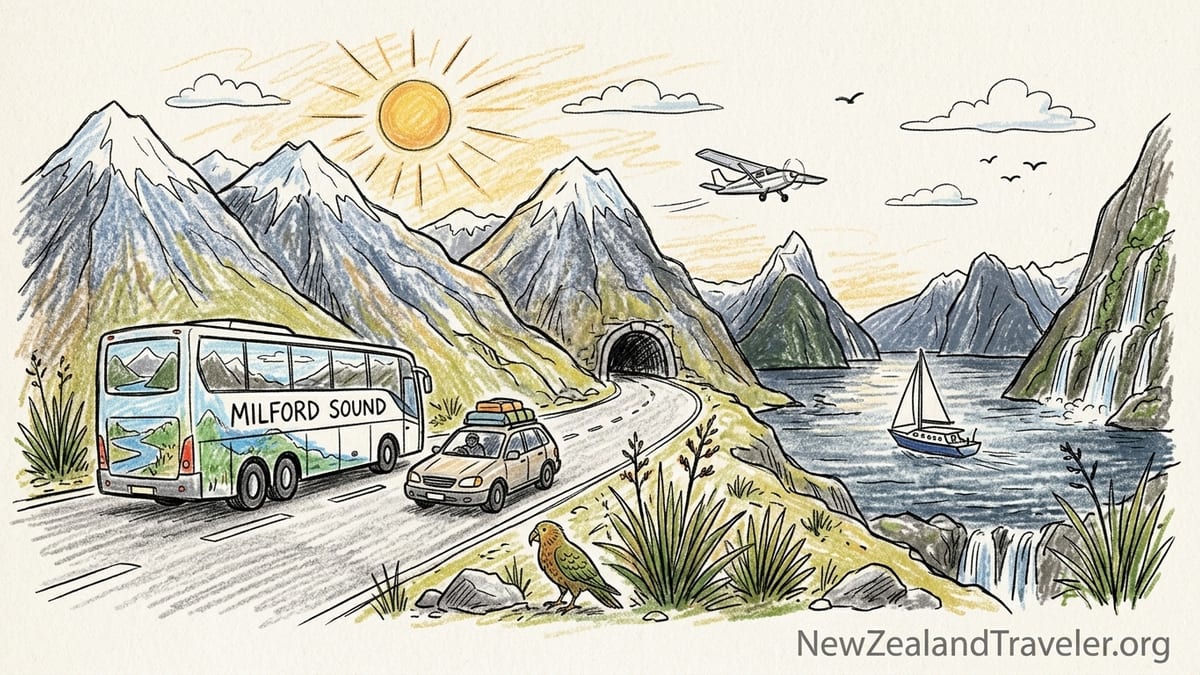
Understanding the Queenstown to Milford Sound Journey
Before comparing transport options, it helps to understand what the journey actually involves. There is only one sealed road route from Queenstown to Milford Sound. It runs south via Kingston and Mossburn to Te Anau, then follows the Milford Road, State Highway 94, through Fiordland National Park to Piopiotahi Milford Sound. From central Queenstown to the Milford Sound boat terminal the distance is around 287 to 300 kilometres one way and typically takes 4 to 5 hours of continuous driving in good conditions, without extended sightseeing stops.
The character of the road also changes along the way. The first half between Queenstown and Te Anau is relatively gentle highway driving through open farmland and rolling country. North of Te Anau, the Milford Road narrows and becomes more winding as it climbs through the Eglinton and Hollyford valleys toward the Darran Mountains, passes through the 1.2 kilometre Homer Tunnel, then descends in tight bends to sea level at Milford Sound. It is beautiful, but it is also demanding driving, especially on the return in fading light or rain.
On a typical day trip from Queenstown, travellers spend 8 to 10 hours in transit for only 1 hour 45 minutes to 2 hours on the fiord itself. Modern coaches, photo stops and commentary can make that journey a highlight in its own right, but it remains a very long day. That is why serious comparison between coach tours, self-drive and scenic flights matters. Each option changes the balance between cost, fatigue, flexibility and resilience to weather.
Weather is another central variable. Fiordland is one of the wettest inhabited regions on earth and rain or low cloud are common at any time of year. The road can be affected by snow and avalanche control, roughly June to October, while high winds and poor visibility can ground small aircraft even when coaches are still running. How you travel between Queenstown and Milford Sound will shape how much the weather can disrupt your plans.
Coach and Cruise from Queenstown: The Classic 12-Hour Day
The most common Queenstown to Milford Sound day trip in 2026 remains the coach and cruise package. Large operators run daily departures year round, typically using glass-roof or panoramic coaches with on-board commentary. Sample products listed in late 2026 include full-day coach and cruise tours priced around 135 to 200 New Zealand dollars per adult, depending on season, inclusions such as lunch, and whether you choose a standard or smaller group bus. Durations are usually advertised at about 12 to 13 hours from hotel pickup to drop-off.
A typical schedule works like this. A coach collects guests from central Queenstown hotels between 6.15 and 7.00 in the morning. The bus follows the highway south to Te Anau with one comfort stop, then continues along Milford Road with short scenic breaks. Many major tours include quick stops at viewpoints such as Mirror Lakes, Knobs Flat or Monkey Creek for photos and a leg stretch. Arrival at Milford Sound is usually timed for a late morning or early afternoon sailing, with a 1 hour 45 minutes to 2 hour cruise along the length of the fiord to the Tasman Sea and back. After the cruise and a short break at the terminal, the same coach returns to Queenstown, typically arriving around 7.00 to 7.30 in the evening in summer and earlier in winter.
The main strength of this option is that it removes almost all logistic effort from the traveller. You are picked up at or near your hotel, luggage is not required for a day trip, and a professional driver handles the long hours and tricky sections near Homer Tunnel. That is particularly valuable for visitors who are not used to driving on the left, who are travelling with children or older relatives, or who simply prefer to watch the mountains and waterfalls rather than watch the speedometer and mirrors. In wet weather, coach drivers are also accustomed to Milford Road conditions, including narrow bridges, kea on the roadside and occasional rockfall zones.
The trade-offs are time and flexibility. A coach tour from Queenstown is essentially a 12 hour commitment with limited freedom to alter the pace or stops. You will not be able to linger at a trailhead for a spontaneous walk or pull over every time a vista catches your eye. If you are prone to motion sickness, twisting sections of the Milford Road can be uncomfortable despite the driver being in control. For budget-conscious visitors who accept a long day in exchange for relative affordability and convenience, however, coach and cruise remains the value benchmark for Queenstown to Milford Sound.
Self-Drive and Cruise: Maximum Freedom, Maximum Fatigue
Hiring a car in Queenstown and driving yourself to Milford Sound is the option that promises the greatest freedom. With your own vehicle you can choose your departure time within reason, decide exactly how long to spend at viewpoints like Eglinton Valley, Lake Gunn or The Chasm, and potentially combine the day with short walks such as the Key Summit section of the Routeburn Track or the Lake Marian Track if you add extra days. You also avoid sharing a packed coach and can manage your own breaks, playlists and snacks.
To make the day remotely comfortable, most self-driving travellers leave Queenstown between 6.00 and 7.00 in the morning, aiming for a midday cruise at Milford Sound. The non-stop driving time is usually put at about 4 to 5 hours each way, but once you account for fuel stops in Te Anau, photo breaks, toilet stops and slower speeds on wet or icy sections, it is sensible to allow at least 5 and a half hours from Queenstown to the boat terminal. That means as a driver you may be behind the wheel for 10 hours in a single day, much of it on unfamiliar roads, with only the cruise itself and brief pauses as down time.
The Homer Tunnel section is where fatigue and weather can combine to make the return leg challenging. The tunnel is a little over 1.2 kilometres long and sits high in the mountains, with avalanche and ice risk in winter and early spring. Traffic lights or manual control can create queues at each portal in peak periods. As you emerge from the tunnel on the Queenstown-bound side, the road descends steeply with tight bends and cliffs, which can be intimidating in rain, fog or after dark. New Zealand transport agencies frequently emphasize that chains may be required and that the Milford Road can close without much warning in adverse conditions.
Spectacular as it is, this is not an ideal candidate for a same-day return drive if you are unused to long rural distances, driving on the left, or focusing for many hours. Real-world feedback from travellers in recent seasons often mentions arriving back in Queenstown exhausted, with the last hour between Te Anau and Queenstown feeling like a slog rather than a scenic joy. That exhaustion increases accident risk. For that reason, many local advisers suggest that if you want to self-drive Milford Road for its flexibility, you should seriously consider breaking the trip with a night in Te Anau either on the way in or on the way back, rather than forcing the entire loop as a day excursion from Queenstown.
Fly-Cruise-Fly: The Half-Day, High-Price Option
At the other end of the spectrum sits the fly-cruise-fly experience. Small-plane operators based at Queenstown Airport and nearby airfields run half-day trips that combine scenic flights across the Southern Alps with a Milford Sound boat cruise. In late 2026, published prices for fly-cruise-fly options typically fall in the range of about 430 to 700 New Zealand dollars per adult, depending on operator, season and whether the cruise is on a larger vessel or a smaller nature boat. Advertised durations are usually about 4 and a half to 6 and a half hours door to door.
One example itinerary begins with a mid-morning check-in at an airfield on the eastern side of Queenstown. After a safety briefing, passengers board a fixed-wing aircraft with large windows for a 35 to 40 minute flight over Lake Wakatipu, alpine basins and glacier-clad ranges before descending through Fiordland to land at Milford Sound airstrip. From there a short transfer connects with a 1 hour 45 minutes to 2 hour boat cruise on the fiord, often with a light lunch included. After the cruise, a return flight traces a slightly different route back to Queenstown, giving fresh views of hanging valleys and waterfalls, with the entire outing typically completed within one half of the day.
The obvious advantage is time. By replacing 8 to 10 hours of road time with around 1 hour of flying, you regain most of a day in Queenstown while still experiencing both the cruise and some spectacular alpine scenery. The views from the plane arguably equal or surpass those from the road, particularly in clear conditions when you can see icefields, tarns and the full structure of the fiords that the highway never reveals. For some travellers, the reduced fatigue and the chance to see Fiordland from the air justify the significantly higher price.
There are two substantial caveats. First, small aircraft are much more sensitive to weather than buses. Low cloud, strong winds or rain in the valleys frequently force operators to delay or cancel flights, especially in winter and shoulder seasons. Road-based coach and cruise tours often still operate on days when fly-cruise-fly is grounded. It is not uncommon for visitors to have a flight cancelled after checking in, with either a shift to a road-based alternative or a refund. Second, not all travellers are comfortable in small planes, whether for reasons of motion sensitivity or fear of flying. If you already find short commercial flights stressful, the intimacy and movement of a light aircraft may undercut the experience.
Coach-Cruise-Fly: A Compromise for One-Way Road Time
Several Queenstown operators now market combinations in which you travel one way by road and return by air. These coach-cruise-fly or fly-cruise-coach options aim to give guests a taste of both experiences while halving the road time. A representative product in 2026 might be billed as a premium coach to Milford Sound in the morning, a 2 hour cruise, then a late afternoon scenic flight back over the mountains to Queenstown or vice versa, with hotel transfers on either end. Durations often sit around 9 to 10 hours door to door, longer than pure fly-cruise-fly but shorter and less tiring than coach both ways.
Pricing for these hybrid tours tends to sit between the all-coach and all-flight extremes. Publicly listed rates often fall somewhere around 550 to 800 New Zealand dollars per adult. Exactly where a particular tour lands in that band depends on inclusions such as lunch, the size and comfort level of the coach, and whether the flight segment is operated by a partner airline or the same company. From a travel planning perspective, the key point is that you are paying a significant premium over a standard coach tour in exchange for eliminating roughly 4 to 5 hours of road time and gaining alpine flightseeing in one direction.
This format suits travellers who are curious about Milford Road and want to see its scenery at least once from ground level, but who do not want to spend 8 or more hours on a bus. Going out by coach lets you experience the classic photo stops and stories about the land from a guide, while flying home gives you a faster and often more relaxing return at the time of day when many people feel the drag of a long excursion. As with fly-cruise-fly, however, the flight segment remains subject to weather. Operators usually have fallback plans, such as converting to coach both ways, but that can leave you with the long day you were trying to avoid, so it is important to read the current terms and cancellation policies at booking.
Because these hybrid options rely on coordination between ground and air schedules, availability can be more limited than straightforward coach tours. Departure dates may cluster in peak visitor months like January, February and March, with fewer offerings in winter. If coach-cruise-fly is your target experience, plan to book early during busy periods and schedule it away from your arrival or departure day in Queenstown to provide some flexibility if weather forces a change.
Weather, Homer Tunnel and Risk Management on Milford Road
Whichever way you approach Milford Sound, Fiordland weather and the nature of Milford Road should inform your decision. The region records several metres of rain per year on average, with heavy rainfall events that can trigger surface flooding, rockfalls and temporary road closures. From roughly June to October, the high sections around Homer Tunnel are subject to snow and an avalanche control programme. Chain requirements are enforced in winter conditions and fines for failing to carry or fit chains can be significant. Traffic can sometimes be held at control points such as The Divide, the Hollyford turn-off or the tunnel portals while crews manage risk.
For coach and cruise passengers, most of this becomes background logistics handled by professionals. Tour companies monitor road status updates, adjust departure times to clear control points safely and have protocols for turning back if authorities close the road. Coaches are fitted out for alpine driving, and drivers often know the hazards intimately after years of experience. This does not eliminate delays, but it means someone else is reading the notices and deciding whether it remains safe to proceed. If the road is open but flights are cancelled, coach and cruise may be the only option operating from Queenstown that day.
Self-drivers must take a more active role. That means checking New Zealand transport bulletins before departure, allowing extra time to pass through control areas, and being prepared for conditions that change between morning and late afternoon. Visitors from right-driving countries also need to adapt quickly to left-side driving on narrow, sometimes shoulderless roads, with bridges that can be one lane and sections where tourist drivers stopping unpredictably for photos create additional hazards. Fatigue late in the day magnifies every misjudgment, particularly on the dark interior highway between Te Anau and Queenstown in winter.
For fly-cruise-fly and coach-cruise-fly, the central weather risk sits in the sky rather than on the tarmac. Low cloud over the Alps, crosswinds at Milford Sound airstrip or limited visibility in the valleys can all trigger cancellations. In practice, this means that scenic flights are sometimes cancelled while coach tours still operate. Operators generally offer a choice between switching to an all-road option or taking a refund. If you have only one available date in your itinerary and experiencing Milford Sound is crucial, road-based tours give you the highest probability of actually making the trip, although even they are occasionally halted by road closures in extreme events.
Who Should Choose Which Milford Sound Option?
Once you understand the trade-offs, the choice between coach, self-drive and scenic flight becomes a matter of matching the product to your own limits and priorities. If your budget is tight and you are comfortable with a long, shared excursion, full-day coach and cruise is the most cost-effective option out of Queenstown. Expect to pay in the vicinity of 135 to 200 New Zealand dollars per adult, accept the 12 to 13 hour duration and treat the road journey as central to the experience. This suits solo travellers, couples and small groups who prefer someone else to handle logistics and who are not especially motion-sensitive.
Self-drive and cruise appeals to those who value autonomy and are experienced with similar or longer days behind the wheel. It makes the most sense if you either break the journey with an overnight in Te Anau or Milford Sound, or if your broader itinerary already includes those locations and Milford is only one element in a road trip. It can also work for small families who want to manage their own schedule and stops. However, as a pure Queenstown day trip, self-drive demands honest self-assessment. If you are at all unsure about tackling 8 to 10 hours of driving in one day, on unfamiliar roads and often in variable weather, it may be safer and more enjoyable to leave the driving to a professional.
Fly-cruise-fly is the natural choice for three types of traveller willing to pay considerably more to reduce transit time and fatigue. First are visitors on short stays who want to see Milford Sound without sacrificing an entire day in Queenstown. For them, paying roughly 430 to 700 dollars can be viewed as purchasing time as much as scenery. Second are those for whom the flightseeing itself is a major draw: photographers, aviation enthusiasts and travellers who may never again have the chance to cross the Southern Alps in a small plane. Third are older travellers or those with back, joint or health issues that make long bus rides or drives uncomfortable or impractical. For these groups, the price premium buys not just time, but physical ease.
Hybrid coach-cruise-fly products serve travellers in the middle. If your budget can stretch beyond a coach tour but not all the way to the top-end scenic flights, and you would like both the ground-level Milford Road experience and an aerial overview, these tours are worth a close look. They work especially well for couples or multi-generational groups in which one or two people care deeply about reducing coach hours while others are happy on the road. Everyone shares the cruise and one segment of the journey, while the flight home or out provides a memorable highlight without requiring a full-day air excursion.
When a Day Trip Feels Too Long: Overnight Alternatives
For many readers, running the numbers on distance, duration and fatigue leads to a simple conclusion: attempting Milford Sound as a same-day return from Queenstown feels like too much. The good news is that staying overnight closer to the fiord opens more relaxed and immersive options. The most practical base is Te Anau, the lakeside town at the southern gateway to Fiordland National Park, roughly two hours north of Queenstown by road. By shifting at least one night there, you cut each Milford Road driving leg roughly in half and give yourself a buffer for weather and road conditions.
A common pattern is to drive from Queenstown to Te Anau one afternoon, spend the night, then make a separate day trip along Milford Road with a morning cruise the following day. That splits the total driving over two days, reduces the risk of driving the mountain section after dark and leaves more energy for short walks and viewpoints. If the weather on your planned Milford day looks unpromising, you have more flexibility to swap days, explore local walks around Te Anau or visit glowworm caves instead, then tackle the fiord on a clearer day if your schedule allows.
The other, more exclusive alternative is to stay overnight in Milford Sound itself. Accommodation there is very limited and often priced at a premium, but spending a night means you can enjoy the late afternoon and early morning light on the fiord when most day trippers have departed or not yet arrived. It also allows you to join the first cruises of the day, which are usually less crowded. For travellers who prize tranquillity and can absorb the higher cost, this approach reframes Milford Sound from a rushed day trip into a destination in its own right.
For those on extended South Island itineraries, it is also worth considering building Milford Sound into a broader Fiordland loop rather than treating it as a Queenstown side trip. For example, you might travel from Queenstown to Te Anau, onward to Milford and back, then continue to Manapouri for a separate day on Doubtful Sound before returning to Queenstown or moving on to the south coast. This itinerary design reduces backtracking and spreads the effort of travel more evenly.
The Takeaway
Milford Sound from Queenstown is one of New Zealand’s great travel experiences and also one of its longest standard day trips. At roughly 287 to 300 kilometres each way, the road journey dominates the schedule for any coach or self-drive excursion. Understanding that reality helps set expectations and clarify which transport option fits your circumstances in 2026. Coach and cruise remains the workhorse product because it balances cost, convenience and relative safety, at the price of a very long but logistically simple day. Self-drive offers unmatched freedom to stop, linger and combine the journey with other Fiordland experiences, but it also concentrates responsibility and fatigue in the driver’s seat, which can be a serious burden on a same-day return.
Scenic flight options reset the equation by radically shrinking transit time and replacing hours of highway with minutes of soaring over glaciers and valleys. Fly-cruise-fly, and to a lesser extent coach-cruise-fly, are not just upgrades; they are different days entirely, trading money for time, energy and unique perspectives on the landscape. Their main limitation is weather sensitivity, which makes them best for travellers whose schedules can tolerate possible cancellations or changes.
If you are weighing all three, start with two questions. First, are you genuinely comfortable devoting 12 to 13 hours to a single excursion, much of it in transit. Second, how anxious would you be about driving or flying in unfamiliar conditions. If long days on a bus do not bother you and your budget is moderate, book a reputable coach and cruise from Queenstown with hotel pickup and enjoy being a passenger. If you have a flexible itinerary, relish driving and can build in at least one night in Te Anau, a self-drive Milford Road adventure can be unforgettable. If time in Queenstown is short or your energy is limited, and you can afford the higher price, then paying for a scenic flight is likely to give you the best experience for the day.
However you decide to travel, the key to a rewarding Milford Sound experience is planning for the distance and respecting the conditions rather than underestimating them. Do that, and whether you arrive at the fiord by coach door, car door or aircraft hatch, the immense cliffs, waterfalls and dark water will feel like a deserved reward rather than the exhausted end of an over-ambitious side trip.
FAQ
Q1. How long does a Milford Sound day trip from Queenstown really take by coach?
Most full-day coach and cruise tours from Queenstown take around 12 to 13 hours from first hotel pickup to final drop-off, including photo stops and a 1 hour 45 minutes to 2 hour cruise.
Q2. Is it safe to self-drive from Queenstown to Milford Sound in one day?
Experienced drivers can complete the return in a day, but it involves 8 to 10 hours behind the wheel on sometimes narrow, winding roads. Fatigue, weather and unfamiliar left-side driving mean many local experts recommend either taking a coach from Queenstown or breaking the trip with at least one night in Te Anau instead of attempting the full loop in a single day.
Q3. How much does a Milford Sound coach and cruise tour from Queenstown cost in 2026?
In late 2026, large operators commonly advertise Queenstown coach and cruise packages in the approximate range of 135 to 200 New Zealand dollars per adult, depending on season, coach type and whether lunch is included.
Q4. What are typical prices for fly-cruise-fly tours from Queenstown?
Scenic fly-cruise-fly products usually fall around 430 to 700 New Zealand dollars per adult. The lower end of that band tends to be standard fixed-wing flights with larger-boat cruises, while the upper end can include smaller planes, boutique cruises or peak-season departures.
Q5. How often are scenic flights to Milford Sound cancelled for weather?
Exact cancellation rates vary by season and year, but it is normal for small-plane flights to be grounded multiple days each month in winter and during unsettled periods due to low cloud, wind or rain. Road-based coach and cruise tours often still operate on some of those days, which is why travellers with inflexible schedules sometimes choose the bus.
Q6. Are there hotel pickups for Milford Sound tours from Queenstown?
Most major coach and coach-cruise-fly operators include pickups from central Queenstown hotels or nearby meeting points. Scenic flight operators generally offer shuttle transfers between downtown Queenstown and their airfields, although exact pickup locations are confirmed at booking.
Q7. What are the main risks on the Milford Road and around Homer Tunnel?
Key risks include heavy rain, surface flooding, rockfalls, winter snow and ice, and controlled avalanche areas near Homer Tunnel. The road is also narrow and winding in places, with one-lane bridges and steep drops. In winter and early spring, authorities may require chains and occasionally close sections of the road for safety.
Q8. Who should seriously consider paying extra for a scenic flight option?
Travellers with limited time in Queenstown, those who find long bus rides uncomfortable, and visitors who especially value aerial views of the Southern Alps are the ones most likely to benefit from paying extra for a flight-based option. Older travellers or those with back and joint issues may also find that the reduced transit time and smoother overall day justifies the higher cost.
Q9. Is it better to stay overnight in Te Anau before visiting Milford Sound?
Staying in Te Anau turns Milford Sound from an exhausting Queenstown side trip into a more manageable excursion. It cuts driving distances each day, allows a more relaxed start for a morning cruise and provides flexibility if weather forces you to shift your Milford plans by a day.
Q10. When is the best time of year to visit Milford Sound from Queenstown?
Milford Sound operates year round. Summer offers longer daylight and generally easier driving but can be busier and warmer on the coach. Winter and shoulder seasons often deliver dramatic waterfalls and fewer crowds but bring increased risk of snow, ice and weather-related changes, especially for self-drivers and flight-based tours.