


Queenstown now markets four ski areas within roughly an hour and a half of town, which sounds like a dream until you have to choose where to spend your precious ski days. For winter 2026, Coronet Peak, The Remarkables, Cardrona Alpine Resort and Treble Cone all offer distinct personalities, terrain and logistics. This guide focuses squarely on the decision of which ski field to ski, and when, instead of a generic overview of Queenstown in winter.
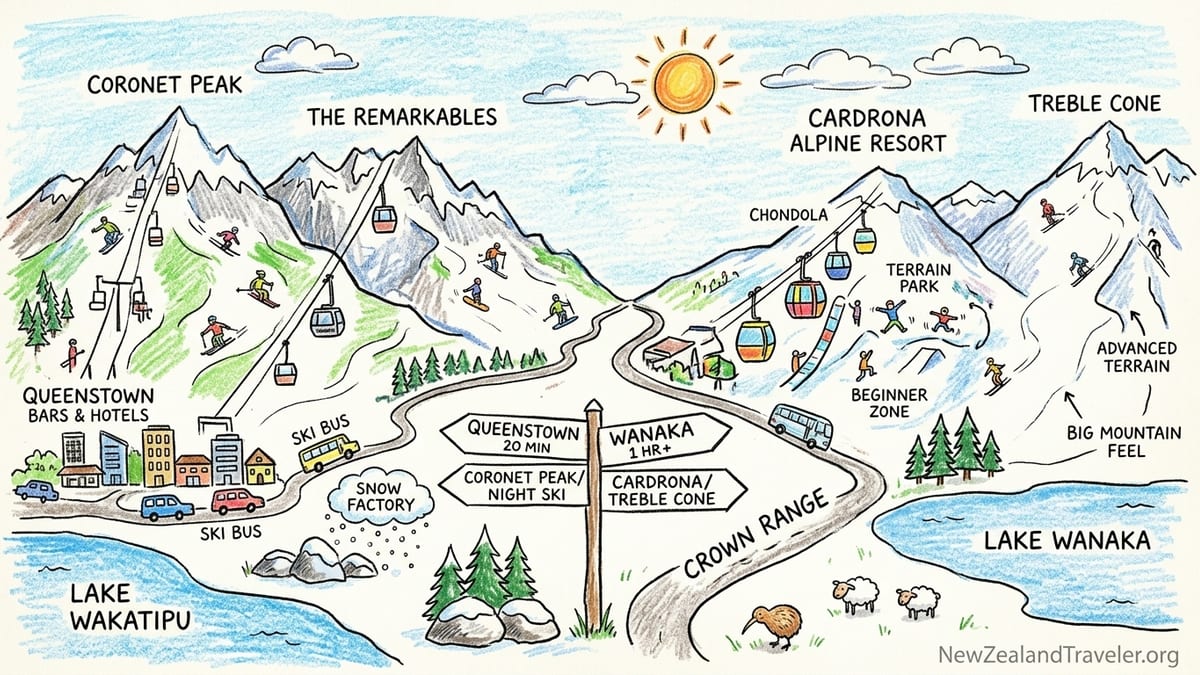
Key Facts for the 2026 Queenstown Ski Season
For 2026, Queenstown’s official tourism information lists Coronet Peak and The Remarkables both opening on 13 June, with Coronet scheduled to close on 4 October and The Remarkables on 11 October. Cardrona Alpine Resort is set for a 20 June to 18 October season, while Treble Cone plans to operate from 27 June to 27 September. These planned dates can still shift with weather, but they give a useful framework when planning a trip and deciding how late in spring you can reasonably expect to ski each mountain.
From central Queenstown, Coronet Peak is the quickest access, at roughly a 20-minute drive on a fully sealed road. The Remarkables sits behind the airport, usually 40 to 45 minutes away, with a sealed lower section and alpine gravel above. Cardrona and Treble Cone are on the Wanaka side of the Crown Range and Hawea, about 60 to 75 minutes by car to Cardrona, and around 90 minutes or a little more to Treble Cone depending on conditions. In practical terms, this means Coronet is realistic for a spontaneous afternoon or evening, while Cardrona and Treble Cone are better planned as full-day excursions.
Lift passes are split between two operators. Coronet Peak and The Remarkables are NZSki mountains and share the same MyPass RFID card, which can also cover Mt Hutt. Cardrona and Treble Cone share a separate pass and app under one ownership. Standard adult single-day lift passes across all four fields in 2026 cluster in a similar price band, with public media kits and tour-operator tables indicating adult day rates around the high NZD 100s, and free skiing for children aged five and under at all four. Discounts are increasingly dynamic and online, so buying early and pre-booking buses generally secures noticeably better pricing than walking up on a busy July morning.
For many visitors, the biggest new operational change in 2026 is Coronet Peak’s Snow Factory. This all-weather snowmaking system can create snow in temperatures that would previously have been too warm, and is specifically targeted at the learner slopes and a designated snow play zone from late May. That means first-timers and families chasing early-season snow now have a far higher chance of finding skiable terrain at Coronet even if natural snow is slow to arrive.
Coronet Peak: Convenience, Night Skiing and Early-Season Reliability
Coronet Peak is the closest ski area to Queenstown’s bars and hotels, and it behaves like a local’s mountain. On a clear weekday before a storm, you can see rental shop staff loading their cars on Shotover Street at 7.30 a.m. and still be clicking into their bindings for first chair just after 9. For visitors, that proximity means you can realistically ski a half day after a morning arrival flight, or grab an Uber to a ski bus stop without turning it into a dawn expedition. The sealed road is usually well maintained, and on many days a two-wheel-drive rental car with chains in the boot is entirely adequate, although you must follow daily chain and parking instructions.
Terrain wise, Coronet Peak is well suited to confident intermediates who enjoy fast laps on groomed trails. Long, rolling blue runs such as the M1 and Big Easy are natural progression for skiers who can already link turns but still want the comfort of wide pistes. The mountain’s intermediate bowl layout means it is easy to regroup at the base or at the Coronet Express top station, which is handy for mixed-level groups. Advanced terrain exists in the form of steeper fall-line pitches and off-piste faces, but compared with Treble Cone it feels more like short, intense bursts rather than sustained leg-burners.
For first-timers, Coronet’s beginner zone is compact but effective, especially now it is backed by the Snow Factory. In practical terms, a July family who books first-timer packages for two days can be reasonably confident there will be enough snow on the beginner carpets, even during lean early or late periods. Lesson programs are extensive, with morning and afternoon group lessons and private instruction available. Rental facilities are modern and integrated with the MyPass system, so once you have your card set up, subsequent visits become quick scan-and-go experiences.
Coronet is also the only field in the region with regular night skiing. Typically scheduled a few evenings each week in the core of winter, these sessions transform the mountain into a social hub, with floodlit groomers, live DJs on the deck and locals using it as their after-work fitness. For a visitor based in Queenstown, a realistic itinerary might be a day at another mountain and then a Friday evening at Coronet for night skiing, using your NZSki day or multi-day pass across both. The on-mountain après experience leans toward busy bar decks and sunset drinks rather than fine dining, and the real post-ski nightlife happens back in Queenstown itself.
The Remarkables: Learner Heaven and Freestyle Heartland
The Remarkables sits across the lake from Coronet Peak and has a very different feel. The access road climbs higher into the range above Queenstown Airport, and once you step out of the base building, the views across Lake Wakatipu and the surrounding peaks can stop even seasoned skiers. Many families and first-timers report that they choose The Remarkables simply because they want those big mountain vistas in their holiday photos, even before considering the terrain mix.
For beginners, The Remarkables offers one of the more forgiving progression paths in the region. Several dedicated learner areas with surface lifts sit right beside the base lodge, so nervous adults or young children are never far from the café or a warm-up break. Once learners are ready for green and easy blue runs, they can graduate gently without committing to long, intimidating descents. Ski schools here are very visible, with clusters of lesson groups moving between carpets and chairlift-accessed terrain in a way that keeps new skiers surrounded by peers of a similar level.
The mountain’s reputation among freestyle skiers and snowboarders is equally strong. Terrain parks at The Remarkables tend to attract a younger, more park-focused crowd, helped by regular events and a layout that allows park riders to lap lines with minimal traversing. You will see local teenagers spending entire days hitting the same rail line or jump set, while film crews set up for midweek shoots. For a visiting intermediate who wants a taste of park skiing, progression parks with smaller features provide an accessible entry point, especially when combined with a freestyle lesson.
Intermediate and advanced riders will also find plenty of off-piste and side-country style terrain, including chutes and natural halfpipes that open up with good snow. Snow reliability here can be slightly better than Coronet in marginal seasons because of elevation and aspect, although both rely heavily on modern snowmaking systems on their main trails. For logistics, the drive can feel longer and more exposed than Coronet’s, particularly on snowy days, so visitors who are not comfortable with alpine driving often opt for the regular ski buses that leave from central Queenstown and major hotel stops.
Cardrona Alpine Resort: All-Rounder with Resort-Style Infrastructure
Cardrona sits over the Crown Range on the Wanaka side, and from a Queenstown base it is the first of the two Wanaka fields you reach. The drive time is usually around an hour to an hour and a quarter, but can stretch longer in chain conditions or mid-July holiday traffic. Many visitors treat Cardrona as their “big day out” from Queenstown, leaving around 7 a.m., catching an early ski bus from Frankton or driving themselves over the pass, and not returning until dinner.
Once on the mountain, Cardrona feels closer to an all-round ski resort than a local hill. The base area is more expansive, with multiple cafes, childcare options and a broad rental and retail village atmosphere. The lift network includes a chondola that combines gondola cabins and chairs, which is particularly attractive for nervous beginners or families with small children who prefer the security of an enclosed cabin on their first rides to the top. Terrain spreads across several basins, with long, flowing groomed runs that suit classic intermediate cruising.
Beginner areas at Cardrona are generous and serviced by their own lifts, which reduces congestion and keeps first-timers away from faster traffic. Intermediate riders can spend entire days exploring varied blue and easy black runs, with enough length in each descent to feel like a journey rather than a short lap. Cardrona’s parks have a long-standing reputation in New Zealand for hosting major freestyle events, so park skiers and riders often split their time between here and The Remarkables, depending on snow and event schedules.
Snow reliability at Cardrona often benefits from higher base elevations compared with Queenstown’s closer fields, and the resort invests heavily in snowmaking and grooming. In practice, that means you might find Cardrona holding onto quality corduroy on sunny, warm days when lower mountains are starting to show thin patches on exposed faces. On the flip side, stronger winds can occasionally impact upper lifts, so it is wise to check the morning snow report before committing to the long drive or bus ride from Queenstown. For après, most visitors either linger for a last drink on the extensive outdoor decks or head back to Wanaka or Queenstown for evening meals, since there is no true on-mountain village for overnight stays at the base.
Treble Cone: Advanced Terrain and Big-Mountain Feel
Treble Cone is the outlier in this quartet. It is the farthest from Queenstown, sitting beyond Wanaka on the shores of Lake Wanaka and Lake Hāwea, and the access road is narrower and more rugged than those to Coronet or Cardrona. From Queenstown, you are looking at around an hour and a half or more of travel one way by car or bus, which means it is rarely the choice for a casual half-day. Instead, Treble Cone appeals most to strong intermediates and advanced skiers who are happy to trade time on the road for some of the most sustained fall-line skiing in the region.
Once you arrive, the rewards are clear. Treble Cone’s main faces drop steeply toward Lake Wanaka, creating long runs that begin on open, often ungroomed terrain and then flow into groomed sections lower down. For advanced skiers and riders, this translates into genuine big-mountain sensations, with wide bowls, natural features and off-piste powder stashes that can last longer after a storm than at more heavily trafficked fields. In good snow years, strong locals will often describe Treble Cone days as their season highlights.
For lower intermediates and beginners, however, Treble Cone can feel limited. There is a learner area near the base, and a few groomed blue options, but the proportion of terrain that is comfortable for cautious skiers is smaller than at Cardrona or The Remarkables. If you are a family with a mixture of confident parents and nervous kids, you may find that the advanced members of the group love the mountain while beginners spend more time at the café. Ski schools and rental services operate as at any major field, but Treble Cone remains better suited to visitors who already know they enjoy challenging terrain.
Snow reliability at Treble Cone is closely tied to natural snowfall patterns, and the shorter scheduled 2026 season from 27 June to 27 September reflects its focus on the core winter months. On a powder day, the combination of steep pitches and fewer lifts can mean that lines form quickly in popular areas, and it rewards those who arrive early on the first bus or with chains on and ready to drive before dawn. Après on the mountain itself is relatively low-key, with a focus on big view decks overlooking the lake. The true celebration often takes place in Wanaka afterwards, which is another reason many advanced skiers choose to base themselves there rather than in Queenstown if Treble Cone is their primary target.
Snow Reliability, Altitude and the Impact of the Snow Factory
Across the four ski areas, snow reliability in 2026 reflects a combination of natural snowfall, altitude, aspect and snowmaking infrastructure. Cardrona and The Remarkables generally benefit from higher base elevations than Coronet Peak, which can give them an edge in marginal conditions, particularly later in the spring shoulder. Treble Cone’s higher and more exposed terrain can offer deep mid-winter conditions when storms line up, but its shorter season dates indicate that it is planned around the highest-probability snow window.
Coronet Peak’s introduction of a Snow Factory in 2026 changes the calculus for early season, particularly for learners. This all-weather snowmaking machine is set up to blanket the learner slopes and snow play area with man-made snow from late May, regardless of air temperature. In practice, that means a family landing in Queenstown in mid to late June has a very strong chance of being able to slide on snow at Coronet, even if natural snowfall has not yet fully covered the main mountain. It is less about waist-deep powder and more about guaranteed surfaces for first turns and sledding.
All four ski areas continue to invest in traditional fan-gun and lance snowmaking on key main trails, which helps them maintain groomed runs through mild spells. However, it is still worth planning around seasonal patterns if your trip dates are flexible. July and August remain the safest bets for consistent coverage, while late June and late September offer quieter slopes but depend more heavily on snowmaking and recent storms. When booking, it is sensible to check each mountain’s live snow reports in the week before you travel and stay open to adjusting which field you ski on which day.
Altitude and aspect also influence visibility and wind exposure. On stormy days, lower and more sheltered terrain at Coronet or The Remarkables can sometimes offer better visibility than the more exposed upper slopes at Cardrona or Treble Cone. Local rental shops and hotel concierges often have an informal consensus each morning about which mountain is likely to ski best under that day’s conditions, and seasoned visitors listen to that local knowledge when choosing between the four.
Getting There, Parking, Lessons, Rentals and Après
From a logistics point of view, NZSki-operated Coronet Peak and The Remarkables share similar systems. Both offer frequent ski buses from central Queenstown, major hotels and park-and-ride hubs near Frankton, which take the pressure off visitors uncomfortable with winter driving or chain fitting. Parking at the mountains is free but tiered, with upper lots filling early on busy days and overflow parking connected by shuttle buses. It is common in July for locals to leave town by 7 a.m. to secure a close park at Coronet or a good bus seat to The Remarkables.
Cardrona and Treble Cone are accessed either by self-drive over the Crown Range and through Wanaka, or by commercial ski buses that pick up in both Queenstown and Wanaka. For visitors staying in Queenstown without a car, it is often easier to book a dedicated day trip bus product that includes return transport and maybe a beginner package. These buses leave earlier than the Queenstown local shuttles and return later, acknowledging the longer distance involved. Parking at both Wanaka fields is again free, but the access roads can be more challenging after fresh snow, which is another argument for using bus services if you are not experienced with alpine driving.
Lesson quality is strong across all four mountains, with English-speaking instructors familiar with northern hemisphere guests and short-stay holiday patterns. NZSki’s MyPass system at Coronet and The Remarkables stores lift tickets, rentals and lessons on an RFID card that you tap at gates, which streamlines adding extra lesson days or upgrading packages. Cardrona and Treble Cone operate a separate pass and, more recently, emphasize online pre-booking for both lessons and rentals to secure spots during school holidays.
Rental equipment quality is broadly similar across the fields, with standard and performance skis and snowboards available. One practical tip for Queenstown-based visitors is to consider renting boots and skis in town from well-known chains, then using mountain rentals only for top-ups like helmets or clothing. This avoids morning queues at on-mountain rental areas, especially on Saturdays. For après, Coronet and The Remarkables channel most of the post-ski energy back into Queenstown’s CBD, where bars and restaurants from lakefront pubs to cocktail lounges soak up the ski crowd. Cardrona and Treble Cone après is more about a last drink at the base or a relaxed session in Wanaka, which has a cozier, smaller-town evening scene compared with Queenstown’s nightlife.
Freestyle and park riders should consider how they want to split their evenings. A common pattern for a week-long Queenstown stay is to spend days at The Remarkables or Cardrona for park laps, then choose one or two nights of Coronet Peak night skiing for social laps under lights. Families with young children, on the other hand, often prioritize fields with the simplest bus logistics and largest beginner zones, which tends to mean The Remarkables and Cardrona for full days, with Coronet as the convenient bonus mountain.
Passes, Pricing and When to Go Beyond Queenstown
Coronet Peak and The Remarkables share NZSki lift products, ranging from single-day passes to multi-day bundles and full season passes that also include Mt Hutt. Publicly available pricing tables for 2026 marketed to tour operators show rack-rate one-day adult passes at both Coronet and The Remarkables in the high NZD 100s, with child passes lower and children five and under skiing free. In practice, most visitors do not pay the full rack rate, instead booking online early to access dynamic discounts or packaging passes with rentals and lessons into first-timer bundles.
Cardrona and Treble Cone operate under a combined product umbrella, with options including single and multi-day passes valid at one or both mountains, season passes, and flexible multi-day products where you choose which days to ski. The official messaging for 2026 emphasizes that buying passes online and in advance gives the best chance of securing preferred dates and prices, particularly during New Zealand and Australian school holidays. Like NZSki, Cardrona and Treble Cone also offer free skiing for under-fives and discounted youth and senior categories.
The more strategic question for Queenstown-based visitors is when it is worth committing to the longer trip to Cardrona or Treble Cone instead of sticking to the two closer Queenstown fields. If you are on a very short break, say three to four days, and staying centrally without a car, it often makes sense to focus on Coronet Peak and The Remarkables, perhaps with one night skiing session at Coronet. This keeps your transit time low and maximizes slope time, especially if you are mixing skiing with other Queenstown activities like jet boating or winery visits.
If you have a week or longer, or if you are an advanced skier craving more variety, then adding at least one Cardrona day is highly recommended. The broader terrain, higher elevation and resort-style infrastructure justify the early start from Queenstown. Treble Cone becomes particularly worthwhile for strong intermediates and advanced riders on forecast powder or cold chalk days, when its steeper faces can shine. In that scenario, staying a night or two in Wanaka to avoid backtracking over the Crown Range both ways can make the experience more relaxed and gives you a chance to sample Wanaka’s lakefront charm.
The Takeaway
Choosing the best ski field near Queenstown in 2026 is less about finding a single winner and more about matching each mountain’s character to your own priorities. Coronet Peak offers unbeatable proximity to town, efficient infrastructure and night skiing, now backed by a Snow Factory that boosts early-season reliability for learners. The Remarkables combines big-lake views, gentle learner progression and a strong freestyle scene, making it a favorite for first-timers and park riders alike.
Cardrona, across the Crown Range, feels like the region’s all-rounder resort, with broad groomers, a chondola, extensive beginner facilities and well-developed park and event infrastructure. It asks more of your travel time from Queenstown but rewards it with elevation, varied terrain and a relaxed, resort-style base. Treble Cone stands apart as the advanced rider’s mountain, a place where long, steep runs and a big-mountain atmosphere turn the longer drive into a pilgrimage for those who live for challenging terrain.
For many visitors, the smart strategy is to start with the NZSki pair of Coronet Peak and The Remarkables for convenience and a strong foundation of lessons and progression, then add Cardrona or Treble Cone days according to skill level and snow conditions. By aligning your field choices with who you are as a skier, how long you are staying and what the weather is doing, you can build a Queenstown ski itinerary that feels tailored rather than generic, and make the most of the four very different mountains within reach.
FAQ
Q1. Which ski field near Queenstown is best for absolute beginners?
For complete first-timers, The Remarkables and Cardrona stand out thanks to their large, gently graded learner zones and straightforward progression to green and easy blue runs, all located close to the base buildings.
Q2. If I only have two days in Queenstown, where should I ski?
With just two days and a Queenstown base, most visitors focus on Coronet Peak and The Remarkables, using NZSki passes and minimizing travel time so they can ski from first chair to last lift.
Q3. When is it worth driving all the way to Cardrona from Queenstown?
Cardrona makes sense if you have at least three or four ski days, value long cruising runs and resort-style facilities, or if snow reports show better coverage and conditions there than on the Queenstown side.
Q4. Who should prioritise Treble Cone in their itinerary?
Treble Cone is best suited to strong intermediates and advanced riders who enjoy steep, sustained runs and are comfortable dedicating a full day, including a longer drive or bus ride, to a single mountain.
Q5. How important is Coronet Peak’s Snow Factory for 2026 trips?
The Snow Factory matters most for early-season and learner-focused trips, as it greatly improves the chances of having skiable beginner terrain in late May and June even if natural snow is limited.
Q6. Are there combined lift passes that cover both Coronet Peak and The Remarkables?
Yes, NZSki’s MyPass products and multi-day passes can be used at both Coronet Peak and The Remarkables, allowing you to decide each morning which of the two to visit without buying separate lift tickets.
Q7. Can I visit Cardrona and Treble Cone on the same lift pass?
Cardrona and Treble Cone share a unified pass system, and many 2026 products allow you to ski either mountain on different days using the same multi-day or season pass, subject to specific pass conditions.
Q8. Is night skiing available at any mountain other than Coronet Peak?
Within the Queenstown and Wanaka fields discussed here, scheduled night skiing is a Coronet Peak specialty, so if skiing under lights appeals to you, plan at least one evening there.
Q9. Do I need to rent a car, or are ski buses enough?
Ski buses are sufficient for most visitors, especially those staying in central Queenstown, with regular services running to Coronet Peak, The Remarkables and Cardrona, and dedicated day-trip buses available for Wanaka fields.
Q10. Which month offers the best balance of snow and crowds?
Late July and August typically provide the most reliable combination of snow coverage and operating lifts, although they coincide with school holidays, so early booking for passes, buses and lessons is strongly advised.