


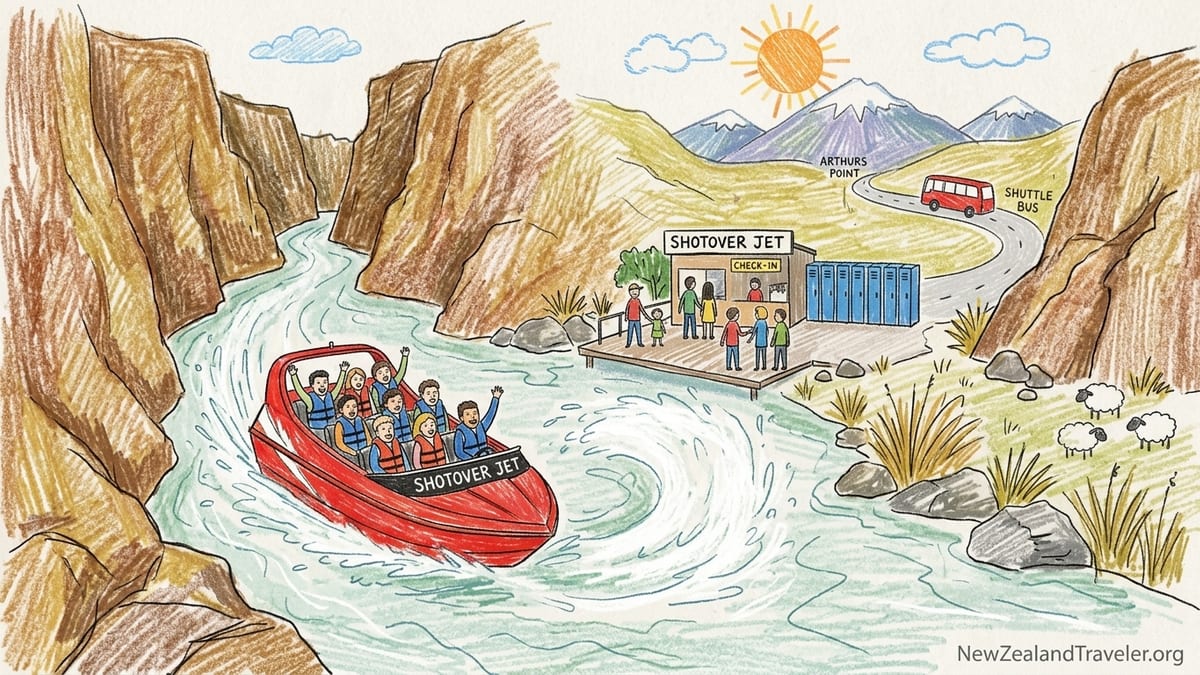
Standing on the gravel "beach" at Arthurs Point with the Shotover River the colour of melted glacier ice, I finally boarded the famous red jet boat that every second Queenstown brochure seems to feature. Twenty-five minutes and a lot of spray later, I had a clear answer to the question most travellers quietly ask at the booking desk: is Shotover Jet really worth paying close to NZ$200 for less than half an hour on the water?
Booking, Check-in and the Ride Out to Arthurs Point
My Shotover Jet experience started, as most do, in central Queenstown. I checked in at the operator’s town office, which shares space with other activity counters and souvenir racks, and confirmed the details that matter: current price, age and height rules, and shuttle time. At the time of writing, Shotover Jet lists adult fares at around NZ$199 and child fares (5 to 15 years, with a minimum height of 1 metre) at NZ$109, with children under 5 riding free if they meet the height requirement, although a ticket is still required. The staff were direct about two practical points: the ride on the water would last about 25 minutes, and handheld phones and cameras were not allowed on board at all.
The shuttle to Arthurs Point left from near the main intersection of Shotover and Camp Streets and took roughly 10 to 15 minutes to reach the river base, about 7 kilometres out of town. That short drive is part of the experience. Queenstown’s compact centre falls away, houses thin out, and the hills close in around the Shotover Gorge. The driver pointed out the turn-off to Skippers Road, where other jet boat and rafting outfits head, which helped frame how specific Shotover Jet’s canyon section is compared with the more open lake and river runs closer to town.
Check-in at the river base was efficient and functional rather than theatrical. Inside the main building, I joined a short queue to confirm my booking, sign the usual liability waiver on a tablet, and have my weight checked discreetly for boat loading. Staff repeated some key rules: minimum height, no riding while pregnant, and the instruction to leave loose items and valuables in the lockers. There were toilets, a small retail counter with branded beanies and gloves, and a viewing area where the next boat screamed past within a few metres of the deck, making even the nervous in our group grin or wince.
From check-in to boarding took about 20 to 25 minutes, including a safety briefing video played on overhead screens. That downtime, more than the actual ride duration, is what makes the overall outing feel like a substantial experience rather than a quick in-and-out, especially if you are travelling from the centre of Queenstown on the shuttle and not driving yourself.
What I Wore, What They Provided, and Dealing with the Weather
I rode in early spring, when Queenstown can move from bright sun to sideways rain in the time it takes to order a flat white. Shotover Jet does not issue wetsuits or full spray gear. Instead, they provide a life jacket and a lightweight splash-proof outer layer only in particularly wet conditions, and rely on you to dress sensibly for the season. On the day, staff recommended warm layers, a windproof jacket, and a beanie or hat. They specifically mentioned that the wind-chill at close to 90 km/h feels similar to being on an exposed chairlift at Coronet Peak.
I wore a merino base layer, a fleece, a light but properly waterproof shell, jeans, and sturdy trainers I did not mind getting damp. That combination was about right. During the high-speed sections the apparent wind is sharp, but the cold never moved from "bracing" into "miserable." The boats carry heated handrails, which sounds like a gimmick until the river spray begins to accumulate and you realise your fingers are the one thing that are definitely not suffering.
Weather matters less than many visitors expect. The operator runs year-round, and only river conditions or high winds tend to cancel departures. I watched an earlier trip head out in light drizzle, and those guests returned with wet shoulders and occasional damp jeans but not soaked through. My own ride, under patchy blue sky with a stiff breeze, produced a steady patter of spray rather than drenching waves. If you arrive in mid-winter, a hat, gloves and an insulated but windproof jacket are worth packing specifically for this trip. The key is to dress as if you are going to sit on an exposed ski lift for half an hour rather than for a sedate lakeside stroll.
For travellers counting grams in a carry-on bag, it is useful to know that Queenstown itself supplies most of what you might suddenly discover you need. Multiple outdoor stores on Shotover Street stock reasonably priced gloves and beanies, and some hotels keep spare gloves or scarves behind reception. That means you do not have to buy expensive branded gear at the river base unless you want the souvenir value.
Lockers, Glasses, Phones and Cameras: What Really Happens
One of the most important practical details of the Shotover Jet experience is the strict rule about what you can carry on board. Handheld phones, cameras and any loose items are not permitted on the boat. This surprises a lot of first-time riders, especially those used to more relaxed rules on open-lake jet boats. At the river base, staff direct you to a bank of complimentary lockers just before you walk down to the beach. Each locker is shared with the other passengers on your specific departure, and the system is simple: all bags, loose hats, and anything you might instinctively reach down to hold must go in.
If you want to film, the only option is a hands-free action camera mounted on a head strap or clipped firmly to a hat. Forehead-mounted GoPros and similar devices are explicitly allowed, while chest mounts, wrist straps, selfie sticks and small tripods are not. I used a small action camera on a head strap and it felt secure enough throughout the spins and close passes, although the footage tends to be more about spray and shouting than cinematic vistas. If you are set on capturing something sharable, it is worth confirming at check-in that your mount is acceptable and doing a test run on shore to make sure it will not shift.
Glasses are treated very differently from phones. Eyewear is recommended all year, partly to cut the glare off the pale blue water and partly to act as a shield against cold spray. I wore prescription glasses without a strap and never felt at risk of losing them, even during the most abrupt turns. The drivers are skilled at reading the water and do not throw the boat around so violently that items attached to your face are in danger. That said, if you are particularly worried, a simple sports strap bought in town is cheap insurance. Sunglasses also help if you are riding in full summer light, when the exposed canyon edges can be bright enough to make you squint in photos.
Because phones stay ashore, the operator runs its own photo and video capture system. Staff photograph each boat from fixed points along the shoreline and often capture short videos at one of the spin spots. After the ride, you can review the shots on screens at the base and decide whether to pay for digital downloads or prints. For families or groups, this can add another NZ$40 to NZ$70 to the outing, depending on the package, so it is worth factoring that into your total spend if mementos matter to you.
On Board: Where I Sat, How It Felt and Just How Close the Canyons Are
Boarding is surprisingly calm. Our group walked down to the water’s edge in life jackets, posed for a quick pre-ride photo, and stepped into the boat one row at a time. The driver asked whether anyone wanted the "full noise" seats at the very front or the splash-prone back corners, and several of us, myself included, volunteered for the front right side. Families with younger children tended to be placed more toward the centre, where the ride is marginally less exposed.
The seating layout is compact, with three to four people per row and handrails directly in front. I ended up on the outside seat in the second row on one run and the front outside seat on the other, and that difference is significant. On the outer edge you feel the boat lean and slide most intensely, and you are the closest body to the canyon walls as they whip past. On the inside, the sense of speed remains but the visual drama is slightly muted.
The question everyone asks before they ride is: how close does the boat really get to the rock? The honest answer is "uncomfortably close, but in a clearly controlled way." On several passes, I watched the bare canyon wall slide past what felt like a metre from my shoulder. In reality, there is likely a little more space than that, but the combination of speed, confined space, and the driver’s deliberate habit of swinging toward the rock before snapping the boat back into the centre of the channel makes the gap look razor-thin. Passengers on my side involuntarily leaned away more than once, even though you intellectually know the boat has done this thousands of times.
Speed itself is part of the thrill but not the defining feature. The boats are capable of about 85 to 90 km/h in the shallow straight sections, but your brain gets used to that pace surprisingly quickly, especially after the first minute or two. What stays shocking throughout the ride is how fast that speed is maintained in places where, from shore, you would barely be comfortable paddling a kayak. Narrow bends, rock overhangs, shoals and the occasional driftwood log all blur together, and the driver threads the boat through with small, constant steering corrections you barely notice until you look directly at the bow and see how much it flicks.
Spray, 360-degree Spins and the Actual Fear Factor
Before each spin, the driver raises one hand and twirls a finger in the air, the signal you will see in every marketing video. The move is more than theatre. It gives passengers a second to brace, close their mouths and angle their faces slightly away from the direction of travel. The boat then pivots sharply around its own axis, sending a fan of spray out to one side and sometimes back over the people on the outermost seats.
The spins are dramatic without being punishing. You stay firmly seated, held by the solid side bolsters and the grip of your own hands on the heated rail. On the outside seats, the lateral force pushes you into the padding enough that you understand why loose objects and self-held cameras are banned, but not so much that you feel rattled. I took several direct hits of spray to the upper body and face, enough to blur my glasses temporarily, but my lower half stayed mostly dry except for damp shoes. Passengers in the centre rows ended the ride noticeably less wet.
In terms of fear, the Shotover Jet sits in an interesting middle ground. It is more intense than an open-river ride like KJet on the Kawarau, where there is open water on either side and more time between manoeuvres. It is far less psychologically confronting than a bungy jump, canyon swing or skydive, because there is no single moment where you have to choose to step off something. The fear here is cumulative and environmental. The noise of the engine, the echoes off the rock walls, the sense of being trapped between sheer cliffs, and the speed all combine into a sustained adrenaline high rather than one spike.
On my boat there were two passengers who described themselves as "not adrenaline people" at check-in. Both screamed through the first set of spins, gripped the rail in a white-knuckle way for the first few canyon passes, and were laughing out loud by the time we idled at a calm pool while the driver explained the gold mining history of the gorge. Nobody asked to get off, and nobody looked shaken when we returned to the dock. For most travellers comfortable with moderate theme park rides, Shotover Jet feels wild but not overwhelming.
Did the 25 Minutes Feel Short for the Money?
The official line is clear: about 25 minutes on the water at speed, with the entire outing from Queenstown and back taking roughly 1 hour 45 minutes including transfers and check-in. The value question, though, is personal and more nuanced than a simple cost-per-minute calculation. At nearly NZ$200 for an adult ticket, Shotover Jet is in the same price band as a half-day wine tour or multiple runs on the Skyline Queenstown luge combined with the gondola, and sits below major heli-scenic flights or full-day Milford Sound coach and cruise packages.
On the water, the 25 minutes did not feel short in an emotional sense. The ride is dense. From the first acceleration away from the dock, there is very little dead time. The driver strings together sprint sections, tight canyon passes, spins and short pauses where the engine idles and you catch your breath while listening to a quick story or safety check. By the time the boat drifted back into the wider section near the base and slowed for the final spin, my arms and throat were pleasantly tired from holding on and shouting. I did not find myself wishing for another immediate 25 minutes.
Financially, the calculation is tougher if you are travelling as a family or on a long multi-stop itinerary across New Zealand. A family of four with two paying children is looking at roughly NZ$600 to NZ$650 once photos and a hot drink before or after the ride are factored in. That is significant in any currency. If your budget only allows one big-ticket adrenaline purchase in Queenstown, you may find more perceived value in a longer experience such as a combination rafting and jet boat trip, or in something that fills more of your day like a guided hiking excursion or a winery loop.
From my perspective as a travel writer and as a paying customer, the ride itself did enough to feel worth the one-off cost. It delivered exactly what it promised: high-speed canyon boating in a visually dramatic, geologically interesting setting that you cannot easily access otherwise. I would not, however, feel the need to pay full price again on the same trip to repeat it. For me, Shotover Jet is a "do it once and do it properly" experience rather than a repeat staple every visit.
Canyon vs Speed: What Ended Up Being the Real Highlight
Going in, I assumed the speed would be the main draw. After all, the brochures emphasise the 360-degree spins and the headline number of up to about 90 km/h. In practice, what lodged in my memory was not the raw pace but the setting. The Shotover River’s canyon is tight, copper- and rust-coloured in places, with jagged schist slabs leaning into the river and occasional man-made relics from the gold rush era clinging to the banks. The river itself is a pale blue-green that looks almost artificial from some angles, particularly when the light hits it side-on.
There are moments when the boat slides past rock outcrops so closely that you can see individual seams and crystals in the stone, and others where you look up and realise the cliff beside you rises tens of metres almost vertically. On one section, the driver cut the engine and let us drift for a few seconds in relative silence, pointing out an old mining tunnel and explaining how the early jet boats evolved in this very gorge. Those small interpretive pauses help reframe the activity from a pure thrill ride into something more rooted in place.
Speed still matters, of course. Without it, the proximity to the canyon walls would feel like a scenic float rather than a controlled brush with danger. Yet if I picture the ride a week later, what comes back first is the sensation of being enclosed in a natural corridor of rock that would be almost impossible to experience on foot, especially at that level just above the waterline. For travellers who care about landscape as much as adrenaline, that blend of geology and velocity is where Shotover Jet earns its reputation.
Compared with other Queenstown jet boat options, that emphasis on the canyon is what keeps Shotover Jet distinct. Lake Wakatipu and the lower Kawarau offer big-sky vistas and wide turns that feel more like a fast sightseeing cruise. The Shotover gorge is tighter, louder, and more intimate, with less space between you and the landscape. That intimacy is what you are really paying for.
Would I Personally Pay Nearly NZ$200 Again?
As a one-off, my answer is yes. If I were planning a first-time Queenstown itinerary for myself or for close friends who enjoy some adrenaline, I would include Shotover Jet and be comfortable with the outlay. The experience is iconic for a reason, tied deeply into local history and ownership, and offers a perspective on the Shotover River that you do not really get from the lookouts along the road or from more distant rafting tours alone.
As a repeat, full-price purchase, I would hesitate. Once you have experienced the combination of speed and canyon proximity, the element of surprise that justifies the cost is gone. If I were returning to Queenstown with a tighter budget, I might opt instead for a different activity I had not tried, such as an extended back-country 4WD tour or a full-day Dart River jet boat and walking combination out of Glenorchy, which offers both water time and time on shore in native forest.
For families, the decision sits at the intersection of budget, age spread and appetite for thrill. Older teens who relish roller coasters are likely to talk about Shotover Jet more than they will remember a more sedate lake cruise, making the price feel better justified. Younger children at the minimum height may enjoy it in the moment but retain fuzzier memories, which can make parents question whether those hundreds of dollars could have funded something more interactive or educational. From conversations with other passengers at the base, a common compromise is for one parent and older children to ride while another adult stays ashore with the littlest kids to watch and film from the viewing platform.
In short, I would gladly allocate the money to ride Shotover Jet on a first visit or as a special occasion, but I would not treat it as an automatic must-do on every Queenstown trip the way I might budget for a simple gondola ride or a walkable hike. The experience is memorable and sharp enough to stand alone for years.
The Takeaway
Shotover Jet delivers exactly the product it advertises: a concentrated, canyon-focused jet boat experience that uses speed and proximity rather than free-fall or height to generate adrenaline. The operation is polished without feeling overly scripted, the safety briefing clear, and the logistics of check-in, lockers and shuttle transfers straightforward. The boats themselves are comfortable and solid, the heated handrails are more than a marketing line, and the drivers balance showmanship with a sense of control that lets even cautious riders relax after the first few minutes.
Is it cheap? No. At close to NZ$200 per adult for roughly 25 minutes on the water, this is one of Queenstown’s more expensive per-minute thrills. Yet the setting in the Shotover Gorge is unique, the canyon walls really do feel alarmingly close, and the combination of spins, spray and geology leaves most people stepping off the boat buzzing rather than counting the minutes. For travellers who value intensity and location-specific experiences over slower, cheaper outings, Shotover Jet earns its place on the must-consider list.
Who will love it most? Anyone who enjoys fast roller coasters, has at least a moderate tolerance for speed and noise, and wants a Queenstown story that goes beyond simply admiring Lake Wakatipu from shore. Photography-minded visitors who are happy to rely on head-mounted cameras or to purchase official photos will also find the no-phones rule less frustrating. Families with confident older kids and teens, couples looking for a shared rush, and solo travellers keen to tick off an iconic local experience are all well-served.
Who may find the price-to-duration ratio difficult to justify? Ultra-budget travellers, those planning multiple expensive excursions across New Zealand, visitors who prefer leisurely scenic experiences to sharp bursts of adrenaline, and anyone likely to resent strict camera rules or the inability to document the ride with a handheld phone. If you fall into that second group, you might still visit the Arthurs Point lookout, watch a few runs from the viewing deck, and save your dollars for a longer day out elsewhere. For everyone else, Shotover Jet, tried once with eyes wide open to the cost, is a memorable and distinctly Queenstown way to spend a slice of your travel budget.
FAQ
Q1. How long is the actual Shotover Jet boat ride?
The high-speed portion on the water lasts for about 25 minutes, not including check-in, safety briefing, and shuttle transport from Queenstown.
Q2. How much does Shotover Jet cost and are there child prices?
At the time of writing, adult tickets are around NZ$199 and child tickets about NZ$109, with children classified as ages 5 to 15 and a minimum height requirement of 1 metre.
Q3. Do you really get close to the canyon walls?
Yes. From the outer seats it often feels like the rock is only about a metre away, although in reality there is a safe margin. The sense of proximity is a key part of the thrill.
Q4. Will I get wet and what should I wear?
Expect spray rather than a full soaking. Wear warm layers suited to the season, a windproof or waterproof outer layer, closed-toe shoes you do not mind getting damp, and sunglasses or glasses to protect your eyes.
Q5. Can I take my phone or camera on the boat?
Handheld phones and cameras are not permitted on board. Only hands-free action cameras mounted on a secure head strap or hat clip are allowed, and everything else must go into the lockers at the base.
Q6. Is Shotover Jet suitable for young children or nervous riders?
Children must meet the minimum height requirement, and those under 10 must ride with an adult. Nervous riders usually find the first few minutes intense but adjust quickly, as the drivers combine speed with a strong sense of control.
Q7. What happens if the weather is bad?
Shotover Jet operates in most weather conditions, adjusting clothing recommendations rather than cancelling for light rain or cold. Trips may be postponed or cancelled if river levels or wind make the ride unsafe.
Q8. Are there lockers or somewhere to leave my belongings?
Yes. Complimentary lockers at the river base are provided for each boat group. You are encouraged to leave bags, loose hats, phones, and other valuables in the lockers before boarding.
Q9. Is the ride worth the price compared with other Queenstown activities?
Value depends on your priorities. Shotover Jet offers an intense, location-specific experience in the Shotover Gorge, but the cost is high for the time involved. Travellers who love speed and dramatic scenery tend to feel it is worth doing at least once.
Q10. Would you recommend booking Shotover Jet in advance?
Yes. Popular time slots and school holiday periods can sell out, so booking ahead helps secure your preferred departure and leaves you more flexibility to plan other Queenstown activities around it.